
Cloud, Cyber, and AI Capabilities
Navigating the Code of Future Warfare


Welcome to the latest edition of Defense Tech and Acquisition.

A new AI Executive Order and Cloud Marketplace for National Security
DoW focuses on scaling munitions from containers to hypersonics
Five military Portfolio Acquisition Executives (PAEs) are promoted.
The Army’s G-TEAD brings speed and competition to close capability gaps.
The Navy is deploying an MUSV with a Carrier Strike Group to advance CONOPS.
Air Force pursues attritable ISR tentatively and is encouraged to go big on CCAs
Space Force supports Blue Origin despite setback and gets corrections from HASC
Europe pursues armor, Poland spends big, and AUKUS goes joint on UUVs
The HASC completes markup and advances their FY27 NDAA bill.

Executive Order: Promoting AI Innovation and Security

Advanced AI capabilities make our Nation stronger, but also introduce new national security considerations that require coordinated action across executive departments, agencies, and components.
It is the policy of the U.S. to promote AI innovation and security by working collaboratively with the private sector to modernize government and private sector information systems and harden them against external threats
To protect American ingenuity and IP from exploitation and theft by adversaries; and to cultivate America’s advanced AI-enabled capabilities.
Prioritize the cyber defense of National Security Systems and DoW information systems
Cybersecurity and Infrastructure Security Agency (CISA) shall release Binding Operational Directives and other guidance as appropriate to:
Prioritize the cyber defense of Federal Government information systems.
Establish or expand Federal programs and cybersecurity services that enhance AI-enabled defensive tools.
Facilitate access to cybersecurity tools and services including, where appropriate, covered frontier models for agencies, State and local authorities, and operators of critical infrastructure.
Form an AI cybersecurity clearinghouse, in voluntary collaboration with the AI industry and operators of critical infrastructure, that coordinates and deconflicts scanning for software vulnerabilities and prioritizes remediation of vulnerabilities.
Develop and maintain a classified benchmarking process to assess the advanced cyber capabilities of AI models and determine the threshold at which an AI model should be designated a “covered frontier model”
Design a voluntary framework with AI developers through which developers would be able to:
Provide the Federal Government with access to covered frontier models, subject to appropriate confidentiality, cybersecurity, insider-risk, and IP protection, use, and nondisclosure requirements, for a period of up to 30 days before they plan to release such models to other trusted partners.
Collaborate with the Federal Government to select trusted partners that will have early access to covered frontier models to promote secure innovation and strengthen the cybersecurity of critical infrastructure.
Our Take: This is a light-touch, innovation-focused approach to managing the cybersecurity risks of frontier AI models without imposing excessive regulation. It emphasizes public-private collaboration, leverages AI for defense, and introduces voluntary government pre-release reviews for the most advanced systems. Given the voluntary framework, successful implementation will hinge on companies’ willingness to engage and the government’s effectiveness in coordinating efforts. At this pivotal time with mixed public sentiment surrounding frontier AI, improving coordination to better secure critical government systems is a pragmatic and constructive step.

Pentagon’s JWCC Follow-on Would Create Cloud Marketplace, Expand AI and Edge Computing

BLUF: The next iteration of the Joint Warfighting Cloud Capability (JWCC) contract would establish a cloud marketplace for military users while expanding support for AI, edge computing and cross-domain operations
The program is intended to create a single marketplace through which DoD organizations can access authorized cloud services from a broad range of vendors.
Under the proposed structure, the UCM would be organized into three tiers.
Hyperscale cloud service providers delivering core infrastructure and platform services.
Everything-as-a-Service (XaaS) offerings — including software-, platform- and infrastructure-as-a-service capabilities.
Commercial innovators and small businesses offering cloud-based technologies that meet the department’s security requirements.
While officials have touted the success of JWCC, the DoD began working on a successor contract in 2024 to improve the program — such as by adding more cloud service providers and different contract types.
AI integration is another major focus of the proposed JWCC follow-on.
A Cyber Force Budget Would Require at Least $10B
BLUF: The Commission on US Cyber Force Generation published their report on what a Cyber Force roadmap would look like. A new uniformed service focused solely on cyberspace operations would require an initial budget of $10B realigned from the Services.
The Commission comprises of CSIS in partnership with the Cyber Solarium Commission 2.0 at FDD.
There has been a growing chorus in recent years calling for an independent cyber force to remedy readiness shortfalls with the underlying cyber personnel in the military and inconsistencies across each of those services.
Currently, each of the military services are responsible for providing personnel for a set number of teams to CYBERCOM, which then employs those forces in operations for the other geographic combatant commands.
The commission studied two possible structures:
Within the Department of the Army, akin to the Marine Corps under the Department of the Navy and the Space Force under the Department of the Air Force
Its own military department called the Department of the Cyber Force, which would then require its own service chief and secretary.
Core focus areas for the new Cyber Force would be offensive and defensive cyber operations. The report recommends leaving efforts related to defending the DoDIN to the services, which is currently CYBERCOM’s number one mission area.
Related: Cyber Force? Senator Pushes to Create Service Branch Under the Army
U.S. Cyber Force an Inevitability

“This is something where it feels like a conversation where the volume continues to rise. … I think we’re facing an inevitability. I’d just rather we pull this trigger and do it sooner rather than later. It's typically better to prepare for war in advance of conflict rather than after the fact.” - Joshua Stiefel, Commission Co-Chair and VP for GR at Second Front
Cyber Innovation Warfare Center Will Pair Industry Side-by-Side With Operators
BLUF: CYBERCOM’s new Cyber Warfare Innovation Center will pair operators and members of industry side by side in order to drive faster capabilities and tactics, and bridge the so-called valley of death.
CWIC is one of three enabling organizations under the CYBERCOM 2.0 plan, the department’s push to improve how cyber forces are generated from the services to the command.
The other two are a Cyber Talent Management Organization and an Advanced Cyber Training and Education Center.
The goal is for the center to feed tactics and requirements to the acquisition pipeline in CYBERCOM J9, who will work to build and field them.
“For too long, prototypes developed by industry have withered in the so-called valley of death, failing to transition to operational use. We do not have the luxury of time anymore to let good technology sit on the shelf. The CWIC will be our proving ground, a collaborative environment where operators and industry will sit side by side to test new concepts against realistic threats and operational scenarios.By forging this direct link between those who build the tools and those who wield them, we ensure that our best innovations actually make it to the fight and onto the cyber battlefield.” Katie Sutton, ASD for Cyber Policy
Gaining the Cyber Supply Chain Advantage

BLUF: We need to invest in defending our supply chains. That means bringing a defensive and offensive operational security mindset to protect our own supply chain attack surface and map where our adversaries are most vulnerable.
Our adversaries study America’s defense industrial base every day. They don’t need to target a prime contractor when a smaller supplier offers an easier entry point to penetrate and then swim upstream.
These sub-tier attacks cost almost nothing but impose billions in disruption and downtime on U.S. businesses and government. Those simple economics make our supply chains a constant target of choice for our adversaries and AI will only accelerate the trend.
The DIB was estimated at roughly 108,000 companies, 92% of which are small businesses. When you look at their cyber posture, most struggle with even basic email security and IT hygiene.
The DIB is poised to spend $63B over the next two decades on the CMMC.
Expecting small businesses to bridge the gap between baseline compliance controls and defense against AI-enabled nation-state attackers is not a strategy. It’s exposure.
Right now, every prime contractor and every program office pays separately to monitor the same small supplier to meet audit requirements. Under an enterprise security approach, suspicious activity can be identified and acted on collectively, not in isolation. This would cut costs and harden the entire DIB ecosystem.
If our adversaries can map our DIB from the outside in, we can map theirs and then prepare to activate those options.
DIB companies that have the resources to adopt this more operational approach to supply chain risk management valuing shared insight and collaborative mitigation in their own supplier relationships.
Built, Not Stolen: How Commercial Data Is Changing Intelligence
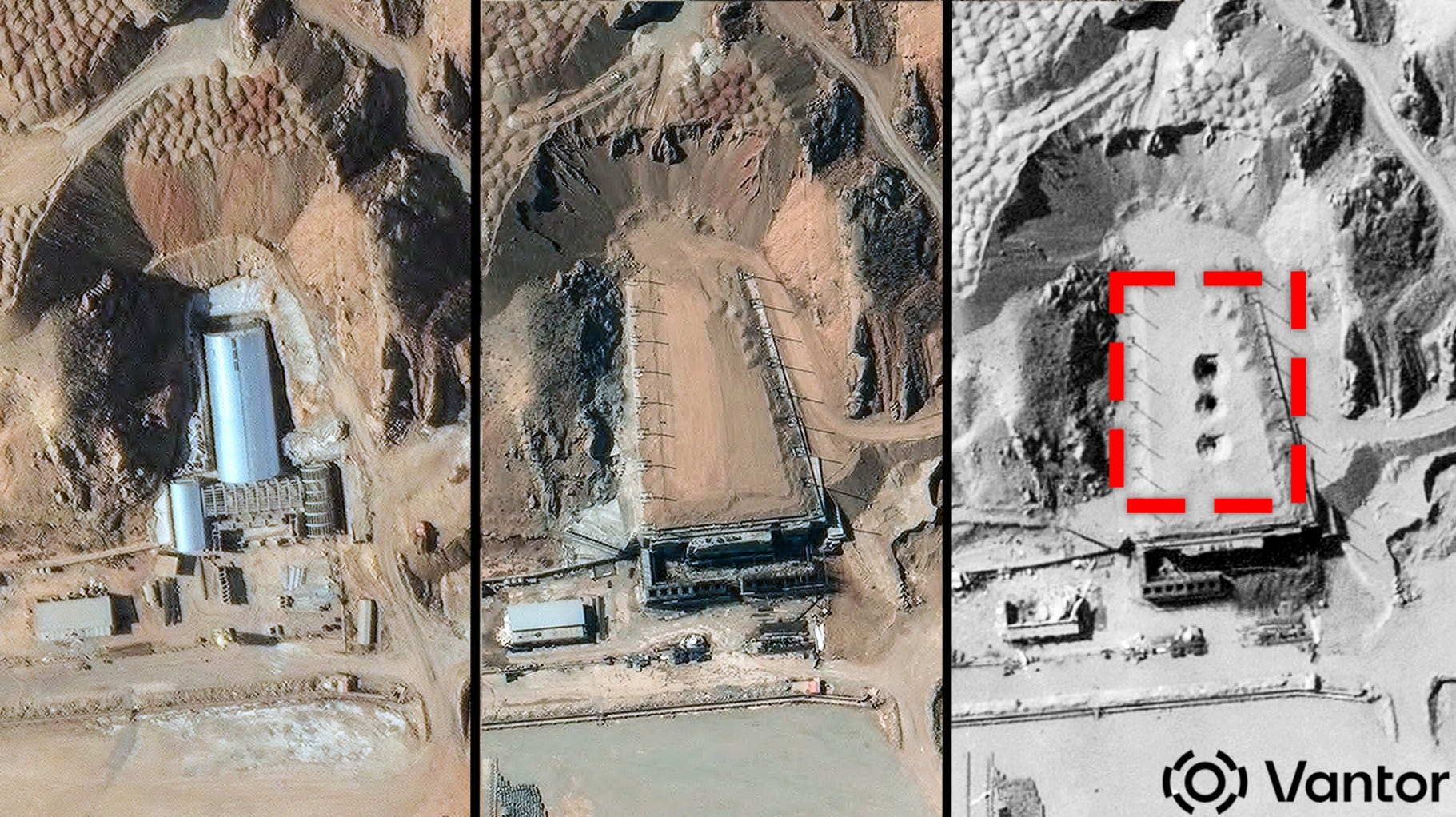
BLUF: An adversary can assemble an intelligence targeting picture without accessing a single classified system, but solely through Commercial satellite imagery.
In 2024, ODNI releases an IC policy framework for commercially available information and the IC Strategy for 2024-2026 reflecting the growing intelligence value of public and commercial data.
Publicly available data, aggregated and processed at scale, can generate intelligence effects traditionally associated with classified collection.
The gap between open source and classified is shrinking.
What has changed about the data is the ability to fuse the information together in significant way, and the speed at which it can be processed by AI
AI enables continuous ingestion and correlation across these streams, producing time-indexed models of military activity –force posture reconstruction, pattern-of-life analysis, and increasingly, predictive assessments.
The recent restriction of commercial satellite imagery during an active conflict, and U.S. response to its use are two public signs that the market now produces intelligence effects once associated primarily with state collect systems.
Commercial analytic platforms that directly enable targeting decisions by identifying military assets, tracking movements, or providing operationally actionable intelligence may in certain circumstances, approach the Law of Armed Conflict threshold.
IC has begun adapting through new policy on commercially available information, a new OSINT strategy, and new sourcing standards for publicly available information, and OSINT in analytic products.
The U.S. operates within a dense web of legal constraints governing intelligence collection and use. Its competitors do not face equivalent restrictions when exploiting the same commercial data environment.
Operational security must shift from protecting information to disrupting patterns.
The meaning of unclassified must be reassessed. Data that is individual benign can, when aggregated, produce operationally significant insight.
Legal review must move upstream. The most consequential legal questions are no longer confined to the moment of strike authorization, but data sourcing, vendor reliance, and analytic methods.
The Quantum Clock Is Already Ticking on America’s Autonomous Arsenal

BLUF: The Pentagon is building a generation of autonomous systems drones, loitering munitions, uncrewed vessels, and the command networks that direct them on a cryptographic foundation that a future quantum computer will be able to break.
For autonomous weapons, the most urgent part of the threat is already here, and the United States is not moving fast enough to meet it.
Experts widely expect a quantum computer to threaten today's public-key cryptography within the 2030s. Everything an adversary captures today that must stay secret into the 2030s is, in effect, already compromised.
An autonomous system has to know that an order is genuine. The difference between a loyal drone and a hijacked one is, at bottom, a cryptographic signature: the system verifies that a command came from a legitimate controller and not an impostor.
An adversary who can forge the authentication that an autonomous system trusts does not merely read its mail it can potentially issue orders the system will obey.
What is missing is urgency calibrated to the specific vulnerability of autonomous systems and a recognition that for these systems, the 2035 horizon is dangerously late.
A conventional weapon system is fielded, used, and retired. An autonomous system, by contrast, is defined by its software and its cryptographic trust relationships, which persist and propagate.
DoD should treat post-quantum cryptography as a mandatory design requirement for any autonomous system entering development today not a retrofit to be scheduled before 2035.
The services should prioritize autonomous C2 links at the front of the CNSA 2.0 migration queue, ahead of less time-sensitive systems.
Congressional Defense authorization and appropriations committees should require the DoD to report which fielded and in-development autonomous systems remain dependent on quantum-vulnerable cryptography, and on what schedule each will be hardened.
The systems being designed now will live into the threat window. The only open question is whether the U.S. finishes hardening its autonomous arsenal before the alarm goes off.
Boeing’s Ghost Bat Drone Beats Radar with Ace-Level Stealth Performance in Test
BLUF: Boeing announced that its MQ-28 Ghost Bat combat aircraft has officially passed stealth performance tests.
Boeing said this achievement provides customers with clear proof of the aircraft’s ability to survive and avoid detection on complex battlefields.
The MQ-28 is built to work with crewed military aircraft and to handle various missions while remaining hard to detect on radar.
The MQ-28 Ghost Bat was designed to support current fighter and surveillance aircraft by handling tasks such as ISR, EW, and boosting force strength.
Boeing said the MQ-28’s radar cross-section makes it much harder for enemy radar to detect and target the aircraft from a distance. The company added that testing proved that its design, manufacturing, and materials are keeping radar visibility low.
Development of the Ghost Bat began in 2017, and it flew for the first time in 2021. Since then, it has completed over 150 flights and taken part in more complex demonstrations.
Under Drone Dominance, Pentagon Begins Receiving Small Drones
BLUF: DoD ordered a total of 20,000 small, FPV drones from 10 of the top 11 vendors that competed in its Gauntlet 1 competition.
Neros shipped all 2,400 of its ordered Archer small quadcopters, 1,040 accepted.
Two others combined to ship 560 drones.
The Pentagon is now moving out with a broader plan to spend roughly $1 billion purchasing drones within a two-year window. As part of that push, it hosted the initial “Gauntlet” competition consisting of 25 companies competing before ranking the top 11 vendors.
Separately, the DoD tapped five additional companies as winners of a lethality challenge to possibly provide payloads for Group 1 drones, those weighing 20 lbs. or less. These include Bravo Ordnance, Kela Defense, Kraken Kinetics, Mountain Horse and Northrop Grumman.
Looking ahead, the DoD is planning to host a second Gauntlet event to find drones ideally suited for long-range strike and tactical assault in close quarters operations.
Our Take: In checking the leaderboard Saturday morning, we see 22,320 drones ordered from all 11 top performers.
Lockheed’s 10-Foot Containerized Launcher Shoots Down 1,320-pound Attack Drone

BLUF: Lockheed Martin has successfully shot down a Group 3 one-way attack drone with a Joint Air-to-Ground Missile (JAGM) launched from its GRIZZLY containerized weapon system. This is the first time the missile has been used in this way.
The live-fire test at Arizona’s Yuma Proving Ground demonstrated the full process of detecting and destroying a drone using a quickly integrated system.
Lockheed Martin revealed that it completed the integration and live-fire testing in less than 45 days.
The test brought together Lockheed Martin’s Sanctum C-UAS software, Fortem Technologies’ R-40 radar network, and the GRIZZLY launcher. These systems worked together to detect, track, and engage a live Group 3 drone.
Lockheed invested $25M in Fortem Technologies to help bring their radar and interceptor technologies into the Sanctum system.
GRIZZLY is built using a standard 10-foot shipping container and can hold up to eight missiles. The launcher works with both Hellfire and JAGM missiles and uses design features from Lockheed Martin’s M299 launcher.
The system is made for quick deployment and needs very little infrastructure. Operators can reload missiles without tools, and wireless connections link the radar, software, and launcher with minimal setup.
The Navy is showing more interest in using GRIZZLY at sea as it looks at containerized weapons for both manned and unmanned ships. These systems could add firepower without needing big changes to the ships.
US Hypersonic Race: Pentagon’s 5 Next-gen Weapons and Programs Shaping the Future
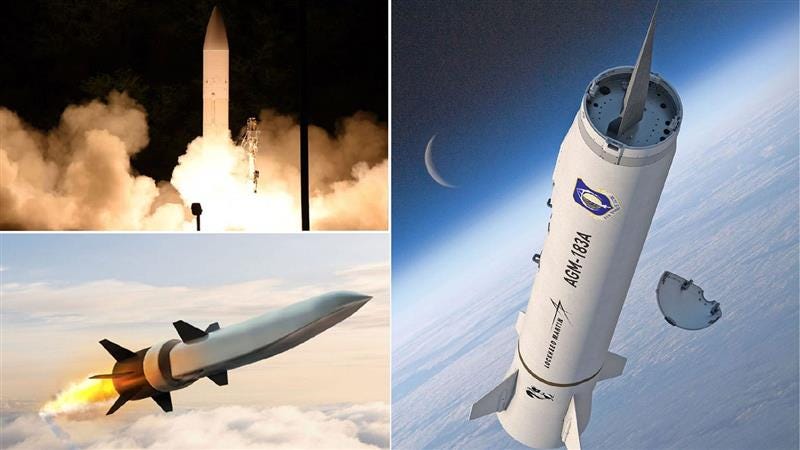
BLUF: Several American hypersonic programs are moving closer to operational service. Some are undergoing advanced testing, others are nearing deployment, and a few represent ambitious concepts that could define future warfare.
One of the most common misconceptions surrounding hypersonic weapons is that any missile traveling faster than Mach 5 qualifies as one. In reality, many ballistic missiles already reach hypersonic speeds at certain points in their flight.
What separates a true hypersonic weapon from a conventional ballistic missile is its ability to maneuver unpredictably while traveling at extreme velocity.
Dark Eagle / Long-Range Hypersonic Weapon (LRHW)
America’s closest path to an operational hypersonic capability. The Army-led program uses a boost-glide design that launches a maneuverable hypersonic glide body capable of traveling at speeds above Mach 5.
Designed to strike heavily defended targets at ranges exceeding 1,700 miles.
Conventional Prompt Strike
CPS uses a common hypersonic glide body jointly developed by the Army and Navy. After launch, the glide vehicle separates from its booster and races toward its target at hypersonic speed while maneuvering along the way.
The Navy plans to deploy CPS aboard the USS Zumwalt and eventually on Virginia-class submarines.
Hypersonic Attack Cruise Missile (HACM)
Powered by a scramjet engine, allowing it to sustain hypersonic speeds within the atmosphere rather than gliding unpowered after launch.
The Air Force views HACM as a key future capability because its smaller size could allow deployment from a variety of bombers and fighter jets.
AGM-183 Air-Launched Rapid Response Weapon (ARRW)
One of the Pentagon’s most visible setbacks in hypersonic development.
A series of testing failures and development challenges repeatedly delayed the program, yet played an important role in advancing American hypersonic research.
Other initiatives
The Navy’s HALO missile and Lockheed Martin’s Mako concept.
DARPA’s OpFires program and technologies like the Common Hypersonic Glide Body (C-HGB) continue to serve as the foundation for multiple hypersonic weapons.
The Pentagon is Rewriting How it Buys AI
BLUF: The Pentagon is quietly overhauling one of its most entrenched systems: how it sources and buys modern technology and by extension, who controls it.
After a public split with Anthropic, the DoD is cutting deals across the tech industry, assembling a line-up of top-performing commercial players to deploy their models on its classified networks.
Connectivity and battlefield resilience are expected from SpaceX
Frontier model intelligence from OpenAI and Google
Compute and hardware acceleration from Nvidia
Open-weight model ecosystems from Reflection
Enterprise deployment at scale from Microsoft, Oracle and AWS.
The Pentagon is billing this pivot toward a best of breed strategy – assembling a mix of commercial providers instead of betting on a single vendor – as a way to accelerate its AI-first warfighting vision.
It’s a deliberate move to avoid winner-take-all dominance and retain long-term control over the technologies that will define modern warfare.
Instead of monolithic, all-in-one platforms, the Pentagon is shifting toward a model that looks more like modern cloud architecture: modular, interoperable and composed of multiple vendors. No single company owns the full stack, and that’s the point.
The Pentagon’s multi-vendor approach starts to look less like procurement reform and more like a safeguard. Overreliance on closed, proprietary models risks concentrating power in private hands, limiting visibility into how decisions are made. A modular system, by contrast, creates conditions for accountability.
Our Take: As part of the ongoing transformations and rebuilding of the DIB, this is a pivotal strategy. To enable many vendors to integrate warfighting capabilities to avoid or minimize vendor lock, fuel competition, and maximize resiliency in supply chains and operational availability.
Pentagon Looks to AI, Other Tech to Help Tackle Contested Logistics Challenges
BLUF: With U.S. military supply chains facing a growing risk of adversary attack, senior defense officials are keen on using AI and other advanced technologies to address the challenges associated with contested logistics.
Supply chains face a variety of potential threats, including kinetic strikes, cyberattacks, geopolitical instability and infrastructure vulnerabilities.
“Logistics will be sort of the key as we go forward, ensuring that we can produce the mass and scale and really reconstitute all of our capabilities at a time of need and, you know, much faster than any adversary can. It’s not just the systems that are forward or the exquisite systems. It is everything from the interconnected software, it is transportation nodes, its logistics hubs, it’s fuel, it’s ports, it’s the supply chain all the way down to the critical minerals that that the military relies on.” Brent Ingraham, ASA/ALT
“From an R&E standpoint, we’re looking at planning tools, the actual movers, and reducing logistics chains. We’re looking at a handful of technologies and AI tools for planning are absolutely important. How do we get small modular nuclear reactors onto bases for energy resilience.” Robert Mantz, Principal Director Energy Resilience
Engineer Raises $42M to Build the Amazon of Composite Parts
BLUF: Zack Eakin left Anduril in 2024 to start a new composites company called Layup Parts. The goal is to make ordering custom parts made of carbon fiber or fiberglass as easy as if they were sold on Amazon.
Layup Parts raised $42M in a Series A funding round led by Marlinspike, with participation from new investors Cerberus Ventures and Pinegrove Venture Partners, and existing backers Founders Fund and Lux Capital.
Eakin has been working with composite materials for around two decades. He was the first engineer at Elon Musk’s Boring Company in 2017 and by 2021 was once again elbow-deep in composites when he took the role at Anduril.
While startups dramatically reduced the time and cost required to prototype and ship parts to customers, no one was doing this for composites.
Composites tend to be harder to deal with and there had been a lot of consolidation among composite companies.
The biggest business lines for rapidly prototyping and producing parts are aerospace and defense. That includes both startups and the more traditional defense primes.
“If we have stock materials, and you have a good understanding of those materials, we can build software that has an order of magnitude reduction in the amount of clicking it takes for an engineer to produce those and ultimately gets to zero clicks, where it just takes customer data and poops out shapes.” Zack Eakin

Don’t Let China Buy Into America’s Industrial Future
BLUF: Modern manufacturing is no longer about building more factories. Tomorrow’s factories will not merely produce goods. They will generate information, shape supply chains, and help determine future military and economic advantages. They are as much data systems as production systems.
Future military strength will depend heavily on commercial manufacturing.
DoD is prioritizing industry driven, commercial solutions that are modular “plug and play” with other industry partners.
Companies that build robotics, autonomous platforms, industrial software, and precision components may not have traditionally been viewed as defense firms, but many now sit at the core of the national security ecosystem.
Chinese capital could also end up crowding out American investment.
China knows advanced manufacturing will shape the next era of competition, and it has spent over a decade determined to dominate it.
Others might assert that excluding China is merely a shield for uncompetitive American manufacturers and that they can only get stronger if forced to compete with Chinese firms.
But American manufactures are not shielded from all competition.
They already compete fiercely with companies from Japan, South Korea, and Germany, which have formidable manufacturing cultures and capabilities. In addition, as noted, competition with China is not on a level playing field.
The U.S. can’t afford to lose its edge at the increasingly important cross section of data, technology, and advanced manufacturing, especially since it is foundational to so many other competitive arenas, from defense to energy to AI.
Rebuilding American manufacturing is urgent. But it should not involve inviting America’s principal rival into the systems on which future military and economic power will depend.
Mach Industries Raises $300M at $1.8B Valuation

BLUF: Mach Industries announced that it closed a $300M Series C co-led by Infinite Capital and Ribbit Capital. The round brings Mach’s valuation to $1.8B, up from $470M after its $100M Series B a year ago.
Funds are expected to be used to expand its Forge factory network, increase small jet engine production, advance the second generation of its systems and hire.
The company now has multiple product lines:
Stratos: A “pseudo-satellite” that deploys communications tech, sensors, and effects from the stratosphere via a high-altitude balloon.
Viper: A turbojet-powered vertical takeoff one-way attack UAS.
Pike: A small plane-like drone (formerly called Venom) built in collaboration with Divergent.
Dart: A low-cost kinetic drone interceptor designed to take down Group 1-3 drones. Mach also designed a ground-based radar system to go with it.
Glide: A high-altitude glider with a strike system capable of long-range, low-signature delivery.
Our Take: Huge props to our friend Nate Diller who’s guiding the company to great heights. Looks like we’ll have to update our War Unicorn’s post soon.
Applied Aerospace & Defense Goes Public

BLUF: Applied Aerospace & Defense—a Huntsville, Alabama-based, PE-backed defense and space subsystem manufacturer—went public on the New York Stock Exchange yesterday, raising $650M in its IPO and valuing the company at $3.25B
PE firm Greenbriar Equity Group is set to keep a roughly 80% stake after the IPO.
The company, while not as well-known as some of the primes, produces many critical subsystems for space and launch systems, aviation, and C5ISR and precision-strike (missile bodies, satellite solar arrays, fuel tanks, aircraft wings, etc).
Our Take: It’s good to see more defense companies going public but we do want to see these funds gained from IPOs and large raises to go into new products or scaling promising ones, not necessarily driving an M&A spree that reduces competition at the sub supplier level. Sounds like Applied will likely be doing some of both as their CEO mentions using IPO for both “internal investment and acquisition opportunities” but a company where a PE firm owns 80% of it seems more likely to focus on streamlining (if history is any guide). We are concerned that this could bring less resiliency to the industrial base if this becomes a trend.
L3Harris Successfully Tests Advanced Propulsion System
BLUF: L3Harris Technologies has successfully tested a potential propulsion solution for the Army’s PrSM Increment 4 program, demonstrating readiness to support the extended range capabilities.
L3Harris conducted the testing at its facility located in Orange County, Virginia
“The Direct Connect Transition Test shows the missile’s core propulsion is not a future concept but a validated capability that can be loaded onto current HIMARS and M270 launchers quickly, dramatically shortening the time to warfighter delivery.” Randy Crites, Vice President, Advanced Programs, Lockheed Martin.
Impulse Space Raises $500M

BLUF: Impulse Space has raised $500M Series D round led by 137 Ventures and BANNER VC to expand production of orbital transfer vehicles and other spacecraft.
The funds will allow it to scale up production of vehicles like:
Mira, a maneuverable spacecraft that can deploy satellites and host payloads,
Helios, a high-energy kick stage under development to quickly move spacecraft from low Earth orbit to geostationary orbit and beyond.
Commercial customers are interested in Helios to get satellites to GEO faster.
Impulse also sees an opportunity at NASA to establish a moon base.
The company now has 500 employees and about 200 open positions.
Related Article: Impulse Space Raises $500M Series D to Build In-Space Mobility Infrastructure for the Space Economy
Our Take: We are very bullish on Impulse Space. Apart from their commercial and NASA ambitions, they are deeply involved in Space Force’s responsive space efforts and their Space-Based Interceptor (SBI) efforts for GD4A (teaming with Anduril).
Axiom Space Adds $175M to Funding Round

BLUF: Axiom Space added more than $175M to its latest funding round, with Japan’s largest bank joining the company’s investors.
The company added the funding to a $350M round it announced in February that was led by Type One Ventures and the Qatar Investment Authority.
Investor interest is due to the company’s commercial space station plans and work on lunar spacesuits for NASA’s Artemis lunar exploration campaign.
Funds will support work on its space station and spacesuit programs as well as its broader space infrastructure and technology advancement roadmap.
Shifters Raises $10.2M Seed for Ground Robots

BLUF: US-Israeli robotics startup Shifters announced that it’s raised a $10.2M seed round led by Ace Capital Partners, bringing total funding to $15M.
Funding will accelerate the development of its autonomous ground robot teams, which they say will “help operators extend reach, improve situational awareness and preserve human life in dangerous environments.”
This includes dangerous environments first to clear rubble, navigate tunnels, and operate in jammed or debris-filled areas before human teams move in.
The company has developed three products:
RITA: The software and command layer that “helps robotic systems interpret intent, adapt to changing conditions, and execute autonomous tasks with confidence.”
TRUST: A family of robotic platforms that look a lot like rugged robotic dogs.
DIGITAL TWIN: A virtual simulation and analysis tool that “mirrors Shifters robots, environments, and missions in a virtual space.”
Powerus Teams Up with Swarmer
BLUF: Powerus and US-Ukrainian company Swarmer announced a partnership to explore integrating Swarmer’s swarming tech with Powerus’ air and maritime platforms and mission systems.
Powerus has three companies under its umbrella:
Kaizen Aerospace, which makes heavy-lift aerial drones with payload capacities ranging from 100 lbs to 1,000 lbs (with goals to get to 2,000 lbs).
Tandem Defense, which makes FPV quadcopters, including one that made the cut for the Drone Dominance Program’s Phase II competition.
Agile Autonomy, which is focused on maritime autonomy including conversions of private boats into USVs.
Swarmer has three primary software products:
Swarmer UI: Flagship swarm management software, which coordinates recon and strike drones, even in areas with limited comms.
Swarmer AI: A module for collaborative autonomy, designed especially for denied environments.
Swarmer OS: The company’s UAV operating system layer. This helps ensure secure data storage, streaming, and status updates, making the swarms reliable.
Our Take: This is an intriguing teaming arrangement for UAV capabilities. Definitely one to watch.
Motorola Snaps Up C-UAS Startup D-Fend Solutions for $1.5B
BLUF: Motorola Solutions acquired Israeli-American drone-takeover company D-Fend Solutions for $1.5B, adding a key C-UAS capability to its broader public safety portfolio of products.
D-Fend’s drone-downing tech uses an RF-cyber “takeover” systems that detects UAS via their radio signals, “hacks” them, and lands them instead of jamming or kinetic defeats.
Their product lineup includes:
EnforceAir: identifies, locates, and commandeers rogue drones.
EnforceAir 2: A more compact package that has better Size, Weight, and Power (SWaP), portability, and performance.
EnforceAir UX: The user interface and airspace-management tablet software for EnforceAir and EnforceAir 2
EnforceAir PLUS: An enhanced version of their other platforms that offers more adaptability to radio frequencies, jamming, an optional radar detection and an AI-integrated target fusion system that “merges cyber and radar data.”
Anduril Teams with Elbit America for Army’s Self-Propelled Howitzer
BLUF: Anduril has joined the Elbit America team to provide the Sigma mobile tactical cannon for the Army’s self-propelled howitzer modernization program.
Anduril will provide its C5ISR capabilities for Sigma and will integrate its artificial intelligence-driven Lattice software platform into the system.
Elbit will provide the 155-mm, 52-caliber fully automated cannon
OshKosh will provide the 10×10 vehicle.
Anduril Set to Win ACV cUAS Award
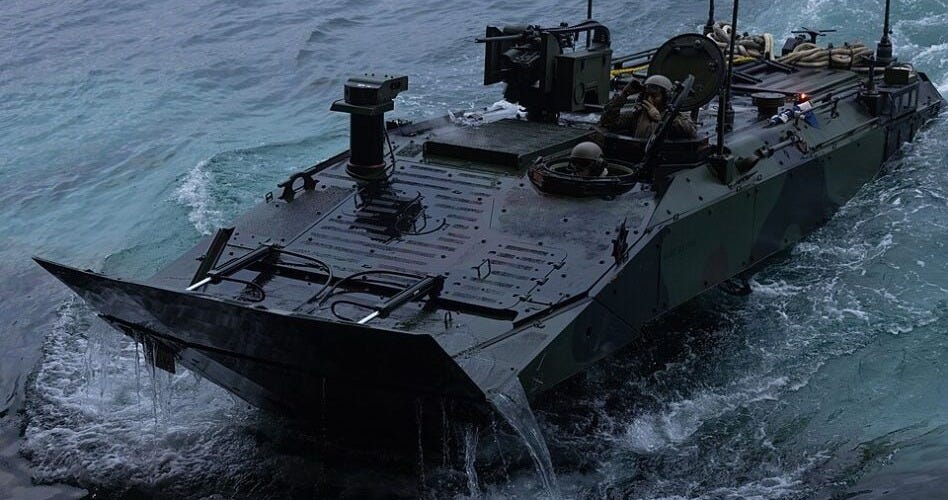
BLUF: The Marine Corps announced that it intends to issue a sole-source contract to Anduril for non-kinetic counter-drone technology for its Amphibious Combat Vehicles (ACVs), including the company’s Pulsar-L EW platform and vehicle integration kits.
Pulsar is Anduril’s family of EW systems; Pulsar-L is the smaller, lightweight version (weighs less than 25 lbs).
DoD Not Allowed to Fix Most of Its Own Stuff. Guess Who’s Cashing In?
BLUF: Because defense contracts often prevent the military from repairing its own equipment, critics say weapons companies are price-gouging the Pentagon.
Until the early 1990s, the Pentagon often purchased complete technical data packages for its equipment, allowing the military to handle its repairs as needed.
Over time however, acquisition officials ceded some leverage over the issue.
Many DoD contracts now leave repair and maintenance, which can make up as much as 70% of a military program’s lifetime cost, to the vendors.
Examples
RQ-11 Raven: When it has issues restarting, DoW was having to ship the drone back to the contractor at a cost of $26,000, regardless of the issue. It was found that common issues could be solved with hot glue.
Black Hawk: Screen control knobs are prone to breakage but contract terms require the purchase of an entire screen display assembly for $47,000. The knob itself could be manufactured for about $15.
Repair and Maintenance Instructions: Lockheed Martin has charged $900 per page for biannually updated maintenance manuals for the AC-130J. Boeing was paid $84M for Air Force One flight and maintenance manuals.
Weapons contractors say that giving the DoD the information it needs for its own repairs may compromise their private intellectual property (IP) and trade secrets.
The Warrior Right to Repair Act was introduced last year — which would have made contractors hand over the technical data for troops to fix their own gear.
Weapons contractors successfully lobbied to remove it from the National Defense Authorization Act (NDAA) for FY2026.
Renewing their push for the Warrior Right to Repair Act this year, Sens. Warren and Sheehy contend that a military right to repair will save the Pentagon, and taxpayers, billions of dollars.
Marines have found that they can 3D print a communications antenna it needs, dropping the cost from $5600 to $10 each and accelerating availability from 220 days the vendor typically takes to producing it nearly immediately.
“We’ve given away our right to repair our own equipment some of the time, which [means] we will have exquisite pieces of equipment sitting on the sidelines for 8 to 12 months, when we know how to 3D print [them much more cheaply]. That is a sin, and we’ve done it to ourselves.” Army Secretary Driscoll
Our Take: This is a complicated issue because it requires nuance. Most of the systems being discussed were ones that the government 100% (or very nearly) of the development and production readiness costs to field. For those systems, there should be little argument about the government having the ability to repair and modify them as they want. The challenge has been that OEMs for those systems usually assert restricted rights for the technical data based on some nugget of IP that they assert they developed at private expense. The government should be prepared to challenge those assertions (we see promise in the IP Ombudsmen provision in the FY27 NDAA).
On the flip side, there are firms who have invested most or all of their own funds to developing a product at great risk. Gaining access to technical data on those systems should be part of the broader business case in procuring them since it would not be fair or sustainable for those companies to get 10% margins in production (which are common for many of the legacy systems) and then have little to no revenue beyond. If DoW wants the right to repair on those systems, it should either buy the technical data or negotiate a more comprehensive price in procurement that provides a healthy margin for those companies to gain a reasonable return on their risk.

PAE Star Power
The following PAEs were nominated for promotion or recently promoted
Col Timothy Helfrich, PAE Fighters and Advanced Aircraft to BGen
Col Ryan Frazier, PAE Space Sensing and Targeting to BGen
Col Eric Zarybnisky, PAE Assured Access to Space to BGen
Ms. Shannon Pallone, PAE Battle Mgmt C3I was recently promoted to SES
BGen Jason Vooheis, PAE C3BM to AFLCMC/CC as a Lt Gen
Munitions Industry Needs New Acquisition Strategy
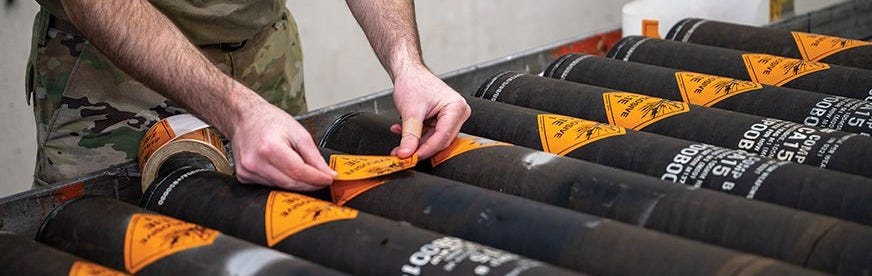
BLUF: The munitions industrial base’s inability to arm a coalition partner, deter an adversary or replenish stockpiles is not a funding problem, but an acquisition strategy problem. The solution is to contract for stability, readiness and surges.
Production lines that sat idle between contract awards cannot surge on demand. Suppliers that exited the market during years of procurement uncertainty cannot be recalled overnight. And surge capacity that was never funded cannot be conjured by emergency appropriation.
DoD spent decades designing munitions contracts that maximize government flexibility.
Episodic contract awards leave production lines idle for months between cycles.
The result is a process that systematically transfers demand and readiness risk to industry.
This risk imbalance discourages private investment, accelerates supplier exits among small and medium-sized businesses and leaves the Pentagon reliant on a hollowed-out supply chain at precisely the moments when capacity is most critical.
The Munitions Industrial Base Task Force advocates for requirements-based, multiple-year contracts that treat industrial capacity as a readiness function, not an administrative byproduct.
What they provide, and what current practice does not, is time-based demand stability: the multi-year horizon against which suppliers can justify hiring, tooling investment, sub-tier qualification and workforce development.
They incorporate economic price adjustment mechanisms for volatile inputs, energetics, metals and specialty chemicals, without which small and medium-sized businesses cannot responsibly commit to sustained production.
It funds steady-state production quantities across multiple years, keeping up the minimum sustaining rates necessary to retain workforce, tooling and supplier networks.
Multiple-year contracts, properly structured, incorporate annual reviews, defined quantity adjustment bands, recompete triggers and termination for convenience provisions.
The U.S. does not have a munitions production problem. It has a munitions contracting problem. Will the acquisition community will treat industrial capacity as the strategic asset it is.
DLA Working to Increase Demand Signal Precision
BLUF: DLA is working with the military services to be more precise in what it buys and provide a more specific demand signal.
When it comes to spare parts, the agency’s record is “not good,” and one of the ways it can improve its ability to apply available resources is to improve forecasting accuracy.
To increase forecasting accuracy, the agency is digitally connecting with and continuously exchanging data across disparate systems with each of the armed services, as well as applying artificial intelligence solutions.
“Collectively, the average accuracy is only around 60 percent. That means potentially we might be ordering 60 percent of the right thing, meaning it’s available when it’s required, … or there’s another 40 percent that might mean 20 percent we’re buying too much of the wrong stuff, and it sits on the shelf and it’s costly. Obviously, sunk cost ... never contributes to readiness. It has forced us to be connected; it has incentivized all of the aspects of interoperability, so it’s no longer the technical aspect of interoperability that’s a limiter — it’s really the human, the procedural dimensions.” DLA Director Army Lt. Gen. Mark Simerly

Army Directorate is Delivering Tech to Soldiers in Under 180 Days
BLUF: The Army’s Global Tactical Edge Acquisition Directorate (G-TEAD) has been awarding contracts and delivering tech at speeds the Army has never seen.
G-TEAD was part of the Army’s overarching goal of continuous transformation.
G-TEAD was born to get capabilities with a TRL of 7 or above into the hands of the warfighters as quickly as possible, specifically within 180 days or less from when the directorate publishes white papers.
The Directorate has awarded two OTAs for counter drone systems. The Merops counter drone system and one made by Mountain Horse Solutions.
An OTA for ground autonomy to be announced in coming days.
After the white papers are posted for a specific technology area, hundreds of companies respond and about 15 companies are then selected to take part in exercises called Accelerated Capability Events (ACEs).
Around five winners are selected from the competitions and eventually one finalist wins the OTA. Hill said the other winners still win agreements so they can be put on contract at any time (without having to go through another competition).
All of the ACEs so far have taken place in US Army Europe and Africa’s theater, but in Nov or Dec, the first one will take place in US Army Pacific theater.
G-TEAD prioritizes the tech it’s looking for directly from the commanding generals of the Army Service Component Commands (ASCCs).
The team looks at the larger Army capability gaps through the service’s Forge database, which is a data environment facilitating the synchronization and integration of modernization processes enabling Army modernization enterprise collaboration and a common operation picture of progress.
ASCCs have always had requirements, but never acquisition authority or access to RDT&E and G-TEAD brings both.
“The G-TEAD in general, we’re fighting against a cultural problem right, an identity. What does acquisition look like in the eyes of our warfighters, which is really important at the tactical edge. It’s really an understanding of what acquisition officers and operational commanders do. How are we a combat multiplier? And how we can take a system that is historically slow, and how can we weaponize that system to be flexible and responsive for the warfighter?” COL Christopher Hill
Our Take: There are so many exciting elements to this story. OTAs, rapid timelines to awards. Demonstrating capabilities in exercises vice paper proposals. Awarding to multiple winners (including some awardable, not funded) to maintain competitive pressure. GTEAD also has a cool logo and their director, COL Christopher Hill, teases some exciting news coming soon on their Accelerated Capability Events (ACE). This could be the ground autonomy OTA.

AI Making Vulnerability Detection Faster and Easier for Cyber Actors
BLUF: As the Army modernizes its network, the availability of AI capabilities is presenting new opportunities for the network to be compromised.
With all data under now under a single architecture, the Army must better understand the ins and outs of the network, especially in the face of a growing threat of emerging AI tools that are making it easier for attackers to exploit holes.
The hardest barrier to these changes is likely cultural. It involves getting personnel the right training and changing the bureaucracy into more of an operational mindset as opposed to a compliance or checklist based posture.
“The threat now is a different spot. These new AI capabilities [are] lowering the barrier of entry and exposing more of our attack service. We really need to better understand our unified network, rapidly understand where those attacks may be coming in … and be able to ingest the threat and act faster than any adversary.” David Markowitz, Army Deputy CIO and CDAO
Data Evolving into Army Warfighting Capability
BLUF: Data is a warfighting capability. It impacts how Army Materiel Command can anticipate requirements and deliver and share large amounts of information at scale.
AMC is focusing on three main priorities: equipment readiness, reimagining the organic industrial base and enhancing sustainment and quality of life for soldiers.
It is also reimagining the organic industrial base by transforming its 23 depots, arsenals and ammunition plants into “modern, data-driven production nodes” capable of manufacturing, repairing and overhauling equipment at scale.
“Sustainment can no longer be treated as an afterthought. It must be the decisive advantage of our future force. That means transforming our traditional practices in ways that are meaningful, in ways that are measurable, in ways that are mission-focused, ensuring that we deliver materiel and critical capabilities where and when they are needed, in support of our warfighters and the national interests we entrust them to defend.” LTG Gavin Lawrence, Deputy CG, Army Materiel Command
Army, J-7 to Test New Sensor with High-Altitude Balloon

BLUF: The Army’s G2 and Joint Staff’s J-7 are set to test a new prototype system, dubbed Project Wallabee, comprising a sensor with autonomous target recognition (ATR) capabilities on top of a stratospheric high-altitude balloon.
The exercise, in which the Army’s G-2 is partnering with the J-7’s Warfighter Laboratory Incentive Fund program, is the first time the military is testing manufacturer Urban Sky’s high-altitude balloon with Applied Intuition’s ATR software that controls and processes data from the small sensor.
It’s been notoriously difficult to find sensors small enough to thrive on high-altitude platforms given the precarious nature of the stratosphere with extreme weather and thinning air.
The payloads that the Army has been investing in up until this point have been much heavier and require much more power, causing them to be ineffective in the stratosphere. As a result, he said the force needs something lighter and that can operate in the vast temperature swings in that part of the atmosphere.
A multi-layered approach allows the force to provide early entry forces with the tools they need to find without relying on uncontested communications or exquisite space-based sensing systems.
House Wants the Army to Consider Sea Drones for Watercraft Escort Missions
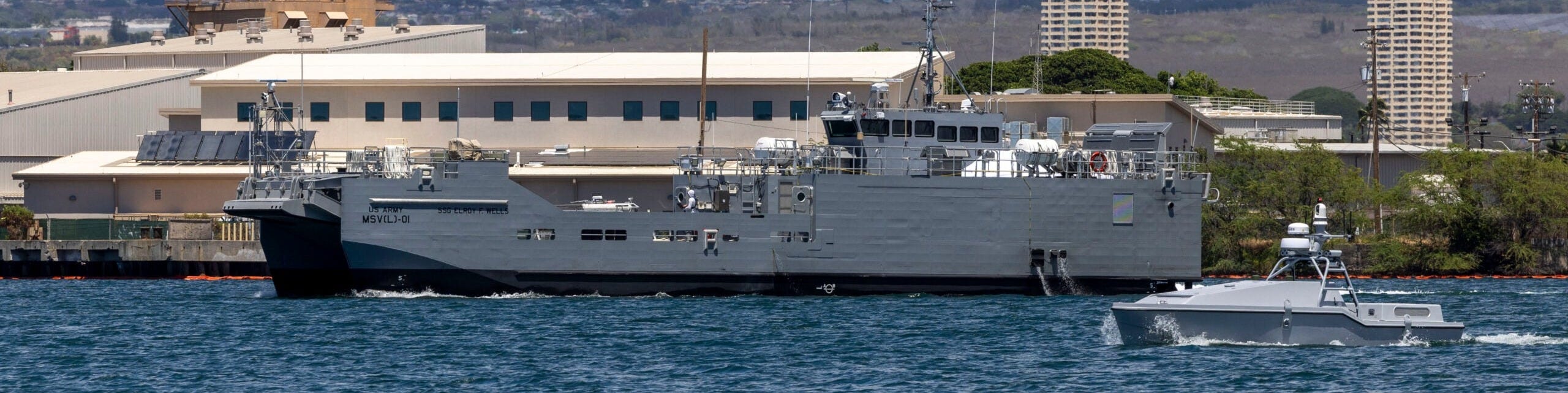
BLUF: The HASC wants the Army to examine the use of unmanned surface vessels to escort its watercraft against threats the ground branch may face during contested logistics.
The draft bill includes: The committee believes that manned Army watercraft may be aided by dedicated USV providing enhanced force protection, early warning, sensing and defensive effects while reducing risk to personnel.
The Army’s watercraft fleet has been highlighted in recent years amid concerns of a poor logistical footprint under contested conditions as Washington orients regional forces to counter China.
The Army’s logistical support vessels and other landing craft have been eyed as a crucial capability in any conflict spanning the Indo-Pacific.
The HASC wrote the Army may not provide resourcing consistent with a realistic strategy to support the watercraft needed for operations in the Indo-Pacific area of responsibility.
Last week DIU issued a solicitation for autonomous resupply vessels for the Army operations in the Indo-Pacific. The call is looking for solutions that could provide USVs capable of transporting containers up to sea state six to locations 1,600 nautical miles away and back.
Ramjet-Powered PrSM Increment 4 Advances Toward Flight Testing
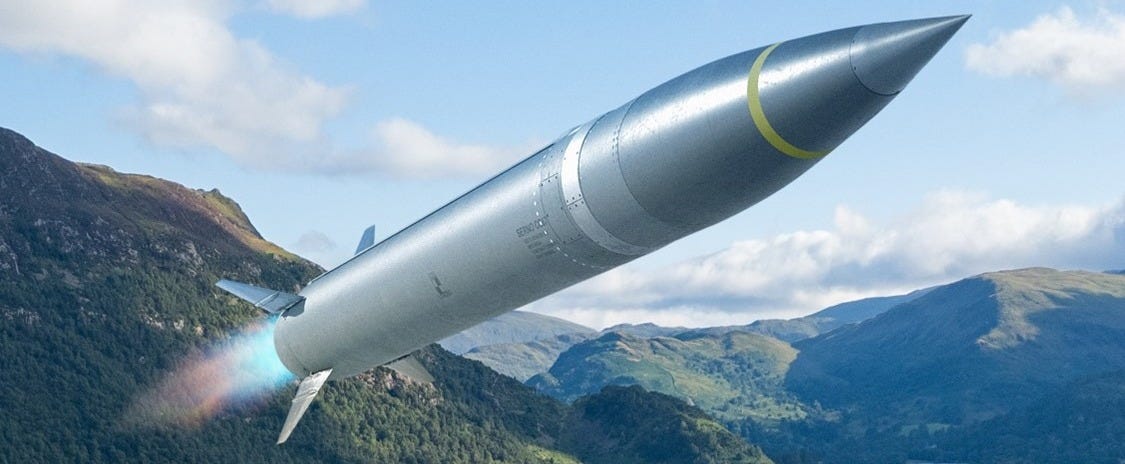
BLUF: L3Harris has conducted a key propulsion test for the Army’s ramjet-powered Precision Strike Missile (PrSM) Increment 4 program, paving the way for flight testing to begin in the fall.
During the Direct Connect Transition Test, the developmental missile successfully transitioned from a solid-rocket booster to an air-breathing ramjet engine, which is intended to significantly enhance its range for future threat environments.
Increment 4 features a combination of rocket-booster and ramjet propulsion. After the initial boost phase, the missile uses atmospheric oxygen to sustain combustion in its ramjet engine, eliminating the need to carry an onboard oxidizer during cruise flight.
The missile is expected to strike targets at ranges exceeding 1,000 kilometers, nearly double the range of earlier PrSM variants.
Launched from existing HIMARS and M270 launchers, the missile is designed to operate in GPS-denied environments and features high control authority and high terminal velocity, complicating interception in anti-access/area-denial scenarios.
Increment 4’s development is being accelerated for operations in the Indo-Pacific, where it could hold long-range land and maritime targets at risk.
To support the program’s timeline, prime contractor Lockheed Martin and L3Harris have invested more than $300M in additive manufacturing and automation, establishing a rapid-production hardware pipeline.
PAE Maneuver Ground Polaris Industry Stakeholder Engagement Forum
PAE Maneuver Ground is hosting a discussion of the Polaris 2026 Soldier Modernization Plan to engage with industry and stakeholders about future modernization priorities. It is focused on delivering capabilities for the Army of 2030 and shaping the Army of 2040. 12-13 Aug in Alexandria, VA
Other Army News:
Army Awards Production Contract for the Spectrum Situational Awareness System (S2AS) to 3dB Labs
Army Plans Acquisition of 1,134 PrSM Missiles and More HIMARS in FY2027 to Expand Long-Range Strike

A Navy Carrier is About to Deploy With a Robot Ship. Could it Change the Navy Forever?
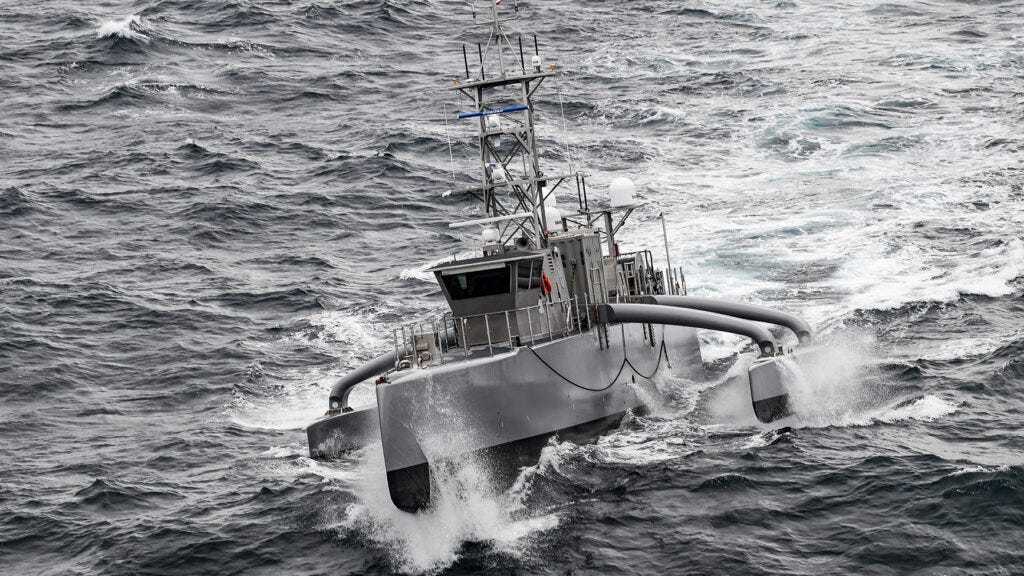
BLUF: Aircraft carrier Theodore Roosevelt is gearing up for a deployment with a Seahawk MUSV as part of its strike group for the first time. This is a key milestone signifying the transition of the unmanned system from an experimental to operational part of the fleet.
This deployment could lay the foundation for how the Navy develops its CONOPS for integrating unmanned into the rest of the fleet, at a time when the Navy is still struggling to articulate how and when it will make autonomous vessels a core part of its arsenal.
The Seahawk is one of Leidos’ unmanned vessels. It supports anti-submarine warfare and maritime domain awareness, and stems from a DARPA initiative.
Per Bryan Clark, the announced upcoming deployment with the Theodore Roosevelt shows the Navy wants unmanned systems to supplement primary forces as the Navy develops new tailored force packages for specific mission sets and geographies.
Whatever is learned from this deployment will help the service set its approach to both the CONOPS for unmanned vessels, and their acquisition strategy.
CNO ADM Daryl Caudle’s Fighting Instructions laid out plans to utilize a “hedge force strategy” that seeks to capitalize on unmanned systems and create a range of tailored options that fall outside the traditional carrier strike group model where an aircraft carrier, a destroyer, and several other assets go out to sea together.
In an attempt to procure MUSVs faster, the Navy announced in March a new MUSV marketplace where industry could submit proposals. This shift to the marketplace approach veered away from narrow requirements into performance-based requirements, ultimately allowing more options for the warfighter.
The Navy announced in May that seven designs from the marketplace were selected to advance to the prototype testing phase. Leidos is one of the seven.
“We need to move these capabilities from individual units into composite mission sets, including contested logistics. Using USVs to move food and parts replenishing underways without risking humans is a major use case.” CNO ADM Daryl Caudle
“It is certainly a significant development. Up to now, it’s all been a matter of testing, and the actual use in operational deployment is a major step. I think that what will happen as a result of this is, we won’t necessarily see immediately some big change in the way the fleet operates, but it will tell the fleet a lot about how to use this type of capability.” Bradley Martin, a senior policy researcher at RAND.
Our Take: Deploying a Seahawk with the Roosevelt is a key effort to infuse MUSVs into the Fleet. We continue to see competing perspectives across the Navy on USV and UUV adoption. Some appear resistant and focused on Carrier Strike Groups and manned ships, setting high bars that USVs must match in speed and range. Others, active champions of USVs and UUVs, are eager to explore pairing them with manned ships for targeted missions and novel unmanned mission sets. Increasing the number of exercises and deployments of the full range of USVs and UUVs should be a top Navy priority over the next few years. Dedicated resources are needed to capture these insights and drive modern CONOPS and acquisition strategies.
Navy Accepts Accelerated Delivery of Future USS Patrick Gallagher
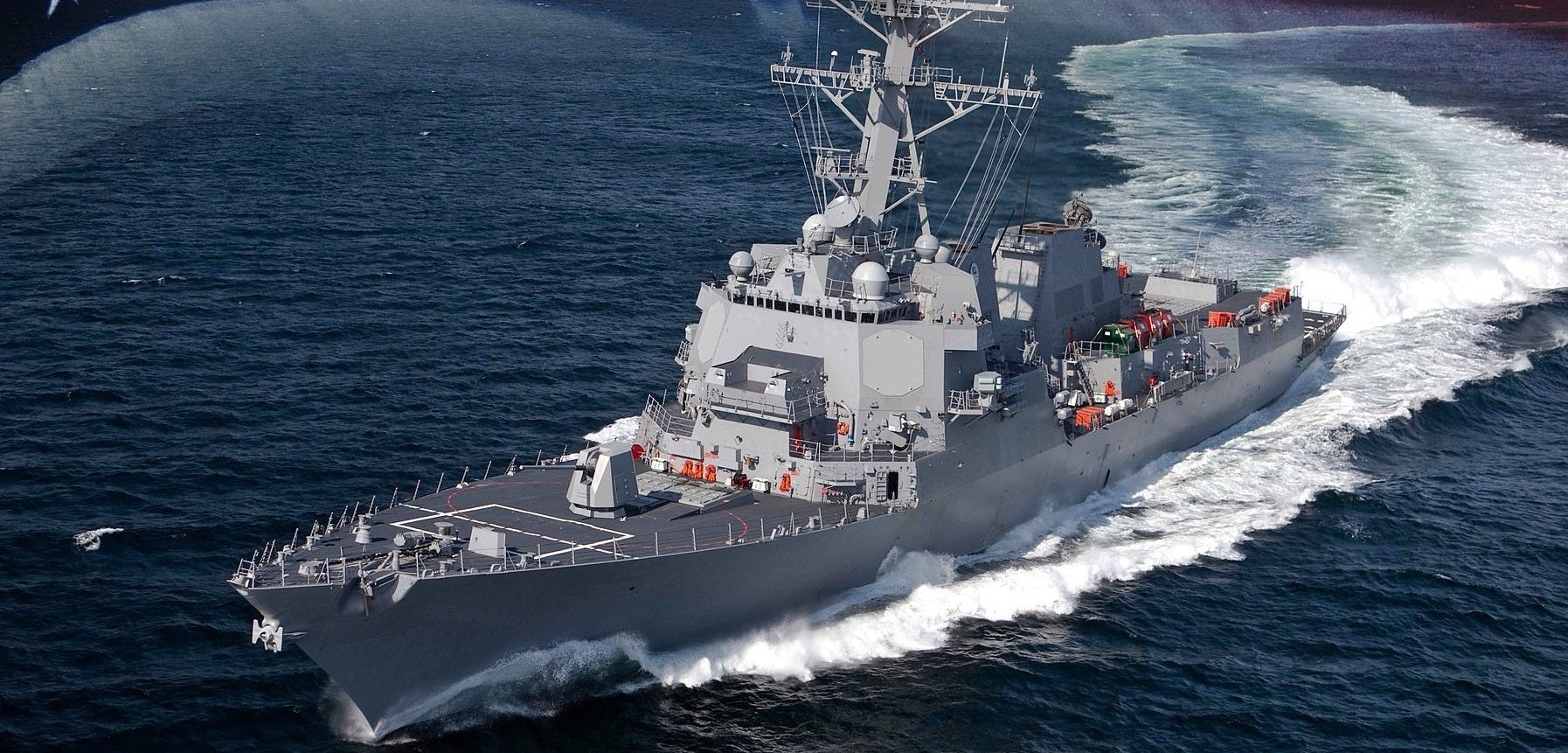
The Navy accepted delivery of future USS Patrick Gallagher (DDG 127), the final Flight IIA Arleigh Burke-Class destroyer, from Bath Iron Works, May 28.
The delivery, which marks the official transfer of the ship from the shipbuilder to the Navy, was accelerated by more than two months, due to exceptional builder’s sea trials.
The trials executed hull, mechanical, electrical and combat systems at sea testing in series, during a single accelerated effort.
“Our nation’s leadership, including Secretary Hegseth and Acting Secretary Cao have been very clear—build ships faster. Thanks to innovative collaboration between the Navy and industry, we’re doing exactly that.” - William Mahan, PTDO ASN/RDA
Raytheon’s Most Advanced Maritime Radar Set to Boost Battleship’s Defense Capability
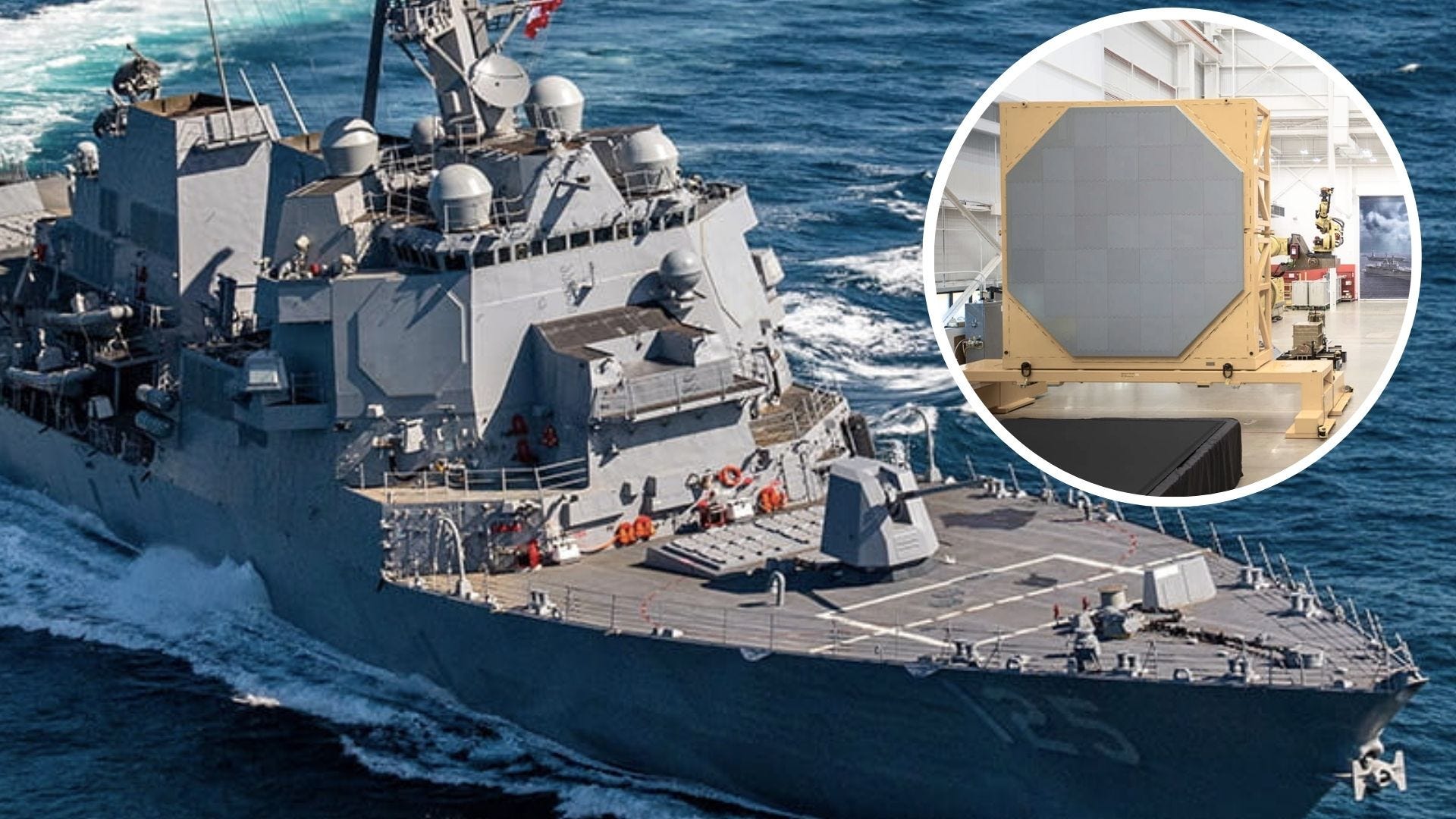
BLUF: Raytheon’s most advanced radar is set to power the Navy’s battle power. Their SPY-6 family of radars can simultaneously defend against ballistic missiles, cruise missiles, hypersonic missiles, hostile aircraft, and surface ships. The Navy awarded Raytheon a $515M contract for the SPY-6 family of radars.
SPY-6 radars offer many advantages over legacy radars, such as greater detection range, increased sensitivity, and more accurate discrimination.
the SPY-6 radar is now operational aboard two commissioned U.S. Navy ships. The company also confirmed that the system has been installed on 11 additional vessels, which are currently undergoing various stages of testing and evaluation.
The SPY-6 is expected to see widespread deployment across the fleet in the coming years. Over the next decade, more than 50 U.S. Navy ships are slated to receive the advanced radar system.
Once fully integrated, the SPY-6 will strengthen the Navy’s ability to detect, track, and counter a broad range of threats. These include aircraft, surface vessels, ballistic missiles, and EW attacks.
The company also revealed that each variant uses the same hardware and software, and their construction is modular, making the SPY-6 family more reliable and less expensive to maintain.
“With over a decade of demonstrated success at sea, SPY-6 remains the U.S. Navy’s most advanced maritime radar, providing the fleet with unmatched sensing power and multi-mission readiness to counter evolving threats. Backed by an $800M investment to modernize our radar manufacturing facilities, we’re accelerating production and are expecting to double SPY‑6 output by 2028.” Barbara Borgonovi, Raytheon President of Naval Power
The Navy Wants Next-Generation Munitions, So it’s Spending Millions on Innovation Hubs
BLUF: The Navy broke ground on the Maryland Energetics Innovation Hub (MEIH) to furnish lab space where companies can test new tech, such as high-performance computers to run simulations.
The Navy awarded ACMI $50M to bring companies working in munitions and energetics closer to the service’s technical expertise. The group aims to raise another $200M for the project.
The MEIH will focus on eight technical areas: developing new energetics materials, high-performance computing; non-destructive test and evaluation; integration with drones or unmanned systems; automating energetic processing and assembly; creating new manufacturing processes for propulsion systems and warheads; analyzing energetics obsolescence, and producing high-precision, high-throughput non-energetic components.
The southern Maryland-based hub builds on an ecosystem of energetics companies working in the region, but could foster new growth and partnerships for companies designing military technology.
Defense tech hubs have already sprouted around the country, in Austin, TX; Rhode Island’s Unity Park and Quonset Point; and the Louisiana coastline. MxD, a Pentagon manufacturing partner, has a 22,000-square-foot hub in Chicago.
“This initiative ensures that NSWC Indian Head Division remains at the forefront of energetics innovation, scale-up, and production. By bringing together government and industry partners in a collaborative environment, we can accelerate the development and fielding of critical capabilities that strengthen the Navy’s arsenal and the larger munitions industrial base.” CAPT Stephen Duba, NSWC Commander
Congrats to Justin Fanelli for winning
Washington Exec’s Government CTO of the Year award.
Other Navy News:

Marines to Make Weapon Integration a Priority

BLUF: The Marine Corps is working to operationalize its long-term vision known as Force Design, and its armament goals are a combination of kinetic and non-kinetic effects that the Marines needs to integrate seamlessly to operate in an evolving landscape.
One of the Marines’ top priorities is its Organic Precision Fires concept. The effort is intended to equip small, dismounted units with man-packable, precision-strike loitering munitions to destroy targets beyond line of sight without relying on external support.
In the near term, the Marine Corps is focused specifically on Organic Precision Fires-Light, a loitering munition system intended for small Marine Corps units operating on the front line.
The capability will give small formations the ability to launch kamikaze drones at targets beyond the reach of rifles and other direct-fire weapons.
In 2024, the Marines selected AV, Anduril, and Teledyne FLIR for the multi-vendor effort, with Teledyne and Anduril receiving follow-on contracts ($42.5M and $23.9M respectively) following the program’s initial phase.
The Marine Corps is also developing a larger companion system, Organic Precision Fires-Medium, aimed at battalion-sized formations.
The medium variant is a little bit bigger and expands capability to engage armored targets beyond line of sight, looking after anti-tank targets and weapons for dismounted Marine Corps anti-armor.
Marines’ AV-8B Harrier Has Flown Off Into The Sunset

BLUF: In a ceremony , the Marine Corps said its official farewell to the AV-8B when its final operational Harrier II squadron, Marine Attack Squadron 223 (VMA-223), known as the “Bulldogs,” marked the retirement of the aircraft at Marine Corps Air Station Cherry Point, NC.
The event closes a remarkable chapter in Marine aviation history.
The Harrier’s departure marks more than the retirement of an aircraft; it represents the conclusion of a concept that shaped Marine air power for generations and helped define the Corps’ expeditionary character.
The Harrier was the embodiment of the Marine Corps’ longstanding determination to bring airpower wherever Marines fought, regardless of whether a conventional airfield existed.
Looking forward, the F-35B possesses short takeoff and vertical landing capability. Unlike the Harrier, however, it combines that flexibility with stealth technology, sensor fusion, powerful electronic warfare systems, and the ability to operate as an intelligence-gathering node across the battlespace.

Ashley Devoto Named as Air Force, Space Force CIO
BLUF: Ashley Devoto has a decades-long career in cybersecurity fields and will now oversee the Air and Space Forces’ modernization and sustainment efforts for information technology and more.
She served as the chief information security officer for major companies like Discount Tire and Booz Allen Hamilton, as well as an advisor for cyber-focused venture capital and investment firms.
Her career started in 2005 when she became a cyberspace operator for the Air Force. During her 15 years of service, she directed full-spectrum operations of the service’s computer emergency response team.
USAF Wants “MQ-9 Next” Reaper Replacement to Be Modular, Cheap
BLUF: Modularity is a key area of interest as the Air Force formulates its latest set of requirements for a successor to the MQ-9 Reaper.
A modular design, both in terms of hardware and software, would help make the chosen platform more flexible and adaptable to different mission sets.
Earlier this year, the Air Force laid out other prospective requirements for an MQ-9 replacement, including a design that is easier to produce, lower-cost, and that can be more freely sent into higher-risk environments.
This follows several abortive Air Force attempts in the past to devise a successor to the Reaper.
Greater control over intellectual property, and software in particular, has emerged as a major guiding principle.
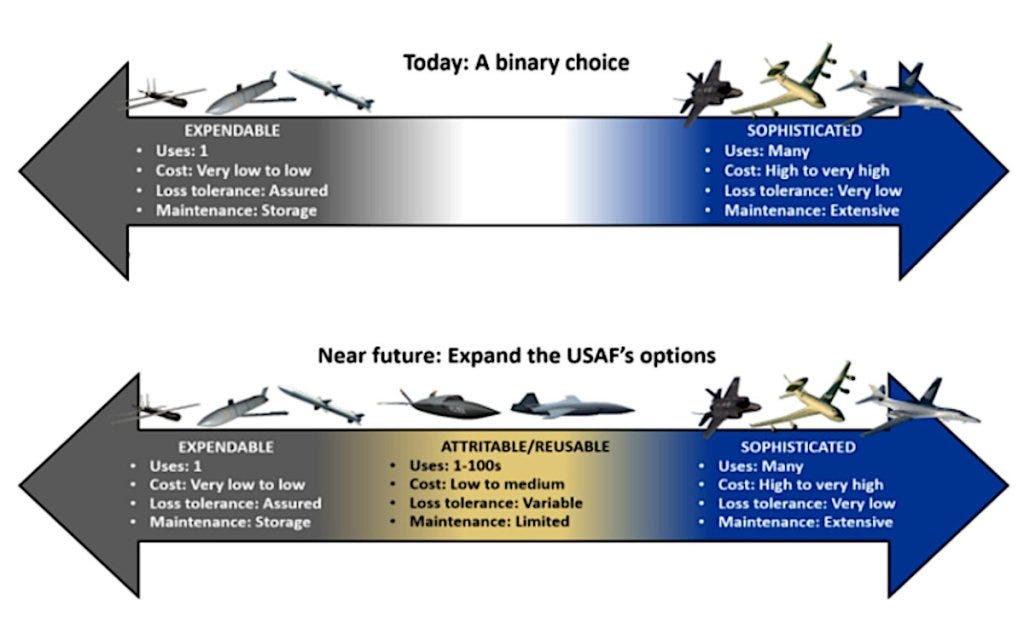
I think what we’d like to have is something that’s perhaps got more range, perhaps a lot more modularity. We could hang ISR [intelligence, surveillance, and reconnaissance] sensors, we could hang weapons, we could hang fuel – something that we could line-in/ line-out, very modular. We’re just going through some early work, our Air Force Futures team, to figure out exactly how we want to tackle that going forward.” Gen LaMontagne
Our Take: This whole scenario is classic Air Force. They will do studies for the next 3 years and try to find the perfect set of requirements while the PLA simultaneously fields 3 different versions of ISR UAVs. This mentality is rooted in the thinking that once we buy one thing, we’re stuck with it forever, so we have to get it perfect. This is the Air Force’s most limiting bias that keeps it from getting with the times. It’s only a minor miracle that CCA Increment 1 is where it is (well it’s actually the leadership from a few key people).
The mentality should be let’s field an ISR platform that is simple and can swap out sensors with maybe some ability to integrate APWKS and JAGM. Give it a moderate range to support CENTCOM missions and ACE concepts in the Pacific but think of it as the first model. Field it within the next 2 years and get something out to the warfighter. Simultaneously think about the next iteration and what effects another larger UAV could provide. Maybe it’s a version with higher SWAP for delivering EW/Cyber effects and maybe there’s a version that’s more of a weapons carrier (although this is less ideal since it drives a lot of design considerations and we have other platforms to do that). Come on Air Force - we can do this!! Aim High.
Demand for New Airplanes ‘Outstripping’ Production
BLUF: The Air Force is seeking to buy around 108 new aircraft in FY27 but would buy more if the production capacity existed.
Despite the overall defense budget soaring to $1.5T and the Air Force budget increasing ~25%, the service’s 62 new fighters fell short of its goal of 72 new fighters per year to hold down the fighter fleet’s age and keep capacity steady.
The service is responding to the issue by retaining more of its older aircraft it had planned to retire, such as the A-10 and the KC-135 tanker.
Leadership acknowledges that industry is put off by the “sawtooth” funding that fluctuates every year.
To that end, the Air Force is supporting multiyear procurement deals for the F-35 and F-15EX and modernizing its older fleets.
The 2027 procurement budget request includes:
38 F-35As
24 F-15EX Eagle II fighters
23 T-7A Red Hawk trainer aircraft
15 KC-46 Pegasus refueling tankers
An undisclosed number of B-21 Raider bombers
Our Take: The situation the Air Force finds itself is partially about steady demand for certain aircraft but also because it’s been so tentative about starting new efforts. The F-15EX situation is in the Air Force’s court as they have been steadily adding the total numbers they plan to buy. On the F-35 front, it’s been more about the delays with Block 4 and TR-3. The Air Force has few other production lines for aircraft it wants although it should be considering buying Block 70/72 F-16s and rapidly scaling up CCA production (for multiple increments) to meet the need for capacity. It should also be leaning into NGAS to get a more survivable tanker fielded but that looks like it’s going to be deferred indefinitely.
Now Is the Time to Boost CCA Investment
BLUF: The FY27 defense budget request comes at a crucial time for the CCA since the Air Force inventory is both too old and too small for the myriad missions it faces, and CCA can be the key to ensuring U.S. fighting capacity in the future.
The Air Force wants about $1B to move the CCA Increment 1 program into production in FY27 and accelerate the introduction of this game-changing technology. Congress should support that objective.
These uncrewed jets have the potential to radically change air warfare. Because they are autonomous, CCA can act as force multipliers operating in partnership with crewed combat aircraft.
CCA will change air combat and inaugurate new types of missions, increasing effectiveness and lethality.
Despite the magnificent performance of our combat Airmen, the age and lack of capacity is driving operational risk to unacceptable levels.
The Air Force shrunk from well over 4,000 fighters and 400 bombers at the end of the Cold War in 1990 to just over 2,000 fighters and less than 150 bombers today.
Recent wargames point to novel uses of the jets, increasing USAF’s ability to surprise adversaries, decrease their battlespace awareness, deliver kinetic and non-kinetic effects, and draw forces away from manned force packages.
Like the MQ-9, CCA can be employed to execute the most dangerous missions and increase total force effectiveness. But the Air Force will need the funding to develop the CCA autonomy—the mission-oriented “brains” of the aircraft.
The faster Airmen get their hands on this technology and put it to work in operational environments, the sooner warfighters will gain from the technology.
Likewise, those reps and sets will also pay off for the mission commanders operating with CCA, who must develop the tactics, techniques, and procedures needed to effectively integrate, employ, and sustain CCA.
Our Take: Heather nails it 1000%. We often throw tons of money at different problems to try to drive progress faster than risk-averse officials like (check out the gobs thrown at scaling old missiles and accelerating a new high-tech fighter). CCA is actually the case where the risk is low enough and the payoff high enough that it deserves to be funded at “extreme levels” to get the supply chains activated, the manufacturing ready to move, and as Heather points out - to get the operational community activated (beyond just the EOU) to really drive the CONOPS forward. Congress: Please support the $1B and triple the request. Will it be perfectly executable? No. Will it drive positive action? Yes. Will the results be bad for the PLA and other competitors? Yes.
Next Generation Penetrator Bomb Slated to Replace MOP Has Been Designated GBU-76
BLUF: The Air Force is laying the groundwork for fielding the replacement of its GBU-57/B Massive Ordnance Penetrator (MOP) bunker buster bomb. The follow-on Next Generation Penetrator (NGP) has now been designated as the GBU-76/B.
Fuzing is a critical element of the design of deep-penetrating munitions.
These weapons are designed to be employed against targets that are underground or otherwise present inherent challenges when it comes to establishing their exact location and layout.
As such, advanced fuzes that ‘count’ floors to determine depth and/or sense the ‘voids’ of underground mission spaces help maximize the damage.
These fuzes also need to be highly reliable in order to function after impacting very hard surfaces at high speeds and then drilling even further down into them.
The Air Force has said in past NGP notices that it will consider novel, demonstrated, or fielded Guidance, Navigation & Control (GNC) technologies.
The Air Force has previously said that the bomb’s “warhead” is set to tip the scales at around 22,000 pounds, but the complete weapon could be heavier.
The Air Force has raised the possibility of a powered design offering extended reach in past discussions about MOP replacements.
When the Air Force expects to start fielding its first operational GBU-76/Bs is unclear but it seems to want to move into production around FY28/29.
Our Take: The focus on fuzing is accurate because that was one of the hardest challenges with the MOP. In the future, having alternate PNT options will also be key because adversaries will be focused on denying GPS and other common timing sources used for navigation.
Other Air Force News:
House Panel Votes to Prohibit F-22 Retirements Through Fiscal 2032
KC-46’s New Remote Vision System Completes Initial ‘Non-Contact’ Testing

NRO Nominee Says Commercial Space, AI are Reshaping Agency
BLUF: Roger Mason, nominee to lead the National Reconnaissance Office, said that the agency is navigating a period of rapid innovation in commercial space and artificial intelligence that is transforming space-based intelligence.
The NRO operates the nation’s spy satellites and acquires commercial satellite imagery used by military commanders and civilian policymakers.
Under the previous director, the agency has embraced commercial launch and satellite technologies while deploying a proliferated low Earth orbit imaging constellation that now exceeds 200 satellites.
Mason believes that maintaining strong ties with private industry would be essential as the agency expands its satellite architecture and seeks access to emerging technologies.
He said government agencies must provide clear signals to industry about future requirements.
He also highlighted the role of AI as proliferated constellations require AI to synchronize operations and process information at speeds that would be difficult for human operators alone.
“We are in a space renaissance where the pace of technology advancement, speed of innovation and promise of the future has drawn unprecedented investments,”
Lawmakers Push Space Force to Seek More Commercial Integration
BLUF: House lawmakers want the Space Force to buy more technology and services from commercial companies, evidenced in a handful of amendments approved as part of the FY27 NDAA.
The bill now includes at least five amendments that would require studies and plans to incorporate technology from nontraditional firms into missions like:
space domain awareness
space sensing
satellite communications
autonomous satellite operations.
House lawmakers state in their bill they’re concerned about reductions to “seed corn” efforts, like Tactical Surveillance, Reconnaissance, and Tracking, the Joint Commercial Operations Cell, and the Commercial Augmentation Space Reserve.
COMSO is funded through a dedicated commercial services line, which dropped from ~$168M in FY26 appropriations to just $23M in the FY27 request.
“The committee encourages the Secretary of the Air Force, in coordination with the Chief of Space Operations, to continue developing and operationalizing mechanisms to ingest, validate, and fuse relevant commercial data into the HAC. The committee continues to encourage the Space Force to treat commercial data as a core element of a resilient, hybrid SDA architecture designed to operate effectively in a contested space domain.” NDAA Provision
Our Take: We appreciate the congressional focus here because the Space Force has sometimes not matched its rhetoric with the budget…and has slow rolled integration of commercial data into operations. However, the Space Force does deserve a reasonable amount of credit because they turned to commercial and non-traditional providers for an increasing range of critical capabilities. Shortchanging some of the lines (like TacSRT and COMSO) do send a conflicting message this year.
Space Force’s Commercial Gatekeeper Offers a Playbook for Startups Seeking Defense Business
BLUF: As investment pours space startups, the Space Force is trying to draw more of those companies into the national security market and offers some candid feedback on what companies get right — and wrong — when approaching government buyers.
Col. Tim Trimailo shared his personal observations from those interactions.
His central message for startups:
Build something that solves a real problem.
Explain why it matters.
Be candid about what has gone wrong.
Understand how government buying works.
Keep commercial customers in the picture.
Trimailo’s advice also reveals a persistent misunderstanding between startups and the acquisition system with many companies expecting hidden pools of funding or rapid procurement pathways. He warned that such opportunities are rare.
Trimailo cautioned against abandoning commercial markets in pursuit of perfect alignment with government requirements.
That philosophy reflects a growing consensus within parts of the Space Force that commercial innovation is most valuable when it remains commercially viable.
“Persistent engagement is really the name of the game. We want to see dual-use capabilities, we want to see other people paying down some of our R&D bills,” Trimailo said. The strongest performers are often those that combine private capital and government funding in a deliberate sequence as they move through development.” Col. Tim Trimailo
Our Take: This is generally good advice even if it puts more of the onus on industry rather than detailing how the Space Force could be a better buyer. There is also some double talk in this messaging where the Space Force wants its cake and to eat it too. To tell industry they have to build something that solves a military problem and have good understanding of the operational user while also building a viable commercial business can sometimes drive agonizing tradeoffs. The Space Force might not buy data that doesn’t provide say a certain level of resolution for imaging or does not pass over certain locations with a desired rapidity. So, to meet that need, a company may need to invest in higher quality sensors and a larger constellation that raises their prices and maybe reduces their commercial customer base. The answer lies in both parties discussing the tradeoffs and the Space Force showing a demand for service levels that are price competitive for the commercial sector.
SpaceX Gets US Approval to Test New Starfall Capsules for Space Manufacturing

BLUF: SpaceX will soon test reentry vehicles that could enable in-space manufacturing and rapid point-to-point cargo delivery.
On May 15, the FAA issued an environmental assessment for test flights of the new reentry vehicle, called Starfall.
SpaceX has remained tight-lipped when it comes to providing specific details to the public regarding Starfall.
Previously announced plans included Starship providing rapid delivery of military cargo for the U.S. military.
The Starfall vehicles could also serve as a “proliferated successor” to the International Space Station (ISS), as they could support “a self-sustaining manufacturing economy in space.”
Starfall could put SpaceX in direct competition with companies that have relied on SpaceX rocket launches for their business models.
Varda Space Industries, for example, has flown six in-space manufacturing W-series spacecraft aboard SpaceX Falcon 9 rideshare missions.
Other companies, including Inversion and Armos Space Cargo, have also flown their reentry vehicles aboard SpaceX’s workhorse rocket.
Our Take: This is a big step forward to providing affordable cargo delivery from space and weapons delivery of different types to locations around the globe.
HASC NDAA Markup Challenges Space Force on Satellite Programs
BLUF: Congress took exception to some of the Space Force’s plans in the FY27 budget and is redirecting some key efforts.
Next-Gen OPIR Polar: The Space Force had proposed cancelling this effort in lieu of other proliferated constellations. HASC reinstates it.
Protected Tactical SATCOM-Global: The HASC criticized the decision to procure only two satellites — one from each company — for a program that had been promoted as a proliferated architecture.
PNT Enterprise: The HASC criticized that the PNT enterprise remains disjointed and underprioritized despite its importance to military operations. Requires the designation of single responsible official.
Our Take: We support these changes by the HASC. We noted the reduction to NG-OPIR in our budget post but didn’t recognize it as a full reduction in that capability. It makes no sense to get to this point in that program and not see the polar segment through to completion.
Space Force Wants 5 New Tactical Ops Centers for Electronic Warfare
BLUF: The Space Force wants to make its electronic warfare capabilities more resilient by building five new tactical EW centers in the U.S. and around the globe
The 2027 budget request includes $1B for four new space operations centers around the country.
There is currently just one SEWTOC, run by Mission Delta 3 at Peterson Space Force Base, Colo. If funded, the five new centers will be placed according to the Air Force Strategic Basing process.
The EW centers can operate offensively or defensively and assist joint service across the electromagnetic spectrum by protecting satellite communications.
The first SEWTOC at Peterson uses a signal jamming system called Remote Modular Terminal, made by Northstrat with CACI, and Bounty Hunter, a ground-based system that protects U.S. and allied satellite communications links.
Bounty Hunter works as a kind of “celestial detective” and has been deployed to both U.S. Central Command and U.S. Indo-Pacific Command to “detect, characterize, geolocate and report” sources of electromagnetic interference.
L3Harris delivered two Meadowlands systems to Space Force in April 2025
Meadowlands is a lighter and more compact version of CCS, which allows one operator to control 300% more simultaneous missions from remote locations.
Space Force Announces Launch Deal with Blue Origin After Rocket Mishap
BLUF: The Space Force awarded a task order to Blue Origin for its first National Security Space Launch mission the same day the company’s New Glenn rocket exploded on the launch pad at Cape Canaveral Space Force Base. However, the Space Force says it remains committed to its contract.
Blue Origin is one of three companies approved to compete for launch contracts under Phase 3 of the Space Force’s dual-lane NSSL program.
Its recent award is for “Lane 1,” which covers the U.S. military’s more risk-tolerant, commercial-like missions.
The company is also in the midst of qualifying New Glenn to fly more risk-averse “Lane 2” launches that involve the Pentagon’s most exquisite, sensitive satellites.
While Lane 1 companies can receive launch contracts after their vehicles have flown at least once, firms must complete a rigorous, individualized certification process to compete for Lane 2 awards.
Our Take: The Space Force needs Blue Origin to be successful to build resiliency into its launch program and for other critical missions. At the same time, it needs Blue Origin to show that it can rapidly recover from this setback and get back on-track the way that SpaceX has after its series of failed launches on its rocket lines.

Northrop Grumman Partners with Apex on Space-Based Interceptors for Golden Dome
BLUF: Northrop Grumman has partnered with satellite manufacturing startup Apex to develop space-based interceptors for the Golden Dome missile defense program.
Northrop Grumman is one of 12 firms selected by the Space Force to develop concepts for space-based interceptors.
Apex manufactures standardized satellite buses designed to be produced more quickly and at lower cost than traditional government spacecraft.
Raytheon has disclosed a partnership with Rocket Lab, while Anduril Industries has assembled a team that includes several commercial space companies.
NGC says it has completed key ground tests this year and is on track to demonstrate an on-orbit capability in 2027.

Rebuilding Europe’s Armored Advantage
BLUF: The resurgence of tensions, particularly in Eastern Europe, is accelerating modernization efforts aimed at enhancing the operational readiness and effectiveness of military land vehicles.
The alliance’s emphasis on standardization ensures that military vehicles across different nations can operate seamlessly together, improving collective operational effectiveness.
This standardization is particularly crucial in the context of joint operations, where interoperability can be the difference between success and failure.
The conflict in Ukraine has further accelerated modernization efforts, with the war highlighting vulnerabilities of outdated military equipment and a pressing need for upgrades to counter heavily armored and mechanized formations.
There is a marked shift towards heavier platforms driven by the need for increased armor and sophisticated digital systems.
To support these enhancements, more powerful engines are required to offset the increased weight from additional armor and equipment.
This is not only an issue of operational efficiency but of strategic importance, as maintaining high mobility and speed is a critical combat advantage.
The integration of hybrid and electric systems is also becoming increasingly important for future proofing military vehicles.
As well as the potential to enhance fuel efficiency, they provide a quieter operation, which can be advantageous in stealth missions.
According to GlobalData, the global military land vehicles market – valued at $20.8B in 2023 – is expected to reach a value of $31.3B by 2033
Poland Spends $16.5B in EU-Backed Loans on Heavy Army Weapons
BLUF: The Polish Ministry of National Defence has awarded contracts worth around $16.5B to buy infantry fighting vehicles, self-propelled howitzers, military vehicles, and self-propelled wheeled mortars to a group of local defense companies.
The purchases will be bankrolled by the European Union’s Security Action for Europe (SAFE) low-cost loan program.
The contracts were awarded to a group of companies led by state-run defense giant PGZ.
In September 2025, PGZ selected the U.K.’s BAE Systems as its technology partner for the ongoing ramp-up of local artillery ammunition production.
In addition to procuring the necessary equipment for the Polish military, the contracts are to enable Poland’s defense industry to boost its production capacities for export sales.
AUKUS Virginia-Class Switch Is a Fix, Not a Failure
Jennifer Parker
BLUF: The announcement this week changed the mix of submarines Australia will receive – it did not change the program’s purpose, or its prospects.
Much of the reaction to this week’s AUKUS announcement that Australia will acquire three in-service Virginia-class submarines and forgo buying a new U.S.-built boat has missed the point.
While some have portrayed the decision as a fundamental change to the deal, in reality, it is a relatively minor adjustment to a program that will run for 30+ years.
The practical effect is that all three Virginia-class submarines Australia acquires in the 2030s will be of the same configuration.
Operating three of the same submarines simplifies workforce, training, maintenance and sustainment requirements.
The downside is that an in-service submarine has less life remaining than a newly built boat but that was already true of the first two submarines Australia was due to receive.
Cutting-Edge Uncrewed Underwater Vessels with Advanced Weapons to Boost Warfighting Readiness
BLUF: AUKUS (Australia, U.K. and U.S) partners are set to develop, produce and deploy cutting-edge technologies carried by uncrewed underwater vessels (UUVs).
AUKUS partners are collaborating to rapidly develop these maritime capabilities to boost warfighting readiness.
The first capabilities are expected to be in service by 2027 and will help drive the Royal Navy’s transition to a Hybrid Navy.
The payloads will allow the Royal Navy to detect underwater threats to the UK and allies’ critical undersea infrastructure.
The Royal Navy will be able to integrate payloads from the US and Australia, meaning a more effective and lethal force.
The tech will be used to reinforce the future SSN-AUKUS attack submarine fleet.
The joint development of transformational tech is the first signature project to be announced under Pillar 2 of the partnership.
Our Take: It will be interesting to see how this impacts the Navy’s ongoing UUV work. Do all those projects get converted to a joint project or do UK and Australia get a chance to compete on U.S. efforts? Lots to watch here.
Full P-8A Fleet to Strengthen Australia’s ASW Readiness

BLUF: Boeing P-8A Poseidon is modified for military missions such as anti-submarine warfare, anti-surface warfare, and maritime and overland ISR.
Boeing delivered the 14th and final P-8A Poseidon aircraft to the Royal Australian Air Force (RAAF) last week, concluding the procurement programme.
The fleet enables the RAAF to conduct ongoing ISR and anti-submarine warfare (ASW) operations across Australia’s maritime borders.
Boeing noted that with a full complement of P-8A Poseidons, the air force gains operational elasticity by supporting a cycle in which aircraft can be distributed among immediate missions, preparation, training, and maintenance requirements without reducing long-term readiness.
The key benefit is not only the fleet’s relatively young age, but also the capacity to maintain operational readiness without putting excessive strain on a limited number of aircraft.
Lockheed Martin UK-led Consortium Unveils GBAD Concept for NATO
BLUF: A Lockheed Martin UK-led consortium has unveiled a Ground-Based Air Defense (GBAD) concept for NATO, envisioned as a plug-and-play network that enables agnostic data sharing and interoperability among national assets dispersed across the alliance.
This is part of the second phase of NATO’s Modular GBAD program to counter aerial threats at very short- to medium-range.
The overall project, led by the alliance Support and Procurement Agency (NSPA), was launched in 2023 with a value of roughly €20 million ($23.3 million).
The envisioned common architecture capability would enable continuous coordination and integration of member states’ legacy systems and future assets.
There is a need to build a mesh of high- and low-end sensors and effectors, similar to that proposed under the US’s Golden Dome missile defense initiative.
Lockheed Martin UK stated that the aim of joint collaboration is to use the team’s collective experience to provide the Modular GBAD participating Nations with proven and innovative solutions and technologies in support of NATO Modular GBAD capabilities. A third stage will follow, in which the most promising proposal will be chosen to advance to the integration of emerging technologies.
A similar software system, dubbed Delta, is already employed by the Ukrainian Armed Forces. It has been described as the “digital brain” of the country’s military, integrating multi-domain equipment and data from drones, satellites, and launchers into a common network that serves as an interactive map for commanders.
Warships to Detect, Track Quiet Submarines Over Long Ranges with New High‑Performance Sonar
BLUF: The Canadian Navy’s some of the new destroyers are set to get new Sonar 2087 towed array sonar systems. Thales Canada will supply these systems for the Royal Canadian Navy’s (RCN) future River-class destroyers.
The S2087 is a proven, high‑performance towed array sonar designed to detect and track quiet submarines over long ranges in complex littoral and open‑ocean environments.
Its integration into the River-Class destroyers supports the goal of achieving 75% fleet serviceability by contributing to high operational maturity and long-term supportability.
The S2087 adds a critical layer of capability to the River‑class destroyers, ensuring Canada’s surface combatants are equipped to operate effectively in contested maritime environments.
Currently deployed by the British Royal Navy and selected for Australia’s Hunter‑class frigates, the S2087 strengthens interoperability among Five Eyes and NATO allies.
Other International News:

HASC Adopts FY27 Defense Policy Bill, Adds Right to Repair Language
Over the 14-hour markup, HASC members debated more than 900 amendments on topics spanning the war with Iran, the official name of the DoD, and Kid Rock.
The Right to Repair measure would enable the DoD to obtain government purpose rights by default for any technical data, computer software, or computer software unless the contractor provides evidence that it needs to retain more restrictive intellectual property rights.
Other provisions buried in the en bloc amendment packages included:
A requirement for the Pentagon to provide a quarterly report on munitions inventories;
Authorization for the Missile Defense Agency “to develop and demonstrate an exoatmospheric interceptor capability to strengthen ballistic missile defense capacity and improve homeland defense architecture;”
A prohibition from using funds authorized in the NDAA to purchase a warship from a foreign shipyard;
A prohibition on retiring the E/A-18G Growler;
A report on the Navy’s strategy to design and construct the BBG(X) battleship without interfering with existing nuclear-powered shipbuilding plans, specifically that of the Ford-class carrier;
Briefings on low-cost air-to-air munitions for CCAs and transitioning F-35 sustainment to the military services by 2027;
A brief by the Air Force on the feasibility, cost, timeline, and alternatives associated with restarting the C-17 production line; and
A briefing on UH-60 modernization for the Army.
The HASC adopted the FY27 National Defense Authorization Act in a 44-12 vote.
HASC Seeks Insight into Air Force, DOD Plans for Cargo Drones

BLUF: The HASC wants to know more about how the Air Force and Pentagon might employ autonomous cargo drones to resupply troops in remote locations in the future
The Air Force’s agile combat employment concept for operating in contested areas entails small teams of Airmen dispersing to remote locations in the Pacific, then operating from ad hoc airfields in a bid to make it harder for adversaries to locate and target them.
Resupplying small, spread-out airfields so they can continue to generate airpower won’t be easy.
Several companies are working on the challenge.
Grid Aero unveiled its “Lifter Lite” drone last August, a “flying pickup truck” that could carry up to 8,000 pounds of cargo for distances up to about 1,500 miles.
Joby Aviation, which acquired Xwing in June 2024. It announced a partnership with L3Harris to develop an autonomous vertical takeoff-and-landing aircraft for defense missions like contested logistics
Reliable Robotics, another autonomy startup, has outfitted Cessnas of its own that are capable of conducting resupply missions.
The tactical air and land forces subcommittee wants the Pentagon to develop a strategy for the use of “low-cost and attritable Group 4 and 5 unmanned aircraft systems in contested logistics operations.
The strategy would include an assessment of current and projected airlift capabilities for contested environments, comms challenges during contested logistics missions, and whether unmanned airlift could solve such a challenge.

America Has a Manufacturing and Learning Rate Problem | Bryon Hargis
Generalist
The Rise of Hyperscaler Infrastructure at the Edge | Dan Wright
Atoms Not Bits
The Defense Modernization Caucus | Rep Pat Ryan and Rep Rob Wittman
2F Offset Symposium
Scaling Autonomy That Survives Reality
2F Offset Symposium
How SOFWERX Became Fast Lane for Defense Innovation | Leslie Babbage
Fed Gov Today
SOCOM’s Secret Weapon Isn’t Technology, It’s Humans | Frank Wakeham
Fed Gov Today
AI For Decision Advantage
2F Offset Symposium
Business Breakdown: Anduril
The Merge
Integrating Drone and Unmanned Systems into the Future of US Warfare
Emerging Tech Horizons
How Nominate Turned the Pentagon Into a Growth Engine | Cameron McCord
Crossing the Valley
Bridging the Public-Private Tech Talent Divide | Arun Gupta
CSIS AI Policy Podcast
Confronting Defense Vendors on Waste | LTG (Ret) Tony Hale
Defense Disrupted
Accelerating Spacecraft Development w/AI, Digital Twins, and Simulation
Aerospace & Defense Technology
Comms is the Backbone of National Security | Omar Javaid
Drone Wars

MIL SATCOM USA
Jun 8-10 • Arlington, VA
Future Force Capabilities
NDIA • Jun 8-10 • Las Vegas, NV
Rearm Europe Summit
Mission 2044 • Jun 10 • Berlin, Germany
Growing the DIB: A Conversation w/DASW James Mismash
Hudson • Jun 11 • Washington DC/Virtual
Solid Rocket Motors for Missile Defense
CSIS • Jun 12 • Virtual
Eurosatory
Jun 15-19 • Paris, France
Congressional M&S Leadership Summit
NTSA • Jun 16 • Orlando, FL
Army Summit
Potomac Officers Club • Jun 18 • Reston, VA
Federal Acquisition Conference
PSC • Jun 25 • Arlington, VA
Capital Hill Modeling and Sim Expo
NTSA • Jul 9 • Washington • DC
Training & Simulation Industry Symposium
NTSA • Jun 17-18 • Orlando • FL
See our Events Page for all the other events over the next year.
Enjoying these Defense Tech and Acquisition insights?
Share it with a colleague who’d love this too.