
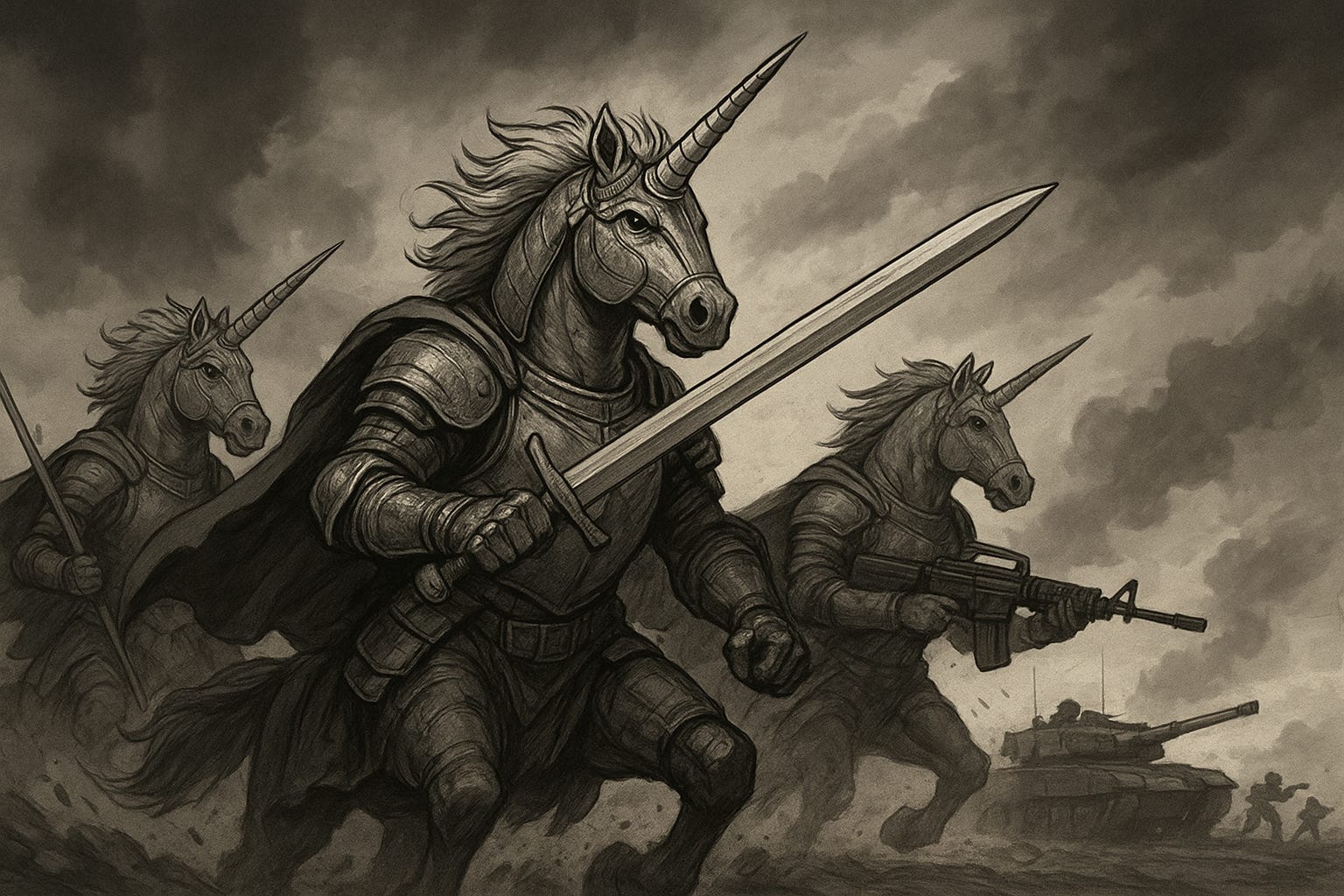
The War Unicorns
Defense Tech's Billion Dollar Beasts



The Department of War has a blessing of non-traditional unicorns charging into military innovation. These billion-dollar beasts—startups valued at $1B+—are rewriting the rules of modern warfare, blending Silicon Valley speed and tech with battlefield grit.
These disruptors are delivering autonomy, agentic AI capabilities, data mesh, and cutting-edge affordable hardware that counters many of the pacing threats. They are non-traditional by the fact that they brought private capital and novel concepts into the defense space rather than relying on government-funded RDT&E and reimbursed IR&D.
Over the last five years, venture capital firms have invested over $180B in defense tech.
We’re rounding up the herd: a comprehensive snapshot of the 22 defense tech unicorns powering tomorrow’s arsenal.
** UPDATE ** Based on feedback from our readers, we’ve added Forterra and CHAOS and removed Rebellion.
The War Unicorn Roundup
AI and Autonomy
Palantir Technologies (post-IPO): Gotham and Foundry platforms for intel fusion and targeting.
Anduril Industries: Lattice AI for border and base defense, unmanned aerial systems, and counter-UAS.
Saronic Technologies: Autonomous surface vessels for naval ops.
Shield AI: Hivemind AI for drone swarms in GPS-denied zones.
Skydio: Enterprise drones with 360° obstacle avoidance.
Applied Intuition: Autonomous vehicle simulation and testing for defense applications.
Scale: Data labeling and AI infrastructure for training defense ML models.
Govini: AI analytics for supply chain and acquisition optimization.
Vannevar Labs: Open-source intel tools for threat hunting.
Forterra: Autonomy platform for vehicles, robotic swarms, and mission systems
Directed Energy and Counter UAS
Epirus: High-power microwaves to counter drone swarms.
CHAOS: Networks for counter-drone radar and distributed sensing.
Space Launch
SpaceX: Launch services and satellite communications for military operations.
Blue Origin: Heavy-lift launch services for national security payloads.
Firefly Aerospace (post-IPO): Responsive launch services, defense tech integration.
Apex: Reusable spacecraft for rapid DoW satellite deployment.
Relativity Space: builds 3-D printed and reusable rockets for easy access to space.
Space Systems and Intelligence
Hawkeye 360: Radio frequency signal detection and geolocation satellites.
Planet (post-IPO): High-resolution imagery and AI analytics for surveillance.
Sierra Space: Satellite manufacturing and missile warning systems.
Manufacturing
Divergent Technologies: AI-driven digital manufacturing and 3D printing for aerospace and defense components.
Quantum
PsiQuantum: Photonic quantum computing systems for defense applications.
Powering the Frontlines: A Quick Capabilities Breakdown
The War Unicorns featured prominently on Silicon Valley Defense Group’s NatSec100 companies list. Three graduated this year to the Defense News Top 100 defense contractors for 2025. This included SpaceX (#40), Palantir (#70), and Anduril (#93). It’s worth noting that Peter Thiel’s Founders Fund lead investments in these three companies with Andreessen Horowitz and 8VC each investing or co-founding in two of the three.
These unicorns aren’t just raking in VC cash; they’re shipping gear that’s already in the field, from Ukraine’s drone feeds to Pacific sub hunts. Here’s a deeper dive into their major offerings to the Department of War’s toolkit.
Palantir Technologies
Palantir’s Gotham platform aggregates and analyzes vast intelligence datasets, enabling fusion of disparate sources for enhanced situational awareness and threat mapping in defense operations. The Foundry platform supports data-driven logistics and acquisition, streamlining supply chains and predictive maintenance for military hardware. TITAN systems deliver AI-enabled deep-sensing for tactical targeting, integrating space-based sensors with ground vehicles to provide real-time intelligence without cloud dependency. Maven Smart System uses AI to process video feeds and sensor data, automating threat detection and decision support for combatant commands across multiple security domains.
Anduril Industries
Anduril’s Lattice platform integrates sensors, AI, and unmanned systems into a unified command network, enabling real-time threat detection and autonomous responses leveraging advanced mission autonomy functionality. Their unmanned aerial systems (UAS) like Ghost and Bolt provide persistent surveillance and rapid intercept capabilities, allowing troops to engage threats at standoff distances without risking personnel. A suite of AUVs are tailor-made for littoral and deep-water survey, inspection & ISR, applicable to a wide range of defense and commercial mission sets. Their counter-UAS solutions fuse radar, optics, electronic warfare and effectors (such as Roadrunner and Anvil ) to neutralize drone swarms, protecting critical assets in contested environments. Networked command and control software leverages AI for predictive analytics, optimizing mission planning and resource allocation across multi-domain operations. Their Fury and Collaborative Combat Aircraft platforms provide advanced Group 5 UAV capability for the Air Force and other customers.
Saronic
Saronic’s six autonomous surface vessels (ASVs) from Spyglass to Marauder enhance naval operations by providing persistent maritime domain awareness, extending fleet reach in denied areas. These vessels feature adaptive path planning and passive sensor fusion, enabling target identification and tracking with minimal human oversight. Resilient multichannel communications support manned-unmanned teaming, allowing integration with existing naval assets for coordinated missions. Payload flexibility accommodates user-defined effects, from surveillance to electronic warfare, adapting to evolving concepts of operations in maritime engagements.
Shield AI
Shield AI’s Hivemind autonomy software enables drones to operate in GPS-denied environments, coordinating swarms for reconnaissance and strike missions without human intervention. Their V-BAT and X-BAT platforms provide vertical takeoff and landing capabilities, supporting long-endurance surveillance and tactical insertions in contested areas. Mission Autonomy features allow for resilient operations under electronic warfare, ensuring platforms adapt to jammed communications and dynamic threats. Hivemind Enterprise tools integrate AI for defense applications, offering extensible autonomy that enhances operator efficiency in high-stakes military scenarios.
Skydio
Skydio’s X10D drones deliver autonomous flight in complex environments, providing real-time intelligence for warfighters in rugged terrains like forested areas. Advanced obstacle avoidance and remote operations enhance situational awareness, reducing risks during high-threat missions. Day-or-night readiness supports national security tasks, enabling faster execution of dangerous operations with minimal personnel exposure. Integration with broader defense ecosystems facilitates intelligence gathering, allowing seamless coordination in multi-domain military scenarios.
Applied Intuition
Applied Intuition’s simulation platforms test autonomous systems for defense vehicles, ensuring reliability in simulated combat scenarios. AI-driven modeling supports development of unmanned ground and air vehicles, accelerating integration into military fleets. Sensor fusion and scenario generation mimic real-world threats, optimizing performance under electronic warfare. Partnerships with DoD enhance training and validation for next-gen autonomy in operations.
Scale
Scale provides data infrastructure for training defense machine learning models, ensuring high-quality datasets for AI applications in autonomy and image analysis. Thunderforge initiative automates military planning, assisting in drafting operations and simulating courses of action with AI-driven insights. Testing and evaluation frameworks for large language models support secure deployment, measuring performance in classified environments for mission-critical tasks. Partnerships with DoD enable AI agents for decision-making, modeling, and workflows, starting with combatant commands to modernize operations.
Govini
Govini’s Ark platform transforms defense acquisition with AI-driven analytics, centralizing data for rapid decision-making across supply chains and modernization. It addresses challenges in sustainment and logistics, optimizing resources for military readiness. Integration of commercial and government data enables sophisticated applications, enhancing efficiency in production and science. Reliance by all military branches underscores its role in accelerating strategic advantages through software.
Vannevar Labs
Vannevar’s Sense capability creates a global sensing grid with digital and physical collection, providing comprehensive awareness for competition missions via Digital Intelligence and Passive RF Sensing. Decide employs AI to turn data into insights, aiding operational planning through Campaign Support and RF Anomaly Detection. Act enables non-kinetic effects for strategic outcomes, supported by dedicated tools in that domain. Deployed across numerous DoD missions, it processes vast data from worldwide sources in multiple languages.
Forterra
Forterra’s AutoDrive and TerraLink create a scalable autonomy ecosystem for ground vehicles and robotic swarms, enhancing mobility and survivability in contested environments via modular hardware and AI navigation. OASIS is the interoperable OS for DoD autonomy, enabling seamless platform integration and mission command through edge computing and sensor fusion. MeshNet (goTenna-powered) provides resilient, off-grid comms for coordinated effects in GPS-denied zones, from logistics to assault. It processes real-time sensor data in harsh conditions worldwide.
Epirus
Epirus’s Leonidas high-power microwave systems deliver directed energy for countering drone swarms, integrating AI for precise threat neutralization across domains. Layered Short-Range Air Defense combines fixed HPM with sensors for comprehensive protection against UAS incursions. Maneuver Short-Range Defense offers mobile electronic warfare on vessels and vehicles, enhancing convoy security and vessel interdiction. Long-Range HPM and Compact EW capabilities provide testing and portable solutions for de-mining and special operations in demanding environments.
CHAOS
Chaos Industries’ Coherent Distributed Networks deliver synchronized, software-defined radar arrays for distributed sensing, detecting airborne threats up to 10 minutes faster than legacy systems. Omniscient Defense Platforms fuse multi-domain sensors into resilient networks for predictive awareness against drone swarms. Integrated Counter-UAS Solutions combine radar with high-power microwave effectors for rapid, non-kinetic drone interdiction on fixed or mobile platforms. Advanced Synchronization Technologies from the Ziva acquisition enable precise wireless timing for coordinated effects in GPS-denied environments.
SpaceX
SpaceX offers reliable launch services for national security payloads using Falcon 9 and Falcon Heavy rockets, deploying satellites for communications, intelligence, and missile defense. The Starshield network provides customized satellite communications, end-to-end services, and resilient terminals for DoD operations. SpaceX demonstrates point-to-point space transportation for rapid global delivery of military cargo and aid via heavy rockets. Contracts with the Pentagon support proliferated low Earth orbit constellations and responsive missions for enhanced military resilience.
Blue Origin
Blue Origin provides heavy-lift launch services for national security payloads, utilizing the New Glenn rocket to deploy military satellites into orbit under multi-billion-dollar contracts. The company develops nuclear thermal propulsion systems for rapid maneuvers in cislunar space, enhancing DoD operations beyond Earth’s atmosphere. Blue Origin supports space vehicle processing and integration, ensuring reliable access for missile warning and secure communications missions. Their awards facilitate critical capabilities like satellite deployment for intelligence and defense sectors across multiple launch sites.
Firefly Aerospace
Firefly Aerospace delivers responsive launch services for tactically responsive space missions, enabling rapid satellite deployment for the Space Force with Alpha rockets. Through the acquisition of SciTec, it provides missile warning, tracking, and defense technologies, including intelligence, surveillance, reconnaissance, and hypersonic test support. Firefly’s partnerships with Lockheed Martin facilitate multiple launches for defense applications, expanding on-orbit capabilities. The company integrates AI-enabled systems for autonomous command and control, bolstering national security operations across domains.
Apex
Apex’s Aries, Nova, and Comet satellite platforms support proliferated constellations for defense, offering scalable payload capacities across orbits. High-rate manufacturing at Factory One enables rapid production of over 200 buses annually, accelerating responsive space deployments. Proprietary systems like Octopus streamline assembly, ensuring mission-specific adaptations for security needs. End-to-end services from analysis to on-orbit commissioning facilitate quick integration for military satellite operations.
Relativity Space
Relativity Space’s Terran R rocket enables responsive medium-to-heavy lift launches for national security payloads, leveraging fully 3D-printed structures and AI-driven manufacturing to accelerate production cycles from months to weeks. The Aeon R engine family provides high-thrust, reusable propulsion with rapid iteration via in-house additive techniques, supporting dedicated DoD missions and proliferated LEO constellation replenishment. Automated Factory One integrates machine learning for real-time quality control and design optimization, ensuring mission-assured hardware for missile defense and ISR satellites. Contracts with the Space Force and NRO facilitate tactically responsive space access, reducing dependency on legacy providers while enabling surge capacity in contested orbital regimes.
Hawkeye 360
Hawkeye 360’s satellite constellation detects, characterizes, and geolocates radio frequency signals, delivering geospatial intelligence for defense and intelligence missions. The company supports missile warning, space domain awareness, and GNSS interference detection through AI-driven analytics and data processing. Contracts with AFRL provide embedded support, data collection, and tools for operational exercises like Rim of the Pacific. Hawkeye 360 enhances maritime domain awareness and threat hunting, offering training and insights to U.S. government agencies for integrated workflows.
Planet
Planet Labs supplies high-resolution satellite imagery and AI-enhanced analytics for persistent surveillance, supporting NATO’s indications, warnings, and maritime domain awareness. The company’s platforms monitor military infrastructure, detect movements, and assess threats for defense agencies like NGA and DIU. Multi-year contracts with the German government enable broad area monitoring over Europe, aiding geopolitical intelligence. Expansions with the U.S. Navy and Indo-Pacific Command provide real-time maritime awareness and hybrid space architectures for national security.
Sierra Space
Sierra Space manufactures proliferated satellite constellations for missile warning and tracking, supporting the Space Development Agency’s Tranche 2 architecture. The company provides solar arrays and power systems for defense satellites, ensuring sustained operations in orbit. Sierra Space develops on-orbit servicing platforms like Eclipse and mobility solutions like Spectre for military logistics. Their AI operating system, Sierra Black OS, optimizes command, control, and data processing for national security space missions.
Divergent
Divergent Technologies’ Divergent Adaptive Production System (DAPS) enables end-to-end digital manufacturing of complex structural components, slashing production times and costs for military aircraft and missile systems through AI-optimized design and additive processes. The company supports rapid prototyping and scaling for defense primes like Lockheed Martin and Raytheon, delivering lightweight, high-strength parts that enhance performance in hypersonic and unmanned platforms. Selected for the Air Force’s $46 billion EWAAC initiative, Divergent accelerates agile acquisition by integrating software-defined factories for on-demand production of critical warfighter components. Collaborations with RTX for naval systems redesign leverage DAPS to reengineer legacy hardware, improving sustainment and adaptability in contested maritime environments.
PsiQuantum
PsiQuantum advances photonic quantum computing with fault-tolerant systems, focusing on utility-scale applications for defense simulations and algorithms. The company integrates optical phase shifters and quantum chips for comparative circuits under AFRL contracts, enhancing computational capabilities. Collaborations with Lockheed Martin develop quantum solutions for aerospace modeling, improving material and system performance. PsiQuantum’s DARPA US2QC participation explores innovative quantum approaches to accelerate military decision-making and threat analysis.
This elite cadre of War Unicorns is poised to redefine modern warfare, but the battlefield of innovation extends far beyond. Numerous billion-dollar tech giants serve the Department of War as a footnote in their revenue, while a wave of rising defense startups stands on the cusp of unicorn status. As the Defense Acquisition Transformation forges a bold new Arsenal of Freedom, the next breakthroughs—from AI-driven autonomy to quantum-secure networks—promise to reshape global security. Stay locked in; the future of defense is just getting started.
Join over 11,000 subscribers to get our weekly recaps and thought pieces. Paid subscribers also get budget and legislative analysis and are valued supporters of our work.
A minor nitpick: "Launch" is typically a very different subsector than platform manufacturers like Apex. E.g., they build and sell satellite buses but not rockets.