
Trillion Five Topline
Deterrence is Cheaper Than Defeat- Why $1.5T Makes Fiscal and Strategic Sense


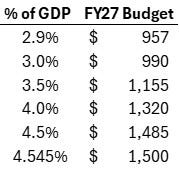
The President opened FY27 budget negotiations with a proposed $1.5T defense topline to build the Dream Military. HASC Chairman Mike Rogers and SASC Chairman Sen Roger Wicker are working to secure $450B in an upcoming reconciliation bill. AEI experts push for $600B in reconciliation to finance the full ask. Are these bold opening bids for negotiations ahead of midterms, or a necessary reset for U.S. defense spending amid peer threats?
Let’s look at the numbers in context.

Percentage of GDP
Defense spending, as a share of GDP, has fallen sharply since the 1960s Vietnam peak, the Reagan buildup, and post-9/11 surge. We’ve been around 3% in recent years.
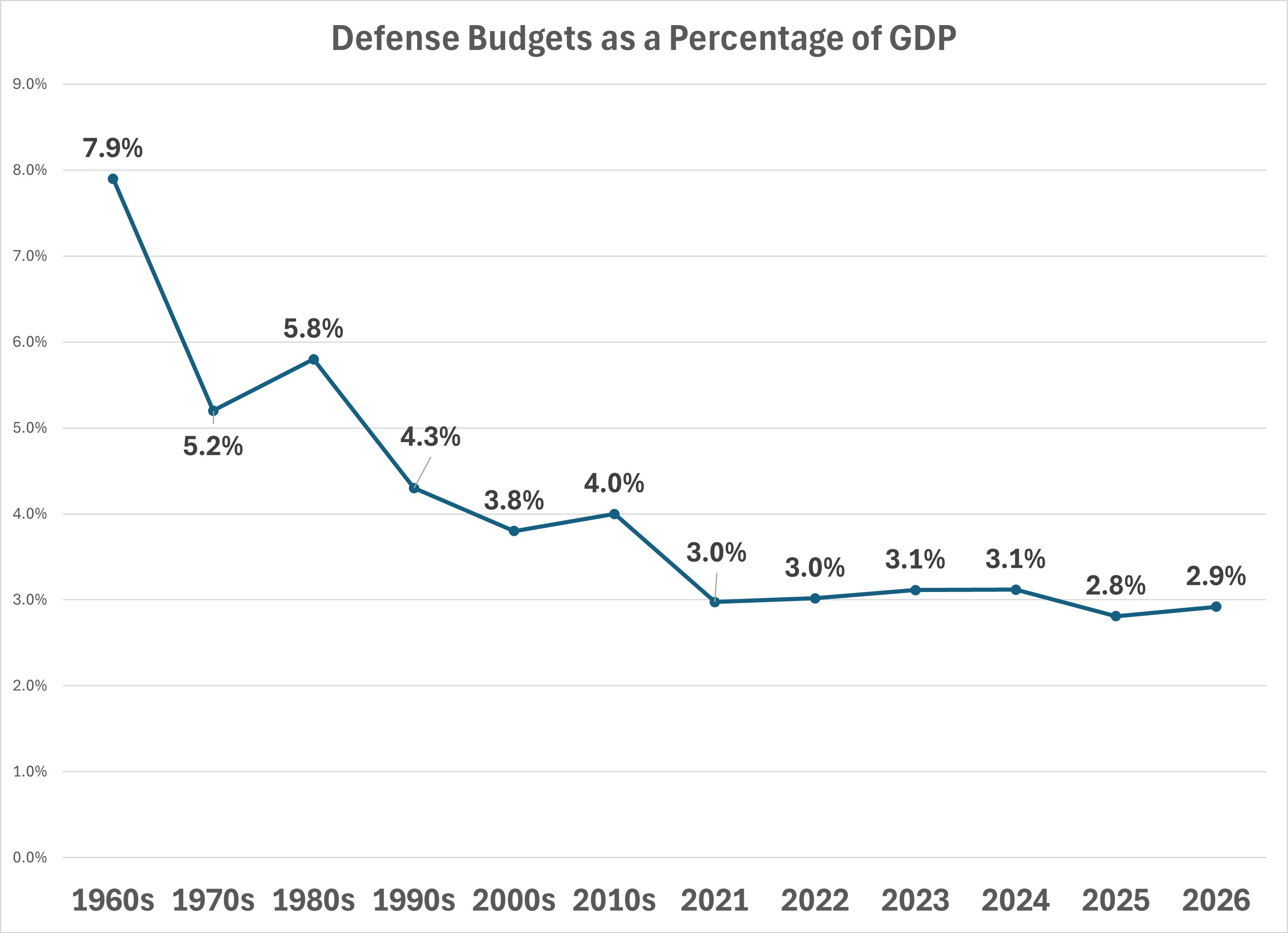
With a formidable peer adversary in China, a renewed focus on the Western Hemisphere, a land war in Europe that expended countless munitions, and we’re still rebuilding our military after two decades of wars in the Middle East, there are no shortages of budget demands. Add to this the need to reindustrialize and rebuild our defense industrial base along with re-shore and secure our fragile supply chains.
A majority of DoW aircraft and ships were designed and produced last century.
GDP estimates for 2027 hover around $33T. A $1.5T defense budget would be 4.5% of GDP. This aligns with Cold War-era norms, yet far below Vietnam/Reagan peaks, but a prudent step up from today’s ~3%.
Percentage of Federal Spending
Defense has declined sharply as a share of total federal outlays since the 1960s.
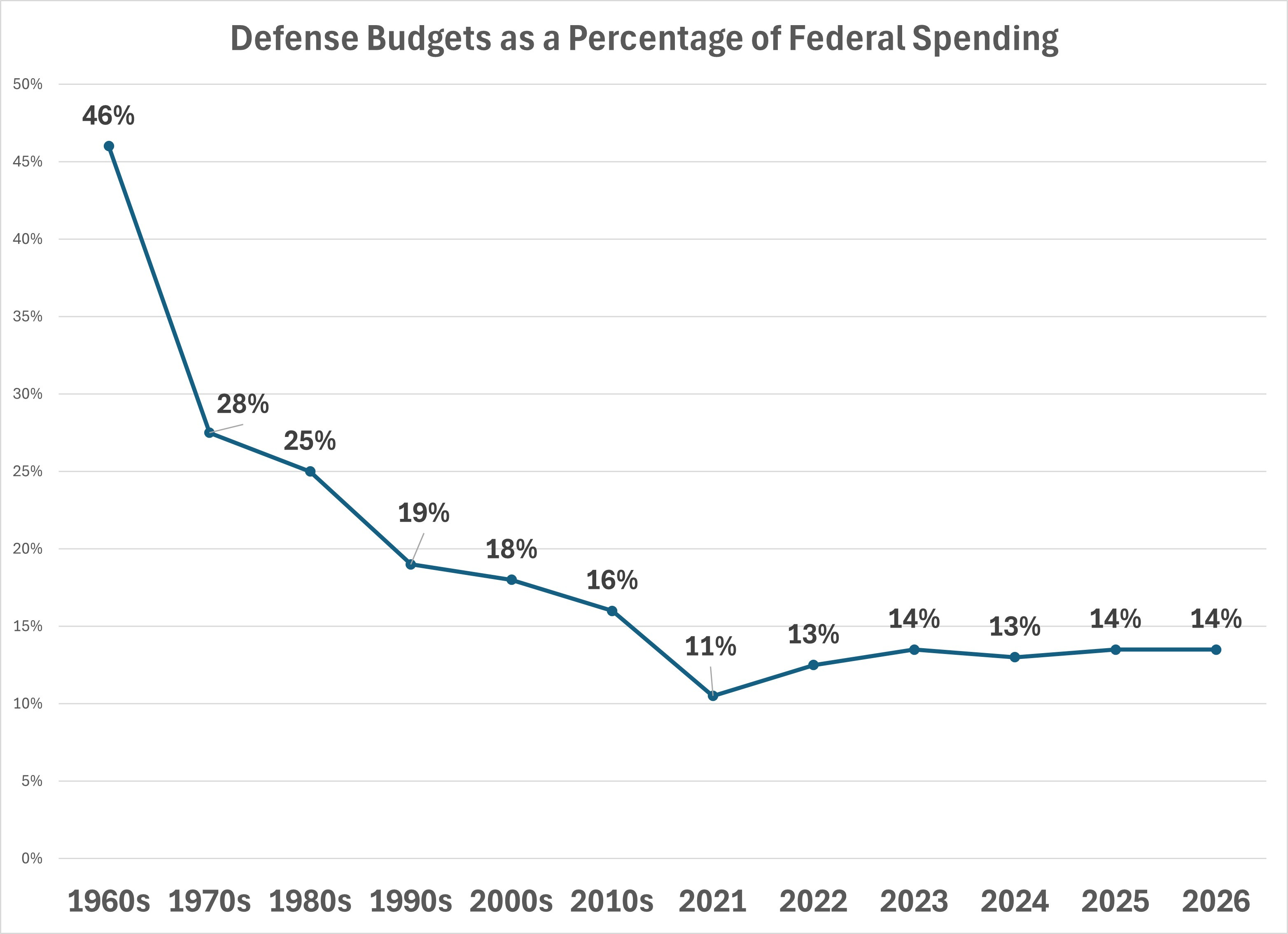
CBO projects ~$7.8T in FY27 (which may vary). A $1.5T defense budget would be 19% — on par with the post-Cold War defense budgets of the 1990s.
Last year’s reconciliation bill (OBBB) provided $150B for mandatory defense spending. Scaling up via another reconciliation would fuel American production of new warfighting capabilities for our Combatant Commanders to include:
Golden Fleet - a boatload of new ships!
Scaling munitions production including hypersonic weapons
Columbia and Virginia class subs
Unmanned Systems - Air, surface, undersea, and ground.
Space capabilities
F-47, F/A-XX, F-35s, and B-21s.
Counter-C5ISRT capabilities
Contested logistics
Pay raises to recruit and retain top talent.
That's not a wish list — that's a prioritized modernization queue that has been deferred for years.
A $500B increase must be managed with discipline and strategic focus. This cannot devolve into a free-for-all where every half baked idea gets funded. Instead rigorous prioritization is essential. Scale production of proven, high-impact capabilities, aggressively acquire mature commercial solutions, and accelerate transition of the most promising defense tech into production and operations. Funding capabilities that solve priority Joint Operational Problems and optimize resilient kill webs will strengthen the Joint Force lethality.
Execution requires a skilled acquisition and contracting workforce along with the industrial capacity that doesn't currently exist at the scale needed. Both have to be built in parallel with the funding.
This expanded budget must be paired with reformed acquisition and contracting approaches that attract and deploy private capital at scale. Key opportunities include modernizing and expanding shipbuilding capacity, surging munitions and critical component production, re-shoring essential minerals and supply chains vulnerable to disruption. Multi-year commitments, performance-based incentives, and reduced bureaucratic hurdles give industry the demand signal to invest. By leveraging private sector innovation and capital—rather than relying solely on government funding—we can rebuild industrial depth, achieve economies of scale, and deliver warfighting capabilities faster and more affordably.
The $1.5 trillion defense budget represents not extravagance, but profound fiscal prudence in an era of rising peer threats. The human and economic toll of actual war—especially defeat or prolonged escalation—dwarfs any upfront investment in readiness and lethality. Deterrence through overwhelming strength is the ultimate bargain: it prevents conflict altogether, preserving American lives, prosperity, and global leadership far more effectively than reacting after aggression begins.
Consider the Alternative
Analysis of potential U.S.-China conflict scenarios project catastrophic outcomes. Global GDP could plummet by up to $10T in the first year alone. Global economies would contract amid trade disruptions, energy shortages, and supply chains collapsing. The impact of Communist China assuming control over Taiwan’s chip industry would be catastrophic for every American. The cost of deterrence failure isn't measured in budget lines — it's measured in military and civilian casualties, economic devastation, and strategic position that takes decades to recover.
This $1.5T strategic investment is the cheapest insurance policy available.
Join over 13,000 defense and industry subscribers to get our weekly recaps and thought pieces. Paid subscribers also get budget and legislative analysis and are valued supporters of our work.