
To The Moon!
Humans and Defense Budgets Soaring to New Heights


Welcome to the latest edition of Defense Tech and Acquisition.
NASA Launches Artemis II to Go Further than any Human Ever!
The FY27 Budget Topline and Initial Defense Docs are Released.
SpaceX IPO Will Be Massive; Marine Corps Wants a Marketplace
Progress on Ramping Up Legacy Missile Lines, Testing Hypersonics
Saronic Has New Fundraising Round; Attack Sub Commissioned
Army’s Gen George Departs, PIT Moving Faster, Doctrine Evolving
Sentinel Advances Construction and AF Futures is Formalized
Space Force Wants its Own Test Centers and Might Cancel OCX
More Communication Could Help Improve Golden Dome PR
Japan Deploys Long-Range Missile; Ukraine’s Defense Industry Soars

Artemis II is Bound for the Moon!

Congrats to NASA and the Artemis team for a successful launch to circle the moon.
The launch is the beginning of a 10-day mission for NASA astronauts Reid Wiseman (Naval Aviator), Victor Glover (Naval Aviator), Christina Koch, and Canadian Space Agency astronaut Jeremy Hansen.
During a planned multi-hour lunar flyby on Monday, April 6, the astronauts will take photographs and provide observations of the Moon’s surface as the first people to lay eyes on some areas of the far side.
Since the Apollo 17 mission in Dec 1972, humans have only operated in Low Earth Orbit, roughly 250 miles. These astronauts have already gone farther than an human in the last 53+ years and hope to break the distance record set by the Apollo 13 crew.

Godspeed Artemis II.
FY27 US Government Budget Release

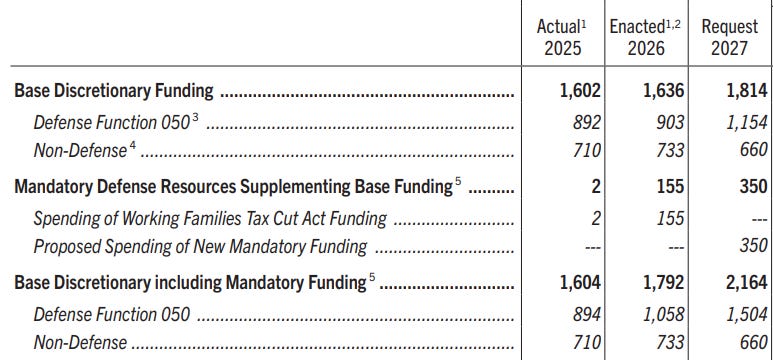
The Budget builds upon the historic $1T overall Defense topline for 2026 and requests $1.5T in total budgetary resources for 2027.
This is a $445B or 42% increase from the 2026 total resource level.
The Budget includes $1.1T in base discretionary budget authority for DOW.
The Budget also includes a request for $350B in additional mandatory resources through reconciliation for critical Administration priorities such as increasing access to critical munitions and further expansion of the defense industrial base.
The mandatory funding protects key priorities such as providing flexibility in maturing technology for delivery and allowing for acquisition approaches for portfolios of capabilities that broaden opportunities for new entrants.
Golden Dome: Development of space-based missile defense sensors and interceptors, kinetic and non-kinetic missile defeat and defense capabilities and enabling technologies for a layered, next-generation missile defense system.
Pay Raise: 7% for E-5 and below, 6% for E-6 to O-3, 5% for O-4 and above.
Key Sections
Space. Space investments encompass efforts in support of the Golden Dome for America, America’s launch infrastructure, and classified programs.
Restoring America’s Maritime Dominance. This builds upon the successes of WFTC to recapitalize the entirety of the Government feet and would ensure the maritime industrial base strengthens its ability to construct ships quickly
Shipbuilding. The Budget requests $65.8 billion in shipbuilding funding to procure 18 battle force ships and 16 non-battle force ships.
Critical Munitions. One of DOW’s highest funding priorities in the 2027 Budget is to rapidly procure 12 critical munitions.
Critical Minerals. Expands DOW’s investments in critical minerals and domestic critical mineral supply chains.
Keeping Warfighters in the Fight. The budget protects and prioritizes critical resources required to sustain warfighter health and medical readiness.
F-47. Continues to prioritize the rapid development and production of the F-47, and would achieve a first fight in 2028.
Homeland Security Border Initiative. Increases funding for the defense of the U.S. by enabling DOW to fulfill border-related operational requirements in the National Defense Areas and along the U.S. southern border,
DoW Nuclear Enterprise. Includes modernization and diversification of nuclear forces and recapitalization of NC3 capabilities.
Unmanned and Counter-Unmanned Systems. Arm America’s military’s combat units with drones while also providing protection against the proliferation of inexpensive and proliferated unmanned systems by near-peer competitors, rogue states, and non-state actors.
Program Reforms
Realigns and reforms to increase effectiveness, efficiency, and lethality.
Restoring Force lethality by protecting Warfighter health funding
Wasteful spending and reforms
Golden Dome, Out-Years and Lots of Missiles: Details of Trump’s $1.5T Defense Budget Request
BLUF: The FY27 budget details show the Department of the Navy getting the largest share at $150B, the Space Force seeing a 77% increase, massive munitions procurement growth, and Golden Dome funded at $17.5B (mostly from reconciliation).
Base budget defense spending hits $1T for the first time. OMB projects the topline could drop to $1.28T in FY28 without additional reconciliation, rising only to $1.35T by FY31.
Service shares: Navy/Marine Corps $150B ($126B base + $24B reconciliation), Air Force $101.2B ($83.4B + $17.6B), Army $60.5B ($36B + $24B).
Pentagon plans to grow active-duty forces by ~21,000, from 1.32M to 1.34M.
Navy requests $65.8B for shipbuilding (~$60.2B base + $5.6B reconciliation), up from $27.2B enacted in FY26. Aircraft procurement at $34.4B, weapons procurement at $22.6B.
Space Force topline: $71.2B, a 77% increase from FY26. RDT&E doubles, with Space-Based Moving Target Indicator at $1B+. Personnel grows from 10,657 to 13,200.
Air Force R&D request: $74.2B. F-47 gets ~$5B (up ~$1.5B). Sentinel dips ~$300M to $4.5B. Air Force missile procurement jumps from $6.3B to $11.4B. CCA drone wingmen procurement starts at ~$1B. HACM procurement at $403M may signal a move into production.
Army missile procurement jumps from $7B to $37B, mostly for PrSM seekers, THAAD, HIMARS, PAC-3 MSE, and Typhon. Manned aviation takes cuts: Apache procurement drops from $361.7M to $1.5M, Black Hawk from $913M to $39.3M. XM30 MICV gets $546.9M for 19 vehicles.
Golden Dome gets $17.5B but only $400M in base budget; the rest depends on reconciliation.
Cyber Command requests ~$2.1B across O&M, procurement, and RDT&E.
FY27 Defense Budget Materials
We’ll do a more comprehensive budget post soon.
Mobilizing Private Capital for Defense: Tactics and Recommendations
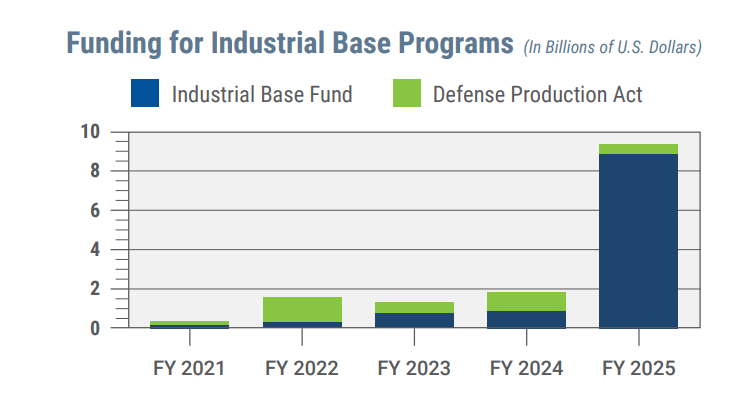
BLUF: America’s capital markets are the largest and most sophisticated in the world, a major force driving the development of new technologies and the expansion of U.S. industrial capacity. For the DIB and dual-use sectors, private capital is a critical source of financing and investment; available indicators suggest roughly $440B in private capital activity from 2020 to 2024. With the appropriate combination of policy and process changes, the DoD could engage even more investment, bringing more resources to bear on DoD priorities
Private capital flows into the defense sector are large and diverse
The DoD has a rich existing toolkit to build upon
The business environment matters just as much as the budget
Recommendations
Portfolio Acquisition Executives (PAEs) Communicate Stronger Demand Signals
DoD Comptroller Consolidate Guidelines on Use of O&M Funds
Congress Expand the Use of Multi-Year Procurement
DPCAP Incorporate Commercial Demand Aggregation into Acquisitions Process
Congress to Increase Budget Flexibility to Expand Total Addressable Markets
PAE Pilot Sharing CUI and Classified Information with Investor Community as Part of Demand Signaling

"Now in our 5th week of the campaign, it is my operational assessment that we are making undeniable progress. We don't see their navy sailing. We don't see their aircraft flying, and their air and missile defense systems have largely been destroyed." - ADM Brad Cooper, CENTCOM Commander
"In every military option, we could not and cannot do our jobs without the men and women across our country who show up every day, around the clock, to a factory floor, a workshop, a laboratory, who build the weapons and capabilities we need to project American combat power at the time and place of our choosing. We carry the weapons that you build. We rely on the systems that you create, and the distance from that factory floor and that assembly line, to the front line, is incredibly short. Thank you — keep it up!" - Chairman Gen. Dan Caine thanks the Americans who work our national assembly lines.
Epic Fury Map
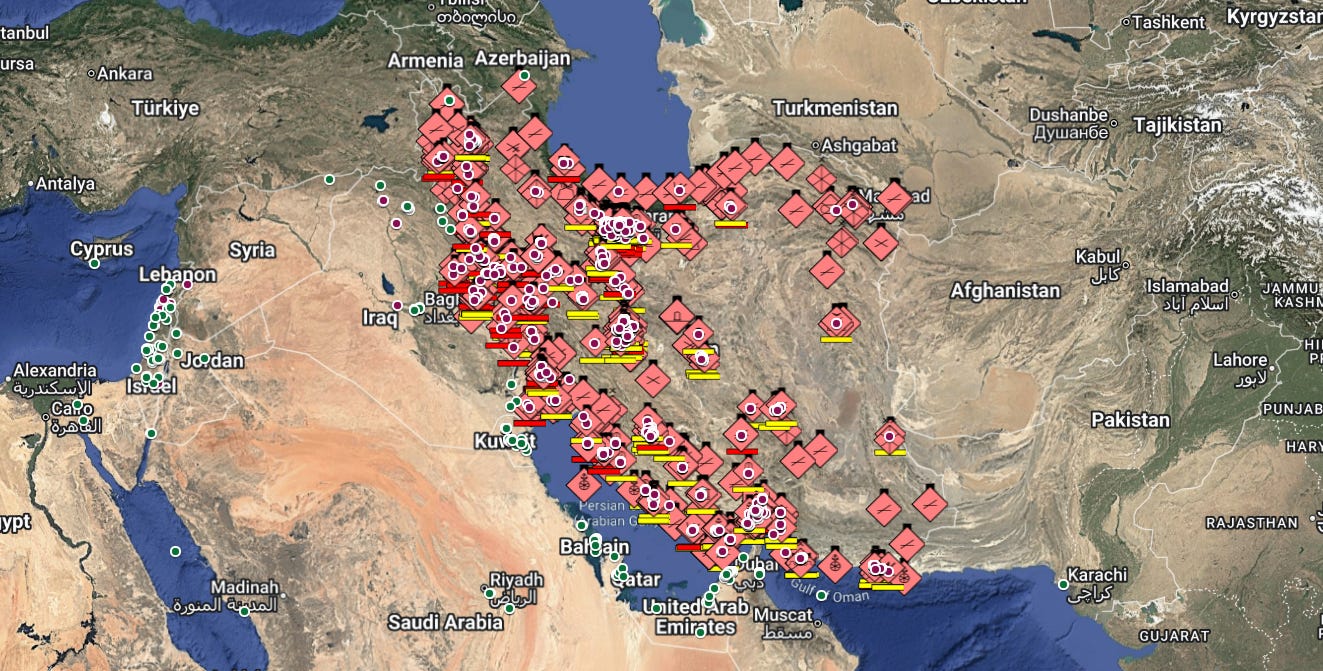
See the Google Map and X Account for Operation Epic Fury with OSINT on attacks.
The US Is Playing a Game of Risk with Real Bullets

BLUF: The Iranian conflict is like playing a live, global game of Risk with real forces, real supply chains, and active shooting wars on the all-important Eurasian landmass. This is no longer a proxy fight or a twilight war. It is a regional war between Iran and a U.S.–Israeli coalition. And it has made the strategic map look exactly like a Risk board.
From Washington's perspective, the strategic objective is to break Iran's ability to threaten the region through missiles, nuclear development, and proxy warfare.
The second fight on the board is taking place in Ukraine, and it is far from over.
The war continues to grind down Russia's conventional military capacity, driving enormous equipment losses, catastrophic manpower costs, and diminishing Moscow's ability to project power elsewhere.
Checkbooks are finally open as Europe talks about stepping up to defend itself. Germany has launched a massive rearmament effort.
Latin America disappeared from U.S. strategic thinking over the past two decades.
The Panama Canal remains a critical logistics chokepoint on the planet.
Argentina is emerging as a key democratic and economic partner with major energy and mineral resources.
Venezuela is no longer aligned with America's adversaries, and Cuba's realignment is next on the agenda.
If the Iranian regime collapses or loses its ability to project power across the Middle East, the geopolitical map of the region could change overnight.
If the war drags on, however, the opposite risk emerges: economic disruption, global energy shocks, and a prolonged conflict that drains American resources while China watches carefully from the sidelines.
A-10 in War
While championing retiring legacy systems, we still have the A-10 in our hearts. The Air Force has long fought with Congress to retire the aircraft, it once again proves a vital capability for the Joint Force. In rapid acquisition discussions, we’ve often hypothesized that if the Air Force felt the need for a “new A-10”, that has the same core capabilities on a modern platform without gold plating it like many exquisite platforms, it would still take 10+ years from Idea to FOC under normal acquisition processes. Yet we should be able to design, develop, and mass produce a new A-10 in only a few years to address these mission sets that never seems to go away.
Here’s a very interesting video of the A-10 in action in Operation Epic Fury.
Related: A-10 Fleet in Middle East Poised to Double as Jets Cross the Atlantic
US Intel Assesses Iran Maintains Significant Missile Launching Capability
Roughly half of Iran’s missile launchers are still intact and thousands of one-way attack drones remain in Iran’s arsenal according to recent US intelligence assessments.
The US intelligence assessment total may include launchers that are currently inaccessible, such as those buried underground by strikes but not destroyed.
Thousands of Iranian drones still exist with roughly 50% of the country’s drone capabilities in operation. The intelligence, compiled in recent days, also showed a large percentage of Iran’s coastal defense cruise missiles were intact.
Consistent with the US not focusing its air campaign on coastal military assets, those missiles serve as a key capability allowing Iran to threaten shipping traffic in the Strait of Hormuz.
Israeli military officials put the total number of operational Iranian launchers at a lower number, roughly 20-25% although they do not include launchers that have been buried or made inaccessible in caves and tunnels in their count.
“They are still very much poised to wreak absolute havoc throughout the entire region.” Intelligence Source
The U.S. Military Assets Damaged or Lost in the Iran War
Billions of dollars of highly sophisticated military equipment has been lost or significantly damaged since the U.S. and Israel began striking thousands of targets across Iran more than three weeks ago.
The bulk of the damage on the ground has been caused by Iranian ballistic missiles and drones.
Battle damage and replacement of losses over the first three weeks of the war likely costs roughly $1.4B to $2.9B, according to Elaine McCusker.
The higher estimate includes damage to a Qatari radar housed on a U.S. air base in the country.
Assets include:
F-15E (4)
F-35 (1)
KC-135 (6)
MQ-9 (12+)
AN/TPY-2 Radar (1)
AN/FPS-132 Radar (1)

Saronic Raises $1.75B in Race to Modernize U.S. Military
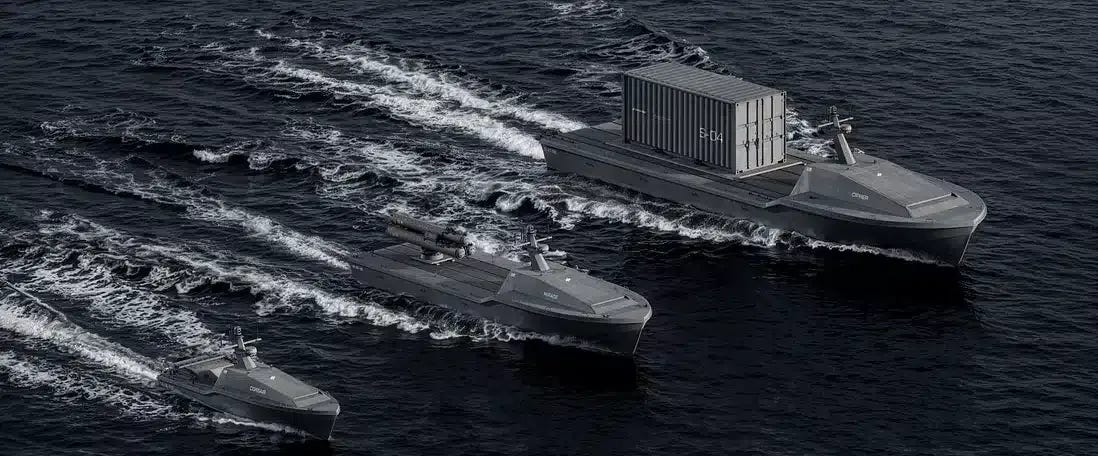
Autonomous ship maker Saronic raised $1.75B and more than doubled its valuation to $9.25B. The round is led by Kleiner Perkins.
The company is working closely with the Navy and aims to build more than 20 ships a year by 2027.
The U.S. government is leaning on innovative defense tech solutions as it fights low-cost drones in Iran and seeks to modernize the military.
Saronic’s main shipyard in Franklin, LA, is currently undergoing a $300M expansion. It is on pace to quintuple production there over the next 12 months.
“We’re seeing a real shift in demand towards unmanned systems that can be delivered at scale and at a fraction of the price point of traditional vessels,” Dino Mavrookas, Saronic CEO
Related: Saronic Raises $1.75B Series D
Solving Yesterday’s Problems Will Kill You
BLUF: The PAE reform consolidates requirements, contracting, testing, and sustainment under a single portfolio leader. These are the middle phases of the innovation cycle, and they are getting real investment and real attention. But what’s missing is where the inputs to requirements will come from.
Each PAE needs four things the current organization reforms don’t provide:
Forward-deployed Problem Discovery Teams in the Combatant Commands
Fusion Cells – collect data from the field, industry and labs and rapidly do due diligence.
Rapid operational assessment is built into the cycle.
Lateral distribution at operational speed.
The Innovation Targeting Cycle phases run continuously by a fusion cell, each rotation generating the input for the next.
Phases include: Detect, Define, Develop, Deploy, Assess, Distribute.
A solution fielded in weeks, assessed against reality in the field, with rapid dissemination of findings across the force.
An Innovation Targeting Cycle would provide the front end that connects the reality of the warfighter’s at the tip of the spear to the PAEs.
Swarm Forge Prototype Project
BLUF: CDAO, in partnership with USSOCOM, ARSOC, DIU, and the US National Drone Association is calling on industry to shape the future of warfare.
Bring your technology into Swarm Forge.
Put it in the hands of operators.
And run it in an adversarial environment.
It’s a critical initiative to rapidly integrate autonomous, AI-enabled drone swarm technologies into our military units.
This Pacesetting Project is the first in DoW’s AI Strategy and is designed to increase the lethality, maneuverability, and connectivity of the warfighter through human-machine teaming.
The solicitation is open on Tradewinds until April 17, 2026.
Successful submissions will be invited to the first Swarm Forge Crucible in June.
Old-School Spycraft Could Make a Comeback as AI Undermines Trust
An article in the CIA’s Studies in Intelligence journal argues that artificial intelligence may erode confidence in certain electronic communications and further revive centuries-old human intelligence techniques.
AI is widely expected to revolutionize intelligence gathering, enabling faster, cheaper and more scalable collection of information but a new analysis suggests the technology may also spur a return to some of espionage’s oldest methods.
As AI degrades the reliability of digital communications like text messages and video calls, traditional human intelligence tradecraft like dead drops, brush passes and in-person meetings could regain renewed importance.
AI is already being used to generate convincing deepfakes and fabricate messages which introduces a new source of “noise” into digital communications, making it harder to distinguish between authentic and synthetic signals.
Pentagon-Backed X-65 Jet with 537 mph Top Speed Moves Closer to First Flight
BLUF: Aurora Flight Sciences (Boeing subsidiary) has moved the X-65 fuselage to Virginia for final systems integration, with first flight planned for 2027.
The X-65 is built under DARPA’s Control of Revolutionary Aircraft with Novel Effectors (CRANE) program to prove aircraft can be controlled without traditional moving surfaces like flaps and rudders.
Instead, the aircraft uses pressurized air distributed through 14 embedded effectors to manage pitch, roll, and yaw, potentially reducing weight and simplifying maintenance.
The aircraft has a wingspan of about 30 feet, gross weight of ~7,000 pounds, and a top speed of 537 mph. It is a purpose-built demonstrator, not designed for operational use.
Engineers are now installing electrical, propulsion, and active flow control systems in the fuselage. Wing and tail structures continue production in Bridgeport, West Virginia.
Aurora and DARPA reached a co-investment agreement in August 2025 to complete the aircraft and move toward flight.
DARPA Lift Challenge
BLUF: The DARPA Lift Challenge aims to shatter the heavy lift bottleneck, seeking novel drone designs that can carry payloads more than four times their weight, which would revolutionize the way we use drones across all sectors.
By offering $6.5M in prize money, the Lift Challenge seeks to incentivize university researchers, independent innovators and industry to set a new standard in vertical lift performance.
See other DARPA Challenges.
The Iran war is Defense Tech’s Chance to Shine, But Few Systems and Weapons are Ready
BLUF: The war in Iran is forcing the U.S. government to consider integrating newer tech tools from defense startups into its battlefield strategy.
Several defense tech startups have seen demand skyrocket since the U.S. first struck Iran and many customers have offered to buy out capacity or asked firms to ramp production.
Two days into the war, the U.S. used up a reported $5.6B in munitions.
This is the moment defense tech and Silicon Valley have been waiting for.
Despite their real-world applications, key defense tech tools accounted for only $4.7B of the FY26 budget (data from Obviant)
Major defense tech winners so far include Anduril and Palantir who recently signed multibillion-dollar-ceiling contracts with the Pentagon.
Palantir’s tools are already deeply ingrained in the DOD, and the U.S. and its Middle East allies are actively using the company’s Maven platform.
The sector has seen a surge in popularity in Silicon Valley, with deal value nearly doubling to $49.9B last year from $27.3B in 2024, according to Pitchbook data.
Despite that excitement, spending on the defense tech sector accounted for <1% of contract dollars in 2025, according to data from the Ronald Reagan Presidential Foundation and Institute.
Anduril, Palantir and Elon Musk’s SpaceX account for 88% of that.
“The world is more dangerous. Technologies that were on the drawing board a decade ago have now proven themselves on the battlefield.” Mike Brown, partner at Shield Capital.
“LUCAS is one of the only major new systems emerging in the Iran war, but production is modest. Most U.S. air capabilities in Iran have been with traditional fighter jets and bombers.” Tara Murphy Dougherty, Govini CEO
Darkhive Secures $49.7M APFIT Contract

BLUF: Darkhive’s $49.7M contract—the program’s “highest single award to date”—was just under APFIT’s $50M maximum statutory cap, “demonstrating both the depth of operational need and APFIT’s ability to efficiently transition and scale mature technologies,”
Darkhive is a tactical autonomy and edge software company built around small UAS. Prior to the APFIT award, the company had won over $14M in SBIR contracts and raised a combined $25M in its 2023 Seed and 2024 Series A rounds.
The $49.7M APFIT award is designated for Real-Time C2 at the Tactical Edge, so we can assume it’s focused on the latter three software offerings.
“This award represents a significant milestone in Darkhive’s ability to provide our advanced hardware and software solutions at scale and keep pace with demand across the military services. We understand the urgency to advance compute and connectivity at the tactical edge.” John Goodson, Darkhive CEO
Applied Intuition Launches First Mobile Operations Center for Autonomous Systems: Applied Edge
BLUF: Applied Intuition launched Applied Edge, a field-deployable mobile operations center that packages rugged compute, satellite comms, and its Axion autonomy toolchain into a self-sufficient node for testing and operating autonomous systems anywhere.
Edge arrives with power, HVAC, rugged compute servers, 5G/Starlink communications, and operator workstations ready on arrival with no build-out required. Data, models, and workflows persist between test events.
Axion Sim and Mission Control run natively on Edge, enabling teams to plan missions, replay logs, evaluate behavior, coordinate multi-asset operations, and stream live telemetry from a single platform.
Supports SCIF/SAPF configurations, allowing classified programs to operate from Edge without fixed facilities.
Designed to address a core problem: government test ranges are built for hardware, not software, and add months of scheduling overhead with no persistent DevSecOps environments.
“The cycle of standing up and tearing down autonomy stacks between events is over.” - Qasar Younis, Applied Intuition, Co-founder and CEO
Integration Will Define Special Operators’ Future Success

BLUF: If SOF is going to support multiple threats across the globe and across the spectrum of conflict, then it will have to integrate with conventional forces, with new technologies and with new business processes.
The threat environment is complex, dynamic, asymmetric, technological and intense — all adjectives that play to the strengths of special operations.
Integration doesn’t just stop with other formations, it also extends to new technologies. From AI and autonomy to cyber and space, technologies are opening up entirely new avenues for SOF to accomplish the mission.
The challenge isn’t creating technologies but integrating them into SOF operations.
Integrating transformational technologies into SOF has two main hurdles.
The first is the technical challenges. Adding AI isn’t just a question of bolting AI onto an existing tool or radio, but rather requires attention being paid to the architecture of a solution. Where does the compute happen?
When faced with new technologies, humans are vulnerable to both cognitive overload and cognitive offload.
The new threat environment is also challenging old business processes. In the past, a weapon system concept to production can take decades, today it can be days. Existing bureaucracies simply cannot keep up.
Joint Interagency Task Force 401 is working closely with SOF, services and interagency partners to rapidly test, evaluate and field counter-drone solutions. A new way of working that integrates new partners and new technology.
“Don’t measure the success of a program merely on cost, schedule and performance. If there are no metrics for operational impact, you’ve lost.” Maj. Gen. Edward Vaughan, Joint Rapid Acquisition Cell (JRAC) Executive Director
AI-Powered System Lets Drones Fly Without GPS or Cameras in Complex Environments

BLUF: Drones can now navigate without GPS or cameras using a new AI framework that relies only on onboard sensors.
A research team from Prince Sultan University has developed a system called CLAK that enables unmanned aerial vehicles to estimate their position using LiDAR, barometric altitude, and inertial data.
The approach targets environments where satellite signals are weak or unavailable, such as tunnels, dense cities, forests, or conflict zones.
The CLAK model combines multiple AI techniques into a single pipeline. It uses convolutional layers to extract patterns from sensor inputs, followed by bidirectional LSTM networks to understand motion over time.
The team is now exploring ways to further optimize the model, including reducing computational load and improving adaptability across different terrains and mission types.
First Set of Defensive Cyber Kits to Be Delivered to CYBERCOM Units
BLUF: Sealing Technologies, a Parsons subsidiary, is delivering the first batch of standardized Joint Cyber Hunt Kits (JCHK) to four CYBERCOM units, the first time defensive cyber warriors have had a common kit for hunt missions.
The suitcase-sized kits allow CYBERCOM’s defensive teams to respond onsite to intrusions and conduct hunt forward missions on foreign partner networks, where remote monitoring from a security operations center isn’t possible.
The kits provide significantly more storage than prior capabilities, along with increased speed and AI capabilities for threat identification and analysis.
This is the first time CYBERCOM’s defensive teams have had a standardized kit. Previously, each service outfitted units differently, creating inefficiencies in kit, training, funding, and operations and maintenance.
A full rate production contract worth up to $500 million over three years was announced in February. Parsons will deliver 74 units this calendar year.
DIU originally ran JCHK contracting on behalf of CYBERCOM, which will now take it over.
There is interest from other DoD and broader federal customers, including CISA.
Joint Interagency Task Force 401 Enhances Counter-UAS Capability to Protect the Southern Border
BLUF: JIATF-401 is rapidly delivering counter-UAS systems to the southern border war with advanced technology, an integrated system architecture, and expanded authorities.
In just four months, more than $20M in counter-UAS technology was deployed to the border.
JIATF-401 conducted site surveys at priority sites across the southern border to identify capability gaps and deliver solutions on a rapidly accelerated timeline, integrating advanced sensing, tracking, and neutralization systems at key locations.
With the assistance of the Office of the USD(P), JIATF-401 spearheaded Pentagon efforts to expand protection from unmanned aircraft for the newly established national defense areas along the southern border.
“These efforts reflect our focus on rapidly delivering critical capability to the warfighter. From the southern border to critical infrastructure across the homeland, we are ensuring operators have the tools, training and permissions they need to detect and defeat UAS threats.” - BG Matthew Ross, Army, JIATF-401 Director
UAVs: ISR, Deterrence and War
BLUF: IISS considers developments in Europe, the Middle East and the Indo-Pacific, and reviews the roles, impact and implications of UAV use in Russia’s war of aggression in Ukraine.
ISR remains an essential element of the spectrum of capabilities required to support deterrence.
Should deterrence fail, then ISR is a critical element of combat.
Many countries are trying to reconcile the competing demands of national capacity-building with military needs. The former requires time, the latter immediacy.
The combat roles of uninhabited systems continue to expand.
A significant shift is the development of combat platforms dedicated to operating in concert with crewed combat aircraft.
One goal is to supplement limited numbers of crewed combat aircraft with a greater mass of uninhabited systems, while a second is to reduce the risk to the former.
CCA’s arrival, however, will not presage the end of the crewed combat aircraft; rather, CCAs will be a complement to at least one more generation of inhabited multi-role fighters.
Carlyle Said to Plan Defense Fund as Governments Hike Spending
BLUF: Carlyle Group is planning a dedicated defense sector fund, pitching it to investors as a vehicle for reindustrialization and expanding domestic manufacturing capacity as U.S. and European governments ramp up military spending.
The fund has not been formally marketed and no target size has been disclosed. Carlyle has begun early-stage investor outreach.
Carlyle has deep roots in defense investing dating to its 1990s partnerships led by former SECDEF Frank Carlucci. The firm recently secured exclusivity to develop a $2B data center at Fort Bliss, Texas.
Other PE firms are moving into defense: Warburg Pincus is exploring a $1.5B defense-focused fund. Shield AI recently secured $2B with Advent International leading and Blackstone contributing $500M.
The U.S. Army and Treasury met with Apollo, Carlyle, Cerberus, and KKR to pitch a $150B infrastructure modernization program.
All 32 NATO members have pledged to increase defense spending to 5% of GDP by 2035.

SpaceX Quietly Files for Big Bang IPO
BLUF: SpaceX has confidentially filed with the SEC for what could be the largest IPO in history, targeting a June listing at a potential $1.75T valuation and raising up to $75B.
The filing puts SpaceX on track to be the first of a trio of mega-IPOs in 2026, ahead of OpenAI and Anthropic.
SpaceX is exploring a dual-class share structure giving Musk and insiders outsized voting control, and may allocate up to 30% of shares to retail investors, far above the typical 5-10%.
The company’s revenue is approaching $20B in 2026, driven by its Falcon 9 launch business and Starlink constellation.
The xAI portion is expected to generate less than $1B.
21 banks have been lined up for the IPO, internally codenamed “Project Apex.”
Senior roles include Bank of America, Citigroup, Goldman Sachs, JPMorgan, and Morgan Stanley.
SpaceX has received over $24.4B from federal government work since 2008.
Pentagon Awards Pratt & Whitney $6.6B for F-35 Engines
BLUF: The Pentagon finalized a $6.6B deal with Pratt & Whitney covering F135 engines for F-35 Lots 18 and 19, with deliveries beginning this fall.
Lockheed Martin expects to deliver 296 F-35s across Lots 18 and 19.
Lot 18 funds ~140 production engines plus spare modules for $3B.
Lot 19 covers ~150 production engines for $3.6B. Work runs through March 2028.
The Lot 18 contract was originally issued as a $2.9B undefinitized deal in August.
The Tuesday modification formally definitizes the agreement and adds Lot 19.
The Engine Core Upgrade (ECU) won’t begin production until at least 2031. A parallel effort is overhauling the jet’s power and cooling system.
Related Article: World’s Most Advanced Military Engine Secures New Deal
SBA Announces New “Made in America Loan Guarantee” to Restore Manufacturing Dominance
BLUF: SBA announced that small manufacturers across the country will soon be eligible for enhanced support through the International Trade Loan (ITL) Program.
The loans, which come with a 90% federal guarantee, will help manufacturers expand facilities, hire workers, and increase production.
The SBA also launched its Make Onshoring Great Again Portal, a free tool designed to connect small businesses with a database of more than one million domestic suppliers and producers and cut over $100B in red tape crushing small businesses, including manufacturers.
“Today, the SBA is taking another step to support reindustrialization with our new Made in America loan guarantee, which will give U.S. manufacturers additional financing to expand operations, modernize equipment, and supercharge domestic production. Small businesses make up 98% of all manufacturers in America.” SBA Administrator Kelly Loeffler
The U.S. Military Risks Letting Contractors Define How It Sees the Battlefield
BLUF: There is a failure is playing out across the U.S. military in the governance of its integrated command platforms. The definitional layer of these platforms, which defines threat levels or escalation thresholds, is the proprietary IP of contractors, ungoverned by an institutional process, and subject to change without notice.
MOSA is helpful but it is not enough as it only governs the technical interface layer, but not the semantic layer, thereby enabling vendors to retain control over the ontologies.
While the U.S. military may realistically have to accept some level of vendor-lock on these commercial platforms, it should refuse to outsource the definitions that govern how those platforms see the world and maintain the authority to alter it.
JADC2 systems depend on ontologies: the structured frameworks of concepts, categories, and their relationships that explain what constitutes a threat, what “readiness” means, and where the escalation thresholds are found.
Once a platform flags a threat, these categories begin to appear in briefings, influencing command decisions and turning vendors’ ontological choices into de facto doctrine.
In my experience, most senior leaders assume that the platform’s categories reflect published doctrine. Few have ever seen the underlying ontology, and fewer still know who wrote it.
Recommendations
Separate the definitions from the platforms that use them.
Design a layered architecture in which data, definitions, and applications are distinct so that when you swap tools, the concepts stay put and only the interfaces change - with the ontology remaining as shared infrastructure.
Develop doctrinally grounded ontologies, modeled on the Joint Doctrine Ontology and built on the Basic Formal Ontology, and to represent them in standard formal languages (e.g., Resource Description Framework, Web Ontology Language) for machine use.
Treat ontology maintenance like doctrine and order-of-battle management: assign clear ownership, require justification grounded in joint publications and peer-reviewed research, and record any change.
Our Take: While these may be good recommendations, I cringe at the detailed work and coordination that would be required to establish an ontology baseline that OSW and all the combatant commands can agree with and keep updated. If combatant commanders, who are using today’s systems in many exercises and now in active war, are satisfied with the results, then there seems little reason to over bureaucratize a process that is working. As AI agents are employed more, it would be good for key commanders to understand the context that is guiding the AI models and to make sure their folks are providing key feedback to industry providers working in the space.
Vendors Struggle to Navigate the Anthropic Ban’s Fallout
BLUF: The vendor landscape in D.C., has been rocked by the ongoing dispute between Anthropic and the administration, with the business community searching for clarity in contracting requirements amid increasing anxiety over how technology contracts with the government will be handled.
A judge on Friday temporarily barred the government from enforcing either the supply chain risk designation or the governmentwide ban, though the government has until April 2 to seek an emergency stay on the injunction.
The governmentwide ban raises concerns for companies that have Anthropic products — like its generative AI, Claude — embedded in different parts of their software stack.
One company that builds AI platforms to expedite permitting, documentation and compliance processes continues using Claude internally, namely for coding, product design and prototyping but has had to pivot from using it for customers.
There’s a fear that the standard administrative requirements are being transformed into legal traps by making specific policy mandates material.
Companies are increasingly worried about contractual retribution, and the concern that the administration may use its power of suspension and debarment.
One company also said there are new questions about how the government will decide if a company is a fit partner and if it is now more subjective.
Our Take: We still hold out hope that DoW will find a way for Anthropic to return to business as usual given the bad demand signal this sends and because of their critical technology. At the least, DoW should rescind its supply chain risk designation and allow the defense industrial base to use certain products - and make that clear.
Red Cat Closes Acquisition of Apium Swarm Robotics
BLUF: Red Cat Holdings, Inc. , a U.S.-based provider of advanced all-domain drone and robotic solutions for defense and national security, today announced it has acquired Apium Swarm Robotics, a California-based developer of distributed control systems for autonomous swarming drones and uncrewed surface vessels (USVs).
Apium will operate as an independent Red Cat company, continuing to develop and scale its multi-agent autonomy architecture for integration across Red Cat’s Family of Systems.
The acquisition deepens Red Cat’s ability to deliver intelligent, adaptive unmanned systems that enable coordinated operations in contested and communication-degraded environments.
Apium’s distributed autonomy stack allows multiple robotic platforms to dynamically coordinate, adapt to mission changes, and complete objectives without continuous operator input.
This decentralized control approach enables greater resilience, lower operator burden, and more effective performance in complex scenarios, including GPS- and comms-denied operations.
PE OceanSound Closes $3.4B Fund III
BLUF: New York and Florida-based PE fund OceanSound Partners closed a $3.4B Fund II to invest in technology and technology-enabled services companies serving aerospace, defense, government and highly regulated enterprise end markets.
The fund is targeting 12 majority investments out of the new fund in companies valued at up to $750M including debt with a sweet spot valuation of $150-$300M.
Their areas of focus include digital and analog microelectronics, embedded computing, materials technologies, autonomous systems, workflow management software (including AI) and space technologies.
One specific area of focus may be cyberdefense given that many federal agencies use outdated software and hardware that’s vulnerable to cyber threats.
Our Take: While we want to see PE support defense with some of the large infrastructure investments, we have also seen PE drive significant consolidation in some markets to monopolize certain sectors. That approach may drive less resiliency into the defense industrial base so DoW should keep an eye on those trends.
Velo3D Awarded $9.8M Multi-Year DoW Contract Supporting DLA
BLUF: Velo3D, Inc. an industry leading metal additive manufacturing company has been awarded a $9.8M, five-year IDIQ contract supporting DLA’s Joint Additive Manufacturing Acceptability (JAMA) Pilot Parts Program, to accelerate adoption of additively manufactured components across DoW sustainment operations.
Under the award, Velo3D will deploy its industrial-scale Laser Powder Bed Fusion (LPBF) manufacturing capability and Rapid Production Solution (RPS) framework to produce complex metal components that have historically faced long lead times, diminished manufacturing sources, or limited domestic supplier availability.
The JAMA Pilot Parts Program seeks to establish repeatable technical qualifications and procurement pathways for additively manufactured spare and replacement parts.
The initiative supports broader DoW efforts to strengthen supply chain resilience, address obsolescence challenges in legacy systems, and enable faster delivery of mission-critical components to operational units.
Our Take: We don’t normally announce every small contract award, but it is starting to feel like additive manufacturing is about to really have its moment. In the early stages, there were a lot of hurdles with parts certification, material decisions, and availability of reliable, high-end 3D printers. DLA getting an industrial-scale capability to solve complex parts that plague reliability is a huge step.

For Acquisition Reform to Succeed, the Pentagon Needs Civilian Agency Budget Flexibilities

BLUF: Hegseth’s acquisition reforms will fail without addressing the Pentagon’s rigid budget system, and the flexible authorities DoD needs already exist at civilian agencies.
Defense acquisition reform has been the brightest spot amidst the disruptive efforts to change the workings of the federal government.
Secretary Pete Hegseth is pursuing speed, time-based iterative innovation, and commerciality to get the warfighters what they need in the span of months rather than decades.
The new acquisition system built on OTAs, MTAs, rapid prototyping, and PAEs depends on the ability to move money within the year of execution to fund what works and kill what doesn’t.
The Pentagon’s is attempting to leverage commercial technology and achieve civil-military integration of the US and allied industrial bases.
The current linear system takes up to 25 years to deploy a new initial operational capability. That doesn’t count the additional years to become a program of record: up to three years for requirements, three years of budget programming, and two years for competition and contracting.
McNamara’s PPBE process was rejected by every other federal agency. No other entity in the world has adopted it, with the closest comparison being Soviet five-year plans.
The PPBE Commission’s report was incremental rather than recommending wholescale deconstruction. Implementation of its recommendations won’t happen until at least 2028.
Civilian agencies already have the flexibility DoD lacks: NASA gets two-year appropriations organized by mission. HHS operates with multi-year and no-year funds. DHS can carry over half its unobligated balances. The VA receives advance appropriations. NNSA has no-year appropriations with no colors of money.
The defense appropriations subcommittee continues to oppose real budget flexibility, most recently in report language opposing the Army’s agile funding request in the FY26 Defense Appropriations Act.
For the Pentagon to succeed in any competition with China it needs each and every one of the flexible authorities already granted to the civilian agencies, not in 2028, or 2030, but now.
Our Take: Required additional reading for all acquisition and defense professionals: Competing in Time and Required to Fail.
New Acquisition Czars Say They’re Not Trying to Blow Up the System
BLUF: Pentagon leaders, eager to move fast and avoid the delays and cost creep that plague large-scale government programs, are empowering officers outside traditional structures with authorities and oversight for some of the biggest military programs on record. But the four-stars tackling those responsibilities say they don’t intend this unusual structure to be a permanent change to the system.
The Direct Reporting Program Managers (DRPMs) are still new in their jobs.
The first DRPM was established as a means to grasp the sprawling Golden Dome missile defense effort, which includes elements across multiple agencies and services. Space Force Gen. Michael Guetlein, a career acquisition specialist, to be the DRPM for Golden Dome, reporting directly to DEPSECDEF Stephen Feinberg.
Gen. Dale White became the DRPM for four of the Air Force’s largest, highest-risk programs (F-47, B-21, VC-25B Air Force One, and Sentinel ICBM) were bundled together under the banner of Critical Major Weapons Systems.
This vision of a temporary top-level figure to shepherd these key programs to some early operational point makes sense given Deputy Secretary’s Feinberg business background.
White has spent much of the last decade overseeing some of the programs in his portfolio now and spent time at nearly every major Air Force acquisition and development organization, including the Rapid Capabilities Office.
Guetlein likewise has vast experience ranging from Space Systems Command to the NRO to the MDA to Headquarters Air Force.
Many elements, such as dismantling the Joint Capabilities Integration and Development System (JCIDS) and delegating certain acquisition program decisions, have pushed authorities back to the services.
“We are actually planning to disband the DRPM concept once we get the momentum and get the capability into the field, and fold that back into the services and into the agencies. When we stood up the manpower documents and everything, everything for Golden Dome is temporary. There is not an enduring manpower document or any of that kind of stuff going forward. So the intent is to stand down at some point in the future.” Gen. Michael Guetlein
“In the ideal world would be, you don’t need a DRPM. My idea going into this was not to try to go around the system, but to work within the system as much as I can. Everything I do is in partnership with the current Air Force acquisition structure. I choose to use the authorities only when and if I need to. The majority of the time, I have found the system is willing to work with me to be able to make sure we get what we need to get done.” Gen Dale White
Our Take: The DRPMs, much like the new PAEs, are providing vital management of the highest priority and risk portfolio of programs. Like most strategic initiatives, it comes down to people, especially the key leaders to ensure success. Gen Guetlein and Gen White are outstanding, officers and leaders with decades of experience managing these key programs across many organizations. While these two may be considered unicorns, it is vitally important for the DoW to continue to develop new leaders behind them to take the reigns in a few years, either as DRPMs, PAEs, or PMs of the Department’s biggest programs that will provide decisive advantage for decades.
Beyond SaaS: New Business Models in Defense Tech
BLUF: Many national security startups are rethinking how they operate, developing novel business structures to more effectively deliver capabilities to the warfighter. The companies that win will not just build superior tech; they will design business structures that navigate procurement constraints, accelerate adoption, and ultimately translate innovation into fielded capability at scale.
Traditional venture-backed business models – SaaS, marketplaces, consumer platforms – are built for large, competitive markets with many buyers.
Defense is the opposite: one customer, constrained budgets, and procurement systems that don’t neatly reward off-the-shelf products.
Unlike traditional B2B and consumer markets, defense is a heavily regulated monopsony market with multi-year budgeting processes, often dominated by special interest groups beyond the control of the DoW, that do not neatly align to the priorities of the end-users.
The DoW is not accustomed to buying tech products off the shelf or as a service.
In a single-buyer market for high-risk, exquisite first-of-its-kind systems, cost-plus contracting becomes the rational choice: development costs are uncertain, and with few potential customers to amortize upfront R&D, systems integrators need a structure that ensures cost recovery and preserves predictable margins.
This model is the inverse of the quintessential VC-backed startup, which heavily invests its own capital into R&D upfront and then makes profits by selling products into large markets with strong operating profit margins.
Over the past three decades, all traditional defense primes have aggressively pursued mergers and acquisitions as a major source of growth.
A significant amount of the defense budget goes to services providers – that is, businesses whose primary product is human labor which they bill by the hour.
Startups are using AI to disrupt these services-heavy operations. Advanced code generation models are also enabling a new set of companies to disrupt traditional engineering services businesses.
In recent years, a number of startups have raised VC funding to “roll up” mature, cash flowing companies in fragmented industries and drive operational efficiencies using AI and automation, taking a new, tech-enabled spin on a traditional private equity investment strategy. The defense industry, particularly defense manufacturing, is no exception.
Rather than selling individual products, acquiring legacy facilities, or retrofitting incumbents with new technologies, a number of startups are pursuing a “factory-as-product” model.
Several startups are exploring contractor-owned, contractor-operated (COCO) business models. COCO businesses maintain ownership of their products and operate the products on behalf of their customers.
A new class of startup holding companies has emerged, assembling portfolios of smaller, mission-critical businesses whose combined scale can meet venture expectations. A leading example of this new wave of defense holding companies is Valinor.
Our Take: Maggie lays out such great insights into these new business models. It is worth reading her full piece.
What Stanford Got Right About Defense Techs Scaling Problem
Valley One is Familiar Territory. Leap from prototype to production, navigating OTAs, sponsors, ATOs. DIU’s transition planning requirements, commercial first mandates and PAEs move in the right direction.
Valley Two Is Where Things Get Harder. Production contracts are often just permission to compete next year. Being written in the POM to fund and sustain long term.
Programming decisions are zero-sum. For a new capability to get funded, something else has to lose funding. That means venture-backed companies aren't just competing on technical merit; they're competing against sunk costs, existing training pipelines, sustainment models, and Service identities tied to legacy platforms.
Production-to-programming should be modeled as a multi-year process, not a discrete milestone.
For many companies, integration into a prime's portfolio is the fastest and most realistic route to scale. Designing for that outcome early is strategy, not surrender.
Related: Defense Tech’s Gold Rush
Other Acquisition News:

Pentagon, Boeing Agree to Triple PAC-3 Seeker Production
BLUF: Boeing reached a seven-year framework agreement with the DoW to triple production capacity of seekers for the PAC-3 MSE, matching Lockheed Martin’s push to surge PAC-3 all-up round production from 600 to 2,000 per year.
Work begins immediately at Boeing’s Huntsville, Alabama facility.
In 2025, Boeing increased seeker deliveries by over 30%.
The deal comes as the cost exchange ratio in Operation Epic Fury draws scrutiny.
Iran produces an estimated 10,000 Shahed drones per month at roughly $35,000 each, versus a $4 million PAC-3, a 114-to-1 cost advantage for Iran.
The Pentagon also recently announced a deal with BAE Systems and Lockheed Martin to quadruple THAAD seeker production, matching a January agreement to quadruple annual THAAD interceptor output from 96 to 400.
“To build a true Arsenal of Freedom, we must strengthen every link in the chain. We are moving beyond the old model and forging direct partnerships with critical suppliers to ensure the entire defense industrial base is postured to expand production and deliver the decisive capabilities our warfighters need at speed and scale.” Michael Duffey, DoW, USW(A&S)
Related Article: Department of War Forges Landmark Agreement to Triple PAC-3 Seeker Production, Bolstering the Arsenal of Freedom
Our Take: While taking steps to deepen the supply chain are positive, we need lower cost interceptors that were developed this century to really scale to the level needed to say protect U.S. bases in the Pacific as well as the homeland…and intercept missiles closer to mid-course than at terminal entry where it’s a much closer call.
America’s Innovative New Missile Could Win the Hypersonic Arms Race—And Leave Adversaries in the Dust
BLUF: AFRL and Ursa Major successfully launched the novel, liquid-fueled Affordable Rapid Missile Demonstrator (ARMD) at supersonic speeds—an important milestone on the road to a reliable hypersonic weapon.
The missile reached supersonic speeds—or faster than the speed of sound (1,087 feet per second)—during the flight.
Achieving supersonic speeds is a steppingstone on the way to a reliable hypersonic, a weapon that can travel at Mach 5, or five times the speed of sound.
The Air Force designed the ARMD program to develop affordable, liquid-fueled hypersonic missiles at rapid speeds, and the recent launch proved just that, showing proof of concept in just a year.
ARMD features Ursa Major’s innovative Draper engine, which meshes the benefits of solid and liquid rocket systems.
Traditionally, liquid systems offer better maneuverability because they can stop, start, and throttle on-demand, but the fuel itself is more volatile and can’t be stored for long periods of time.
On the other hand, solid systems can be stored for years, but there is no way to stop the fuel from burning once it’s lit, making the rockets less agile.
But with its non-toxic hydrogen peroxide and kerosene propellants, Draper has the storability of a solid engine and the adaptability of a liquid one.
“We are not just building a single missile; we are forging a new path toward a cost-effective, mass-producible deterrent for the nation.” Brig. Gen. Jason Bartolomei, AFRL commander
Pentagon Plans Major Boost in Spending and Research on Mass-Producing Munitions
BLUF: The Pentagon is surging munitions spending and R&D aimed at mass production, with Air Force missile procurement jumping from $3.7B in FY26 to $11.4B in FY27 and projected to reach $16B by FY29.
OMB states one of the Pentagon’s top FY27 priorities is to “rapidly procure 12 critical munitions.”
Air Force munitions spending is poised to grow nearly eightfold over the 2020s: from $2.6B in 2020 to projected $16B in 2029.
DARPA posted two RFIs on March 31 seeking: (1) manufacturing processes for missile propulsion systems, seeking to compress timelines from months to days or hours; (2) low-cost avionics and sensors for air-to-air weapons at scale.
AFRL seeks industry proposals for mass-produced cruise missiles capable of 350+ nautical miles at less than $250,000 per unit.
Looks to hold a capstone demo within 16 months of award using at least four missiles sharing data over a link and swarming to engage a target in a GPS-denied environment.
DARPA’s Gambit program successfully tested rotating detonation engine technology in 2025, seeking affordable high-supersonic, long-range air-to-ground munitions.
UNION and X-Bow Team Up on Energetics Production
BLUF: Software-defined manufacturing startup UNION and solid rocket motor-maker X-Bow Systems teamed up to build “surge-capable” propulsion system production capacity in response to AFRL’s “Endless Forge” initiative.
New Mexico-based X-Bow, founded in 2016, is on a mission to shake up the super-consolidated and prime-dominated (L3Harris’ Aerojet Rocketdyne and Northrop Grumman) SRM industry.
X-Bow applies advanced manufacturing techniques (such as 3D-printing, a patented propellant, and additive manufacturing) to SRM production.
UNION’s idea is that smart factories are a kind of weapons stockpile in and of themselves. The company is building factories—their first is set to come online later this year—using AI-powered software to quickly build what’s needed.
Lockheed Plans Precision Strike Missile Production Boost
BLUF: Lockheed Martin plans to quadruple its output of Precision Strike Missiles, used for the first time in the Iran war.
The company is planning “targeted investments” in advanced tooling, facility upgrades and testing equipment “to slash production lead times,” according to the department. No dollar figure was provided.
There is also potential to negotiate a multiyear contract, should Congress authorize it.
An anti-ship option, dubbed Increment 2, is also in the works.
Army and Navy Continue Tests of Hypersonic Missile
BLUF: The Army’s PAE Fires and the Navy’s PAE Strategic Systems Programs conducted a successful launch of a common hypersonic missile from Cape Canaveral Space Force Station on March 26, 2026.
The Army and Navy partnership helped accelerate timelines, reduce costs, and deliver a capability to defeat time-sensitive, heavily defended, and high-value targets at speeds exceeding Mach 5.
The program uses a shared architecture of a booster rocket paired with a common hypersonic glide body (the Dark Eagle system).
The Navy is integrating it into Conventional Prompt Strike for Zumwalt-class destroyers and future Virginia-class submarines.
This is at least the third successful hypersonic test from Cape Canaveral, following launches in December 2024 and April 2025.
This is also the first test conducted under the new PAE organizational structure rather than the Army’s legacy Rapid Capabilities and Critical Technologies Office.
The Army and Navy partnership to field a common hypersonic missile across land- and sea-based platforms supports the National Defense Strategy by accelerating timelines, reducing costs, and delivering a highly survivable capability to defeat time-sensitive, heavily defended, and high-value targets at speeds exceeding Mach 5.
Pentagon Launches $10K Lethality Prize Challenge
BLUF: The DoD today opened the call for submissions for its competition in search of adaptable lethal payloads for small drones.
The Lethality Prize Challenge launched in line with the Pentagon’s $1B Drone Dominance Program will see winners receive a cash prize of $10,000 for scalable solutions to match the rapidly growing production of small drones.
The solicitation comes nearly a week after DOD mentioned it would launch the prize competition during a Drone Dominance industry day.
DOD got very specific with industry outlining what it’s looking for in a “lethal payload” i.e. a warhead with accompanying safety and communications systems.
The Pentagon says it will offer to put the winners through a weapons system review and limited safety releases, at no additional cost, to prepare for integration with platforms during the Drone Dominance Phase II Gauntlet.
“The Prize Challenge is intended to establish an affordable, modular lethal-payload ecosystem that enables interoperability across multiple platforms and supports a repeatable, scalable safety-certification pathway.”

Hegseth Asks Army’s GEN Randy George to Retire, Fires Two Others
BLUF: SECWAR Hegseth asked Army Chief of Staff GEN Randy George to step down immediately, cutting short his tenure which began in September 2023, and fired two additional generals the same day.
Gen. Christopher LaNeve, the current Vice Chief of Staff, will replace George on an interim basis.
Hegseth also removed Gen. David Horne (ArmyT2COM) and MG William Green (Army Chief of Chaplains).
Since taking office, Hegseth has fired over a dozen generals and admirals, including CJCS Gen. C.Q. Brown and CNO Adm. Lisa Franchetti.
The moves coincide with deployment of thousands of 82nd Airborne troops to the Middle East as the Iran war enters its fifth week.
Related: Hegseth fires Army’s top officer, Gen. Randy George
The MV-75: The Army’s New Aircraft and Future of Air Assault Warfare

BLUF: The Army has formally introduced the MV-75, its next-generation tiltrotor assault aircraft developed under the FLRAA program to replace or supplement the UH-60 Black Hawk.
The Army selected Bell’s V-280 Valor design in 2022. The “MV-75” designation reflects its multi-mission, vertical takeoff and landing role.
The MV-75 is expected to cruise at around 300 mph, compared to the Black Hawk’s roughly 180 mph. Range improvements are equally large, enabling operations across the Indo-Pacific without relying on forward staging bases. The Army describes the capability as “twice as far, twice as fast.”
Mission set includes air assault, troop transport, medical evacuation, and logistical resupply. The aircraft can carry a squad-sized element.
The Army has accelerated the timeline, with initial operational fielding now expected as early as 2026. Testing is underway at Redstone Arsenal.
The platform is designed with modular systems for future upgrades and is expected to operate alongside unmanned systems as part of networked warfare.
Army’s Enterprise Contracting Vehicles Likely to Speed Procurement but Not Without Risk
BLUF: The Army has awarded 14 enterprise license agreements consolidating 118 contracts (an 88% reduction) in eight months, but experts warn the approach could reduce innovation over time if officials default to incumbents.
The Anduril 10-year, $20B ceiling contract and Palantir 10-year, $10B ELA are the highest-profile examples. Under Secretary Obadal said the Army plans to maintain the same pace for the rest of the year.
ELAs consolidate multiple agreements for the same vendor into one structure, improving pricing consistency, transparency, and reducing contracting overhead by tens of thousands of hours annually.
Most deals have centered on software, though the Anduril deal also covers hardware. In Anduril’s case, 120 different contracts were collapsed.
Former Under Secretary Gabe Camarillo noted ELAs can save time and money by consolidating disparate contracts, and pointed to predecessors like CHESS.
Risk: officials could default to already-signed vendors over potentially better options. “Over time ... you could actually see it where you become less innovative,” a former acquisition official said.
Industry must be agile under these mechanisms, as flexibility could mean inconsistency in demand. The absence of a clear plan can make it difficult to structure delivery.
“I think the proof will be in how profitable is it for industry? And how cost efficient? And is it effective for government?” - Alek Jovovic, CSIS
Army Tests Autonomous Strike Drone Featuring AI-Enabled Targeting Capabilities

BLUF: The Army’s 101st Airborne tested Northrop Grumman’s new Lumberjack one-way attack drone during Operation Lethal Eagle, integrating it with Palantir’s Maven Smart System for autonomous target detection and strike.
Lumberjack went from concept to flight in under 14 months. It is a Group 3 drone designed as an inexpensive, one-way attack platform that can also drop smaller munitions and provide non-kinetic effects.
The drone was launched from a platform-agnostic ground launcher modified by Empirical Systems Aerospace. It can also launch from manned and larger unmanned aircraft.
The Army integrated Lumberjack into Palantir’s Maven Smart System for real-time mission planning and live monitoring, the first customer demonstration of that integration.
Palantir’s Agentic Effects Agent was used to automatically identify targets, analyze battlefield data, and suggest actions to personnel.
Lumberjack deployed surrogates of Northrop Grumman’s Hatchet, a six-pound miniature precision weapon, for simulated strikes.
Army Adapts Doctrine Force-wide, Integrating Drone Lessons to Achieve Drone Dominance
BLUF: The U.S. Army is implementing a force-wide overhaul of its operational doctrine, integrating lessons from the widespread use of uncrewed aircraft systems (UAS) to maintain its edge in modern warfare.
The effort supports the Army's goal to achieve "drone dominance" and shifts how the service develops its tactics, techniques, and procedures (TTPs).
Instead of relying on a traditional years-long process, the Army now fields new drone capabilities to Soldiers iteratively, allowing their real-world experience to guide rapid doctrinal updates.
Army’s PIT Accelerates Capability Delivery with Faster Contracting and Prototyping
BLUF: The Army’s Pathway for Innovation and Technology (PIT) office, serving as the “plus one” to the Army’s six PAEs, is embedding innovation with operational units and using a venture-capital-inspired approach to bridge the gap between prototype and fielded capability.
PIT reports directly to ASA(ALT) and synchronizes the Army’s innovation organizations, acquisition leaders, and industry partners across a unified framework.
Selection panels for emerging tech include the “big three”: a PAE or PM, a PIT representative, and a warfighting unit representative, ensuring scalability, producibility, and manufacturability are evaluated from the start.
The office consolidates four S&T programs: FUZE (the Army’s flagship innovation engine running xTech, SBIR/STTR, and ManTech), JIOP (rapid prototyping in real-world environments), and two additional programs focused on discovery and fielding.
PIT collaborates with JIATF-401 to enhance counter-UAS development and deployment, and works with the C2 Trail Boss to integrate command-and-control solutions.
All spending is aligned to ensure a PAE or PM is involved early so promising prototypes don’t die in the valley of death.
Apache Helicopter Launches Unmanned Aircraft System

BLUF: An AH-64E Apache helicopter launched an Altius 700 UAS on Feb. 26, progressing from requirement to demonstrated solution in less than six months despite a 43-day government shutdown.
The launch took place during the Cross Domain Fires Concept Focused Warfighting Experiment 26 Aviation Excursion at Yuma Proving Ground.
Teams from TRADOC, Futures and Concepts Command, DEVCOM, PEO Aviation, and industry partners worked under the Portfolio Acquisition Executive Maneuver Air umbrella.
Launched Effects on existing aviation platforms will close the reconnaissance and surveillance gap and extend the reach of kinetic, EW, and ISR capabilities.
The project is presented as a model for how the Army will move from identified capability gaps to tangible solutions at speed.
The Army Is Already Ditching Its Most Powerful Laser Weapon Yet
BLUF: The Army will not transition its 300 kW IFPC-HEL “Valkyrie” laser to a program of record, instead using the single prototype to inform a new Joint Laser Weapon System developed with the Navy in support of Golden Dome.
A March 9 CRS report revealed the Army no longer plans to transition the IFPC-HEL. The program has been reduced to a single prototype for testing only, expected to be delivered by September.
The prototype will be used to inform the Joint Laser Weapon System (JLWS), a new Army-Navy collaboration initiated in support of Golden Dome to counter cruise missile threats.
JLWS “represents the next step in the evolution of counter-cruise missile laser weapons,” per the Army’s FY26 budget request.
The decision comes as the Pentagon accelerates laser weapons across the military in response to the drone and cruise missile threat, even as the Army’s four 50 kW DE M-SHORAD systems have been demilitarized and the Marine Corps returned its five CLaWS units to Boeing.
Other Army News:

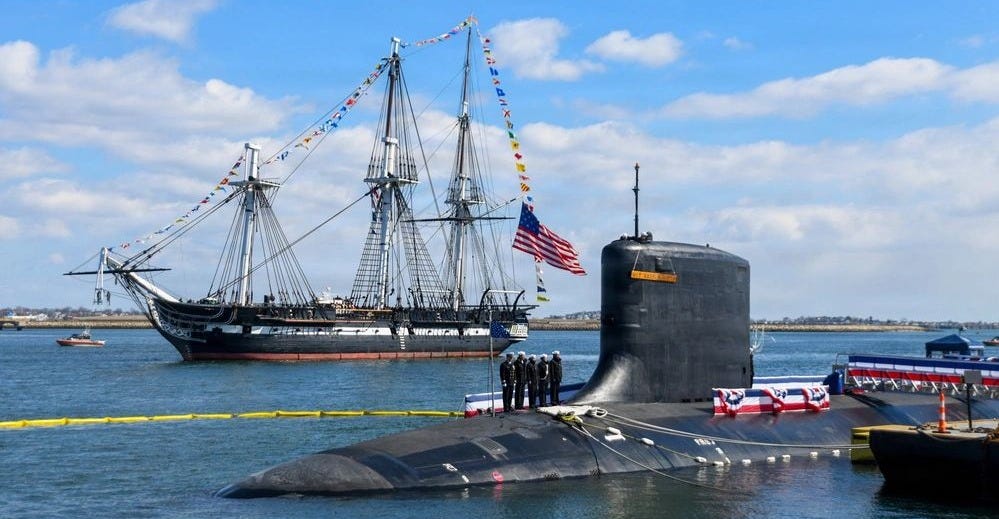
USS Massachusetts Commissioned Into the US Navy
BLUF: The USS Massachusetts (SSN-798), the 25th Virginia-class fast-attack submarine, was commissioned in Boston Harbor on March 28, 2026.
The submarine is 377 feet long, displaces roughly 7,800-8,000 tons, can reach underwater speeds of about 25 knots, and dive to depths greater than 800 feet.
Built through a partnership between General Dynamics Electric Boat and HII’s Newport News Shipbuilding, construction began in December 2020. The vessel completed sea trials in the Atlantic and was delivered to the Navy in November 2025.
The Massachusetts is the seventh submarine built to the Block IV configuration, designed to reduce maintenance requirements and enable more deployments than earlier variants.
It carries Tomahawk land-attack cruise missiles and torpedoes for anti-submarine warfare, intelligence collection, and precision strikes.
The crew includes about 147 sailors, including 39 women, roughly a quarter of the crew.
“Today, USS Massachusetts is tested and battle-ready.” - Joshua Hightower, USS Massachusetts, XO
2027 Budget Request Includes More Than $65B for Navy Shipbuilding
BLUF: The FY27 budget requests $65.8 billion for Navy shipbuilding, including 18 battle force ships, 16 non-battle force ships, and initial funding for Trump-class battleships and the Golden Fleet.
The $65.8B shipbuilding request ($60.2B base + $5.6B reconciliation) is up from $27.2B enacted in FY26 for 19 battle force ships.
Budget establishes Trump’s Golden Fleet, including initial funding for Trump-class battleships and next-generation frigates.
Battleships expected to be conventionally powered, armed with lasers, hypersonic missiles, and other advanced weapons. Analysts estimate upwards of $10B per vessel and 10+ years to build.
Budget maintains or increases procurement of Columbia-class and Virginia-class submarines and amphibious vessels.
Auxiliary vessel procurement expands to include sealift vessels, hospital ships, tankers, submarine tenders, and other logistics platforms.
Budget also includes “unprecedented investments” in unmanned and counter-UAS systems as part of the Pentagon’s drone dominance initiative, and “historic investments” in AI including continued support for GenAI.mil.
Related Articles:
Trump Seeks to Double Number of Ship Requests with 2027 Defense Budget
Pentagon’s New $65.8B Shipbuilding Request Is Highest Since 1962
Faster to the Fight: How the Navy Is Reengineering SBIR/STTR Innovation
Isaias “Cy” Alba and Adel Mansour
BLUF: The Navy announced an overhaul of its SBIR/STTR programs emphasizing speed, commercialization, and private-sector investment, with implications for small business eligibility and private equity involvement.
The most notable changes include increased emphasis on commercialization and private-sector investment (including Navy-hosted private capital events), introduction of training programs such as “Navy Launch” focused on customer discovery and commercialization strategy, and the Navy small business office preparing to support the new portfolio acquisition executive structure.
Companies able to demonstrate clear pathways to commercialization, including private investment or dual-use application, may be better positioned. Firms focused solely on early-stage research without a defined transition strategy may face roadblocks.
The push for fast timelines could compress proposal preparation and development cycles, potentially leading to mistakes in systems requiring extensive testing.
Private equity firms can invest in SBIR awardees, but no single firm may own a majority interest. VC, hedge funds, and PE can collectively own more than 50% of an SBIR awardee. This restriction does not apply to STTR.
Standard small business affiliation rules apply. Safe harbors exist for minority stakes and SBIC investments.
Key Takeaways:
Small businesses should assess commercialization readiness
Engage early with program stakeholders
Monitor ongoing implementation as the Navy hosts private capital events and commercialization trainings.
USS Gerald R. Ford’s Record-Breaking Deployment Could Last 11 Months, Top Admiral Says
BLUF: CNO ADM Daryl Caudle said the USS Gerald R. Ford’s deployment will be “record-breaking” and will likely extend into the 11th month.
The Ford has been underway since last June. Its deployment was extended in February to support the U.S. military campaign against Iran (Operation Epic Fury), which began Feb. 28.
If the Ford reaches 11 months, it would mark one of the longest carrier deployments since the end of the Vietnam War. The USS Nimitz spent 341 days at sea during the COVID-19 pandemic in 2021.
The crew has faced persistent toilet issues and a March 12 fire that destroyed more than 100 crew members’ beds. The Ford sailed to Souda Bay in Crete for repairs and then to Croatia.
The Ford resumed flying sorties just two days after the fire.
The USS George H. Bush and its strike group left Norfolk on Tuesday for the Middle East to support Iran operations. It is unclear whether the Bush will replace the Ford or the Lincoln.
“For those that are not in the Navy, that’s an extraordinary thing to even think about something of that kind of deployment length. So my hat’s off to the Ford.” - ADM Daryl Caudle, CNO
AeroVironment Wins Spot in Navy ISR Initiative With JUMP 20-X UAS
BLUF: The Navy selected AeroVironment to provide contractor-owned, contractor-operated ISR services using its JUMP 20-X Group 3 VTOL UAS.
AV will compete for delivery orders alongside other industry partners under the Navy’s initiative to expand and modernize ISR capabilities.
The JUMP 20-X offers fully autonomous, hands-free flight, 13+ hour endurance, 115-mile operational range, 30-pound payload capacity, and more than 70 payload configurations.
The system requires no traditional launch and recovery infrastructure.
AV has previously delivered ISR services to US Naval Forces Southern Command/4th Fleet, the 22nd MEU, and the Korean Navy.
Related: AV Selected to Deliver ISR Services to U.S. Navy with JUMP 20-X, Advanced Payload Integrations
Navy Identifies 4 Vendors to Compete for COCO Drone ISR Services
BLUF: NAVAIR’s PMA-263 plans to issue four basic ordering agreements for land- and sea-based UAS COCO ISR services to AeroVironment, Shield AI, Insitu, and Textron, expanding the vendor pool as prior agreements expire.
The Navy requires runway-independent, multi-intelligence capable UAS with at least 75 NM range, 10 hours time-on-station, FMV, EO/IR, EW-type sensors, and the ability to operate in GPS-denied environments.
Contractors are responsible for personnel, equipment, certifications, O&M, spares, and product support. Services must be available 24/7 on a normal and surge basis.
The expansion broadens industry partnership beyond the two incumbents (Insitu and Textron) to include AeroVironment and Shield AI.
Services support domestic and coalition partners in combat and contingency operations.
The Navy Wants You to Make Drone Killer Ammunition
BLUF: The Naval Surface Warfare Center Crane Division last month revealed the service’s new “Drone Killer Cartridge,” or DKC, a small-arms ammunition specifically designed to destroy small quadcopter drones.
The ammo works much like a shotshell in that it disperses a cluster of projectiles, but it’s designed to be fired from a service rifle or machine gun instead of a shotgun.
The cartridge’s design, coupled with the range and velocity of typical centerfire rifle ammo, increases the probability of “hit and kill” against drones.
In a recent demonstration at Indiana’s Camp Atterbury, DKC achieved a 92% success rate.
As small drones are now seen as a common weapon on the battlefield, military and other agency leaders project needing millions of DKC rounds.
Our Take: As we’ve heard that the Russians adapted their tactics to avoid this type of weapon, DoW should be wary of going all-in on this approach. Instead, they should see it as one option when targets are presented in a way that allows its use.
The Navy Brought a One-of-a-Kind Laser Weapon Back from the Dead
BLUF: The Navy is reviving previously retired laser weapon prototypes to keep counter-drone experimentation moving forward, as the military’s inventory of operational directed-energy systems remains thin.
The Navy’s 150 kW Solid State Laser Technology Maturation Demonstrator (SSL-TM) is reportedly being brought back into service.
The Army’s four 50 kW DE M-SHORAD systems have been completely demilitarized, its AMP-HEL systems are occupied on the border, and the Marine Corps returned its CLaWS to Boeing.
The Navy’s eight ODIN laser dazzlers are all installed aboard active warships at sea, and the 60 kW HELIOS system has had a challenging year.
The shortage of spare laser weapons is forcing the military to call retired prototypes back into service to sustain counter-drone experimentation.
USS Zumwalt Destroyer and Hypersonic Weapon
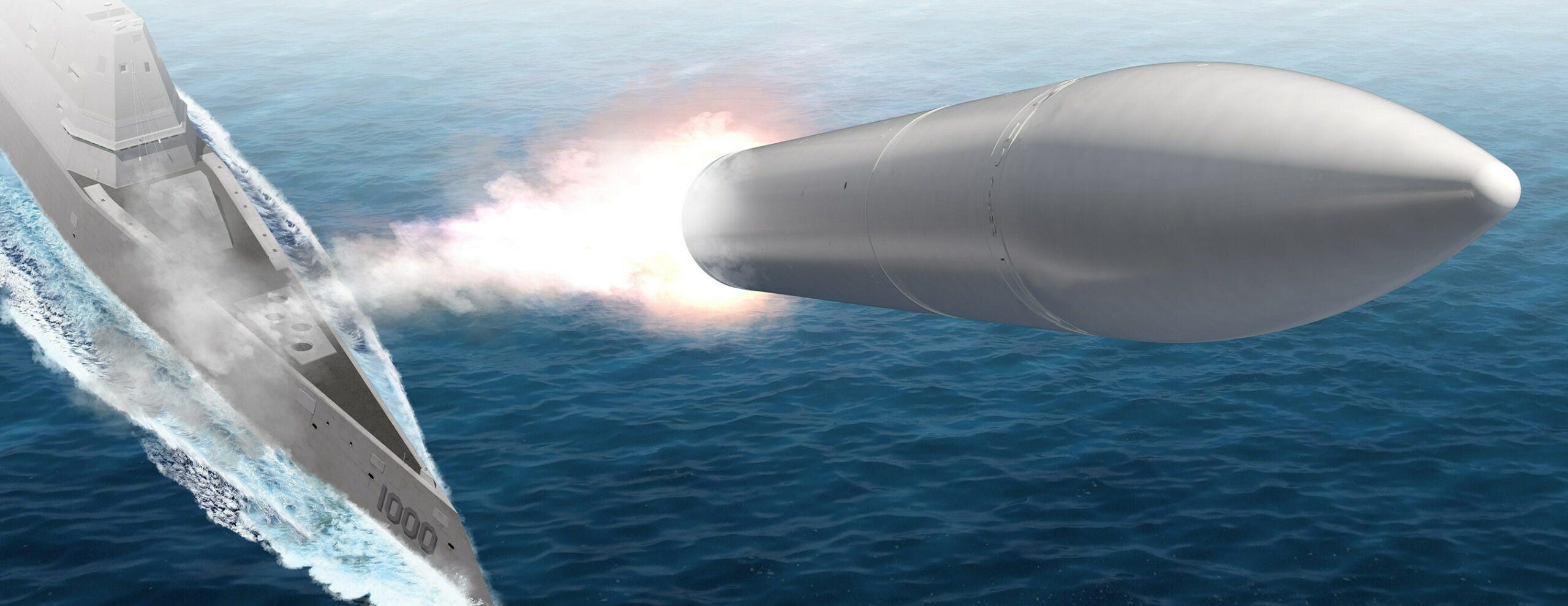
BLUF: The Navy awarded Lockheed Martin a $1.35B contract modification to support production and integration of the Conventional Prompt Strike hypersonic weapon system aboard USS Zumwalt, covering engineering, systems integration, and long-lead materials through September 2032.
The overhaul replaced the ship’s twin 155mm Advanced Gun Systems with four 87-inch missile tubes. Each tube carries three CPS missiles via an Advanced Payload Module canister, for a total of 12 hypersonic missiles.
USS Zumwalt completed sea trials after three years in dry dock. Live-fire testing expected in 2027 or 2028 with initial operational capability to follow.
CPS uses a booster rocket and a Common Hypersonic Glide Body (C-HGB) that maneuvers at speeds above Mach 5, shared with the Army’s Dark Eagle system.
The Navy plans to extend CPS integration to USS Michael Monsoor (DDG-1001, dry dock 2027), USS Lyndon B. Johnson (DDG-1002), and Virginia-class Block V submarines.

US Marines Conduct First Live-Fire Drone Strike Against Maritime Surface Vessel
BLUF: Marines from III Expeditionary Operations Training Group at Okinawa executed the Corps’ first live-fire drone strike against a maritime surface vessel from a naval surface craft, hitting an unmanned surface vessel the unit designed and built itself.
The event at Naval Base White Beach, Okinawa, marks a new era where Marines design, build, and deploy their own unmanned systems and targets.
Sailors also demonstrated the ability to launch attack drones from self-built unmanned surface vessels.
The branch’s focus is twofold: perfecting lethal payload delivery and developing robust counter-UAS capabilities.
Marines are being trained to act as engineers who can build unmanned systems from local economies during conflict, including payloads with mechanical and electronic safety devices.
“The threat from III MEF to our adversaries can change from one day to the next. It is innovative, flexible and rapidly adaptable.” - Maj. Brant Wayson, III EOT Group, Unmanned Systems Branch OIC
Marine Corps Seeks Marketplace for SUAS Parts
BLUF: Due to increasing reliance and demand, the Marine Corps is seeking parts for small, unmanned aircraft systems that are available and can be rapidly procured along with a marketplace that can help deliver them.
The notice comes as current procurement for these parts is fragmented across the region, leading to procurement delays, a lack of supply chain visibility, and an increased risk of inadvertently acquiring parts non-compliant with the NDAA.
The service aims to consolidate the ordering of these parts into one contract vehicle for the II Marine Expeditionary Force and other commands supported by Marine Corps Installations East.
This streamlining is intended to grant the commands improved supply chain security and greater accountability to sustain Group 1 SUAS -- small vehicles primarily used for intelligence, surveillance and reconnaissance missions.
The Marine Corps is seeking a contractor that can provide and operate a COTS, secure, web-based marketplace for procurement of parts.
The government will nominate specific parts for review, and the contractor will execute a process to ensure the parts are compliant with authorization legislation.
Our Take: There is some concern that this is the first fragmentation of a consolidated drone marketplace as intended by JIATF-401. It’s not entirely clear how this effort jives with that implementation and how Drone Dominance will impact what drones the Marine Corps can even buy. If DoW intends to mitigate some of DJI’s reach, they are going to have to consolidate within the department…especially since we currently only buy a few thousand drones a year.

U-2 Dragon Lady to Get Major Electronic Warfare Upgrade
BLUF: BAE Systems has been awarded a contract to support and modernize the AN/ALQ-221 Advanced Defensive System aboard the U-2 Dragon Lady, extending the Cold War-era spy plane’s ability to operate in contested airspace.
Under the contract from Robins AFB, BAE will provide field support, perform repairs, and deliver software updates to detect and respond to emerging threats.
The AN/ALQ-221 combines radar warning receivers with electronic countermeasures to help pilots detect, identify, and respond to hostile radar systems.
The system has been progressively enhanced over roughly 60 years of service.
The U-2’s modular design and open avionics architecture allow for rapid integration of new capabilities.
Sustainment work is being carried out at BAE Systems’ facility in Nashua, NH.
Our Take: FFS, re-read America’s Ancient Arsenal. There has to be some Ops Research performance, cost, risk, and industry analysis in the Pentagon that points to designing a new ISR capability that doesn’t require mods to the Mid-Century Modern U-2.
B-52s Carrying JDAMs over Iran as US Bombers Play Growing Role in Air War
BLUF: B-52s flew over Iran carrying JDAM gravity bombs for the first time during Operation Epic Fury, signaling weakened Iranian air defenses and expanding the bomber role in the air campaign.
The U.S. has amassed 15 B-1s and 8 B-52s at RAF Fairford in England.
B-52s initially mounted attacks with stand-off munitions but shifted to JDAMs as Iran’s air defenses weakened.
Payload capacity is a key reason for bomber prominence in the war.
The B-52 can carry 20 2,000-lb JDAMs or 20 JASSMs.
The B-1 carries 24 JDAMs or 24 JASSMs.
The B-2 carries 16 of either.
Bombers also carry more bunker-busting weapons than fighters, including 5,000-lb GBU-72 Advanced Penetrators.
A-10 Warthog Being Tested with Aerial Refueling Probe Bolted onto Its Nose
BLUF: A test A-10 flew for the first time with a refueling probe replacing its nose-mounted receptacle, and within days successfully connected to a C-130 drogue, a modification with implications for the broader USAF tactical fleet.
The probe replaces the A-10’s standard boom receptacle, allowing it to refuel from drogue-equipped tankers like C-130s rather than only KC-135s and KC-46s.
The implications extend beyond the A-10. Equipping USAF fighters with probes could be a major enabler for Agile Combat Employment in the Pacific by enabling refueling from smaller, more dispersed tankers.
Air Force fighters with probe capability and smaller tactical tankers would be of extreme value during a Pacific crisis.
Our Take: The Air Force needed to think of this years ago when they made the decision that fighters needed the same refueling apparatus as bombers. Air Force fighters could have adopted the Navy’s approach for the F-18 by employing a drogue which allows for more flexibility and simultaneous refueling of two fighters from one aircraft. Bombers need to be refueled by boom given the volume of gas they take on and the risk of detection during prolonged refueling. Retrofitting that to existing fighters would be a massive undertaking.
Sentinel Program Advances with Silo Prototype
BLUF: The Air Force, Northrop Grumman, and Bechtel broke ground on a full-scale LGM-35A Sentinel ICBM launch silo prototype in Promontory, Utah, validating a modular construction approach for 450 future silos.
The prototype validates a modular, repeatable construction approach designed to accelerate fielding and reduce cost growth.
The program shifted from refurbishing legacy Minuteman III silos to building new ones after tests showed repairing and adapting the existing silos would cost too much and cause further schedule delays.
New silos replace legacy Minuteman III infrastructure rather than refurbishing it, preserving uninterrupted alert coverage.
Construction is underway on a new Wing Command Center at F.E. Warren AFB, Wyoming.
All propulsive elements of the Sentinel missile have been demonstrated, including test firings of stages one, two, and three and a hot fire test of the post-boost propulsion system.
A flight test is planned for 2027. Sentinel remains on track to field initial capability in the early 2030s.
“The new silo design delivers operationally relevant capability on a predictable cost and schedule.” Gen. Dale White, DRPM, Critical Major Weapon Systems
Related Article: Construction of Sentinel ICBM Silo Prototype Begins in Utah
Air Force Quietly Selected Low-Cost Missile in December
BLUF: CoAspire received a contract in December for the Family of Affordable Mass Missiles-Lugged (FAMM-L), a low-cost air-launched cruise missile for fighters and bombers.
The “lugged” designation means the missile can be carried on weapons racks on fighters and bombers. This clarifies the “family” in FAMM, which previously only referred to palletized versions for cargo aircraft.
Zone 5 Technologies’ Rusty Dagger and Anduril’s Barracuda-500 were selected last year to develop the palletized cruise missiles for the C-17 and C-130J.
In parallel, the Air Force developed a lugged cruise missile for Ukraine’s MiG-29 fleet under the Extended Range Attack Missile (ERAM) program, with Zone 5’s Rusty Dagger and CoAspire’s RAACM.
A July 2025 RFI sought a 500-lb weapon with at least 250 nm range, production capacity of 1,000 rounds per year, and a unit cost not to exceed $300K.
Brig. Gen. Robert Lyons, PAE for Weapons said the next phase of development launches this spring.
6th Iteration of Power Wargame Provides Strategic Insights for Leaders
BLUF: U.S. Strategic Command recently brought together experts in the U.S. Government and from Allied nations to use rigor and data to consider and examine ways to deescalate an international crisis.
The Air Force Wargaming Institute hosted the USSTRATCOM-sponsored Power Wargame 2026, an annual five-day, joint, interagency, strategic-level wargame at Maxwell Air Force Base, March 9-13.
The wargame incorporated global force management considerations, the challenges of sustainment and logistics over time, and what conflict in the cyber and space domains will mean for accomplishing operational and strategic objectives long term.
The Wargaming Institute hosted more than 200 participants, contributing expertise from several combatant commands, the Air and Naval War Colleges, the Department of State, and other subject matter experts.
The notional scenario places these future leaders in a high-stakes environment where their decisions have tangible consequences within the game’s framework.
By moving beyond theory and into a dynamic, responsive environment, students gain a deeper, more intuitive grasp of strategic cause and effect, learning directly from the successes and failures of their actions within the simulation.
USAF Implements Restructure of Strategy, Design, Requirements Directorate
BLUF: The Air Force consolidated the core functions of Integrated Capabilities Command (Provisional) directly into its Headquarters rather than establishing a separate major command.
The goal is to streamline capability development with Force Design refinement and Requirements for force modernization.
It’s intended to strengthen the Air Force’s ability to develop capabilities closely aligned with operational requirements and force design concepts.
The transformed directorate now functions as a single, enterprise-level organization with the authority and proximity to drive faster, more cohesive decision-making across the modernization portfolio.
Our Take: This was the logical follow-on from the SECAF not approving the stand-up of a new command for this role. In reality, A5/7 always owned these functions but is now a bit more empowered with the MAJCOMS losing some of their clout. Given that the A5/7 is a three-star billet and the MAJCOM commanders are still 4-stars, they will always be able to escalate when they have specific requirements they want validated.

Space Force Budget Would More Than Double in Trump’s $1.5T Defense Plan
Within the $1.5B total budget, funding for the Space Force would climb to more than $71B, up about $40B from fiscal 2026 levels.
A significant portion of the increase is tied to missile defense systems based in orbit. The budget includes about $17B for the Golden Dome program.
The request also introduces several new program lines, including a $1.5B Space Data Network, automated satellite command-and-control systems, and expanded procurement for proliferated communications satellites.
Taken together, the Space Force budget would allocate $40.6B to research and development, $19B to procurement, $9.6B to O&M, and $1.8B to personnel.
Our Take: There are so many space missions that deserve greater resourcing, this is a very promising step forward for the joint force.
Saltzman: Space Force Guardians Integrated Throughout Iran Ops
BLUF: Chief of Space Operations Gen. Chance Saltzman confirmed Space Force capabilities are deployed “inside the threat zone” and deeply integrated into joint operations against Iran in Operation Epic Fury.
Space Forces Central has provided communication, navigation, targeting, and other effects throughout the campaign supporting 12,300 targets engaged.
Space forces were among the “first movers” in Operation Epic Fury, helping pave the way for initial strikes in late February.
Guardians are integrated at CENTCOM HQ at MacDill AFB, Shaw AFB, and forward deployed locations in the CENTCOM AOR.
Related Article: Space Force Instrumental in Operation Epic Fury, Service Chief Says
SDA’s Sandhoo Likely to Lead Space Force Missile Warning and Tracking Portfolio
BLUF: The Space Force intends to tap SDA acting director Gurpartap “GP” Sandhoo to lead the new Missile Warning and Tracking PAE office, which will be responsible for developing sensor satellites for Golden Dome.
The PAE announced March 17 covers both legacy missile warning/tracking constellations and ongoing development programs across all orbital regimes, including SDA’s Tracking Layer, Next-Gen OPIR, and Resilient MWT MEO.
Sandhoo is likely to keep his SDA role in a double-hat arrangement as Congressional approval would be needed to change SDA’s legal status.
One industry source said the move would result not in SDA being dismantled but in it gaining “more power.”
CSIS’s Clayton Swope cautioned that consolidating programs may cut costs but could dilute innovation, warning against anything that “quasi-merges SDA into a bigger program.”
Our Take: Given the expanded responsibilities and authorities of PAEs, it makes less sense to maintain both an SDA and PAE organization. A better approach to maintain the connection to the CSO would be to make the Deputy PAE position a billet that can only be filled by a senior space operator.
Pentagon Weighing Termination of Raytheon GPS Ground Control Contract After Years of Delays
BLUF: The Pentagon is expected to terminate or sharply reduce work on the Next Generation Operational Control System (OCX) for GPS, built by RTX, after 15 years of development, ballooning costs, and persistent delays.
The Air Force awarded the OCX contract to Raytheon in 2010, initially valued at about $1.5 billion with delivery expected in 2018. Costs have since grown to at least $6 billion, per the GAO, with delivery slipping more than seven years.
RTX’s current contract option expires March 31 and is unlikely to be extended in full. The Space Force may instead transition elements of already delivered OCX software into the existing Architecture Evolution Plan (AEP), a legacy ground system that has been incrementally modernized.
Acting acquisition executive Thomas Ainsworth pointed to systemic problems in program management, contractor performance, and systems engineering on both government and contractor sides.
The Pentagon’s independent test office warned that OCX delays are slowing deployment of M-code, the jam-resistant military GPS signal, putting warfighters and allies at risk.
Further upgrades (OCX 3F) required for next-generation GPS IIIF satellites are not expected until at least FY2027, with operational acceptance slipping to 2028.
Our Take: One of the authors helped write the requirements for OCX and spent a year on the first source selection in 2007 (!!)…and remains horrified that the prime contractor has been allowed to continue underperforming for what has almost been two decades.
Space Force Wants More Testers, Looking at Own Test Center to Deliver Faster
BLUF: The Space Force is putting acquirers, testers, and operators into “test integration teams” at the start of programs and exploring whether it needs its own testing apparatus, separate from the Air Force.
The integrated approach helps the team evaluate whether a “minimum viable product” can be delivered that may not pass all tests perfectly but brings a new capability to the force at faster speeds.
This is in lieu of waiting for the traditional sequential developmental-then-operational testing cycle.
The service needs more testers to support this construct, which means more people - with some calling for the 10,000-member branch to double in size.
Currently, the Air Force’s Director of Test and Evaluation and Air Force Test Center oversee Space Force testing. Officials are evaluating whether a separate Space Force test entity is needed.
Test plans will be tailored for individual systems based on acceptable risk levels.
“We will no longer have the luxury of pursuing perfection when a system that is good enough provides combat capability on a more operationally relevant timeline.” CSO Gen. Saltzman
Varda Space Industries Launches W-6, Expanding Hypersonic Reentry and Autonomous Navigation Capabilities
BLUF: Varda Space launched its W-6 reentry capsule aboard SpaceX’s Transporter-16 mission, carrying an AFRL-funded hypersonic navigation system capable of identifying spacecraft position during GPS and radio blackout caused by plasma sheaths.
The autonomous navigation system was developed by Rhea Space Activity (RSA).
It uses onboard cameras to capture images through the plasma sheath and match objects against the Space Force’s Unified Data Library.
The system represents a step toward fully autonomous navigation for hypersonic and reentry vehicles, providing an alternative to satellite-based navigation during blackout periods.
The capsule included thermal protection system tiles and external sensors for heat flux, temperature, and pressure measurements during reentry.
This is Varda’s sixth mission and first launch of 2026. The company is scaling vehicle production and flight testing to support a growing range of commercial and government customers.

America Needs to Understand Golden Dome Before It’s Too Late
BLUF: Golden Dome remains largely unknown to the public, Congress wants clearer information, and industry lacks guidance, creating a dangerous information vacuum that adversaries can exploit.
Golden Dome is a modernization effort aimed at defending the US against advanced 21st-century threats, integrating sensing, tracking, C2, and layered defensive capabilities across multiple domains.
Congress is frustrated. Members in both chambers want clearer information on architecture, cost, schedule, and oversight. Industry cannot posture effectively without clearer guidance, creating hesitation when urgency is essential.
Allies also want reassurance it complements existing security architectures.
A full rollout should include:
A clear, plain‑language narrative explaining what Golden Dome is and what it is not.
Fact sheets and graphics that demystify the architecture and purpose.
Pre‑briefings for Congress and industry to ensure alignment and reduce uncertainty.
Coordinated messaging with allies and partners to reinforce collective security.
Calibrated communication to adversaries to strengthen deterrence without escalating tensions.
Golden Dome is a prudent, stabilizing investment in America’s security. But even the best ideas can falter without public understanding.
Our Take: We generally agree here, but all the elements of Golden Dome have been laid out if folks were paying attention. The increased production of interceptors like the SM-2, PAC-3 and THAAD are part of the equation…along with a new lower-cost interceptor. Gen Guetlein recently laid out his plan for a new C2 layer to cover the full spectrum of threats. The Space-Based Interceptor program has been fairly public too. There are certainly some other classified efforts underway, but the bulk of the program is actually out there - it’s just not as neatly packaged into a single program.

Commission Adopts €1.5B Work Programme to Boost European and Ukrainian Defence Industry
BLUF: The new program is intended to enhance and modernise Europe’s defence industry, boost production capacity and secure tech advancement and resilience.
€700+ million will support the production increase of key defence components and products, including counter-drones systems, missiles and ammunition.
This includes €260 million under the Ukraine Support Instrument (USI) of EDIP, to help rebuild and modernise Ukraine’s Defence Technological and Industrial Base (DTIB) by investing in collaborative projects that increase production capacities in both Ukraine and Europe.
€325 million will launch and implement ambitious collaborative industrial projects under the European Defence Projects of Common Interest (EDPCI).
€240 million will fund joint procurement of defence equipment, including counter-drone, air and missile defence and ground and naval combat systems.
€100 million will go to equity support through the Fund Accelerating Defence Supply Chains Transformation (FAST) to help defence start-ups.
€35.3 million is allocated to the BraveTech EU initiative, to boost innovation to tackle urgent challenges faced by the Ukrainian armed forces and improve the competitiveness of the European defence industry.
The first round of EDIP calls for proposals will be visible on the EU Funding & Tenders Portal as of 31 March 2026.
Our Take: Europe is really leaning into integrating Ukraine in their industrial base planning which is somewhat surprising but extremely hopeful given the vast, albeit sad experience they have gained over the last 4 years fighting the Russians.
Repairing the Breach: Getting U.S.-India Ties Back on Track
BLUF: U.S.-India relations stumbled badly during the second half of 2025 but the February 6, 2026, announcement of an U.S.-India framework for an interim trade deal provides an opportunity for the two nations to get the relationship back on track.
Summary of Recommendations
Strengthen U.S.-India energy security through civil nuclear cooperation.
The United States and India should deepen energy security cooperation by leveraging reforms outlined in India’s recently passed Sustainable Harnessing and Advancement of Nuclear Energy for Transforming India Act to expand civil nuclear engagement and accelerate the deployment of advanced nuclear technologies.
Institutionalize India’s Indian Ocean maritime security role within the Quad.
Washington can support India’s role as the lead maritime security provider in the Indian Ocean by encouraging India’s implementation and deployment of the Indo-Pacific Partnership for Maritime Domain Awareness initiative.
Leverage India’s central role in the Indian Ocean by assisting India in transforming strategic ports into integrated, resilient maritime hubs.
The U.S. should engage through the Development Finance Corporation to provide tech assistance, transparent financing mechanisms, and PPP models that enhance port efficiency, digital infrastructure, and supply chain resilience.
Operationalize a U.S.-India pharmaceutical resiliency initiative.
Advance biotechnology supply chains through R&D integration.
Reframe artificial intelligence and semiconductor cooperation around joint infrastructure.
With India’s data center demand, estimated at 5–17 GW by 2030, and with the United States already accounting for the bulk of its $80B in tech-related foreign direct investment, the partnership should prioritize jointly scaling the development of data centers and semiconductor infrastructure.9
Refrain from talking about mediating the India-Pakistan dispute over Kashmir.
Reinvigorate the U.S.-India counterterrorism dialogue.
The State Department should elevate its counterterrorism dialogue with India, focusing on both regional and global terrorist threats which would help restore India’s trust that the United States takes terrorism threats in the region seriously.
How China Fights Against a U.S. Army Division
BLUF: In a potential conflict involving large-scale combat operations between the United States and China, a U.S. Army division would face a People’s Liberation Army (PLA) group army capable of executing a layered, multidomain campaign designed to isolate, paralyze, and ultimately dismantle the division’s operational system.
The PLA’s core operational approach of “systems confrontation” would drive its actions which is designed to paralyze a U.S. division before it can effectively fight, seeking to dismantle a division’s command, maneuver, and sustainment capabilities from the outset through multidomain precision warfare (MDPW).
MDPW integrates overwhelming effects across all domains—land, air, sea, space, cyber, cognitive, and electromagnetic spectrum—rather than engaging in a linear, attrition-based battle.
Systems confrontation pits the PLA’s eight core operational systems—command; firepower-strike; information; intelligence, surveillance, and reconnaissance (ISR); support; protection; political; and mobilization—against its U.S. counterparts, seeking to cripple them simultaneously.
A U.S. Army division attacking a PLA group army would confront an active, elastic, and layered defensive system designed to lure, attrit, and ambush attacking BCTs before destroying penetration forces with massed fires and echeloned counterattacks.
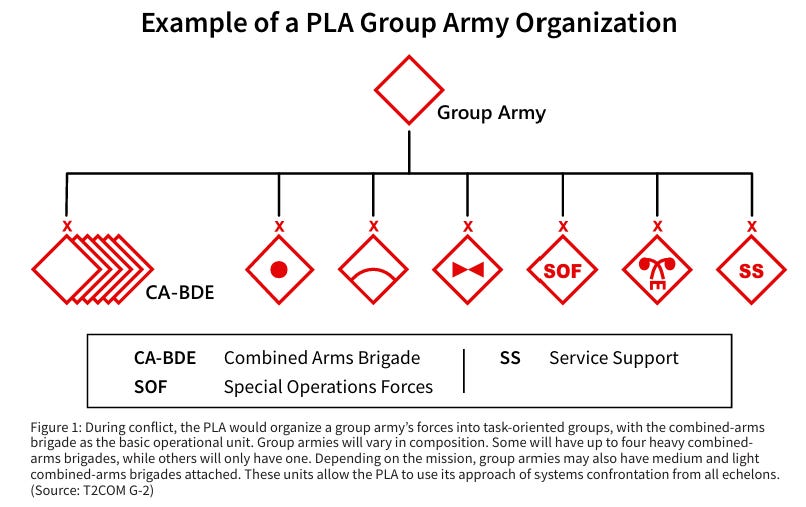
Our Take: If you are interested in the finer points of army warfare, read this very thorough report on how things might unfold in a fight with the PLA. Trigger warning that it’s not an altogether encouraging read.
Ukraine’s Defense Tech Market Hits $6.8B in 2025, Ground Robotic Systems Production Surges 488%
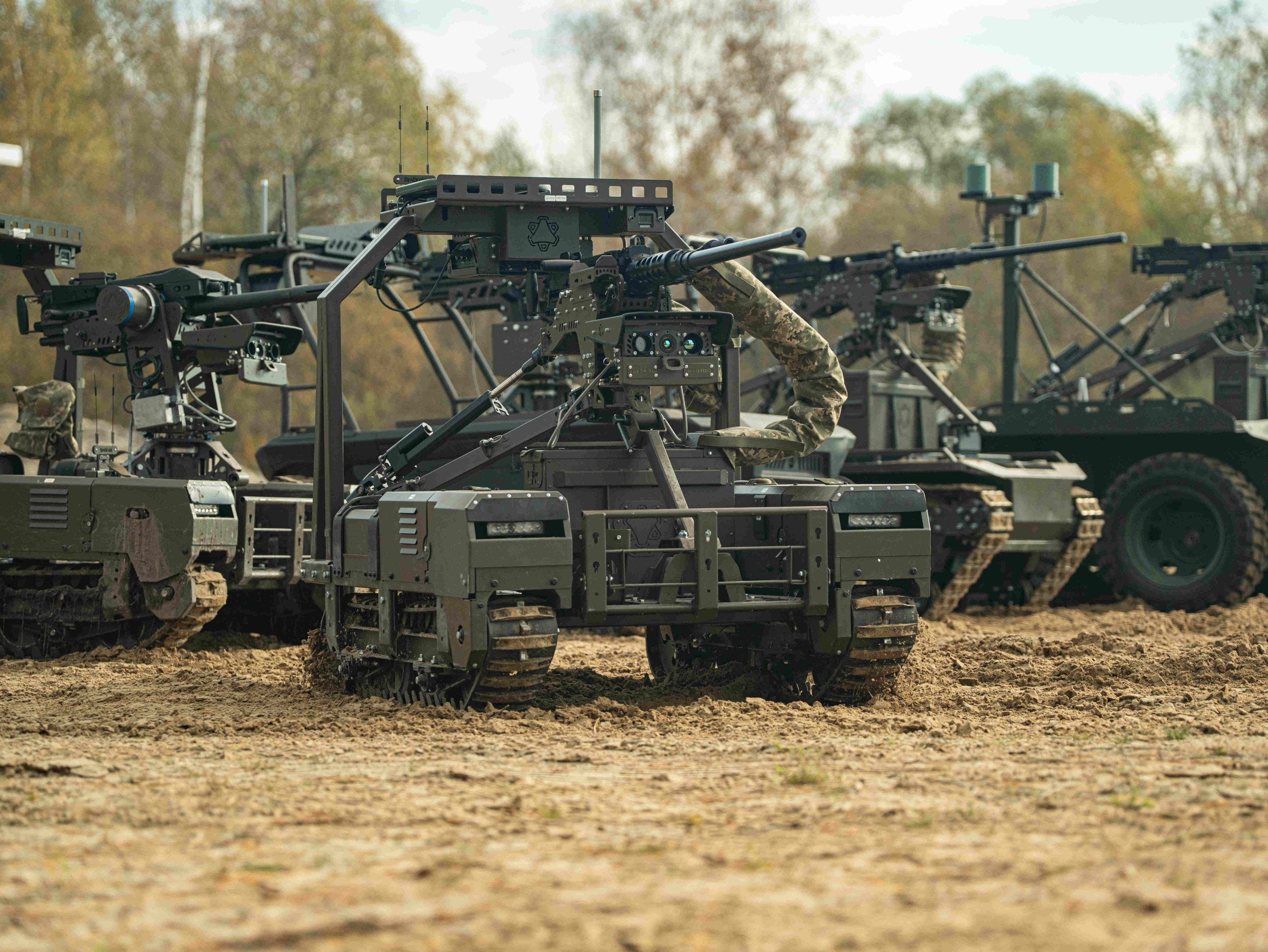
BLUF: A joint study by the Kyiv School of Economics, Brave1, and Defence Builder shows the country’s defense technology market reached approximately $6.8B, with the fastest growth recorded in the segment of ground robotic systems.
Overall, defense production grew more slowly due to limited domestic funding.
At the same time, technology segments showed significantly higher growth rates:
drone production increased by 137%
ground robotic systems by 488%
electronic warfare systems by 215%.
In 2025, Ukrainian defense companies and startups attracted at least $129M in investments and grants.
Key funding mechanisms remain Brave1 grants, venture capital investments, preferential loans under the ‘5–7–9%’ program, as well as financing from partner countries in the form of direct procurement.
Japan’s Domestically Built Munitions with 1,000km Range Could Reach Chinese Coast
BLUF: Japan has deployed its first long-range cruise missiles at a military camp in south-western Kumamoto prefecture, in a landmark expansion of the limits of its pacifist constitution.
The first deployment of the Type-12 missiles, which have a range of 1,000km and could reach targets in mainland China, gives Japan its own “stand-off” capability, or the power to strike an enemy far beyond its own territory.
Ukraine Inks Defense Agreements with Qatar and Saudi Arabia, with UAE to Follow
BLUF: Ukrainian President Volodymyr Zelenskyy has signed new, 10-year defense cooperation deals with Qatar and the Kingdom of Saudi Arabia, and said a similar agreement would be reached with United Arab Emirates in the following days.
The agreement includes collaboration in technological fields, development of joint projects, defense investments and the exchange of expertise in countering missiles and unmanned aerial systems.
Ukraine has been dealing with Iranian Shahed 136 drones and their Russian derivative, Geran, for years and has developed cost-effective ways to counter them.
Another key feature of cooperation is investments in Ukrainian defense tech, so that potential solutions can be quickly available to Gulf countries as they are tested against Russian drones and missiles.
Our Take: This is incredibly smart for the Gulf countries and beneficial for building more international support for Ukraine. The Gulf has had a complicated history with Russia and China - this shift could be one that puts the Gulf 100% back into the western fold as it relates to defense.
China’s Hybrid Engine Promises Stealth, Endurance Boost for Battlefield Drones
BLUF: A Chinese-developed 60-kilowatt hybrid propulsion system tested in December combines fuel-based power generation with electric drive to extend range while reducing noise and heat signatures on small battlefield drones.
The system uses a gas turbine to drive a generator that charges onboard batteries, while an electric ducted fan delivers thrust, allowing drones to switch between quiet and high-power modes.
Traditionally, larger drones rely on fuel engines for range but suffer from noise and heat signatures while smaller drones use battery-electric systems that limit flight time.
This hybrid decouples power generation from thrust to merge both advantages.
The compact layout is designed to fit smaller platforms without compromising performance.
Japan’s Aegis Destroyer Chokai Gets Equipped with Tomahawk Missiles
BLUF: Japan’s Aegis destroyer Chokai has completed modifications and crew training in the US to launch Tomahawk cruise missiles, with live-fire tests planned this summer.
Japan signed a deal in 2024 to purchase 400 Tomahawk missiles. The JMSDF plans to equip all its Aegis ships with the system over time.
The Chokai will conduct live-fire tests in the US this summer before returning to Japan around September.
Tomahawks have a range of over 994 miles, enabling coverage of North Korea and parts of China from the western Pacific.
Japan also reorganized its maritime forces, dissolving the Fleet Escort Force and creating a new Fleet Surface Force to streamline surface vessel operations.
China Building More Giant Zubr-Class Hovercraft
BLUF: China has moved into production of the Zubr-class hovercraft, the world’s largest, with at least nine now in its fleet, a potential indicator of increased preparedness for an invasion of Taiwan.
The Zubr-class can carry 500 troops, or three main battle tanks, or 10 lighter armored vehicles and 230 troops at speeds over 55 knots.
China originally purchased four from Ukraine in 2014 (two built in Ukraine, two assembled from kits in China).
It appears that at least five additional ones have now been built domestically.
China’s fleet of at least nine is by far the largest of any country. Russia has two in service and Greece has four.
Their speed, range, and on-beach delivery capabilities make them less susceptible to some anti-invasion defenses, including many types of naval mines.
A Zubr could also make several trips across the Taiwan Strait in a single day.
An eventual fleet of 10-12 is possible.
China Builds Air-Breathing Engine That Could Power Jets and Missiles Past Mach 6
BLUF: China has unveiled a new type of air-breathing engine that could replace today’s turbine-ramjet systems, and reshape how future fighter jets and missiles achieve hypersonic speeds.
The so-called contra-rotary ramjet engine was developed by researchers from the Chinese Academy of Sciences (CAS).
Designed to run continuously from a stationary start to above Mach 6, the engine aims to eliminate the need for multiple propulsion systems, which represents one of the biggest challenges in high-speed flight.
The prototype has been completed and experimentally verified after over three decades of work.
While still in development, it could significantly upgrade military and aerospace capabilities.
US Approves Potential $83.14M GMLRS-AW Sale to Singapore
BLUF: The State Department authorized a potential $83.14 million FMS to Singapore for 45 M30A2 GMLRS-AW pods and associated equipment.
The GMLRS-AW was designed to engage area targets while avoiding unexploded ordnance, in accordance with DoW cluster munitions policy and international standards.
The system has a range exceeding 70 km and a fragmenting warhead weighing approximately 200 pounds. Compatible with both the M270A1 MLRS and HIMARS.
Lockheed Martin would serve as the prime contractor.
Singapore’s defense spending is projected to reach $19.7 billion by 2029.
This follows a January approval for a $2.32 billion P-8A sale to Singapore.

Prepare that reconciliation and appropriations bill quick please with the later delivery of the budget - so we can have an on-time budget this year!

Lukas Czinger Says 3D-printed Missiles Could Reshape Modern Warfare
Don’t FAR on my OTA w/ Bonnie Evangelista, Last Week in DC
Institutionalizing Defense Innovation w/Mike Madsen, CTRL + ALT + DEFENSE
Govini 2026 Defense Software and Data Summit
Translating Momentum into Mission Readiness w/Michael Obadal
Trust and Interoperability in AI w/Andy Mapes and Justin Fanelli
Augmenting the Arsenal Through Software Defined Manufacturing w/Kevin Czinger and Peter Meijer
Accelerating Mission Readiness w/RADM Chad Jacoby, Patrick Kelleher, and Dr. Vic Ramdass
Nuclear Modernization w/Brandon Williams, Lt Gen Michael Lutton, Madelyn Creedon, and Daniel Poneman
New Wave of Consolidation in Defense Tech? w/Garrett Smith, Drone Wars
From Blockbuster to Biotech Breakthroughs w/Dr. Michael Feasel, DARPA
Epic Fury, FY27 Defense Budget, Spacepower Update, Aerospace Advantage

Defense Industrial Base Conference (DIBCON), Apr 7-9, Milwaukee, WI
FIRES Symposium, Apr 13-16, Ft. Sill, OK
Army UAS Marketplace Showcase, CPE Aviation, Apr 14, Nashville, TN
Army Aviation Warfighting Summit, Apr 15-17, Nashville, TN
Sea Air Space, Apr 19-22, National Harbor, MD
Missile Defense Conference, Apr 21-22, Washington, DC
eMerge Americas Conference and Expo, Apr 22-24, Miami, FL
Digital Transformation Summit, Potomac Officers Club, Apr 22, TBD
Modern Day Marine, Apr 28-30, Washington DC
Army Demand Signal Forum, Apr 28, Palo Alto, CA
Air Force Modeling and Simulation Summit, May 5-8, Colorado Springs, CO
Acquisition Research Symposium, NPS, May 6-7, Monterey, CA (feat. Pete)
ai + expo, SCSP, May 7-9, Washington DC
Xponential, May 11-14, Detroit, MI
Offset Symposium, Second Front, May 14, Washington DC
Inside the Dome: Future of Missile Defense, Tectonic/Payload, May 14, DC
SOF Week 2026, May 18-21, Tampa, FL
See our Events Page for all the other events over the next year.
Join over 15,000 defense and industry subscribers to get our weekly recaps and thought pieces. Paid subscribers also get budget and legislative analysis and are valued supporters of our work.
Hey — I came across your writing and really liked how you think.
I’m exploring something similar from a different angle — writing about human behavior through a system design lens (like debugging internal patterns).
Just started publishing on Substack. If you ever get a moment to read, I’d genuinely value your perspective.
Also happy to support your work — feels like there’s an interesting overlap here.
Happy Easter, Ad Astra.