
The Hidden Issues with Multiple-Award IDIQs
And Why There's a Better Way


We were pleased to have a guest expert on this post with the highly knowledgeable Chelsea Roberts from Collaborative Compositions.

Over the last few months, there have been a plethora of massive, multiple award IDIQ contracts hitting the street. However, the fact is that these are mostly billion-dollar lottery tickets that look shiny on paper but are likely to fall way short of DoW goals.
It’s time to call out the mismatch between these mega-solicitations and the actual transformation the warfighter needs.
First, they ignore or contradict the principles in the Transforming the Defense Acquisition System into the Warfighting Acquisition System to Accelerate Fielding of Urgently Needed Capabilities to Our Warriors Memo and Acquisition Transformation Strategy. Key elements these massive IDIQs ignore:
Prioritizing Non-FAR-based procurement methods and instruments as preferred agreements, to the extent practicable.
Preferencing commercial products and offerings, with enhanced presumption of commerciality to expand qualifying vendors.
Focusing on modifying commercial solutions when a pure commercial solution does not fully meet requirements.
Employing streamlined solicitation approaches including Commercial Solutions Openings (CSOs) across all acquisition tiers.
Secondly, they severely overestimate the acquisition ease that IDIQs bring and their ability to attract truly innovative ideas.
IDIQs by their nature are rigid, hard to manage, and usually carry too much regulatory burden for small businesses.
IDIQs rarely reward SB participation…as they often spend scarce resources to get on the base award only to realize afterwards (due to limited transparency from the government upfront) that they aren’t competitive for any specific task orders.
IDIQs are structurally optimized for government administrative convenience e.g. terms and conditions can be set upfront but not necessarily for driving innovation or meaningful competition at the point of execution.
IDIQs are prime focused which offers little incentive for genuine collaboration. The prime on a TO holds sole privity with the government and can, and often does, use that as leverage over teaming partners.
Finally, many IDIQs are misused for a purpose other than what they were intended. Experts generally agree that IDIQs work best when:
Services and products are repeatable.
Scope is reasonably defined with understood pricing.
Ordering flexibility is needed but requirement flexibility is not.
An excellent example of appropriate use of an IDIQ is JIATF-401’s marketplace with over 1,600 items allowing for dynamic ordering of different quantities based on evolving threats and operational environment. That is not the case in the below examples.
A Couple Examples
The following two solicitations identify some specific issues but also touch on broader contracting challenges we see—and highlight why we need to course-correct.
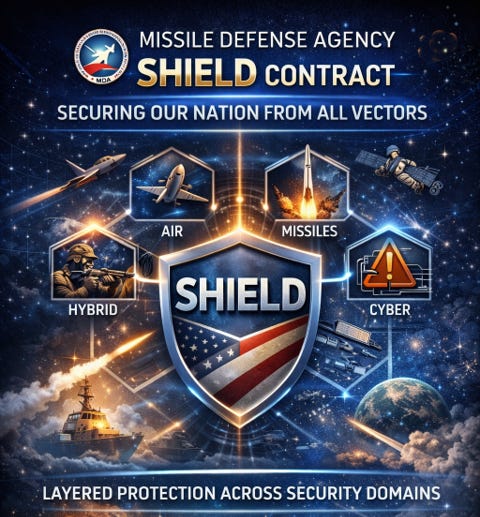
Missile Defense Agency (MDA) SHIELD
“The MDA MAC IDIQ will support national defense objectives by ensuring continuous, layered protection against air, missiles, space, cyber, and hybrid threats originating from any vector - land, sea, air, space, or cyberspace. This effort supports commercial and non-commercial services and commodities of both classified and unclassified efforts on multiple security domains.”
Key Problems
Ceiling Value Very Misleading. MDA advertised a $151B ceiling but had only requested $13.1B in FY26 investment with around $6.8B in reconciliation funds for missile defense radars, missile defense and accelerating hypersonic defense capabilities. Major programs like THAAD and SM-II production contracts already exist and sole source winners were selected for the Glide Phase Interceptor and Next Generation Interceptor. Even the Low-Cost Interceptor solicitation posted in Sep 2025 and the High-Altitude Infrared Search and Track request posted in Oct 2025 were issued under the NOBLE contract, not SHIELD. There are reasonable expectations based on comments from Gen Guetlein that the C2 layer was awarded through the GD4A program office, also not on SHIELD. The Space Force is also pursuing Space-Based Interceptors and the Tracking Layer on its own Other Transaction vehicles. Real executable dollars—and capabilities—on SHIELD look vanishingly small.
Unclear and Unexecutable Strategy. Even if funding was realized, integrating hundreds (or thousands) of vendors into coherent missile defense capability is impossible. MDA historically awards very large contracts to the largest primes and required them to coordinate among themselves. One example was the C2BMC National Team led by Lockheed Martin. While this could be replicated for pieces of the system, it would be unnecessary and likely counterproductive to jam thousands of contractors together to form a construct within an IDIQ that could have been a dozen or less separate contracts.
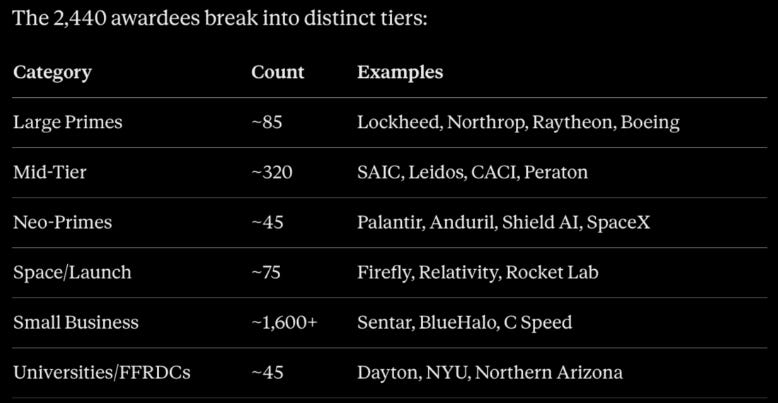
Too Permissive Entry. Golden Dome is the Administration’s prestige acquisition program. It was announced well before the F-47 or Trump Battleship and is key for the pivot to the Homeland. Given that, one would think that SHIELD would be highly selective choosing only the top performers for the 19 tech areas and even requiring demos of vendor capabilities. Instead, the approach was a paltry “describe your experience and relevancy to two of the 19 areas” which admitted over 90% of bidders / 2,440 companies to SHIELD including 1600+ small businesses.
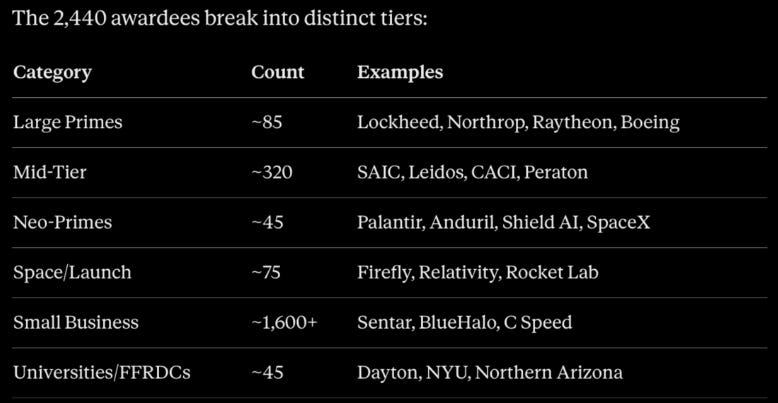
Graphic courtesy of Ross Facione and his SHIELD Pursuit Manual.
No Performance Incentive. The strongest motivator is continued work. There are few things that will make companies pull their best people faster than the possibility of no future business with a key customer. Yet SHIELD includes no real off-ramp provisions based on performance of the awarded TOs. They merely say it will be considered if an IDIQ selectee is non-responsive or fails to submit a quote within a 12-month window.
Not Commercially Oriented. While it supports “commercial service and commodities,” there is no other indication of whether this would be prioritized in any way or subject to a separate pool that would encourage their use. Worse, the contract details over a hundred pages of contract clauses including one that requires a request for approval to incorporate commercial software. It also includes language requiring minimizing restrictions on IP rights “that impact the Government’s total life cycle costs both in costs attributable to royalties from required licenses, and in costs associated with the inability to obtain competition in future” which is code for Government Purpose Rights. While the contract allows for multiple award types, it gives no sense of preference on their expected use that help industry understand whether they need to get approved systems if the majority of TOs are cost-plus. Overall, it is not favorable to commercial offerings at least in how the documentation was drafted.
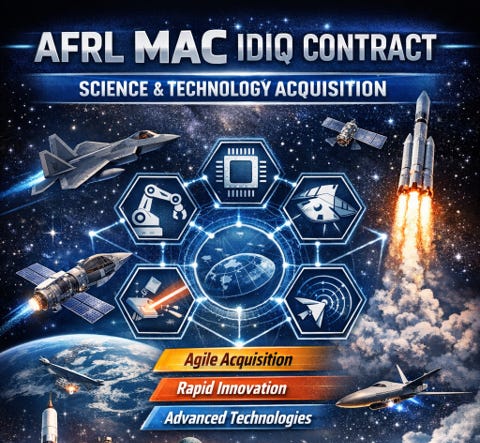
Air Force Research Laboratory (AFRL) Multiple Award Contract (MAC)
“The AFRL MAC IDIQ contract is to provide an agile and rapid acquisition vehicle to acquire AFRL-wide Science and Technology (S&T) requirements. The AMAC aims to facilitate rapid and efficient technology development, ultimately advancing the state-of-the-art for the United States Air Force and Space Force.”
Key Problems
Selection Based Solely on Experience, Not Performance. Awards hinge on having relevant technical experience, not an offeror’s performance or ability to solve problems in a collaborative manner. This heavily favors entrenched incumbents and stifles truly novel concepts or approaches.
Selection Criteria Penalizes Entrepreneurs. Vendors must demonstrate prime-level experience across multiple technical areas to be awardable. This is even true of vendors competing for the small business pool. As an example, in the cyberspace domain (bizarrely named), a company needs to demonstrate experience in five areas or demonstrate experience in 10 areas across the air, space, cyberspace and cross-cutting domain categories to be awardable. This approach penalizes specialized companies who focus on building a cutting-edge solution in one niche area. A company focused on building the next-gen directed energy interceptor may only have focused experience in four areas in the “cyberspace domain” and “Materials Characterization and Testing” and “Power and Thermal Management” - and still be short of qualifying even if they had the most experienced technical team in the industry.
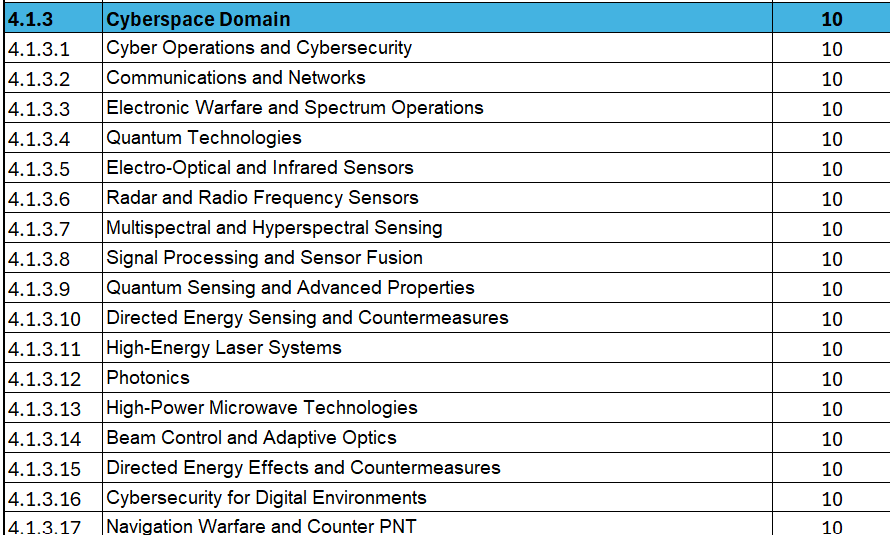
Unnecessary Siloing. Offerors have to pick whether to be in the Unrestricted Pool or the Small Business Pool, they cannot do both. This leads smaller vendors to have to guess at the volume of work that will come through the SB pool or whether they should try to compete in the larger pool where most of the hefty work is likely to be competed. Whether to allocate to SB could have been made on each TO based on the capabilities of smaller companies in the pool.
Confusing Competitive Range. The solicitation states that no additional credit or greater consideration for award is given for receiving greater than the minimum points however the solicitation also says that in competitive range some offerors may be eliminated that are not among the most highly rated. It is very unclear how offerors that meet the “Acceptable” requirements would be differentiated such that the source selection team could narrow the selected pool.
Minimal Dialogue. The solicitation states that the Government may hold vendor discussions or issue Evaluation Notices (ENs) however there seems to be little chance to engage with vendors on potentially unique aspects of their capabilities. For instance, one vendor may have just hired the leading quantum scientist or invested in new modern infrastructure that would not matter in the final down select since those details are not requested and are not graded.
Small Business Participation Commitment. Based on the solicitation, it appears that even vendors participating in the Small Business pool would need to commit to including small businesses (even identifying the specific company names) in their work - which is frankly ridiculous.
Note: Apart from the critiques, AFRL deserves props for not requiring a security clearance as part of the award instead allowing those details to be worked out on specific delivery orders and task orders.
A Better Approach
For contracts intended to support open-ended, highly technical solutioning where a significant amount of development or modification is required, a Commercial Solutions Opening combined with an Other Transaction type contract mechanism is much more suited. This is better for a number of reasons:
The CSO+OT doesn’t overcomplicate or oversimplify the selection process, and it doesn’t drive a lot of overhead in execution. Most importantly these constructs are more aligned with procurement of commercial solutions.
The CSO+OT allows for more flexible down-select criteria to ensure that top performers are selected for the work. Multiple awardees can be chosen and offboarded / narrowed based on a set of multi-phase criteria that is not overly constrained by FAR source selection rules.
The CSO+OT allows for more direct engagement with the government that is better for the smaller business to learn and grow - and for the government to get a unique aligned offering. This is also a much better arrangement for Government innovators as they don’t have to work through primes who could add restrictions, and they can hold “discussions” when needed instead of at mandated points.
When a contract instrument with a pool of vendors ready to execute against specific technology or capability areas is desired, an OT consortium can also be used. While there is some controversy with consortiums based on the fact that they charge a fee, the fact is that they provide an inherently flexible way to assemble a group of high performing vendors to support government goals.
FAR-based IDIQs often have complex offboarding and onboarding procedures which are subject to protest, an OT consortium allows for seamless additions or reductions to ensure the right process is followed with adequate competition.
Helpfully, many OT consortiums have experienced contracting staff (most former gov’t KOs) that can help expedite the non-inherently governmental aspects of executing a contract - speeding up the process.
OT consortia can also improve the government’s ability to do more matchmaking between companies when they see an opportunity for an optimized solution to be devised across multiple less mature products
Two examples that MDA and AFRL could have modeled their solicitations after are below. These CSOs even give themselves flexibility to use either FAR or OT-based rules for awards (which is helpful if a more traditional vendor is selected for work).
USSOCOM AT&L recently issued a solicitation for an Innovative Technology and Agile Acquisition CSO “to support rapid fielding of capabilities [and] carry out prototype projects that are directly relevant to open architecture and integrability. Each specific call against this CSO may establish a tailored scope with additional Ares of Interest to meet the requirements of that call.”
The Naval Information Warfare Center - Pacific recently issued a solicitation for a CSO “to accelerate the acquisition and fielding of advanced commercial solutions that can enhance the capabilities of the U.S. Navy and the joint warfighter…[and] invites proposals for innovative, commercial technologies relevant to our mission.”
Moving Forward
Getting the contract approaches right is vital to acquisition transformation. Having the most creative acquisition strategies, leveraging the most advanced digital modeling infrastructure and having the most streamlined processes can be wasted if ill-structured contracts are used that lock out innovators, sideline commercial solutions, and dilute incentives.
Moving forward, let’s pursue the best approaches, not the ones we are most comfortable using. If there are barriers to using the preferred approach, elevate that to leadership and push to build that capability in your shop…be it Agreement Officer billets or CSO authority.
Join over 14,000 defense and industry subscribers to get our weekly recaps and thought pieces. Paid subscribers also get budget and legislative analysis and are valued supporters of our work.
 | A guest post by
|