

Oversight vs Insight
How the Department of War is Both Centralizing and Delegating Acquisition Authorities



The Department of War announced another Direct Report Portfolio Manager (DRPM), this one for Unmanned Systems (UxS). Will this overcome years of institutional inertia or create greater friction among Service leaders?
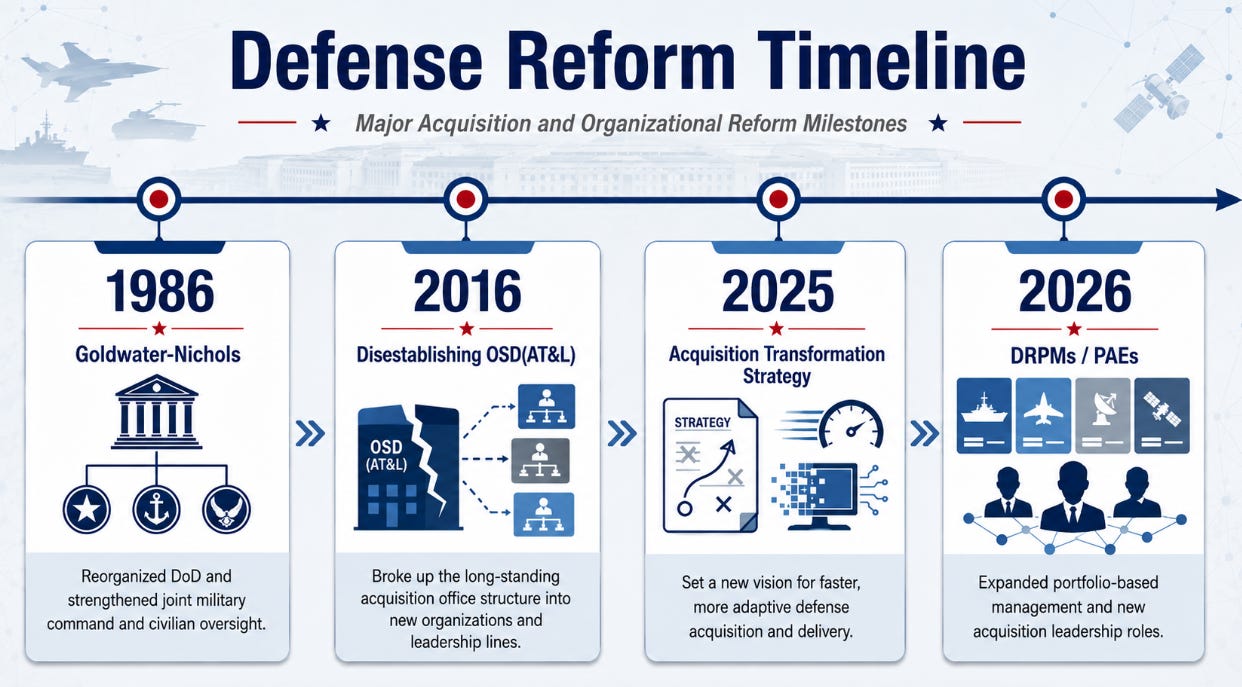
Since Goldwater-Nichols (40 years ago), major Department reforms have wrestled with the same tension: how much decision authority sits at the top versus how much gets pushed to the people closest to the problem.
In 2016, Congress broke up the OSD(AT&L) enterprise into A&S and R&E, along with delegating authorities for most major programs back down to the Services. Smaller programs were further delegated to PEOs.
Over the last year, the Department rolled out ~39 Portfolio Acquisition Executives (PAEs) across the Services. These leaders are empowered to manage dynamic portfolios spanning acquisition, R&D, budgets, requirements, and sustainment, and do so to varying degrees.
The Department also established four new Direct Reporting Portfolio Managers (DRPMs) and a Munitions Acceleration Council (MAC) that report straight to the Deputy Secretary of War for select portfolios along with an Economic Defense Unit (EDU) and Business Operators for National Defense (BOND). The Acquisition Transformation Strategy empowers portfolio leaders and consolidates authority.
Where This Comes From
We started our careers in a program office then moved to the PEO level, the Air Force acquisition executive level, and finally OSD. At every stop, we kept the program office instinct: get close to the problem, trust the people closest to it, and measure yourself by what actually got delivered.
Bureaucracies have a predictable failure mode. People generally view those in layer above you as the micromanagers. They often view those in subordinate organizations as making dumb calls. Both views are usually wrong, and both are symptoms of the same root cause: nobody trusts the layer next to them enough to let go.
The 90% Problem
A former boss used to cite the Lake Wobegon effect: that if you surveyed everyone in your organization, 90% of people believe they are above average.
Program managers believe they are executing as best they can against enormous constraints. This includes being understaffed, annual budget instability, and operating in a complex, dynamic bureaucratic environment. Executives in the Pentagon often believe the program managers are missing obvious problems. Both are operating on incomplete information. This was a recurring issue we saw across major programs.
A key aspect of the new PAE portfolios is providing better metrics and reporting to provide leadership and stakeholders real insights into PAE decisions and progress. Is the portfolio delivering warfighting capabilities at greater speed and scale? Is it fueling greater industry competition to decrease costs and increase innovation?
Directing Versus Asking
The philosophy we carried up through every level was simple. Empower and mentor the people below you, let them learn by doing (and occasionally failing), and they come out better for it.
If an executive asks a manager why they did something a certain way, that question opens up a conversation. It forces critical thinking, and it puts the ownership of the answer where it belongs.
If the executive instead tells the manager how the program should be run, that closes the conversation down. The manager loses ownership of the strategy. The executive loses accountability for the outcome, because now it’s the executive’s call, not the manager’s.
When the program struggles, which most do, both sides quietly blame the other. Nobody actually owns the failure, which means nobody learns from it either.
This is the core argument against reflexive centralization: it doesn’t just slow decisions; it breaks the accountability loop that drives organizational learning.
Why Centralize Anyway
The new DRPM(UxS) will report directly to the Deputy Secretary of War and serves as Decision Authority for the unmanned portfolio, with authority over budget, contracting, technical standards, and test decisions that would normally sit at the Service level. Similar constructs already exist for submarines and strategic systems programs, and the Department is now using that model more broadly.
There’s a strong case here. Decades of entrenched process, bureaucratic hostility to autonomous systems, and platform-centric thinking do not reform themselves. Cross-cutting initiatives, like unmanned systems or munitions that touch every Service, are genuinely hard to solve through independent program offices or even a joint program structure, because no single Service has the authority or the incentive to optimize across all of them. Past attempts have failed. Higher authority gives one accountable leader leverage to force alignment, attract talent, and move faster.
But the risks are real. Decisions travel farther up and back down. The office becomes a designed bottleneck. The people who understand the engineering trade-offs, the contracting realities, and the test data in granular detail are still down at the PAE or program level. Centralizing the decision doesn’t centralize the expertise: it just adds a layer between the two.
Another problem is that fewer managers and executives across the Services are gaining meaningful experience in developing and executing high-level strategy. Without that crucible, they will be ill-prepared to lead major portfolios in the years ahead. At the same time, executives with 25 years of experience have little appetite for being treated as mere middlemen or action officers, simply executing decisions handed down from higher headquarters.
Success depends on execution and leadership personalities, not the org chart.
The Pattern this Usually Follows
Most transformation strategies inside this administration have followed a similar arc. Start with a deliberately disruptive environment to force everyone to confront the need for change. Put an experienced executive in the seat who drives the staff hard through the first few iterations. Once the organization has internalized what “right” looks like, start delegating decisions and authority back down to the level that should own them long-term.
The current wave of DRPMs and Deal Teams could be the forcing function. The real question is whether the Department follows through on delegation once the goals are met, or whether the new authorities simply become the permanent way of doing business. Both outcomes are plausible. Which one happens will say more about the institutional discipline of future administrations.
What has to Happen with PAEs
Portfolio Acquisition Executives are the linchpins. The Acquisition Transformation Strategy is explicit about empowering PAEs with a full team of subject matter experts and the authority to direct outcomes, move money, and adjust requirements without waiting on multiple layers of review. It also calls for a by-exception approach to oversight, using portfolio scorecards so senior leaders can focus on the programs that are actually in trouble instead of reviewing everything with equal intensity.
Oversight should focus on portfolio strategy and strategic trend lines: is the portfolio moving toward the capability the warfighter needs, is risk being managed at a reasonable level, are resources aligned to priority outcomes. It shouldn’t mean reviewing tactical program decisions that PAEs are supposed to own. When a large program goes sideways, and many will, that’s when leadership could get more involved, not before.
This is also the logic behind breaking large, monolithic acquisition programs into smaller, more dynamic capabilities within the portfolio. PAEs can fix issues locally before they become four-star problems.
Way Ahead
PAEs should lean forward to flex their new authorities visibly, document decisions, and explain their reasoning. They can earn more delegation by demonstrating they can handle it.
OSW, SAEs, and senior leaders should ask why before telling how. Every time they substitute judgment, they dilute ownership. Centralizing is a legitimate short-term tool. The harder discipline is knowing when and how to let go.
The spectrum from oversight to insight is still being drawn. This wave of centralization is a reasonable bet as a forcing function to drive change. Whether it becomes permanent or a remains a deliberate phase will define the transformation’s legacy.
As someone who works in the unmanned systems space as a one-man shop helping start-ups and smalls mostly, I see this as just more moving the deck chairs (but only select ones, given the exceptions in the document) vice steering the ship out of danger (by saying "services you had your chance and you have systemically failed to deliver on the promise"). I read the memo when it came out and saw nothing to convince me that anything useful would come out of it.
Trying to re-organize on the fly in a piecemeal fashion, without assessing the "how" of getting the entire community of interest (government, industry, and academia) on board makes it confusing to external agencies who are trying to help. It simply exacerbates the confusion down at the edge where industry is trying to help, but it is literally unclear who they need to talk to, how to contact that person/office, and that person/office is empowered to solve the problem.
Absent precise clarifying language on processes and effective communication to the COI on those processes and who does what to whom, this is simply another cog inserted into an already confusing, inefficient, and ineffective "modernization machine."
I think good leaders and potential centralized should not by default think they're subordinates are making dumb decisions, though we all make bad calls [sometimes] and cultures can lock-in mistakes.
Instead, the reason for higher authority levels should often be collective action problems. Programs managers, for understandable reasons, have incentives that underweight sector or enterprise-wide benefits.
Which collective action problems are most important depends on where you sit and your larger strategic analysis, and there are a range of potential approaches to solving them and [well] established risks in trying to solve too many at once.
PAEs are promising because portfolios are a good unit of analysis for trade offs.
But as one part of my job within A&S I am working with my Service colleagues on Modular Open System Approaches not because program officials are unwise, but because they are constrained and face rational pressures to defect. I think I have a chance of success because the people I work with see the merit and just need facilitation to be able to get after something many of them want to do anyway.
Mine is still a high modernist outlook at risk of ignoring important details about local conditions, but a quality bureaucracy should understand that the interplay and competition of different incentives is driven by the complexity of the problems we face. I am generally most hopeful for acquisition reforms that clearly grasp the trade offs and risks they accept. I am most skeptical of reforms that seem to assume that predecessors or subordinates are dumb.