

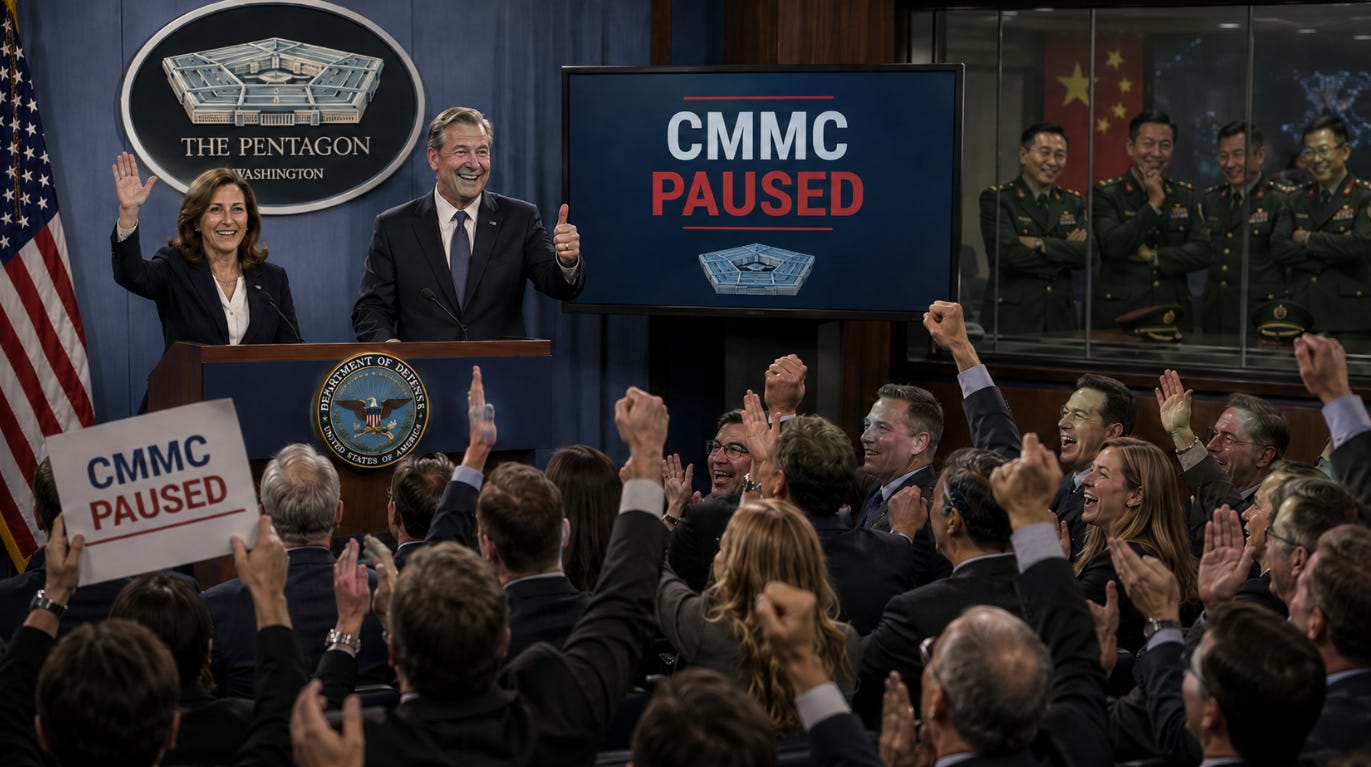
Headlines: USVs Attack, CMMC Paused
New PAEs, Sats, Munitions, and Funding Launched


Welcome to the latest edition of Defense Tech and Acquisition.
First use of US sea drones in attack on Iran; Saronic $3B shipyard in Texas
DoW suspends CMMC Phase 2 responding to industry feedback
OSC scales up lending and hiring; Investments in hypersonics
Army invests in new common launcher and counter drone programs
Navy new AI/data strategy, seeks carrier drones, and digital threads
Air Force graduates final set of PAEs, CCA launches AMRAAM
Space Force CSOs warn of conflict; SDA launches new sats
Europe scales investments in space; Helsing raises Europe’s large round
Congress blocks NDAA, reconciliation, DoD reprograms for personnel

Kamikaze Drone Boats Used By U.S. In Combat For The First Time
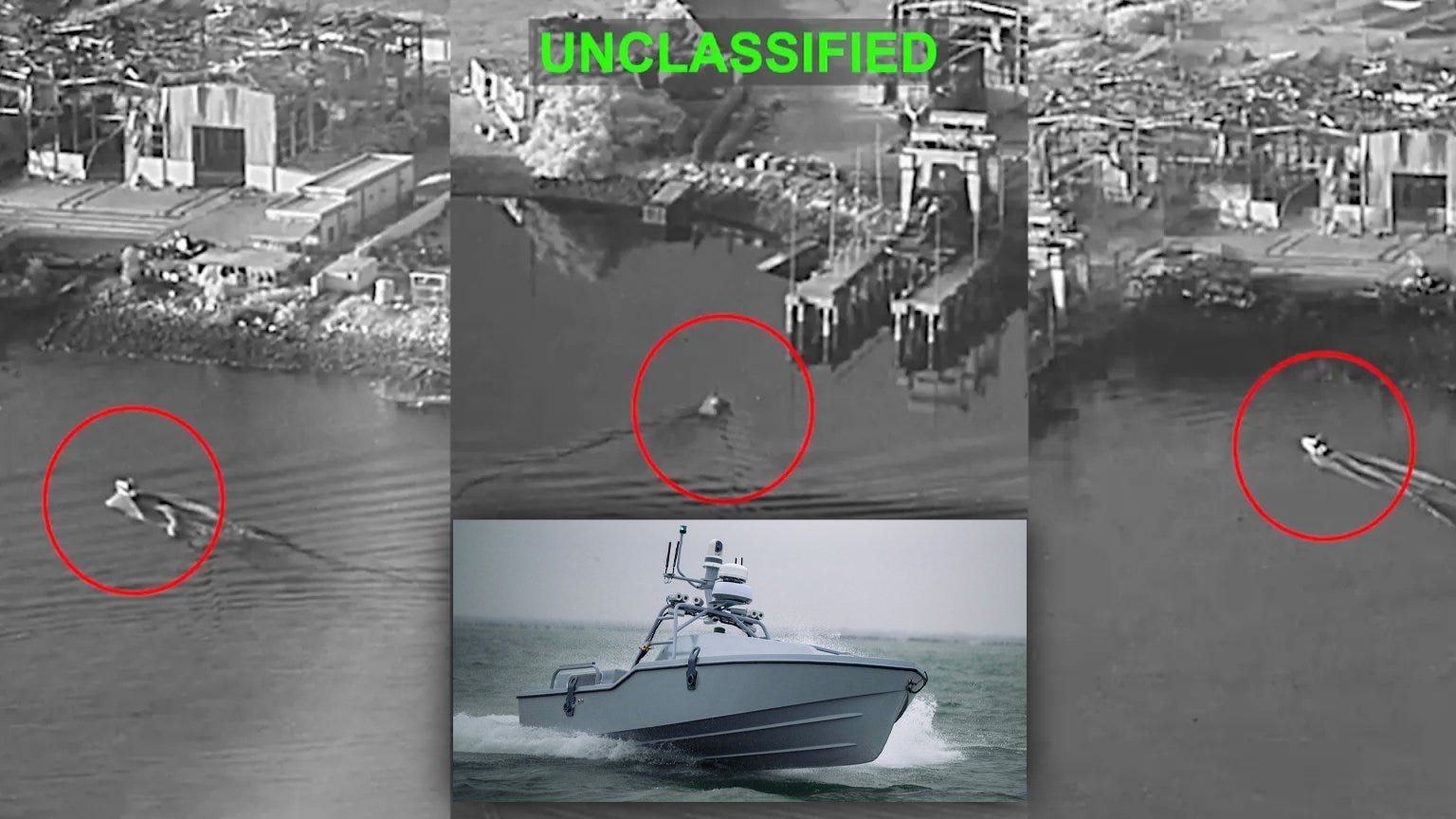
BLUF: For the first time in U.S. military history, USVs were used as a strike weapon in combat. Saronic Corsair USVs engaged a series of attacks against dozens of Iranian target.
Using multiple one-way attack surface drones, CENTCOM forces successfully struck a submarine and ship maintenance facility in Iran.
Three Corsair unmanned surface vessels hit the port at Bandar Abbas Naval Base, marking the first time American forces have employed sea drones in combat operations.
The strikes degraded Iran’s ability to continue attacking commercial shipping.
Last month, a Saronic Corsair USV rescued the crew of a U.S. Army AH-64 Apache that crashed in the Gulf of Oman. That was the first known instance of a drone boat being used to recover personnel as part of a search and rescue mission.
Task Force 59 is a testbed unit tasked with experimenting with the integration of uncrewed and AI capabilities into day-to-day naval operations across the Middle East. The task force is starting to operationalize these technologies.
Using USVs in an attack role could help reduce the burden on aircraft and crews for strikes, at least against certain targets out to sea and along the coast. Above all else, it creates another vector for kinetic operations against the enemy, which complicates their defensive plans.
“I think the tangible impact to the industry is that autonomous systems are now perceived as real credible capabilities rather than a science and technology kind of sideshow where we’re desperately trying to prove that the tech can play a role in these types of operations. So my hope is that not just for Saronic, but all of our partners on the commercial side, that it’s an accelerant to getting more of these capabilities in the war fighters’ hands.” Rob Lehman, Saronic co-founder
Our Take: Kudos to the CENTCOM and Saronic teams. This is yet another clear demonstration that the Navy and DoW must urgently accelerate the adoption of drone technologies across a wide range of missions.
They should rapidly procure a diverse array of platforms and payloads from multiple vendors, then empower operational commands to experiment with, exercise, and fully employ them. Operators, acquisition professionals, and industry partners must iterate quickly and scale these efforts. Senior leadership needs to apply sustained pressure especially on resistant Pentagon bureaucrats to develop robust OPlans and secure the necessary investments in unmanned capabilities.
Related US Military Uses Corsair Maritime Drones to Attack Iran and In First, US Uses Sea Drones in Combat in Iran Strikes: CENTCOM
Pentagon Announces Immediate Suspension of CMMC Phase II Mandate
BLUF: Top Pentagon officials said as currently executed, CMMC is too prohibitively burdensome on the Defense Industrial Base.
The Pentagon is suspending part of its cybersecurity requirements for industry, specifically related to third party assessments, citing onerous burdens on especially smaller defense firms.
We’re seeing that there’s over 100,000 DIB businesses still that needed a third-party assessment conducted and somewhere in the neighborhood of 100, maybe a little over 100 assessors that are available for that. So the math just simply doesn’t math.
“In support of Secretary of War Hegseth’s directive to aggressively scale warfighter readiness, I’m announcing the immediate suspension of CMMC Phase II requirements, which were originally scheduled to go into effect November 10, 2026. I want to be clear across the DoW and our defense industrial base, investing in and dynamically maintaining robust cybersecurity remains a critical non-negotiable priority. This action does not eliminate the legal requirement for our industry partners to protect federal data. We are not reducing cybersecurity through this measure. We are reducing the red tape.” Kirsten Davies, DoD CIO
“We are halting complex audits. We are stopping the requirement for third-party assessors and audits. We are cleaning up active solicitations immediately. If a current defense solicitation or contract contains those suspended phase two requirements, I have directed our program managers and contracting officers to amend or modify them ASAP.” Michael Duffey, USW(A&S)
Related: Pentagon task force to review CMMC hits the ground running
What Security Leaders Do Now in Wake of CMMC Pause
BLUF: Trade coverage is framing the suspension of CMMC Phase 2 as a compliance win for the defense industrial base. It isn’t one. It’s a transfer of risk from a government verification process onto every security leader’s own signature.
What went away is the independent check that used to sit between a self-attested compliance score and a federal contract award. If a cybersecurity worker runs security for a defense contractor or subcontractor, that change should raise their concern level, not lower it.
GAO and SBA publicly credited compliance costs approaching $600,000 for some small contractors with pushing firms out of the defense supply chain rather than bringing new entrants in.
Security leaders should treat this suspension as a forcing function to fix the actual gap between what a self-assessment claims and what the environment can demonstrate — not as permission to slow down.
Stop treating Supplier Performance Risk System accuracy as a compliance-team task and start treating it as an executive liability question.
Build continuous evidence generation into architectures instead of point-in-time documentation.
Treat the department’s RFI open through Aug. 14 as a genuine channel.
Pennsylvania Defense and Innovation Summit
Senator Dave McCormick hosted the first ever Pennsylvania Defense and Innovation Summit at the Army War College in Carlisle, PA. Over 1,300 attendees including 600+ C-level executives from 500 organizations. Over 30 announcements were made on advancing American shipbuilding, munitions, space industry, innovation, and emerging tech with a total of $10B in new investments supporting 4,000+ jobs.
Speakers included President Trump, Gen Caine, Emil Michael, Michael Duffey, Dan Driscoll, Troy Meink, John Ratcliffe, Jamie Dimon, Kelly Loeffler, and C-Suite executives from defense primes, defense tech companies, and investors.
“The way I think about this is the three amigos of America’s defense: funders, founders, and fighters. And you got to have all three to drive America’s combat capability.” - Gen Dan Caine, CJCS
Announcements Tied to PA Summit

DoW Issues Final FY26 APFIT Awards - Surpasses $2B

DoW announced 24 new awards under the Accelerate the Procurement of Fielding of Innovative Technologies (APFIT) program surpassing a $2B lifetime total.
This latest cohort builds on APFIT's proven track record of rapidly transitioning cutting-edge technologies into operational use, delivering over 100 unique capabilities to date to the warfighter at speed and scale. The $476M in new awards include:
Advanced Navigation for UAS and Launched Effects, $11.24M, Army
Assured PNT Device at Scale, $43M, Army
Autonomous Low-Profile Vehicle (ALPV) Liberty, $32.58M, Marine Corps
Beyond Line-of-Sight Link (BLink), $15.55M, PACOM
Counter for All-Domain Operations, $28M, Army
Dragonfly – Electronic Warfare Sensor, $24.17M, SOCOM
Drake Counter-Unmanned Aircraft System (C-UAS), $11.35M, Navy
DYNAMO Expeditionary Power, $20.5M, Air Force and Marine Corps
Expeditionary Multi-Band Protected Communications, $15.86M, Navy
Forward Operations Resilient Grid & Energy Environment (FORGE), $14.72M, Army
Harbinger Open-Architecture Mass Munitions, $30.2M, STRATCOM
High-Energy Density Fuel, $23M, Marine Corps
Kinetic Electronic Safe and Arming Devices and Payloads, $12.98M, Marine Corps
Low Collateral Effects Interceptor & Multi-Mission UAS, $17.5M, Air Force
Mira Highly Maneuverable Spacecraft, $19.75M, Space Command
Optical Navigation Kits, $13M, Space Force
Persistent Subsea Autonomous Profiler (PSAP), $30.8M, Navy
Self-Detoxifying Metal Organic FW Suits for Chem/Bio Protection, $23.67M, DTRA
Tactical Airborne Communications Kit (TACKit), $12M, Air Force
Unruly Portable, One-Way Attack UAS, $31M, SOCOM
Vehicle Protection Active Terahertz Sensor (VPATS), $12M, Army
Wallabee – Low sSWaP Sensing System, $11.3M, NORTHCOM
WaterCube, $10.3M, TRANSCOM
XSTAT Injectable Hemorrhage Control Devices for Bleeding, $11.42M, DHA
"APFIT has fundamentally reshaped how the DoW accelerates the transition of innovative technologies to the warfighter. Our adversaries are not waiting, and neither will we. By scaling the APFIT program past $2B, we are equipping the Joint Force with the lethal capabilities to guarantee dominance on the battlefield." Emil Michael, USW(A&S)
Our Take: We’re big fans of APFIT and happy to see these latest awards across a broad mix of capabilities across the Services and CCMDs. APFIT provides a critical bridge PPBE delays to accelerate warfighting capabilities.
DIU Outlines New Vision
Owen West and MGen Joseph Kunkel
In Its Next Chapter, DIU Aims to Reduce the Military’s Cost Per Kill
BLUF: We just can’t do business the old way, especially when we win every engagement in combat, yet we lose many of those in terms of net costs. This involves bringing defense assets to bear at scale, then reducing the military’s metric for cost per enemy killed.
There are two external factors that make DIU’s reorganization really important.
$250B of venture and other capital flowing into the defense tech space.
How other nations have simultaneously plowed into low-cost, high-tech manufacturing, mass production and fielding of weapons capabilities.
We’re a mature business now — and as a field activity, we now have permanence within the department. So we have to deliver in clear terms operational combat power to the field.
DIU’s role and obligation to speed up procurements and adoption of new capabilities unambiguous to all stakeholders.
In changing how DIU does business, they are also introducing new tools to measure how and where the dollars spent by the organization are translated directly into the field. One of those will be digestible scorecards DIU will post online and share with Congress and its board of directors to promote accountability.
DIU will use that to evaluate and improve its outputs to DOD’s users over time.
Among those metrics, I think one of them has always been speed to contracting, for instance once you put out an indication of interest, how long does it take for something to go on contract and many other things to this, such as fielded capabilities, cost reduction.
“I just want to make sure that we get drones in the hands of troops, and we build up a capability in space that cannot be matched for 10 years by our enemies. SECWAR is determined to get on the other side of this cost exchange, and he has tasked DIU with reducing our cost per kill, and dramatically so.” - Owen West, DIU Director
The Pentagon Built a Faster Engine, Nobody Built the Steering
BLUF: The DoW has just executed the most ambitious acquisition reform in six decades. It scrapped JCIDS — the requirements process that ossified innovation for a generation; replaced program offices with portfolio executives, and built a Warfighting Acquisition System designed for speed.
The changes deliver on years of reform proposals. They also risk repeating a costly mistake of the post-9/11 wars: chasing evolving threats with rapid fixes while no one is responsible for understanding them. Industry will help determine which path prevails.
Consider the counter-drone fight, the clearest test of the new system. Washington treats it as an engineering puzzle. While the technology works, the process for getting it to the warfighter does not. Cheap interceptors proven in Ukraine still have no fast path into U.S. formations.
A new drone variant appears on the battlefield every week, built from commercial parts and open-source software. A firmware update that defeats a jammer costs nothing and takes hours. Our counter, even through the reformed system, takes months.
This is not a technology gap. It is a cycle-time gap.
Successful innovation runs in six phases — detect, define, develop, deploy, assess, distribute. The reforms invested almost entirely in the middle two, develop and deploy. Nobody persistently monitors how the threat evolves at the tactical edge.
DOW should start by doing three things differently.
Invest in problem discovery, not product pitches. Requirements still originate in headquarters, not from soldiers watching the problem in context. The companies that win the next decade will be the ones that put engineers and business developers forward with operational units to understand problems before proposing solutions.
Build for adaptation, not for the requirement. If your product cannot change in weeks — modular hardware, software-defined behavior, upgrades at firmware speed — it is obsolete on delivery.
Plug into the new portfolio structure as a sensor, not just a supplier. Industry keeps asking the department for a clearer demand signal, and fairly so. But the demand signal has to come from somewhere, and the fusion cells that PAEs need cannot function without industry feeding data in and absorbing assessment data out.
Alumni Ventures is offering readers early access to high-growth startup opportunities, including companies like Cambium, which recently raised $100M and was available to AV Syndicate members before the round.

You get:
• Curated deal flow of high-potential U.S. Strategic Tech startups
• No cost and no commitment to join
• The flexibility to invest only if a company excites you
Don’t miss your chance to access opportunities before they close.
AI in Battlefield Intelligence: Expanding the Speed of Decision-Making
BLUF: AI can compress the time between data collection and actionable insight on the battlefield, but that speed creates a structural tension with the validation and human oversight needed to prevent costly errors.
Debate comes into sharper focus as the U.S. Army advances an AI-powered battlefield intelligence system trained on real combat data to support real-time situational awareness and decision-making.
The initiative reflects a broader shift across defense organizations toward leveraging AI to process vast, complex data environments at operational speed.
Modern military operations generate continuous streams of information from sensors, comms networks, reconnaissance platforms and intelligence feeds. The scale and velocity of this data exceed human cognitive capacity, particularly in high-tempo environments.
AI systems are increasingly being deployed to help identify patterns, surface anomalies and prioritize information, so commanders can act more quickly with greater context.
Faster movement from detection to recommendation increases the risk that incomplete, biased or maliciously manipulated data could influence outcomes before proper validation occurs.
In military and critical infrastructure settings, decisions rarely exist in isolation. Actions taken in response to a perceived threat can create downstream effects across missions, systems, supply chains or broader security operations.
AI can help identify patterns, surface risks and accelerate analysis, but it cannot fully account for intent, operational priorities, or the broader consequences of acting on incomplete or degraded information.
Key industries rely on real-time data and automated systems to detect anomalies, optimize performance and support rapid response. Speed increases efficiency while also increasing the potential for error propagation when systems are not properly governed.
Success will require clear decision boundaries, disciplined validation processes, and sustained human engagement in interpreting outputs under pressure. The constraint is no longer AI capability, but decision authority under compressed time.
How a Former Marine Is Rewriting the Future of Battlefield AI
BLUF: A Marine veteran turned SOPAC CTO forced commanders to define their actual technology needs before rebuilding the Pentagon's data pipeline around smaller, edge-deployable compute clusters instead of massive centralized nodes.
The Pentagon’s War Data Platform, a branch of the Advana system digesting thousands of data feeds, has already been used to incorporate dozens of real-time feeds during Operation Epic Fury against Iran.
Bala Selvam found DoD data workflows were built for environments with abundant connectivity and compute, a poor fit for INDOPACOM’s vast distances.
The distance from INDOPACOM’s Hawaii headquarters to its second-largest data center is 9,000 miles, too far for efficient data transfer even with low-earth-orbit satellites; analysis and bureaucracy could add thousands more miles before data reached warfighters.
Selvam asked INDOPACOM leadership to write down everything they expected people to do, then physically took away commanders’ computers until they could specifically define the tasks they needed AI for.
Selvam’s team designed smaller cloud compute clusters (nodes) sized to support battalions of a few thousand troops rather than divisions of 20,000+, built to be harder to target and to require less power and infrastructure.
The approach assumes connectivity exists up to the point of conflict, with most AI inference happening in the AWS cloud, but the team found smaller, more efficient models could still deliver strong results at the edge.
The CDAO said in May the War Data Platform was drawing on roughly 4,000 data sources from more than 55 organizations; officials say Selvam’s compute-cluster concept could become a program of record.
“If you look at what's happened with Operation Epic Fury, in particular, we were able to incorporate dozens of new feeds in real time that allow us to not only serve up that data in the right format, right structure, and everything else for those, for those applications to leverage, but also get data at the speed of conflict.” Cameron Stanley, CDAO
L3Harris and Shield AI Complete First DiSCO EW Drone Flight
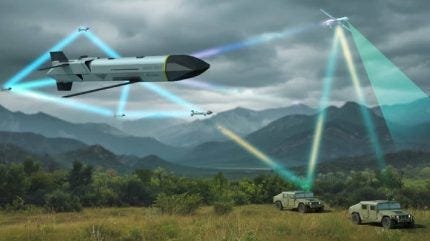
BLUF: L3Harris and Shield AI conducted the first live flight trial of their Distributed Spectrum Collaboration and Operations (DiSCO) system.
The demonstration used Shield AI’s Hivemind mission-autonomy software onboard an L3Harris Green Wolf UAS, enabling the platform to autonomously detect and respond to electromagnetic threats.
The test took place at a live range where uncrewed platforms equipped with the L3Harris Deceptor EW payload identified and analysed unknown spectrum threats.
The UAS used data shared through DiSCO to autonomously direct follow-on systems through the operational area, eliminating the need for human decision-making during the process.
The scenario demonstrated several aspects of networked and distributed EW as the Green Wolf system, configured for both electronic attack and advanced detection, operated alongside other UAS equipped with EW payloads.
“This successful demonstration shows how quickly we can transform concepts into operational capability for the joint force. By pairing autonomous decision-making with advanced spectrum battle management, we’re giving warfighters the resilience and speed they need to stay ahead of rapidly evolving threats.” Lauren Barnes, L3Harris Spectrum President
Our Take: We’re happy to see another example of traditional and non-traditional defense companies partnering to deliver best of breed solutions.
Air Superiority Over Battlefields Demands Both Standoff and Penetrating Airpower

BLUF: The war in Ukraine has revealed many insights about modern, high‑end combat, but perhaps the most consequential is the indispensable value of air superiority. Neither Russia nor Ukraine has made meaningful territorial gains over more than four years of war, because neither side has been able to effectively control the air over the battlefield, a necessary means to obtain strategic advantage.
Both possess advanced surface‑to‑air missile (SAM) systems, yet neither has the advanced aircraft and missiles needed to evade and defeat them.
U.S. and Israeli stealth aircraft effectively dismantled similar Iranian integrated air defense systems to secure air superiority and then strike Iranian targets freely.
With vulnerable older generation fighters and bombers both have relied on drones and cruise missiles.
Some pundits claim cheap drones and cruise missiles are the future; traditional airpower is obsolete; and America’s next war will be dominated by small unmanned systems. Combine inexpensive drones with point defenses, they argue, and one no longer needs to command the air—or to pay for all the expensive systems required to gain air superiority.
The sophisticated anti‑access/area‑denial (A2/AD) networks built by China place SAMs in front of the targets they are defending and their S‑400s and indigenously produced HQ-19s would post threats to non-stealth bombers.
When comparing the expense of any weapons system, the correct metric is cost per effect, which is the total cost required to achieve a specific desired outcome or "effect" in operations, rather than just the upfront unit price of a weapon and/or platform.
In a war with China, the U.S. will absolutely need long‑range standoff weapons. But it will also need the penetrating capabilities of the B‑21, F‑47, and F‑35—and it will need them in meaningful numbers.
Small drones will certainly be part of the next peer fight, but the weight of the air war will fall squarely on the shoulders of classic airpower.
Related for Navy: Why Navies Still Matter in the Age of Drones
If Adaptability Is Our Competitive Advantage, Why Don’t We Invest in It?

BLUF: A senior military leader recently argued that America’s competitive advantage was not its aircraft, ships, satellites, or weapon systems, but its people. Their ability to think creatively and adapt faster than our adversaries. If adaptive thinking is truly our competitive advantage, why do we spend so little time discussing how to create it?
Defense leaders continue to highlight: The future will be uncertain. Technology will continue to accelerate. The next conflict will not look like the last one. Success will belong to those who adapt faster than their opponents.
What I find less convincing is our institutions behave as though they believe it. I call this the adaptability gap: the distance between how much an organization says adaptability matters and how much it invests in producing adaptive people.
Competitive advantage eventually appears in the budget. Show me where an organization spends its money, develops its people, and rewards performance, and I can usually tell you what it believes will make it successful. A competitive advantage is not what you admire; it is what you fund.
Organizations rarely fail because they misunderstand what creates competitive advantage; they fail because they overestimate how much of it they possess.
If talent is your competitive advantage, show me your recruiting budget. If innovation is your competitive advantage, show me your experimentation budget. If adaptability is your competitive advantage, show me what you spend identifying, developing, rewarding, and promoting adaptive people.
Our Take: We fully agree. While the Marines live by the mantra of “improvise, adapt, and overcome” (which we’ll cover in an upcoming post), the Department must build far greater adaptability into its core processes, budgets, and warfighting capabilities. Beyond enterprise structure alone, it must also weave greater adaptability into professional development.
Pentagon’s New Low-cost Cruise Missile Push Includes Contract for Cargo-Plane-Capable Weapons
BLUF: The Pentagon signed framework agreements with Anduril, CoAspire, and Zone 5 to mass-produce low-cost cruise missiles under the Family of Affordable Mass Missiles program, including a cargo-plane-launched variant.
FAMMs split into two designs: one attaches to existing aircraft launch points, the other drops from a cargo plane’s rear ramp as a palletized weapon without modifying the aircraft.
Anduril’s entrant is the Barracuda-500, backed by over $40M invested in a California production facility, with production shifting later this year to the company’s Arsenal-1 facility in Columbus, Ohio; it shares 90% of parts across its missile variants.
CoAspire’s Rapidly Adaptable Affordable Cruise Missile (RAACM) competes exclusively as an air-launched cruise missile.
Zone 5’s Rusty Dagger, styled more like a glide bomb with a reported range over 285 miles, has reportedly already been used against targets in Russia; the company was acquired by Norway’s Kongsberg earlier this year.
The deals are structured as seven-year, fixed minimum-quantity agreements at locked-in prices, intended to stabilize demand signals for industry, though they still require congressional approval.
“Today’s announcement showcases the Acquisition Transformation Strategy in action, expanding the defense industrial base, fielding capabilities faster, and attracting private investment to fund innovation and increase manufacturing output.” - Michael Duffey, USW(A&S)
Other Defense Tech News:
Air commandos seek ‘SOF-peculiar’ attack drones with automatic target recognition capabilities
Don’t just pick the low-hanging fruit — harvest the whole orchard

Saronic Announces New $3B Shipyard In Brownsville Texas

BLUF: Saronic has been making headlines with its drone boats, but its Texas shipyard supersizes its nautical ambitions.
Saronic announced it will build a big new shipyard in Brownsville, TX where they plan to construct an array of crewed and uncrewed ships as big as 850 feet.
It is a big step for Saronic whose largest vessel is a 180-foot drone boat Marauder.
Boosting America’s capacity to turn out new ships and keep existing ones sailing has been a focus of the administration.
Saronic said it plans to invest more than $3B of its own money to build the facility, Port Alpha. The location was chosen after a year-long search.
Initially situated on 835 acres at the Port of Brownsville, with the opportunity to expand to nearly 4,400 acres, Port Alpha will encompass a shipyard and manufacturing facility capable of producing vessels up to 850 feet.
Future site expansion could support the production of vessels over 1,200 ft.
The site provides hundreds of acres of waterfront access, deepwater channel connectivity, multimodal logistics infrastructure, and room for long-term expansion—everything required to anchor a next-generation shipbuilding hub.
“Port Alpha is planned to be the largest shipyard in the Western Hemisphere. We are seeing the need for more shipbuilding capacity, and we are answering the call with a greenfield new yard that will provide the Navy, Coast Guard the capacity that they’ve been asking for, and they desperately need.” Rob Lehman, Saronic co-founder
Related: Saronic Picks Brownsville, TX for Port Alpha
OSC Introduces National Security Fund Finance (NSFF) Program
BLUF: The DoW’s Office of Strategic Capital announced today the National Security Fund Finance (NSFF) program, a new initiative with funding provided by One Big Beautiful Bill Act to strengthen America’s critical minerals supply chain.
By partnering with private capital, the program will help drive investment in critical minerals and materials that are essential to restoring domestic production, strengthening the American industrial base, and addressing critical supply chain vulnerabilities.
The Notice of Funding Opportunity will be released soon. The application link will be posted on the Office of Strategic Capital’s website upon publication at https://www.cto.mil/osc/.
Meet the Wealthy New Investor Taking Equity Stakes in Defense Companies: The Pentagon

BLUF: The Senate's defense spending bill would codify the Pentagon's path to ownership stake in private firms
The administration’s accelerating push to take direct financial stakes in private defense and critical minerals companies raises a host of political, ethical, legal, financial and even long-term strategic questions for the U.S. military. It has taken direct equity stakes in more than 20 private companies.
The Pentagon itself has taken, or intends to take, equity stakes in at least four private firms: one in an L3Harris spinoff that will produce solid rocket motors for munitions, and the others in companies that mine and process rare earth elements and other critical minerals.
A provision in the FY27 defense spending bill now being debated in Congress would give the Office of Strategic Capital new authority to take such ownership stakes in private companies.
The federal government has a long history of giving loans, grants or other financial aid to private businesses. Such programs typically prioritize a specific product or technology that the government considers important, often for national security reasons.
OSC is increasingly becoming a major power center inside the Pentagon. The DoW announced the creation of the National Security Fund Finance program inside OSC.
The program will provide loans to qualified investment fund managers, who will combine OSC loans with private capital to invest in portfolio companies focused on addressing U.S. national security shortages related to critical minerals and materials.
That new system will give the Pentagon an additional avenue to funnel money to companies working in key national security areas, such as rare earth elements and critical minerals. Individual investments in a company would be capped at $500M.
“The concern that I have with it is that I don’t want to pick winners and losers necessarily. And at what point do you suddenly start using one company because you have an interest in it? I think there’s some discussion that’s going to occur yet on that.” Sen. Mike Rounds
“We’ve been investing in U.S. industry in other ways forever, and I think that’s quite appropriate, particularly where you have very high risk, fundamental research that has to be done before something can move toward a commercialization phase. I think when you get to ownership, that’s a different matter. Ownership creates a situation where the parties that are competing with them that are not owned by the government, are they disadvantaged? Are there moral hazards there? And I think there very well could be.” Miles Arnone, CEO of Re:Build Manufacturing
Our Take: The Department and Congress should adopt a clear strategic approach to these investments. Congress should authorize Pentagon equity stakes, but only as a narrowly tailored instrument of last resort, not routine industrial policy. Equity is appropriate solely when the nation faces a demonstrable, strategically consequential market failure that contracts, multiyear procurement, loans, guarantees, grants, or DPA funds cannot resolve. Used selectively, it can unlock capital-intensive production, protect fragile suppliers, and deliver taxpayers upside. Used too broadly, it risks politicizing source selection, distorting competition, and creating conflicts of interest that favor USG-backed firms. It would also deter businesses from national security markets that must surrender equity. OSC’s new fund, which provides loans aligned with private capital, offers a valuable model to accelerate and scale priority investments.
US Munitions Stockpiles, Rare Earths Shortages Not New Amid Increasing Awareness

BLUF: The U.S.’ diminishing armaments stockpiles have been highlighted by ongoing conflicts in Iran and Ukraine, but the problem runs much deeper in a slow procurement process that has weakened necessary supply chains.
The U.S. has become too reliant on China for rare earth metals used in defense applications and the process of acquiring more domestically is too slow.
The structures and financials behind current efforts are too complicated.
Large deals to open new facilities, factories, energetics and chemical plants are really complicated and most people in government have not done them before or worked in the industry.
Industry are seized by this problem of the shortcomings, not just in our supply and in our stockpiles of munitions, but also in the challenges that undergird what it would take to rebuild.
In the last 18 months we’ve seen some reforms that actually start to put the needle on this, where you’ve got on-ramps for new entrants that are producing more rapidly developed and field-based capabilities.
The lack of funds created by the DoD’s two years of continuing resolutions will continue to affect every component of munitions production.
While steps are being taken to increase munition stockpiles and domestically produce rare earth metals, Smith said American innovation and creativity will solve the problem, noting an encouraging increase in trade school admissions.
The above was based on discussions by Mark Smith, Mackenzie Eaglen, Rachel Hoff, and Dominique Yantko at a recent National Security Institute event.
Pentagon Dangles $400,000 Salaries to Recruit Wall Street Bankers

BLUF: The Pentagon is aggressively recruiting Wall Street bankers, private-equity, and private-credit professionals salaries up to $400,000 to staff OSC and deploy >$200B in investments aimed at strengthening U.S. defense manufacturing and supply chains.
OSC grew from a five-person core deal team earlier this year to roughly 35 specialists, with plans to hire about 40 more, recruiting from private equity, private credit, and investment banks including Goldman Sachs, JPMorgan, Morgan Stanley, and Bank of America.
Many recruits are taking substantial pay cuts from seven-figure private-sector compensation; salaries reach cabinet-level pay and, in some cases, the presidential-level $400,000 mark, with some arrangements allowing recruits to retain private stock options or carry.
OSC is targeting more than 30 sectors considered vital to national security, including semiconductors, shipbuilding, critical minerals, undersea cables, and telecom, and lending is not limited to firms that supply the military directly.
Effort sits within a broader administration push to reindustrialize supply chains, overseen by DEPSECWAR Stephen Feinberg, the Cerberus Capital Management co-founder now reshaping Pentagon investment and acquisition operations.
Defense Industry Shifts Procurement Model to Speed Drone Deployment

BLUF: The rapid evolution of software-centric vehicles on the battlefield has placed new pressures on the DoW to restructure its acquisition models.
Few technology developments have turned the military’s acquisition and deployment requirements upside down more than the advent of cheap drones.
Traditional five-to-ten-year hardware procurement cycles and high-priced systems no longer meet the needs of modern warfare. That’s prompting the military services and the defense industry to fundamentally restructure their acquisition models.
Part of that restructuring involves shifting how requirements are established by encouraging engineers to test new technology solutions directly on the battlefield.
Rather than evaluating UAVs solely on standalone hardware specs or volume, defense agencies are also prioritizing the development of operating systems that more easily integrate with common C2 networks.
Rather than starting with a set of requirements and shopping for the most qualified solutions, defense leaders are having programmers identify a specific field operational problem and prototype technical components directly alongside operational units.
The defense industry must also develop new approaches to making autonomous vehicles more fault-tolerant, resilient and survivable.
Software is no longer about ‘smart platforms. It’s about ecosystems as capability and interoperability become the dominant drivers.
As software increasingly defines modern tactical vehicles, industrial developers and government partners must collaborate through open APIs to give remote units the flexibility they need, as demonstrated at Operation Jailbreak
“To me, it really comes down to two things… The first is adaptation… The second is integration and common control.” BG Anthony Gibbs, CPE for Mission Autonomy
“The acquisition reform we’ve been through over the last year and a half fundamentally gives us tools we did not have before. The new flexibility allows acquisition executives to change the way we do requirements and adjust dynamically to emerging maritime threats. It also enables engineers to bypass the lengthy five-year planning cycles that routinely stall innovation.” - CAPT JJ Murawski, PAE RAS Chief of Staff
The Fastest Path to Surge Production
BLUF: Defense tech companies should stop trying to vertically integrate their entire production stack and instead partner with established manufacturers to scale from prototype to surge production faster and cheaper.
The instinct to “own everything” for control and speed works against most defense companies; vertical integration only makes sense for the specific capability that creates competitive advantage, such as proprietary flight control algorithms or sensor fusion, not for the full value chain of design, supply chain, automation, and quality systems.
Many companies treat manufacturing as a downstream concern, but scaling problems often originate in the design phase (long-lead-time components, hard-to-scale specialized labor); Re:Build’s “Manufacturing Constrained Design” approach builds production realities into engineering from day one.
Building in-house manufacturing infrastructure can require $10-50M-plus in facilities, equipment, and workforce, often before a company knows whether its product will hit projected volumes, a use of VC is frequently ill-advised.
Re:Build offers an integrated alternative spanning the full value chain, from sourcing components like ruggedized battery packs and military-spec wire harnesses to standing up entire production lines with over a million square feet of production facilities.
The company positions itself as flexible to a customer’s stage, whether that means full end-to-end support or solving one specific bottleneck, arguing this lets defense companies keep capital focused on what actually differentiates their product.
“If you’re a defense technology company and your secret sauce is proprietary flight control algorithms or advanced sensor fusion, then yes, absolutely keep that in-house. That’s where you should be investing your resources, your best talent, and your capital. Vertical integration stops making sense when you try to extend it to everything else in the value chain.” - Miles Arnone, Re:Build Manufacturing CEO
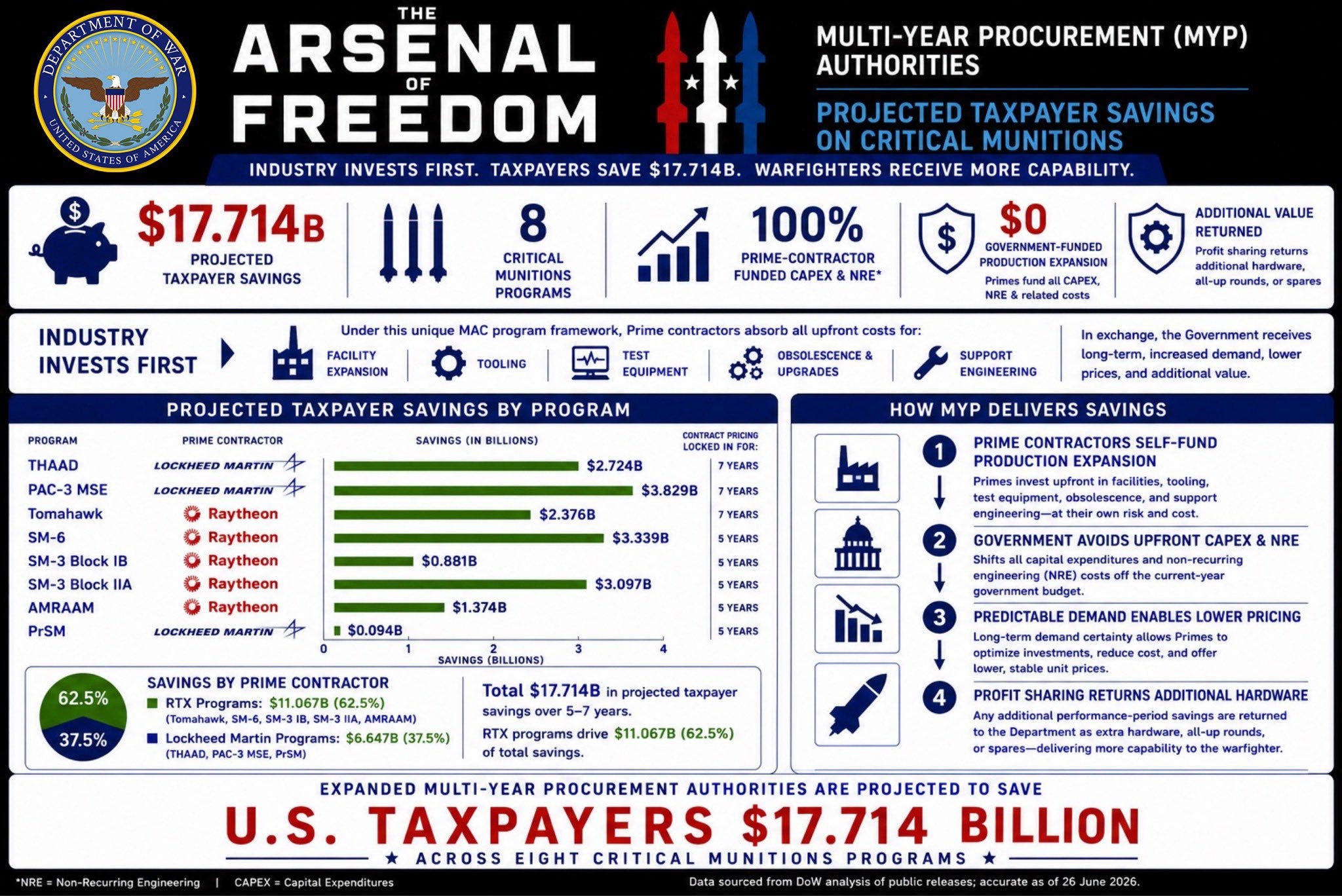
DoW Summary of MYP and Investments in Critical Munitions Programs
US Speeds Up Hypersonic System Development with $400M Funding

BLUF: DoW awarded Kratos Defense & Security Solutions a $400M in funding to accelerate the development of hypersonic systems.
Kratos claimed that it remains at the forefront of hypersonic and advanced technology development and testing, providing affordable, high-performance solutions to meet the needs of the U.S. military and allied nations.
Kratos claims that it’s the only company delivering both propulsion and flyer systems, which includes Kratos’ low cost Erinyes Hypersonic Flyer, Dark Fury, Zeus and Oriole Solid Rocket Motors, along with other Kratos systems and technologies.
“Kratos is a leader in high-speed National Security Systems, including ballistic missile targets, flight test vehicles and recently, tactical systems, where Kratos’ rapid design, engineering, development, flight and fielding capabilities of systems that can be mass produced at low-cost points are clear differentiators for our company.” - Dave Carter, Kratos, President of Defense and Rocket Support Services Division
“Kratos is seeing significant funding from the DoW, which is expected to accelerate our organic growth rate, increase our operating cash receipts, while reducing our customer receivables, inventory and assets.” - Eric DeMarco, Kratos, President and CEO
Other Defense Industry News

Commercial-First Acquisition Will Fail Unless the Workforce Sees It Work
BLUF: Thirty years after Congress mandated a preference for commercial acquisitions under the Federal Acquisition Streamlining Act of 1994, DoW’s commercial adoption is hardly moving from a 16-20% spend on commercial products and services.
Today’s acquisition workforce is being asked to do a lot including fundamentally transforming how the government buys capability while operating with smaller teams, few opportunities to effect change, and accelerating mission timelines.
Behavioral change rarely happens because another memo gets issued or another training module gets assigned. It happens when people can see a different path working in practice, and see it rewarded rather than punished.
The framework in Switch is don’t design change — find the bright spots. Find what is already working and replicate it.
That is more effective than another compliance mandate, because it starts from a fact the reform conversation tends to skip past: the bright spots already exist.
Three things would close it faster than another executive order.
First, elevate peer champions, not management talking points. Identify the KOs and PMs who are already executing commercial buys well and give them a mandate and the time on their calendar to mentor others.
Create safe-to-fail pilot offices. Pick a handful of offices (ideally ones already leaning commercial) and explicitly shield them from the career risk that currently attaches to deviating from the legacy path.
Make the commercial path the path of least resistance, not just a permitted one. The templates, model contracts, and DCMA CIG guidance already exist; what’s missing is default plumbing. Make the commercial template auto-populate and require more paperwork for the non-commercial path.
None of these three ideas require new legislation, a FAR rewrite, or waiting for FY2027 budget cycles. They can start inside a single command, this fiscal year, with the authorities that already exist.
Our Take: We 100% agree with the findings. The recommendations are logical although we have found that forced mentoring is pretty challenging because there usually is a type of person who wants to do that and many others who just want to get their work done (but def worth a try). Regarding career safety, we would argue that almost no one in acquisition has been punished for a delayed program or unhappy user, so the threat is already low on that side. The real issue is having a boss that doesn’t think commercial tech works and having to buck that person (that’s usually how careers get tanked). This is why leadership is so important because if they are encouraging use of commercial, the odds are better that the organization will at least try a bit harder. More concrete incentives like bonuses and recognition could also help reinforce that. The last recommendation made in this article is the most powerful. While I like to think of all my acquisition teammates as warriors ready to take the last charge, the fact is that most choose the path of least resistance i.e. how do I get this think approved so I can obligate my funds and tell the boss we’re on contract. This is why making commercial acquisition easier is the single most effective way to make the acquisition workforce adopt it more.
Post-Advana Rebrand, Accenture Selected for $821M War Data Platform Integration Deal
BLUF: Accenture appears to have beaten out four other commercial bidders to secure a five-year task order worth up to $821M to supply core integration support for the Pentagon’s CDAO-managed War Data Platform.
Advana’s roots go back to the DOD chief financial officer’s unit, at a time when personnel needed to pull data from thousands of disparate business systems that were not all interoperable.
DoW guidance formally restructured the Advana platform into the War Data Platform, billing it as the department’s new common data foundation for AI-enabled military and enterprise operations.
GSA’s Draft AI Procurement Rule Has Improved but Needs Further Reforms
BLUF: Contractors and experts told GSA officials that the draft rule requires further modifications that clarify technical definitions and align with commercial best practices.
GSA published a draft “Basic Safeguarding of Artificial Intelligence Systems” rule in March before releasing a revised version titled the “Basic Safeguarding of Data within Large Language Model Artificial Intelligence Systems (LLMs)” last month.
The latest GSA draft softened language around:
Contractors’ use of foreign AI components
Assigned flowdown requirements based on four general roles: Developers, System Operators, System Integrators and Service Providers —
Axed a specific prohibition of “diversity, equity and inclusion” ideology in AI models in favor of more generally prohibiting “ideological dogmas.”
The proposal’s definition of custom development is still considered too broad by continuing to cover reusable integrator-developed intellectual property.
Another concern raised is that unbiased AI principles language and testing requirements are unclear.
As GSA mulls industry feedback, experts are urging the agency to offer examples of how the large language model proposal would work in practice.
Our Take: We love the suggestion of showing how it would work in practice. All government policies should have to show various scenarios for how the details would be applied. That would be a much better process for refining new policies.
Pentagon Eyes End to PDFs for Budget Transfers
BLUF: For years, DoD has used PDFs to manage how it spreads billions of dollars across the enterprise. Now a team of defense and industry officials are testing whether using modern financial software could get that money out to troops faster.
Jay Hurst established a working group earlier this spring to slash the time it takes to send funds appropriated by Congress down to the program offices and units.
Hurst wants the department to disburse money in a week or two, rather than the current lag time of two or three months.
The group turned to an existing data platform to create a proof of concept that could be used to make the funding process more transparent.
The prototype is currently in testing and will be connected to a visualization platform for executive leadership.
“We don’t have a centralized electronic funds disbursement system. When the comptroller initially gets an apportionment from OMB, we get that via PDF, and then we provide a PDF to the services. That’s obviously not acceptable in the 21st century.” - Jay Hurst at his SASC confirmation hearing Tuesday
PAE/PEO Corner
Col Ryan Frazier PAE SBST confirmed by the Senate to Brigadier General
Eric Zarybnisky PAE Assured Space confirmed by the Senate to Brigadier General
HUGE CONGRATULATIONS TO OUR PAE/PEO FRIENDS. We’re finally getting the acquisition firepower we need in the right places.

Army Partners with Auriga Space to Test Electromagnetic Weapon
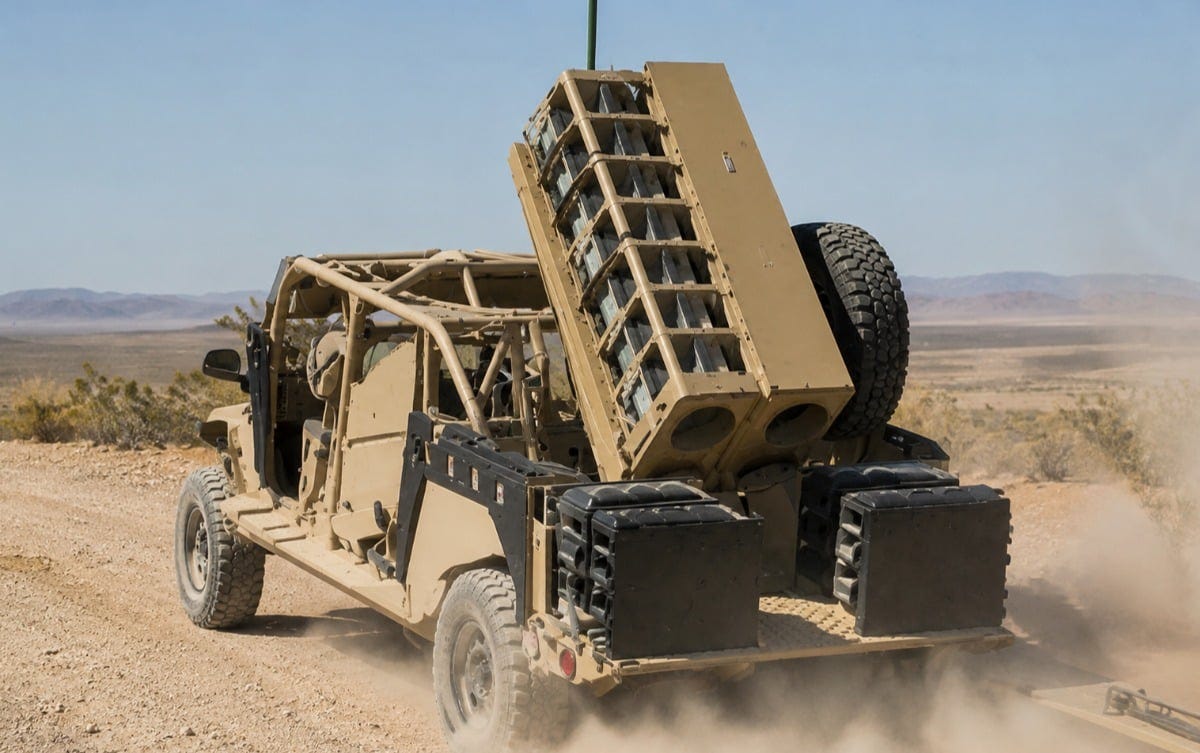
BLUF: DEVCOM Armaments Center and Auriga Space signed a three-year CRADA to develop electromagnetic accelerators for counter-drone defense.
Army has agreed to help test a weapon that fires interceptors using magnets, betting that ditching traditional propulsion might finally solve a math problem that has been quietly draining America’s missile stockpiles.
The CRADA is to explore whether electromagnetic accelerators can offer a cheaper, faster-firing alternative to conventional missile interceptors for shooting down drones.
Auriga’s specific answer to the counter-drone mission is a system called Hermes, a containerized, transportable electromagnetic launch platform built to be moved wherever a deployable defense against drone swarms is needed most, whether that turns out to be a forward operating base, a naval vessel, or a fixed installation guarding critical infrastructure.
Auriga plans the first outdoor flight test of its Hermes electromagnetic launch platform this summer, following existing DoW contracts.
“Attritable drones cost adversaries far less and are far easier to deploy and replenish than present interceptors, and it’s one of the most timely and urgent challenges in modern warfare.” - Winnie Lai, Auriga Space, CEO and Founder
Army’s Heavy Units Face Counter-Drone Capability Gaps

BLUF: Soldiers with 2nd Armored BCT reckoned with a problem heavy units across Eastern Europe have become all-too familiar with in recent years: drones.
Troops launched loitering munitions, reconnaissance drones, and electronic effects at a simulated enemy in concert with tanks, Bradleys, and light vehicles.
UAS still present an enduring issue for the tank-centric formation.
Amid the Army’s sweeping plan to adapt to contemporary battlefields, armor branch leaders have acknowledged “uncertainty” about the community’s ability to adapt, while leaning into new technology, investing in new vehicles — such as the AI-minded M1E3 tank and XM30 replacement for the Bradley — and refreshing doctrine with sections advising tank platoons on drone defense.
The Army has faced deep cuts to its cavalry squadrons and recent divestments to its armor formations amid criticism over its significance. And drones remain a chief concern.
“The inability to defeat drones counts as “the biggest capability gap that we have as an Army Brigade Combat Team in order to maintain maneuver. If we can’t do something about the enemy’s UAS and do it rapidly, then we’re not going to be successful at continuing to maneuver.” LTC Joseph Steadman, 6-8 CAV Commander
Army Moving Forward With Common Missile Launcher

BLUF: The Army is developing an uncrewed common missile launcher and plans to award a Prototype OT agreement in August.
The Common Autonomous Multi-Domain Launcher (CAML) consolidates what has historically been a launcher-per-missile approach into one platform, cutting maintenance, modernization, and sustainment costs.
Two variants: CAML-Heavy on a 15-ton chassis to carry and fire Tomahawk and PAC-3 interceptors; CAML-Medium on a Family of Medium Tactical Vehicles platform for MLRS munitions or AIM-9X interceptors.
The Army scoped the initial launcher around specific missiles like Tomahawk, PAC-3, and IFPC rather than sizing it to its largest weapon, the Long-Range Hypersonic Weapon, to avoid an oversized “lowest common denominator” platform.
The program is on the tail end of vendor demonstrations ahead of the OTA prototype award.
“One, at a very simple level, every missile has its own launcher. That gets very expensive to maintain, modernize and sustain. Very early on, we said we need to collapse into a common launcher platform to the greatest extent possible.” - LTG Frank Lozano, PAE Fires
Army Names Anduril As Potential Hypersonic Supplier

“I have to create greater magazine depth from a hypersonic perspective, and so that’s why we’re actively working with Castelion, we’re actively working with Anduril, and we’re actively working with Ursa Major to expand the scope of the number of hypersonic capabilities that we have in our inventory. I want to be able to stand off at a very long distance and strike key command-and-control nodes. I want to be able to strike key radar sites. I want to be able to take out ballistic missile launch targets.” LTG Frank Lozano, PAE Fires
Army well short of 155mm ammo production goal, Texas facility in the spotlight
BLUF: A DoDIG report found the Army is falling well short of its goal to produce 100,000 155mm artillery rounds per month, with a $469M Texas facility having failed to produce any usable projectile components since opening in 2024.
The DoDIG warned the shortfall “could decrease the DoW’s readiness and increase its risk of not meeting the operational needs of the U.S., allies, and partner nations in potential future conflicts.”
After Russia’s 2022 invasion of Ukraine drained artillery stocks, the Army moved to scale 155mm production from roughly 14,000 to just over 100,000 rounds a month by October 2025; as of March 2026, monthly output stood around 71,000 rounds, or 71% of the goal, without the Mesquite facility’s contribution.
The Universal Artillery Projectile Lines plant in Mesquite, TX, operated by General Dynamics Ordnance and Tactical Systems, was not capable of producing M795 155mm projectile metal parts as of March 2026; the IG said the Army’s response plan does not explain how the facility will start hitting its goal rate.
The Army’s proposed fix shifts some production, roughly 20,000 units to remain at Mesquite and about 9,000 units to NTIB sources not projected to be available until December 2028.
The Mesquite shortfall accounts for only 30,000 of a 64,000-round gap; three other metal-parts facilities are also behind, including GD-OTS’s Scranton Army Ammunition Plant (15,000 of a 35,000 monthly goal) and Canada’s Ingersoll facility, run by IMT Group (roughly 10,000 of a 15,000 goal).

New Concept Explores Converting Commercial Ships into Drone Carriers

BLUF: Elbit Systems is exploring a new maritime surveillance concept that combines unmanned aircraft with converted commercial vessels, creating a new alternative to traditional naval aviation platforms.
Elbit Systems’ proposed solution would transform merchant ships into floating unmanned aviation bases capable of deploying multiple Hermes 650 Spark UAS for long-range ISR missions.
As maritime operating areas expand and become increasingly difficult to monitor, naval forces are seeking ways to extend their situational awareness beyond the limitations of shipborne sensors, helicopters and smaller drones.
Elbit Systems’ concept aims to provide persistent aerial coverage without the cost and complexity associated with operating aircraft carriers.
The Hermes 650 Spark was designed with maritime operations in mind, featuring a front-mounted engine configuration, short takeoff and landing (STOL) capability, two payload bays, satellite communications and compatibility with existing Hermes 900 ground control infrastructure.
Under the concept, a commercial ship could be modified to carry approximately nine to 12 Hermes 650 Spark aircraft, along with deck infrastructure, mission systems and support equipment.
The vessel would function as a mobile unmanned aviation hub, launching and recovering aircraft that extend the ship’s surveillance and operational reach far beyond onboard sensors.
Our Take: The Navy requires more novel CONOPS to leverage unmanned systems to expand ISR coverage, range, and other mission effects. The technology is mature, it just requires the DoW and the commercial industry to implement these solutions.
Typhoon USV Completes First-Ever At-Sea Resupply with USS Essex
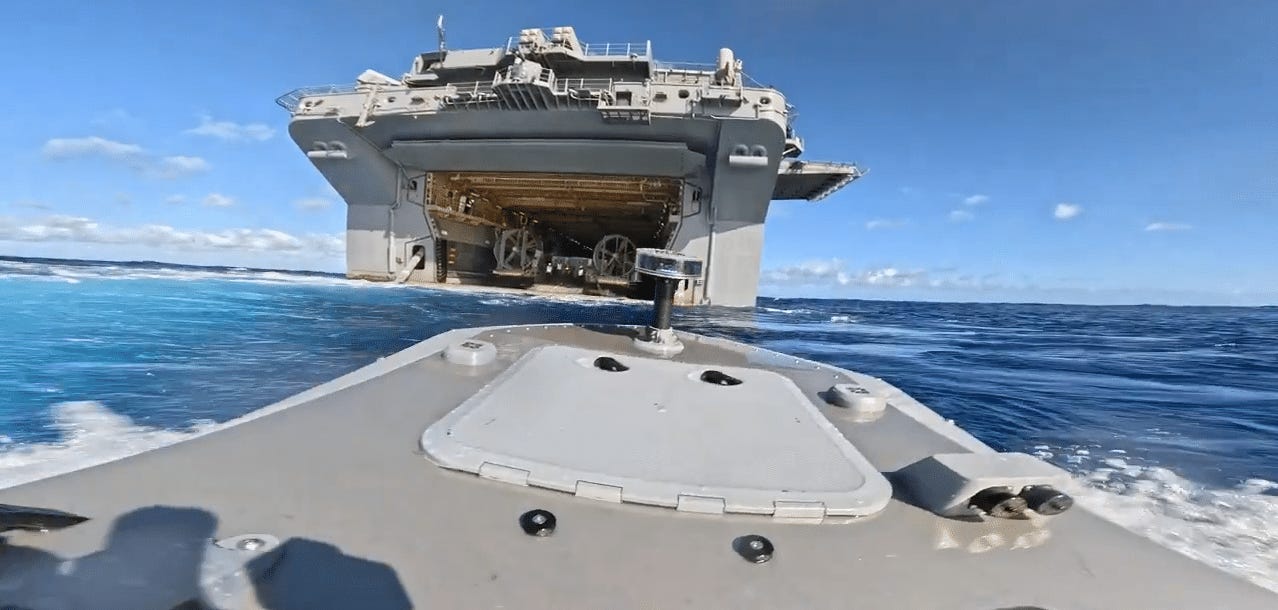
BLUF: Splash Industries Typhoon USV successfully landed in the well deck of the Wasp-class Landing Helicopter Dock USS Essex (LHD-2), marking the first instance of a USV performing an underway replenishment for a larger, crewed vessel.
The Typhoon “drone-boat” type USV came aboard the Essex’s well deck as several sailors spectated. The payload of the vessel is unknown, but the Typhoon has the ability to carry several different types of cargo/sensor packages, changing to match what the assigned mission may demand.
The Typhoon itself offers a 600+ nautical mile range with the ability to loiter for extended periods of time, meaning that this resupply could have taken place over several hundred of miles of open ocean.
The Typhoon navigated and functioned autonomously throughout the mission, presenting the ability to supply cargo to vessels underway without constant operator oversight.
The Navy Is Eyeing Next-Gen Carrier-Based Drones

BLUF: The Navy is looking for a family of carrier-based drones that can fulfill a variety of missions.
An RFI outlines the Navy is exploring the industrial base’s capacity to deliver highly capable, autonomous platforms optimized for operations from Ford-class and Nimitz-class Nuclear Aircraft Carriers.
The drones will be part of the Air Wing of the Future Family of Systems, can be designed as a single-role platform, a multi-role platform, or a modular FoS.
Eight different missions: strikes against surface ships, strikes against land targets, anti-submarine warfare, air-to-air combat against enemy aircraft and missiles, electronic warfare, ISR, aerial refueling, and resupply flights for a naval task force.
Requirements include a minimum 1,000-nautical mile range for strike missions, flight autonomy and mission autonomy maturity, and must be compatible with existing Unmanned Carrier Aircraft control system.
While the RFI mostly focuses on carrier-based drones, the Navy also wants vertical-takeoff UAVs that can operate from other types of vessels, such as destroyers and mobile sea bases.
Related: Navy Wants 1,000 Mile Combat Radius For Carrier Based Tactical Drones
Acting SECNAV Signs Strategy to Weaponize Data and AI
BLUF: The DoN Strategy to Weaponize Data and AI establishes the Department’s roadmap for building a data-ready, AI-enabled force capable of accelerating decision-making and maintaining maritime superiority. Specifically, the strategy:
Accelerates operational AI by identifying the most promising AI projects and rapidly evaluating success for full scale implementation.
Improves data readiness by standardizing, simplifying, and scaling data management capabilities to ensure mission-relevant data is ready to be easily discovered and shared.
Optimizes data and AI infrastructure by deploying reliable, secure, and modular environments including the hardware, software, and data necessary to support the full range of AI capabilities.
Streamlines data and AI governance by modernizing organizational processes to accelerate change and push risk determinations to the lowest level.
Builds a data and AI ready workforce by recruiting, training, and qualifying highly skilled personnel ready to meet the operational needs and rapid pace of AI evolution.
Strengthens partnership and collaboration by leveraging industry, academia, federal stakeholders, and Allies and partner relationships to accelerate delivery of industry leading data and AI solutions.
“This strategy positions the DoN to out-learn and out-fight any adversary by rapidly deploying data and AI. It is our roadmap to building an ‘AI-first’ Fleet.” - Hung Cao, Acting SECNAV
“This strategy formalizes the direction the Department has already been moving. Every day, our Sailors, Marines, civilians, and industry partners are finding new ways to leverage data and artificial intelligence to solve operational challenges.” - Barry Tanner, PTDO DoN CIO
Related: SECNAV Hung Cao unveils plan for Navy to ‘out-learn and out-fight any adversary’ with AI
Redwire Receives $21.5M Follow-On Order from PAE RAS to Deliver Stalker UAS Advanced Navigation and Standard Systems

BLUF: PAE RAS Aircraft PMO Family of Small UAS team awarded Redwire a follow-on award of $21.5M in purchase orders.
These latest awards follow $20M in awards by AIR PMO which included the Marine Corps’ first acquisition of Redwire’s Advanced Navigation version of the Stalker Block 30 UAS.
The latest awards include a second order for an Advanced Stalker Block 30, along with standard systems.
These new acquisitions continue the Marine Corps’ commitment to significantly increase capability and upgrade their existing fleet, which includes hundreds of existing Stalker platforms currently in service.
Each Advanced Navigation system consists of air vehicles; ISR camera payloads; short, medium, and long-range ground control stations; and support kits.
Digital Thread, Not Digital Theater: The Shipbuilding Fix Washington Keeps Missing

BLUF: Washington has funded rhetoric around AI, digital twins, and additive manufacturing for shipbuilding but has failed to build the underlying digital thread, a single traceable evidence chain from design through maintenance, that competitors like South Korea’s Hanwha Ocean already run at scale.
The Navy has 75 Arleigh Burke destroyers in service and cannot find two in the same configuration; the April 2025 executive order and February 2026 Maritime Action Plan set ambitions for AI, digital twins, and additive manufacturing but haven’t produced a defensible digital architecture.
Recent program failures trace directly to skipping digital-thread discipline
Constellation-class frigate started construction without a stable design and was nearly three years behind schedule with the lead ship 26% over its $1.2B target by early 2025; the Coast Guard’s Offshore Patrol Cutter followed the same pattern
The Columbia-class sub, projected at roughly $132B for 12 boats, competes with Ford-class carriers and Trump-class battle cruisers for the same nuclear-certified yards and workforce; CBO warned the Navy’s shipbuilding plan assumes throughput increases the industrial base can’t currently support.
The Navy has already proven the model works in pockets: its Additive Manufacturing Center of Excellence cut a bracket’s turnaround from three weeks to 13 days, NAVSEA reported a 70% lead-time reduction for a critical destroyer valve, and the AEGIS virtual twin and gas-turbine predictive maintenance models show digital concepts functioning at the platform level.
Retrofitting the legacy fleet is a separate, costly problem: the Ford-class Integrated Digital Shipbuilding program spent over $600M trying to digitize a carrier built on analog drawings without yet achieving consistent on-schedule delivery.
Congress and program offices must treat data rights and right-to-repair as prerequisites, not downstream policy questions, alongside a funded plan for the 200-plus ships in the fleet that still lack digital models.
The Depleted Navy Needs Immediate Rebuilding as Dangers Rise
John Phelan
“Outside, beyond the broad seas, there are the markets of the world, that can be entered and controlled only by a vigorous contest.” RADM Alfred Thayer Mahan in 1890.
At the start of this century, the U.S. had roughly twice as many warships as China. Sometime between 2015 and 2020, China edged us out, and the gap has widened since then. The Navy can’t do its job without resources that reflect the centrality of sea power.
Only one force on Earth can preserve freedom of navigation across every ocean, and that is the U.S. Navy.
Congress must immediately pass a Pentagon appropriations bill for FY27 with the Navy as the primary recipient.
An industrial policy that encourages both commercial and naval shipbuilding is essential.
Shortly after my confirmation as secretary, we developed an enterprise operating system that gives real-time insight into all shipbuilding and acquisition programs, applied AI to ship construction and stood up a Portfolio Acquisition Executive for robotics and autonomous systems with a focus on uncrewed platforms.
Hormuz is far from the only trade choke point, or even the busiest.
What we need now is a robust, modern deterrent and fighting force that can keep the seas open, allowing America to remain safe, free and thriving in a world more dangerous than Mahan could ever have conceived.
Drone-Boat Startups Take the Navy to Court
BLUF: Blue Water Autonomy and Saildrone filed separate lawsuits against the Navy after their MUSV designs were rejected from the MUSV marketplace that replaced the canceled MASC program.
The Navy launched the MASC program last July for medium sized drones, but canceled the program in March after a handful of companies had made it to the final stages and kicked off prototype construction.
PAS RAS pivoted to a regular and recurring marketplace for mature enough MUSVs and other classes of vessels in order to accelerate autonomous capability to the fleet.
Related: 2 defense tech companies sue US Navy after losing out on MUSV program, Blue Water Autonomy, Saildrone Sue Navy Over MUSV Rejection, and Blue Water Autonomy, Saildrone launch lawsuits against Navy over MUSV Marketplace
USS Zumwalt Set To Return To Fleet After Long Anticipated Hypersonic Missile Upgrade

BLUF: The Navy expects the stealthy destroyer USS Zumwalt with new Intermediate Range Conventional Prompt Strike hypersonic missile launchers to be formally returned to service by September.
One contributing factor in the delay was the first full shutdown of the notoriously complex Integrated Power System (IPS) since the ship was delivered to the Navy six years ago. IPS is a power plant that provides massive amounts of electricity to propel the ship and run its advanced systems.
GAO provided details in a report released today.
The four new launch tubes, each of which will be able to hold three IRCPS missiles, notably take the place of the destroyer’s original pair of 155mm Advanced Gun Systems (AGS).
GAO wrote the Navy is largely making investment decisions on a program-by-program basis, rather than doing so from a portfolio-wide perspective.
GAO pointed to challenges related to identifying issues with production throughput across both services, while noting that the Navy is the one that oversees the missile body production line.
Related: Navy 2 years behind on hypersonic missile installation on Zumwalt destroyers, Navy, Army risk wasting money, time without unified hypersonic missile strategy, and Lockheed Martin struggling to build Navy hypersonic missile at scale
How Tariffs Are Slowing the US Navy’s Shipbuilding Surge
BLUF: Trouble obtaining new and spare parts results in thousands of lost operational days for the US Navy.
The U.S. has not opened a major public shipyard since Pearl Harbor in 1908!
All four government yards maintain the Navy’s most prestigious nuclear-powered ships and subs.
OMB Director Russ Vought said the administration is pushing hard for an additional public shipyard and the ability to scale US Navy ship maintenance.
Thankfully, a lot of time and money have been spent over the past decade to begin rehabilitating this failing infrastructure, with more to come.
Visit any public yard today, and you’ll hear and see heavy machinery building new dry docks, new piers, and new factories.
Under construction at Pearl Harbor is the eye-wateringly large Dry Dock 5, the single highest-value project in US naval history. This new dock is necessary in order to accommodate fast-attack submarines and nuclear boomers that are much larger than their predecessors and the largest subs ever built by the Navy.
But while navy yards are straining under heavy machinery and equipment, they are also struggling under a burden one might find surprising: tariffs. At one East Coast repair yard, a critical part was stuck at the Canadian border due to a lack of funds to pay tariffs on equipment needed to keep its facilities humming.
The US Navy at the Norfolk Naval Shipyard ultimately paid $60,000 in tariffs on top of the $269,000 parts cost—over 18% of the total adjusted contract for one piece of equipment, according to a shipyard spokesperson.
Figuring out what is exempted, when, and by whom is a winding maze of legalize that shipyard workers don’t have time to navigate, with a backlog of repairs plaguing the Navy.
All levers must be used to expedite ship repairs, including tariff relief when necessary.
While the broader tariff goals to encourage American output and reindustrialization are important and overdue, they cannot harm the US military nor slow down ship repairs at public yards domestically.
The Innovator’s Dilemma Is a Fleet Design Problem
BLUF: The Navy in standing up a PAE RAS: a distinct organization, measured on speed and cost per effect rather than platform performance, buying effects instead of platforms, running a continuous capability conveyor instead of a decades-long program of record.
Clayton Christensen's core insight in The Innovator's Dilemma was never that great companies fail because they're badly run. They fail because they're well run. They listen to their best customers, invest in the highest-margin products, and improve along the dimensions those customers value — right up until a disruptive technology, inferior on every traditional metric, redraws the market underneath them.
Two implications follow.
Christensen's disruptors didn't kill the incumbents' best products as mainframes coexisted with PCs for decades. Carrier strike groups remain the sovereign, survivable capital of the fleet. RAS is the capacity layer as the tailored offset that masses effects without massing forces. The dilemma isn't carriers or drones. It's whether the institution can run two value networks at once.
Our adversaries are running the disruption playbook deliberately with commercial components, fast iteration, attritable mass. The question is no longer whether disruption comes to naval warfare. It's whether we disrupt ourselves on our own terms, or get disrupted on someone else's.
Other Navy News:
World’s first nuclear-powered aircraft carrier to be dismantled
Ursa Major Snags $10M Navy Contract for MK 104 Rocket Engines
Performance Is Not Endurance: Sustaining Combat Power in Contested Ops
Navy awards $850M contract to advance Trident II D5LE2 development

Marines’ New Drone Teams Aim to Improve Implementation
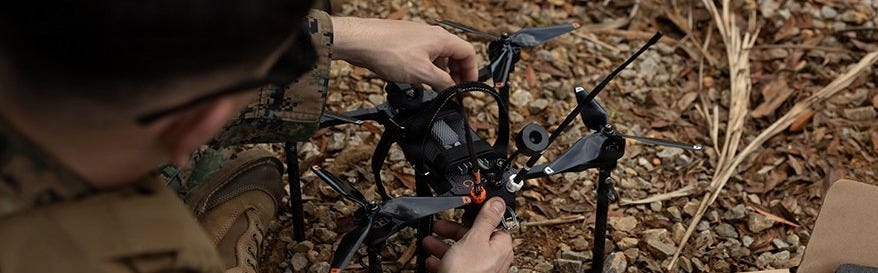
BLUF: The Marine Corps announced two new organizations: the Marine Corps Robotics Integration Group and the Marine Corps Counter Drone Team to contribute to a holistic approach to drone and counter-drone development, training and implementation.'
Establishing the new groups stemmed from the recognition that emerging technologies are developing at a rapid pace, and it is proving crucial to continually disseminate up-to-date information and equipment throughout the force to keep up with the demands of modern warfare.
Both organizations are designed to complement the existing Marine Corps Attack Drone Team — launched in January 2025 to refine warfighter training, inform requirements and otherwise integrate UAS.
The counter-drone unit is set up to operate similarly to the attack team — just on the defensive side instead of offensive — working closely with the MCWIL to find and bring best-of-breed industry capabilities and prototypes into the force.
The Marine Corps Robotics Integration Group will be the focal point for unmanned systems training integration, curriculum development and education.
As new capability packages come online, it will develop and distribute curriculums, training support and certification standards.
“Our goal is to make drones just like a rifle, just like a mortar, just like a machine gun. It's just another weapon system, another capability that our units have to employ, but because it's new, we're working through what that looks like and what ‘right’ looks like.” Col. H. Parker Consaul, Director of the Marine Corps Robotics Integration Group.
Before the Next Fight
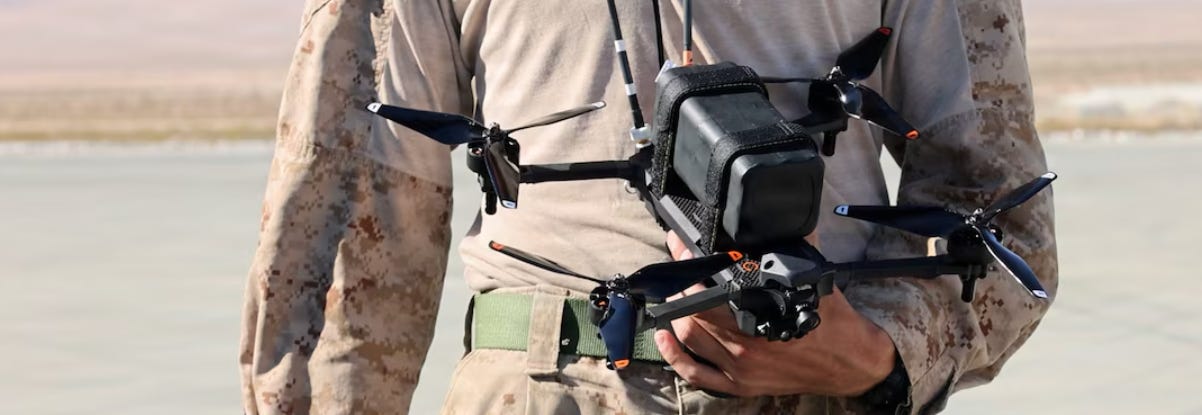
BLUF: The Marine Corps should codify a four-phase doctrine for integrating unmanned aerial and ground systems into the battalion attack, treating drones as organic combined-arms enablers rather than bolt-on tools.
Phase 0 (Shaping): Battalion UAS conduct layered reconnaissance to build the target picture, locate and suppress enemy drone teams, identify reinforcement routes for interdiction, and support deception.
Phase 1 (Deployment and Suppression): Coordinated multi-drone FPV strikes (10-12 systems per target) degrade enemy C2 nodes and drone positions, assault UGVs with EW and machine-gun payloads move forward with lead elements, and pre-positioned ambush drones activate against reinforcing enemy forces.
Phase 2 (The Assault): UGVs absorb the enemy’s initial defensive fire ahead of the maneuver element, FPV drones engage point targets UGVs can’t reach, and all aerial/ground feeds consolidate into a single common operating picture in the S-3 cell to compress the sensor-to-shooter cycle.
Phase 3 (Consolidation): Long-range UAS pivot to tracking enemy withdrawal and counterattack preparation, dormant ambush systems continue striking retreating forces, and logistics/casualty-evacuation UGVs resupply and extract without further exposing Marines.

Air Force PEOs Are Now PAEs
BLUF: Effective July 4, 2026, all Air Force PEOs are redesignated PAEs. All PAEs have full access to current authorities and those provided in the SAF/AQ Apr 23 memo.
William Bailey PTDO of Air Force SAE has also delegated decision authority for all but 18 SAE Special Interest Programs to the PAEs.
Our Take: This is a great step on the part of the Air Force. Now it’s time for the PAEs to step up and make things happen.
YFQ-44A Fury ‘Fighter Drone’ Has Fired Its First AIM-120 AMRAAM Missile
BLUF: Anduril’s YFQ-44A Fury Collaborative Combat Aircraft (CCA) has live-fired an
AIM-120 Advanced Medium Range Air-to-Air Missile (AMRAAM) at a simulated target which is the first for any U.S. CCA-type drone.
The YFQ-44 carries stores externally on two hardpoints, one under each wing.
The Air Force and General Atomics have said the YFQ-42A is on track to conduct a live-fire launch later this year.

“We executed the first weapons shot from YFQ-44A, an important milestone in turning CCA into an operational capability. This was more than a simple weapons release test – it demonstrated an end-to-end, beyond-line-of-sight strike against a simulated target. YFQ-44A took off from Edwards Air Force Base, our Lattice software ingested a target track, an operator tasked the aircraft to engage the target, and YFQ-44A fired an AIM-120 as instructed.” Mark Shushnar, Anduril’s VP of Autonomous Airpower
“Moving from inert carriage earlier in the year to this weapon release demonstrates program maturity, allowing us to validate our digital integration models with actual data,” “These tests provide operational validation that Collaborative Combat Aircraft can execute the weapon employment sequence autonomously within pilot-defined parameters, accelerating capability delivery to the warfighter.” Gen. Dale White, DRPM for Critical Major Weapon Systems
Related Article: Anduril YFQ-44 Fires Live Air-to-Air Missile in Landmark CCA Test
Our Take: If there was a CCA scoreboard for the audience, we’d chalk this down to Anduril leading 1-0. It’s going to be a long game with many milestones ahead.
+1 to GA for achieving first flight
-1 to GA for crashing
+1 to Anduril for first weapons release
DARPA and US Air Force Fly AI-Controlled F-16, Paving the Way for Autonomous Air Combat
BLUF: An F-16 fighter jet, recently modified to serve as an autonomous flying testbed, is undergoing in-air testing using an AI agent to autonomously control flight. This milestone advances state of the art technological infrastructure designed to enable rapid, scalable combat AI development across the joint force.
The aircraft is one of a group of F-16s that have been converted into autonomous-capable platforms under the VENOM program — a joint effort between the U.S. Air Force and DARPA, initiated under the Air Combat Evolution (ACE) program.
The modification, known as the VENOM Autonomy Kit (VAK), was designed and integrated by multiple performers under the DARPA ACE program.
The kit utilizes a novel interface with the aircraft’s flight controls and mission systems, allowing a pilot to toggle between traditional human control and AI control with the flip of a switch.
This ensures a safe, reliable environment for human-on-the-loop experimentation.
Moving forward, VENOM aircraft will serve as the cornerstone for the next phase of AI development under DARPA’s AI Reinforcements (AIR) program.
The AIR program will leverage the VENOM fleet to test multiple AI agents in live-flight scenarios. This critical testing will pave the way for human pilots to seamlessly command and orchestrate teams of autonomous, uncrewed aircraft.
Our Take: These programs are key to feed into the Experimental Operations Unit at Nellis AFB to develop new tactics and techniques for CCAs. As the tech for MUM-T matures, we expect that CONOPS will adapt with it allowing for greater autonomy with all the associated benefits. If we do not adapt that way and expect human micro management in perpetuity, then we will lose out on progress and constrain ourselves.
Software Sold Separately: What the Air Force’s New Approach for CCAs Means
BLUF: The Air Force’s “software sold separately” plan to buy autonomy software decoupled from the physical air vehicle for its nascent CCA fleet could help the drones evolve quickly, foster competition, and avoid vendor lock-in.
The key to that vision is in three option deals with Anduril, Shield AI, and Collins Aerospace to deliver mission autonomy software that would allow CCAs to carry out operations without direct human control.
To make this possible, the Air Force established a common digital standard called the Autonomy Government Reference Architecture, or A-GRA.
This approach “decouples software from hardware, prevents vendor lock, and allows the Air Force to switch between autonomy solutions without having to redesign the entire system.
The service hopes this approach could provide a path forward for better high-tech, software-heavy acquisition programs.
This approach would conceptually allow the service “to buy the best software available independently from the air vehicle,” or the physical CCA itself.
A potential drawback to this approach is that vendors’ programming will need to be designed to work with multiple systems, and, as a result, could lose some of the performance that more tailor-made software might provide.
For that reason, a software-sold-separately approach may not be right for the F-47, which is focused on delivering high performance.
Other systems that wouldn’t require such high performance, such as next-generation mobility or refueling aircraft, may benefit from this strategy.
Col. Timothy Helfrich, the Air Force’s PAE for fighters and advanced aircraft said a future project called the C2 Enclave will also be another option for the vendor pool to bid on with a secure digital workspace where systems operators will manage and direct CCAs.
“When you’re writing the software for a radar, if you knew what the vehicle was going to be on every time, then you would write the software in a way that is tailored to the vehicle design, and also leverages what the vehicle’s other capabilities. If it’s a highly modular system where you’re mixing and matching different sensors, or different electronic warfare jammers or different weapons payloads, that mixing and matching means you’ve got to genericize the software to a degree. That means you’re not going to be able to leverage all the functionality of the payloads every time.” Bryan Clark
Our Take: We are generally bullish on a GRA that has industry buy-in and that supports the necessary performance levels needed for a platform. The challenge with F-47, as noted by Bryan, is that ASICs and FPGAs may need to be tightly integrated with software to meet certain latency requirements (instantaneous bandwidth) and processing needs. A GRA that adds layers in-between software and hardware could be problematic. CCA, and other autonomous systems, could also faces those issues as they get into missions like hypersonic interception where fractions of a second dictate if a target is acquired and defeated.
Air Force Increases Stealthy Cruise, Anti-ship Missile Production
BLUF: The Air Force will expand its procurement of JASSM and LRASM missiles from an anticipated production run of 16,710 to 23,095.
According to CSIS, The Pentagon used ~1,100 JASSMs since Feb. 28 from an estimated pre-war inventory of 4,000.
Work for JASSM lots 22 to 26 and LRASM lots 9 to 12 will be completed by 2033.
In countering China. Air Force bombers and Marine Corps fighters will rely on these stealthy missiles to punch through Beijing’s increasingly advanced air defense networks and anti-aircraft warfare destroyers.
In the future, the Air Force plans to develop a next-generation missile capable of striking air and maritime targets at ranges of 1,000 nautical miles.
A solicitation of the system, dubbed the Long Range Weapon program, reads that war planning scenarios covering the Indo-Pacific influenced this requirement.
Newcomers focused on building and delivering low-cost cruise missiles have also entered the competition.
Our Take: This is a promising development even if the timelines are more extended than is desired. While Low-Cost Cruise Missiles will play a greater role in operations, we still need more of these more exquisite weapons to penetrate certain defenses. We need a lot more of both for the variety of mission sets.
Related Article: LRASM and JASSM Production to Triple Under New US Air Force Contract
Air Force Plans to Buy 28,000 Low-Cost Cruise Missiles in Five Years
BLUF: The Pentagon has reached new framework agreements with Anduril, CoAspire, and Zone 5 as part of a strategy to acquire thousands of lower-cost air-launched cruise missiles in the coming years.
The deals are directly in support of the Air Force’s Family of Affordable Mass Missiles (FAMM) program. The Air Force has already said that it is aiming to buy nearly 28,000 FAMM munitions in the next five years.
Under FAMM, the Air Force plans to acquire multiple types of lower-cost cruise missiles in different configurations including:
Lugged types (FAMM-L) to be launched directly from hardpoints on aircraft.
Ones intended to be employed from cargo planes via palletized munitions systems (FAMM-P).
An extended-range FAMM-BAR design, for “Beyond Adversary’s Reach.”
Anduril, CoAspire, and Zone 5 were also among the companies to receive framework deals from the Pentagon in May as part of a separate program called Low-Cost Containerized Missiles (LCCM).
Leidos is part of the LCCM effort and Castelion received a production order for 12,000 Blackbeard lower-cost hypersonic missiles.
Our Take: It really is an amazing development that we now have multiple companies that can produce low-cost and more sophisticated cruise missiles to help replenish the drained coffers but also to support a mobilization scenario.
Related Articles:
US Air Force Turns to Cheaper Cruise Missiles It Can Buy by the Thousands
Anduril, Department of War Sign Framework Agreement for Air-Launched Barracuda-500

Saltzman’s Farewell Warning: Prepare for War in Space to Preserve Peace
BLUF: Gen. Chance Saltzman in his final public address as chief of the Space Force warned that a conflict extending into orbit would expose the satellites of every nation, arguing that the best way to deter such a war is to build military forces capable of fighting and prevailing in space.
Saltzman argued that the U.S. military could no longer be assumed to operate without interference given China and Russia are developing systems capable of jamming, disabling or destroying satellites.
The Russian and Chinese forces are also becoming more dependent on spacecraft for targeting, communications and battlefield surveillance.
The result has been a shift toward what the service calls space control: protecting U.S. and allied access to orbit while retaining the ability to deny an adversary the advantages provided by its own space systems.
The “Competitive Endurance” strategy strived to avoid operational surprise, deny adversaries the benefit of striking first and develop counterspace capabilities that could disrupt enemy operations without creating dangerous orbital debris.
Saltzman said military commanders (and allies) should spend less time trying to calculate what might dissuade an adversary and more time building forces capable of defeating an attack.
“Whether we want to be in the combat zone or not, orbital mechanics will put all of our space capabilities in a space war zone. We will share the consequences. Therefore, we should share the responsibility for a safe, secure, and stable space domain.” Gen Saltzman at the Global Air & Space Chiefs’ Conference in London.
Space Force Chief Nominee: China Going Breathtakingly Fast with Space Weapons
BLUF: China’s rapidly advancing capabilities in space are a major concern for the presumed next chief of Space Force (Lt. Gen. Douglas A. Schiess), who will likely oversee rapid growth in manpower and equipment to counter the growing threat.
When Schiess was asked specifically what space threats China poses to the United States, especially in the Pacific region, he rattled off a list of developments:
anti-satellite tests from the ground
space-based capabilities that hold U.S. satellites at risk
electromagnetic jamming capabilities under development that are “very worrisome.”
It’s not all threats to U.S. satellites. The Chinese military is also using intelligence, surveillance and reconnaissance satellites to target “our forces much farther than they ever have.”
“What they are doing with what I’ll call counter-space and space superiority capabilities is breathtakingly fast. They built a kill chain to be able to see our carrier strike groups, our bombers, at a much farther pace, speed, and distances, and they’ve also developed missiles and weapons systems to go after that,” Schiess said. “So, the Space Force needs to be able to bring capability to deny, degrade that kill web to be able to protect the joint force.” Lt. Gen. Douglas A. Schiess said during his July 16 confirmation hearing to be the next Chief of Space Operations.
Space Force Faces Growing Pains. Here’s How the Next Chief Can Help
BLUF: The charge to double the service’s size during the next chief’s tenure is not a trivial matter. There are significant challenges with growing a service from roughly 10,000 to 20,000 military members by 2030.
There are options that, collectively, could increase the Space Force without creating a massive influx of the most junior members:
Restoration of service of members separated for non-disciplinary reasons as part of the DOGE streamlining effort.
Interservice transfers: Transfers were the core tapped for the establishment of the Space Force.
Integration of Guard and Reserve forces: The transfer of Air Force Reserve and Guard members to the Space Force.
Direct appointments: Perhaps the most promising option is for the Space Force to direct commission or direct enlist experts from industry and other fields whose specialties the Space Force needs. This would be like the programs the other services employ for medical and legal professionals.
The Space Force should consider expanding to include space specialists in career fields such as lawyers, public affairs, contracting, finance, and additional acquisition personnel particularly scientists.
The mix of options and timing of initiatives the next chief chooses to double the service will likely be one of his most significant, impacting the force today and for generations to come.
Space Force Faces Budget Uncertainty as Leader Plans Exit Next Month
BLUF: Gen Saltzman urged support for his service’s programs, the same day as House lawmakers said they would approve only a fraction of the funds the Trump administration requested for major space efforts.
Lawmakers say they will not fully comply with the Trump administration’s request to fund important priorities through reconciliation which could leave the Space Force far short of the money it wants.
The White House has asked Congress for $1.15T through the normal defense-budget process plus another $350B through reconciliation.
The latter amount would fund major Space Force programs, such as the Air Moving Target Indicator and the space data network, and the vast majority of funds for the Golden Dome missile defense program.
Republican House leaders said they would support a reconciliation bill of $60B.
Our Take: Shrinking reconciliation means that hard choices will have to be made in the appropriations process. We encourage the HAC-D and SAC-D subcommittees to prioritize the AMTI and SDN efforts as they are the backbone for future operations in contested environments. Epic Fury has demonstrated the criticality of space assets. Underfunding these efforts will make us less effective even as the threats grow on a continuing basis.
Space Force Successfully Launches Additional Tranche 1 Satellites, Expands Proliferated Warfighter Space Architecture
BLUF: SDA’s recent launch delivered 21 data transport T1 SVs into LEO on Friday.
This brings the total number of on-orbit T1 space vehicles (SVs) to 63.
These SVs, built by York Systems, will enhance the tracking of advanced missile threats by providing secure, low-latency, beyond-line-of-sight (BLOS) tactical communication links, delivering a resilient, optically-connected network of integrated capabilities to the warfighter at mission-relevant speed.
Tranche 1 will provide initial warfighting capability beginning in 2027.
This includes persistent regional tactical data links, enhanced missile tracking/warning, beyond-line-of-sight targeting, and UHF/S-band tactical satellite communication demonstrations.
Once on-orbit delivery is completed, the T1 constellation will consist of a total of 154 operational SVs including 126 Transport Layer SVs and 28 Tracking Layer SVs, plus four missile defense demonstration SVs.
Related Articles:
Space Force Awards Slingshot $69M for AI-Enabled Training Technology

BLUF: Slingshot Aerospace has won a $69.2M Space Force contract to develop AI-based training environments that will allow military operators to rehearse satellite defense missions and respond to simulated adversary actions in orbit.
The 4½-year SBIR Phase 3 contract supports the Operational Test and Training Infrastructure program, to give Space Force units more realistic tools for testing systems and preparing personnel for increasingly complex operations in space.
Under the contract, Slingshot will provide “high-fidelity, AI-enabled environments where they can rehearse protect-and-defend scenarios, evaluate courses of action, and sharpen decision-making under realistic operational conditions.”
Rather than following a predetermined script, TALOS is designed to simulate how another spacecraft could maneuver, respond to an operator’s actions or interfere with a mission. That approach is intended to make exercises less predictable and force trainees to adjust their decisions as a scenario develops.
Our Take: This is a huge advance in the training regime for RPO and other missions that require deviation from pre-scripted mission plans but rather informed adaptation to adversary actions that could include employing defensive or offensive capabilities.
DIU Seeks Space Power Beaming (SPB)

Problem Statement: As space technologies advance and power requirements for missions increase, there is a growing need to investigate alternative forms of power production, generation, and delivery for both on-orbit and terrestrial assets.
Desired Solution: The Joint Force seeks a demonstration traceable to a future operational capability that will inform architecture decisions. SPB is envisioned as a multi-orbit utility, enabling long-range power delivery to multiple orbital regimes and terrestrial locations. Lines of Effort include:
Space-to-Space Power Beaming
Space-to-Terrestrial Power Beaming
Power Beaming Receivers
Next-gen Power Beaming Components
DIU attributes include rapid fielding, energy delivered, beam size, and operating ranges. Responses due Jul 22nd. Phase 2 pitches the week of Aug 3.
Related Article: DIU seeking ‘near-term’ power-beaming satellite demo
NRO Director Nominee Sees Relationship with Space Force Evolving
BLUF: The Space Force has partnered with the the National Reconnaissance Office to get started on key intelligence, surveillance, and reconnaissance programs but is starting to take more ownership of those efforts.
For years, the NRO focused on developing “national technical means”: highly secretive, strategic-level satellites and space sensors.
With the advent of cheaper launches and proliferated satellite constellations, the Pentagon is increasingly eyeing the Space Force to take over more operational and tactical intelligence.
That’s led to two major NRO-Space Force collaboratives.
Silent Barker, a group of three satellites for wide-area surveillance of other objects in orbit, launched in 2023.
The NRO has also acquired and launched prototypes of “moving target indication” satellites to track targets on the ground, which the Space Force will operate alongside NRO personnel.
In May, the Space Force announced it had awarded a $4.2B contract to SpaceX as part of its AMTI program.
Likewise, the Space Force is going its own way for a new batch of surveillance satellites meant to succeed Silent Barker called SG-XX.
“[Airborne moving target indication], as I understand it, takes us to the next step that’s actually being procured by the Space Force. So to me, this is a good progression of good government decisions in terms of taking strengths and moving them into areas where they should be done by the military.” L. Roger Mason Jr
Related Article: Space Acquisition and NRO Picks Face SASC
Our Take: The key here is not who will actually operate the satellites. There are teams in both the NRO and Space Force who could execute those functions (the NRO is probably more technologically advanced) but rather for the Space Force (specifically SSC) to learn the lessons from NRO that have enabled them to become so agile and responsive in their capability deliveries.

SDA Awards Contracts for 36 Golden Dome Missile Tracking Satellites
BLUF: SDA announced contracts worth $1.75B to build 36 satellites in support of the Golden Dome missile defense shield. The satellites will be part of Tranche 3 of SDA’s missile defense, warning, and tracking layer.
The T3 layer is a constellation of LEO-based satellites built by L3Harris and Sierra Space both to deliver 18 satellites each in time for a potential launch in late 2028.
The Space Force awarded initial contracts for Tranche 3 last year to Lockheed Martin, Rocket Lab, Northrop Grumman, and L3Harris for a total of 72 satellites.
This additional batch of 32—which SDA calls Accelerated Missile Defense Tranche 3, or AMDT3—brings the total tranche to 104 spacecraft.
L3Harris’ satellite design will be based off the Hypersonic Ballistic Tracking and Space Sensor.
Sierra Space’s satellites will be based on its “Horizon” spacecraft.
In the draft NDAA, the SASC directs the Space Force to prioritize acquisition and operational deployment of a full constellation of at least 45 space vehicles equipped with proven HBTSS payloads.
“With these awards, SDA is accelerating the deployment of the Tracking Layer to provide the homeland, our deployed forces, and allies with global, persistent indications, detection, identification warning, tracking, and defense against advanced and evolving missile threats.” SDA Director GP Sandhoo
Golden Dome Tracker: New Contract Awards and Hopes for New Space Infrastructure
BLUF: Golden Dome is an ambitious investment in a new way of doing business with industry. No longer is the Pentagon issuing cost-plus contracts and waiting for tech to evolve. Instead, it’s issuing innovative, and lucrative, contracts to primes and startups and creating strategies for alternative technologies if certain capabilities aren’t delivered on time.
Firms creating orbital transportation, communications relay networks, satellite refueling and other capabilities are marketing their technologies as critical support services for a robust space-based defense system.
The USAF has developed a strategy for Golden Dome that will allow it to pivot to a new technology if a capability can’t be delivered on time.
Philly Shipyard to Build ‘Golden Defender’ Ship as part of New Missile Defense Program
BLUF: Hanwha Philly Shipyard will build a new missile-range instrumentation vessel for the U.S. Navy that will support the Trump administration’s Golden Dome effort
Dubbed the “Golden Defender,” the ship is based on the National Security Multi-Mission Vessel design that Hanwha is finishing for the U.S. Maritime Administration’s training ships.
Hanwha will build the ships, with TOTE Services functioning as the vessel construction manager.
The new ship class would replace the aging MARAD ships SS Pacific Tracker and SS Pacific Collector, which track missile tests.

Helsing Raises $1.8B in Europe’s Biggest Defense-Startup Round
BLUF: Germany’s Helsing raised US$1.8B in Europe’s biggest-ever funding round for a defense-technology startup, valuing the company at $18B and continuing a flurry of mega rounds for the continent’s defense industry.
Helsing raised the funding in a Series E funding round, with investor demand “significantly” exceeding the available allocation.
The company remains predominantly European-owned after the fund raising.
Investor demand reflected strong and growing confidence in AI-driven and software-defined defense technology.
The German company’s offer includes the HX-2 strike drone and the Altra AI-enabled battlefield-operations software as well as concepts including the proposed CA-1 autonomous fighter jet.
German UAV Firm Helsing Picks West Virginia for First US Manufacturing
BLUF: Helsing will initially invest $50M to build a facility in WV to start manufacturing Helsing’s HX-2 drone. The firm plans to produce as many as 2,000 drones a month.
The company said the facility in Martinsburg — situated in the northeast of the state wedged between Virginia and Maryland — is planned to have initial operating capability by November and full rate production within a year.
The HX-2 is a loitering munition powered by company software that can hit targets like armored vehicles and structures as far as 100 km (62 miles) away, according to the firm.
“West Virginia stood out for its skilled workforce, speed to build, manufacturing heritage, and commitment to strengthening the U.S. industrial base,” said McArdle, Helsing’s US general manager, adding that the company was “excited to build in Appalachia.” Dr. Jennifer McArdle, Helsing GM US
China’s Upgraded Y-9 Submarine Hunter Enters Military Drills with New Radar Systems
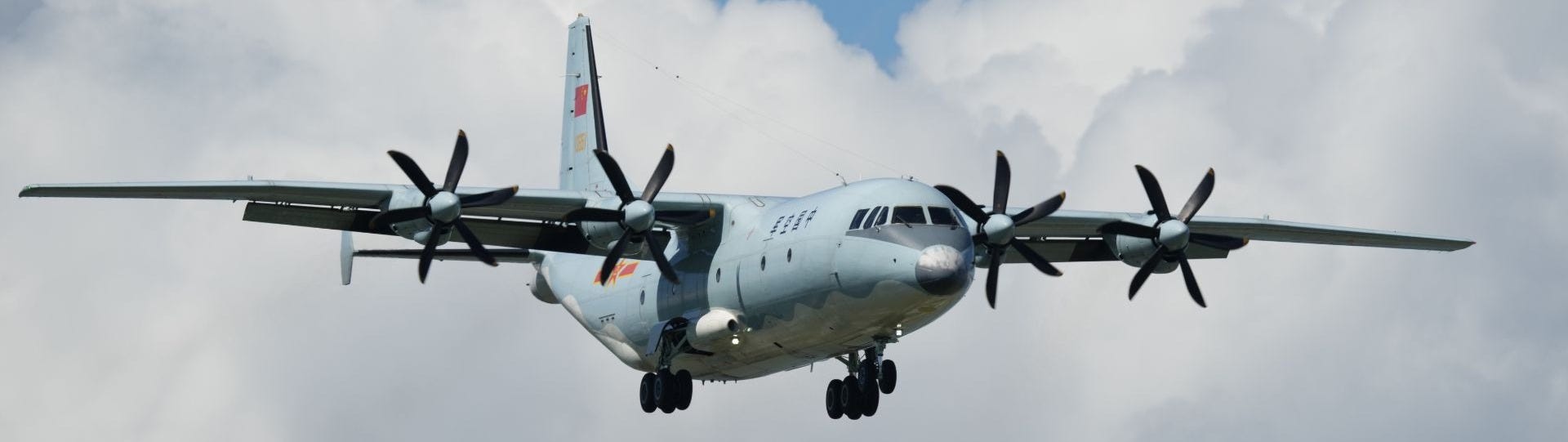
BLUF: The Y-9 aircraft now carries a new active phased-array radar under its nose which should cover a wider area, detect targets from farther away, and scan more broadly than the older model.
There also appears to be a redesigned magnetic anomaly detector (MAD) at the tail which could help cut down on interference from the plane, make maintenance easier, and improve the ability to find submarines under the sea.
These upgrades strengthen China’s anti-submarine warfare capabilities.
Defense Spending Lifts Europe’s Space Economy
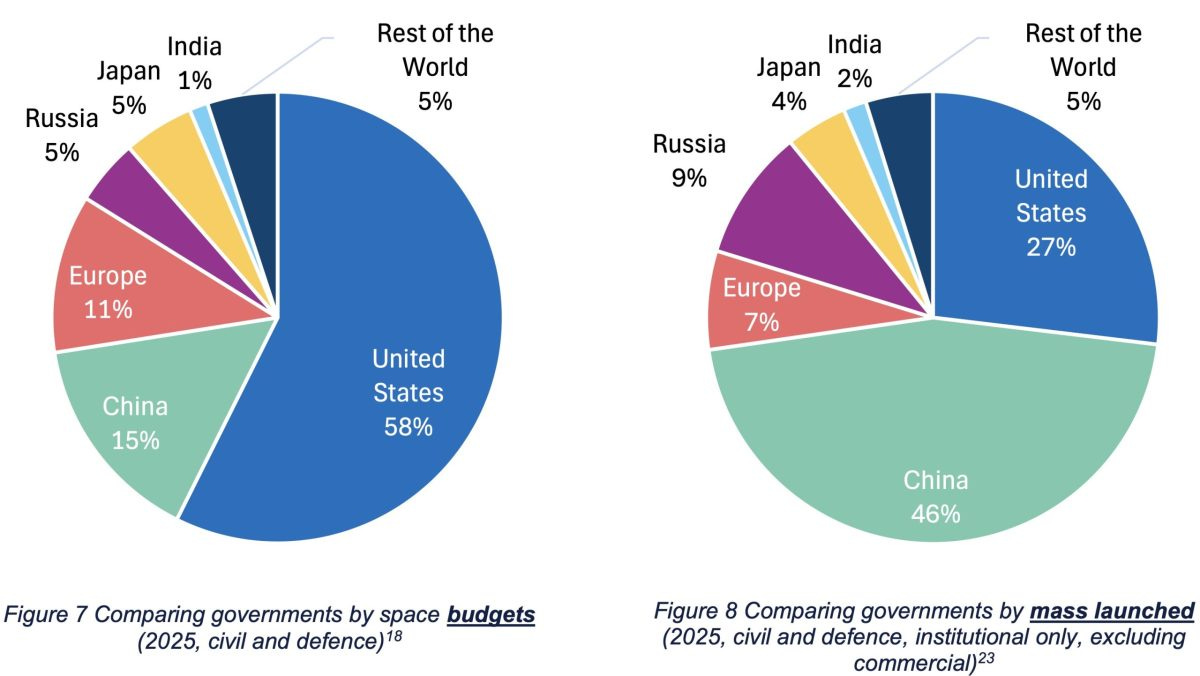
BLUF: European government space spending jumped 12% to 13.5B euros ($15.4 billion) in 2025.
While lower U.S. defense spending and flat NASA funding dragged global government space spending down to 119 billion euros, ESA said budgets are “projected to increase sharply from 2026 onward by over 20% in one year.
The United States still represented 58% of global government space budgets in 2025. China ranked second at 15%, followed by Europe at 11%.
UK Injects £26 Billion into Three Naval Bases Under Decade-Long Modernization Plan
BLUF: The ten-year program to upgrade the UK’s naval bases delivers directly on the Strategic Defence Review’s commitment to warfighting readiness,
Critical naval bases will have new docking ports and refitted buildings, including HMNB Clyde, HMNB Devonport and HMNB Portsmouth.
The funding is the largest program of naval infrastructure investment since the end of the Cold War.
Upgrades will see waterfront infrastructure modernized, and new single living accommodation built for British Armed Forces.
New training facilities, out-of-water engineering infrastructure and R&D capabilities will be provided through the regeneration and upgrade program.
Other International News:
Australian Army completes first successful Apache live-firing
Autonomous Drone Fired from Submarine Torpedo Tube Completes First Sea Trials
New ForceField counter-UAS system stops FPV drone attacks without emitting signals

Our Overall Take: This year, we assess Congress’s ability to pass any defense budget or NDAA as high risk. This includes the base budget, reconciliation, supplemental, and the annual “must-pass” NDAA. Amid midterm elections and contentious debates on defense and non-defense priorities, bipartisan agreement is unlikely in the near term. Insiders see elevated risk of another government shutdown. A continuing resolution is expected at minimum.
As we have stated repeatedly, the single most important action Congress can take to support national security is to pass a defense budget on time. These delays and uncertainty impose billions in costs, harm industry, and force massive fire drills within the Department by diverting focus from operational missions and critical transformations.
House GOP Releases ‘Reconciliation 3.0’ with $60B for Defense
BLUF: House Republicans have unveiled the outlines of their “Reconciliation 3.0” funding bill with $60B for defense, a number that does not even hit the $67B sum requested by the White House to pay for defense expenses tied to the Iran War.
It fails to address the $350B request for reconciliation dollars issued by the Pentagon as part of its fiscal 2027 budget submission.
These funds were viewed as critical for boosting munitions production, drone procurement, and several high-profile weapons programs like the F-35.
“I think what ends up going in the reconciliation is likely to be a grab bag of different things, and what ends up going in the full appropriations bill, if we get to that point, may end up including some things that were in reconciliation but didn’t make it in the final bill, and it may cut some things that were in the base budget request. There’s gonna have to be a lot of reshuffling here by Congress to fit into what is shaping up to be a much smaller top line budget than DoD was planning for.” Todd Harrison
Senate Democrats Block NDAA Amid Concerns on Iran War, Budget Topline
BLUF: Senate Democrats today blocked the FY27 NDAA from moving to the Senate floor, impeding the trajectory of the typically bipartisan measure, due to opposition to the war in Iran and concerns about the growth in defense spending.
Senators voted 50-46 on party lines, failing to meet the 60-vote threshold needed to bring it to the floor.
This marks the 2nd time in two weeks that lawmakers have halted the NDAA, which would greenlight ~$1.14T in defense funding and make policy changes with implications for troop pay, drone operations and defense contractor earnings.
Another concern is the high price tag of the FY27 budget request, which coupled with a further $350B in reconciliation spending would bring defense spending to a historic height of $1.5T at the same time the Trump administration has made sweeping cuts to other government agencies.
Concerns Raised at SASC Hearing on Unobligated Reconciliation Funds and Lack of Updates on Iran War Cost
BLUF: Members of the Senate Armed Services Committee (SASC) raised concerns at a hearing on Tuesday about the majority of funds in the $153B first reconciliation bill being unobligated thus far.
In May last year, the White House suggested that $119.3B of the $153B for defense in the first reconciliation bill would be spent in fiscal year 2026.
Pentagon Seeks to Shift Billions to Cover Rising Personnel Costs
BLUF: The Pentagon is shifting money away from weapons and technology programs to cover “higher-than-expected” military personnel costs, according to a recently released $4.3B omnibus reprogramming request.
The department wants to pull nearly $80M from the Navy’s aircraft procurement accounts now available “due to contract delays.”
The Pentagon also seeks to pull nearly $269M from the Air Force’s RDT&E accounts and $267M from the Space Force’s RDT&E efforts.
See our NDAA and budget posts for the latest insights and analysis.

Fury Fires First AMRAAM as Drone Fighter Race Heats Up
Sandboxx
Palantir Co-Founder's AI Sea Drones Just Unleashed on Iran
Joe Lonsdale
Strategic Landpower Dialogue | LTG Frank Lozano
CSIS
Quantum Leap? How America and Her Allies Can Lead the Next Tech Revolution | Bill Whalen, Eyck Freymann, Sophie Coste, Kathrina Klotz, and Sebastian Orbell
Master of Policy Politics | Hoover Institution
Maintaining Space Superiority | Lt Gen Gregory Gagnon
Aerospace Nation
The End of the B-52 Is Closer Than You Think
Sandboxx

DIA TECHINT
AFCEA • Jul 28-29 • Chantilly, VA
Air and Space Summit
Potomac Officers Club • Jul 30 • McLean, VA
Drone Dominance and Airspace Sovereignty One Year Later
American Drone Leadership Summit • Jul 31 • Washington DC
Space and Missile Defense Symposium
Aug 11-13 • Huntsville, AL
TechNet Augusta 2026
AFCEA • Aug 17-20 • Augusta, GA
MODSIM World
NTSA • Aug 18-19 • Alexandria, VA
Fed SuperNova
Aug 18-20 • Austin, TX
SmallSat Conference
Aug 23-26 • Salt Lake City, UT
DIB Accelerator 2026
ASW(IBP) • Aug 25-27 • Philadelphia, PA
Space Warfighting Forum
NDIA • Aug 25-27 • Colorado Springs, CO
Prodacity
Rise8 • Aug 25-27 • Nashville, TN
Intelligence and National Security Summit
AFCEA • Aug 26-27 • Bethesda, MD
See our Events Page for all the other events over the next year.
The CMMC pause was inevitable once the Pentagon admitted 80% of the DIB couldn't hit even Level 1 by the original deadline. The new PAEs look more like damage control than strategy.