

Headlines: Acquiring Drones, Counter UxS Faster


Welcome to the latest edition of Defense Tech and Acquisition.
The biggest stories across the Department and the defense industry this week:
JIATF-401 rolls out a Counter UAS Marketplace
DoD focuses on factories and critical mineral strategic investments
There are many new PAEs and new calls to reassess pending AI rule
The Army breaks out the big guns and pursues new c-UAS solutions.
The Navy drives software updates to stay ahead of the tech/threat curve.
Air Force progressing fast on F-47 and exploring options for new MQ-9
Space Force needs to avoid space version of the Hormuz situation.
China continues improvements on J-36 and Australia buy JATM missiles
Congress advances continuing resolutions before leaving town.

JIATF-401 Rolls Out Amazon-Style Counter-Drone Marketplace
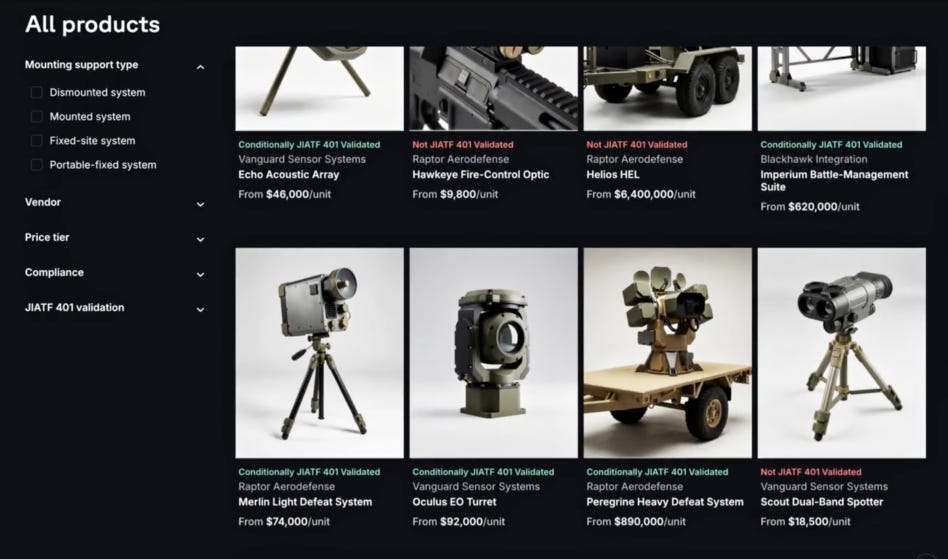
BLUF: JIATF-401 counter drone task force is taking a page out of Amazon’s book and building Prime for the primes and startups. Today, they officially unveiled an online marketplace for companies to submit and list the latest and greatest in counter-drone tech and for government customers (both US and allied) to see what’s on offer, evaluate it, and buy it.
The marketplace was developed by NYC-based software startup Kaizen in “less than nine weeks under a $15M prototype OTA contract awarded by JIATF-401.
It went live a week and a half ago, and we’ll continue to bring on more partner nations and a ton more vendors to the system.
Kaizen has raised $35M from Accel, NEA, a16z’s American Dynamism practice, and others, including a $25M Series A last October.
Taproot is Kaizen’s global library of compliance-engineered building blocks that we believe can help make any constituent service far better than it currently is—forms, marketplaces, permits, applications, reporting, payments, scheduling, and more.
Blacksmith is an Agentic AI-assisted harness that rapidly configures those building blocks to any new mission set” that they work with the government on.
So far, a handful of drone orders have been placed through the platform, but it’s still “largely in testing with administrators to make sure that the orders are coming through and they’re being adjudicated correctly. But even in the early stages, users are fired up about it.
Anduril, SmartShooter, DroneShield, AeroVironment—all of these vendors that are publishing their products already to the marketplace…have given us extremely strong feedback about how simple it was to get onboarded and go through the vendor onboarding experience
"JIATF-401 remains focused on delivering the right counter-UAS capabilities to the right users at the right time. Our revolutionary marketplace, powered through our partnership with industry, creates a streamlined, trusted pathway for the Joint force, domestic law enforcement, and our international partners to rapidly discover and acquire validated technologies." MAJ Mike Hapner, C-UAS marketplace lead for JIATF-401.
Related: DoW Enhances C-UAS Marketplace to Expand Access to Validated Technologies
Our take: This is precisely the kind of commercial-style marketplace the DoW needs to scale across every major portfolio. By leveraging OTAs and commercial software to create trusted, two-sided platforms for discovery, validation, and rapid purchase, JIATF-401 is operationalizing the commercial preference in a way that lowers barriers for both primes and startups while putting capability in operators’ hands faster. PAEs should stand up similar marketplaces for UAS, EW, autonomy, munitions, and software-defined systems, paired with recurring competitions and real user feedback. Done right, these become the competitive engines that harness private capital and deliver the speed and scale the threat environment demands.
SOUTHCOM Establishes Joint Task Force Western Hemisphere
BLUF: SOUTHCOM activated Joint Task Force Western Hemisphere yesterday, a purpose-built, joint task force that will synchronize U.S. military operations with allies and partners to counter threats, strengthen regional security and respond rapidly to crises across the hemisphere.
The task force provides unified C2 at the tactical and operational levels and integrates military capabilities with the 18 partner nations of the Americas Counter Cartel Coalition.
It will increase SOUTHCOM operational effectiveness against threats that undermine regional security and impact the United States and partner nations, while also strengthening the command's ability to respond quickly to contingencies and humanitarian crises throughout the region.
"JTF-WHEM strengthens our ability to work alongside trusted allies and partners, synchronize military capabilities and apply sustained pressure against the networks that threaten our collective security. Together, we are increasing security across the hemisphere and protecting our homeland." GEN Francis Donovan, SOUTHCOM Commander
Defense Tech Investors Thought the War in Iran Could Make Them Millionaires. Instead, They Faced a Wall Street Bloodbath
BLUF: Despite continued conflict and historic levels of defense spending requested by the Pentagon, investors betting on a defense windfall have watched many top contractors lose value.
Trading volumes in major defense contractors surged in the conflict’s opening days—rising for some as much as 140% above their average level since 2025, but the gains didn’t last.
Northrop Grumman is now down over 30%, L3Harris has fallen over 20%, and Lockheed Martin declined nearly 13%. RTX was at one point down 18%, but has since recovered to up 4%.
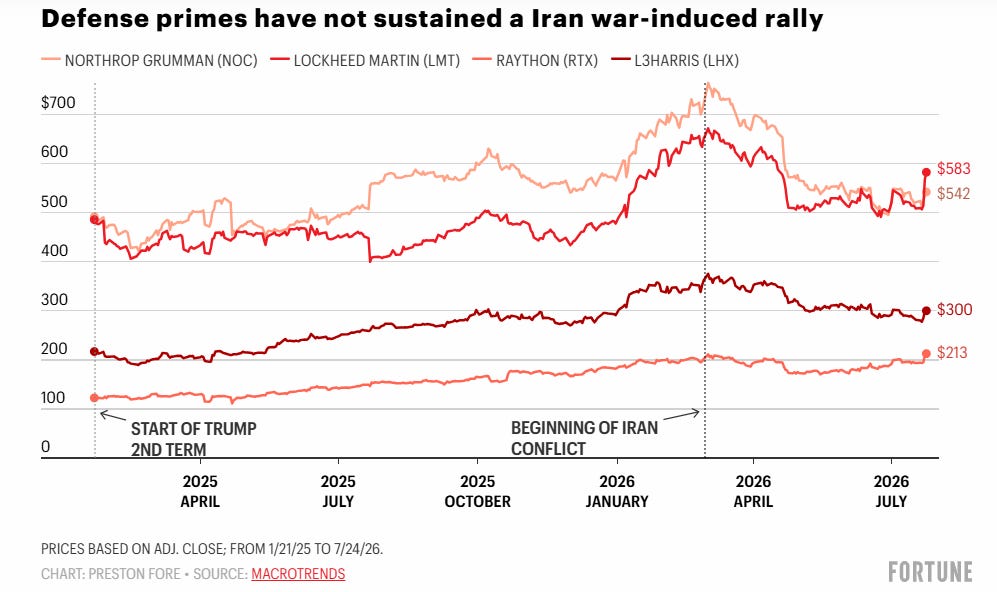
The good news was already priced in. Investors are hunting for the industry’s next payday are waiting to see whether higher defense budgets actually translate into new contracts, faster production, and stronger earnings—or whether political and economic pressures slow long-term momentum.
Many of the defense players are entering the second half of the year on strong footing thanks to enlarged order books.
In the first quarter of 2026 alone, venture capital firms deployed a record $19.8B into defense tech across 262 deals.
Companies like Anduril (whose valuation recently doubled to $61B), Shield AI ($12.5B), and Saronic ($9.25B) are among Silicon Valley’s fastest-growing defense startups.
Yet contract dollars to the 15 highest-valued defense-tech startups tripled between FY22-25 accounted for <1% of all DoD contracting dollars
“Investor alpha is most likely gained when investments are made before wars and before legislated funding, not after a war has begun, become unpopular, or when associated plus-ups are in doubt,” Mike Derrios, GMU Baroni Center Exec Director
Our Take: This piece is more hype than analysis, but it shows the traditional primes reverting to their long-term straight-line growth trajectory after a bout of investor euphoria during the war with Iran. We’ll examine traditional versus non-traditional players in an upcoming piece; for now, defense-tech companies still capturing just 1% pose no real threat to the primes.

XQ-58 Valkyrie Drones With Built-In Landing Gear Are Now In Production
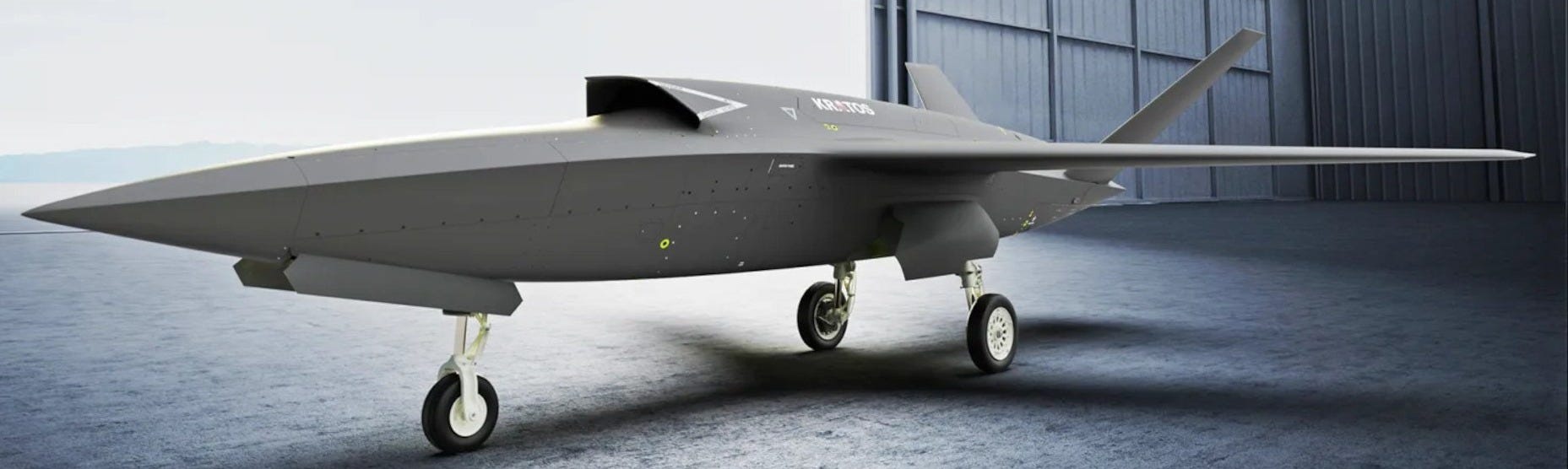
BLUF: Kratos has built the first landing gear-equipped versions of its stealthy XQ-58 Valkyrie drone, with several additional examples now in various stages of construction. The company is also still producing XQ-58s designed for rocket-assisted takeoffs via static launchers, and Valkyrie production is ramping up overall. Both types offer certain advantages in different operational scenarios.
The rocket-assisted takeoff (RATO) and landing gear-equipped conventional takeoff and landing (CTOL) versions of the Valkyrie are the two main known configurations of the design.
The RATO type, which first flew in 2019, also lands via parachute. Kratos has also developed a special launch trolley that allows RATO Valkyries to conduct runway takeoffs, though they still land using the parachute recovery system.
Valkyrie is a highly modular design with an open mission systems architecture intended to be readily configurable to meet customer needs.
RATO XQ-58s can carry up to 1,200 pounds of stores in their internal centerline bay, as well as payloads weighing up to 600 pounds on a single hardpoint under each wing.
US Tech Helps USV Conduct Search Mission, Spot Target Autonomously

BLUF: Shield AI and Taiwan’s Thunder Tiger have successfully completed the first demonstration of Hivemind-enabled multi-asset autonomous maritime teaming in Taiwan. This marks a significant milestone in the evolution of AI-driven naval operations.
The demonstration showcased how multiple unmanned maritime systems can operate collaboratively with minimal human intervention, highlighting the growing role of AIin modern defense.
The exercise featured Shield AI’s Hivemind, an AI-powered autonomy software that enables unmanned platforms to navigate, coordinate, and execute missions without relying on continuous GPS connectivity or human control.
During the trial, several autonomous maritime assets worked together as a coordinated team, demonstrating intelligent decision-making and real-time mission execution in a challenging operational environment.
the demonstration is the first step in a broader collaboration with Thunder Tiger aimed at integrating Hivemind across the Taiwanese company’s portfolio of unmanned systems.
The partnership focuses on improving autonomous capabilities for USVs and expanding coordinated operations across multiple domains in the future.
The Pentagon Can Build Killer Drones. It Needs to Move Faster
John Ferrari and Dillon Prochnick

BLUF: The Pentagon is moving too slow owing to funding, procurement, organizational, and oversight systems that are poorly suited to fielding and continuously updating the most decisive capability on the modern battlefield.
If the U.S. neglects to develop them proactively, it risks having to develop them reactively in a crisis, with far less time to conform with our ethical standards.
What happens to a force that has to disperse to survive when you knock out its ability to coordinate and sustain action?
Cheap sensors and precision strike options are disrupting the American way of war.
Sanctuaries for American forces to operate near the conflict are gone and the concentrated bases that remain are vulnerable targets.
The Navy, Air Force, and Marine Corps all have distributed operations concepts that internalize the dilemma: disperse or die. Dispersed forces strain already-taxed command and sustainment networks.
Humans make mistakes when exhausted and scared. The real questions is not whether machines will be flawless. It is whether they can perform certain functions reliably and at lower cost.
Acquiring drones requires the flexible, multi-year funding already requested in the FY27 budget to be dispersed in a competitive process to groups of soldiers and sailors mixed with civilian engineers, materials scientists, and software engineers, stood up inside the services and command headquarters that face most sharply the operational problem.
Autonomy needs both protected space to grow and rivalry so that losers can be culled.
Responsible autonomous targeting should be bounded.
Moving imperfectly will be less risky than not moving. The best way to protect civilians’ lives and prosperity is to deter conflict.
The technology will arrive either way. The real open question is whether the United States or its adversaries decides what it does. Does the U.S. develop the systems of the future on its terms in advance where we can set appropriate guardrails and train our forces to use them or is it forced to react in a crisis?
Read John and Dillon’s full report Killer Drones: Ready or Not, Here They Come
Our Take: John and Dillon are spot on. Detractors and hand-wringers seeking to slow U.S. drone dominance threaten our military edge. Valid concerns remain for the Department and industry to resolve, yet a slow-and-steady, risk-minimizing approach simply cedes competitive advantage to our adversaries. We must invest tens of billions to rapidly field drones across air, sea, undersea, and ground from innovative American companies, then exercise and experiment with them for swift integration into OPlans.
Where the Giants of Defense Tech Get Their Engineers.
BLUF: The Arena traced the career history of every 2026 software-engineering hire at nine of defense tech's biggest names — 908 people, from Anduril and Palantir to Saronic — to see where the talent actually comes from. It isn't the primes, and it isn't the military.
SW Engineers hired: Anduril 258, Palantir 217, Scale AI 152, SpaceX 115, Applied Intuition 57, Shield AI 52, Saronic 34, Skydio 18, and Vannevar at 5
The come from Commercial tech 61%, Big Tech 18%, Academia 8%, Other defense startups 6%, Legacy primes 4%, Military/Gov 2%, and Neo-prime 1%.
They come from: Amazon 88, Microsoft 32, Meta 21, Google 17, and NG 13.
Anduril 9.3 years and Scale AI 8.7 hire more experienced while Palantir’s forward deployed engineers drive the average down to 5.1 years experience.
These companies rarely poach from each other - only 1.3%.
War Data Platform Integration Plans Under Scrutiny

BLUF: Concerns are mounting as new details slowly emerge about the government’s high-dollar core integration contract for the War Data Platform, formerly known as Advana, that Accenture Federal Services recently won.
Accenture Federal Service won an $821M task order to supply core integration support to the WDP and two weeks later the DoW reported CDAO with GSA tapped them to lead the complex military and data tech integration effort for an undisclosed amount.
One former official criticized this: The entire rationale for rebranding Advana into the War Data Platform was to shift toward real warfighter outcomes and mission impact. Selecting a traditional cost-plus consultancy, after 18 months of contrary administration guidance, with a mixed track record does not signal that shift.
The platform is billed as an ever-maturing asset that enables DOD to provide standardized, secure data access needed to run operational AI that can adequately inform commanders’ fast-paced combat decisions, enterprisewide and across its many disparate military components.
It powers advanced AI systems and agents by providing data and analytics products using more than 700 data sources.
EO 14402 and the Department’s own acquisition reform guidance are explicit about moving away from open-ended, cost-plus consulting arrangements toward firm fixed price, outcome-based, mission-focused contracts that protect taxpayers and reward measurable performance.
Instead, it defaulted to a traditional consulting model that prioritizes manual labor over efficiency and outcomes. That is not how you accelerate AI adoption — it is how you slow it down.
Pentagon appoints new Maven Smart System program director in fresh push for C2 integration

BLUF: CDAO appointed COL Molly Solsbury to serve as Maven Smart System program director. She is intended to further anchor MSS as a core operational cornerstone for C2 integration across the Department.
DoD has been hustling for years to realize its strategic vision for CJADC2. The overarching aim is to enable a network of networks that security links all of the military’s sensors, data, weapons and decision-makers across the services and combat domains.
Palantir’s widely-used platform Maven Smart System is emerging as a key operational asset for interoperable user interface powering the department’s foundational plans for CJADC2.
DEPSECWAR Feinberg issued a memo in March: Transitioning MSS to a POR will provide the stable funding and resourcing necessary for deliberate, sustained development and enterprise-wide integration to give our commanders the C2 necessary to fight and win wars.
The FY27 budget request includes >$1.5B to expand defense users’ access to Maven Smart System as part of Joint Force AI-Enabled Headquarters initiative.

The Factory Is the Product
Nadia Schadlow and Mislav Tolusic

BLUF: Congress is debating anew whether to add billions of dollars to next year’s defense budget. But just as important as how much to spend is what those additional dollars should buy.
For decades, the answer was ships, aircraft, tanks, and other platforms.
But an F-35 that does not have a steady supply of munitions is hardly a capability. A submarine awaiting critical spare parts cannot go out to sea and deter.
What matters is not simply the advanced platforms, but fielding capabilities that can be sustained, replenished, and adapted in combat.
The ability to surge, adapt, and manufacture at scale will increasingly determine military advantage.
We are in the midst of a fundamental realization: the factory is the product.
Our ability to achieve ADM Paparo’s vision of a hellscape of thousands of autonomous systems is highly questionable, today, that we can deliver.
Doing so requires an industrial base capable of producing enormous numbers of inexpensive systems—capabilities—at operational speed.
The FY26 NDAA expanded the Defense Industrial Base Fund to support investments in machine tools, castings and forgings, production modernization, and related industrial infrastructure and established the Civil Reserve Manufacturing Network (CRMN).
If the factory is the product, the question is no longer simply what equipment the Pentagon should buy, but what manufacturing assets it should own or incentivize so that industry can produce capabilities at whatever scale future conflicts require.
One way to broaden this approach and to draw in needed private capital is through a Capacity-as-a-Service (CaaS) model.
If the objective is to deliver continuously improving operational capabilities rather than a single platform, a CaaS model would reward industry for providing capability over time—not just a one-time production run of hardware.
Under CaaS, the DoW would pay contract manufacturers annual retainers to offer rapid production scaling—much like DoW pays commercial shippers to ensure adequate shipping capacity is available in case a contingency develops.
It also changes the economics of defense production. Instead of financing short production runs, companies can invest in scalable manufacturing methods, advanced tooling, and automation that lower costs and increase production rates over time.
Advantage will belong to the nation that can build factories as quickly as it builds weapons, continuously improve production, and translate commercial innovation into military capability. In this age of rapidly evolving warfare, factories are strategic assets.
Our Take: We fully agree. This requires deeper Department-Industry partnerships on production capacity, adaptability, resilience, and long-term strategic growth. We can no longer afford to lock in legacy systems for decades or disrupt industry and investors with highly unstable demand signals. As we note in our piece It’s Time for PMs to Own the Supply Chain, program managers, PAEs, and SAEs can serve as orchestrators for a portfolio of components.
Defense Execs Feel Good About Pentagon Spending Despite Uncertainty on FY27 Budget
BLUF: Defense primes have been attempting to soothe Wall Street’s anxieties surrounding the Pentagon’s uncertain outlook for a $1.5T budget in FY27, with executives pointing to sustained weapons demand as proof that a meaty defense budget will ultimately materialize.
Although RTX has signed off on initial framework deals for munitions like Tomahawk and AMRAAM, those deals are not yet built into the company’s backlog and financial expectations.
If reconciliation funding fails to materialize or is much smaller than anticipated, it could impede the Pentagon’s ability to move forward on multi-year munitions deals — which make up $47B of the reconciliation request.
It could also impact Golden Dome, where the Pentagon requested $17.1B in reconciliation dollars with only $400M for the program included in the base budget. The Pentagon also requested billions in reconciliation dollars for other key programs, like the Navy’s Landing Ship Medium and the F-35 JSF.
Lockheed believes the budget and regulatory environment will ultimately be influenced by a wide array of factors, including Congress, the US political landscape, macroeconomic factors and global threats.
“I know there’s lots of discussions on budget amounts and mechanics, but what I can tell you, as we engage with Congress, is there’s a bipartisan support for increased munitions and ramping in those areas, which are pretty core to our capabilities.” Chris Calio, RTX CEO
“We’re not dependent on significant supplemental or incremental funding above the base budget to drive that growth into 2027.” Kathy Warden, Northrop CEO
“I anticipate the highest defense budget in our country’s history and a supplemental budget that would fund multi-year munitions contracts.” Chris Kubasik, L3Harris CEO
New Initiatives at the DoW’s Office of Industrial Base Growth
Nadia Schadlow and Michael Dressler
USW(A&S) Office of Industrial Base Growth (IBG) has set the following goals:
In the short term, identify companies that have left, been unable to enter, or previously not had a place in the defense ecosystem.
In the medium term, help American companies remove Chinese suppliers from their production chains and minimize risk to the broader US DIB.
In the long term, cultivate a self-sustaining pipeline of domestic companies capable of competing at the prime level, reducing reliance on a small number of large primes.
IBG Initiatives
LYNX is a platform with a streamlined website that enables new contractors to discover DoW contract opportunities, gain visibility across the defense industrial sector, understand the requirements their companies must meet, and receive individualized support for regulatory compliance.
The Civil Reserve Manufacturing Network (CRMN) enables commercial manufacturers to voluntarily enter into agreements with the DoW.
The 1260H List, Section 805, and Section 851 to reduce US reliance on Chinese inputs by working with other DoW organizations to identify domestic suppliers to replace inputs sourced from Chinese military-affiliated companies.
The modern US DIB has undergone drastic changes while experiencing cycles of expansion and contraction.
The industry has seen decades of contracting demand, large government-backed mergers and acquisitions, and the offshoring of manufacturing and processing capabilities, primarily to China, as the government supported globalization.
As a result, today the defense sector is hyper-consolidated and relatively undiversified.
Hadrian Valued at Nearly $8B After Fresh Funding as Money Pours Into Defense Tech
BLUF: Hadrian raised nearly $1.4B in new funding at a $7.9B valuation. The fresh funds will allow it to invest in its workforce and its Opus software platform.
Hadrian builds advanced factories for defense and aerospace companies and agencies.
Opus software is being used by the Army and Navy, and Hadrian will be announcing other defense primes soon.
“It enables us to make massive investments to scale our workforce, our software platform Opus that powers our factories, and frankly, get ahead of the massive amounts of production challenges the country has in areas like submarines, munitions, the drone industrial base. With physical AI sweeping the physical economy, which is 100 times larger than the digital economy, everyone’s going to need to rebase their software to adapt and compete in this new world.” Chris Power, Hadrian CEO
Scaling the US Defense Industrial Base to Meet Record Demand
Steve Beckey, JD Kearney, Nathan Miller, and Timothy Wickham
BLUF: The U.S. defense market is in a historic period of production ramp-up, but the industrial base is struggling to meet the demand. We conducted a comprehensive survey from over 160 companies, including OEMs and Tier 1 & sub-tier suppliers.
As markets signal rising demand — and conflicts are likely to increase the backlog to ~$900B — companies across the industry told us they are navigating complex shifts in operational resilience, financial stability, and technology.
Each segment of the value chain faces distinct pressures, but the overall picture is an industrial base is unprepared for the pending production ramp.
Six key insights on the state of the defense industrial base
The ramp is real, but the supply base lags behind. Suppliers see the demand signal, but many do not believe they can translate it into executable capacity quickly enough.
Uncertainty is stalling investment. Demand uncertainty, both in timing and in scale, is keeping suppliers from making the necessary investments.
The market is burdened by a growing “trust tax.” Suppliers are holding excess capacity in reserve and carrying buffers as insurance against sub-tier delivery risk.
Workforce issues could cripple the ramp-up. The industry continues to struggle with labor challenges, including finding, training, and retaining the expertise required to scale production.
Tier 2+ suppliers are often the hollow middle of the ramp. Sub-tier suppliers are a structurally exposed segment of the industrial base, with the least financial, operational, and digital room to absorb the surge.
AI adoption has begun, but it is not yet a ramp solution. Early adopters are beginning to see marginal benefits, but the technology remains too unevenly deployed to offset the broader challenges.
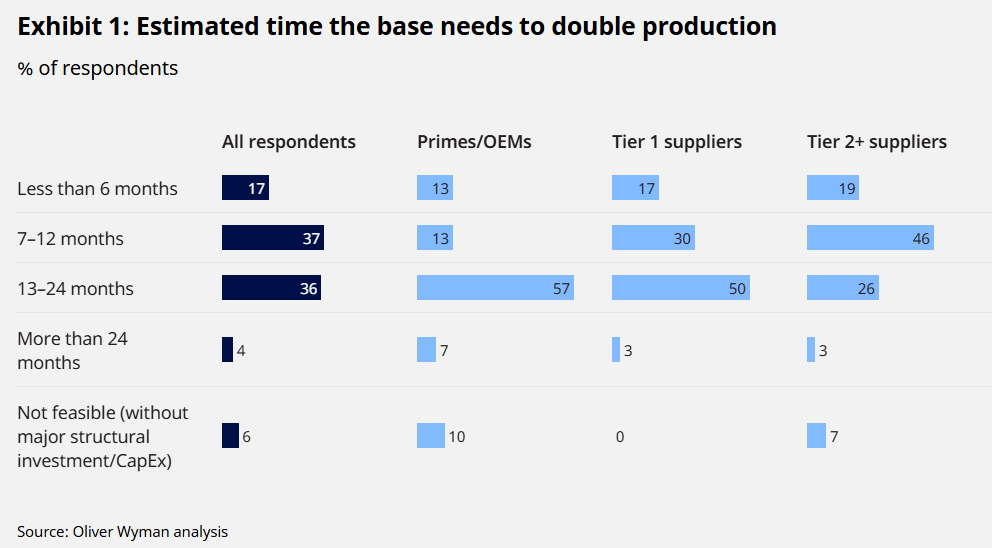
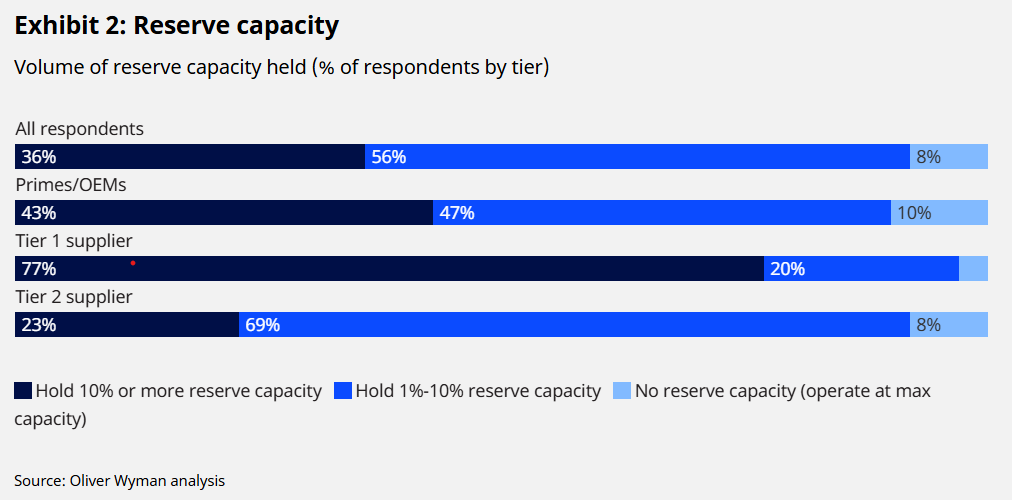
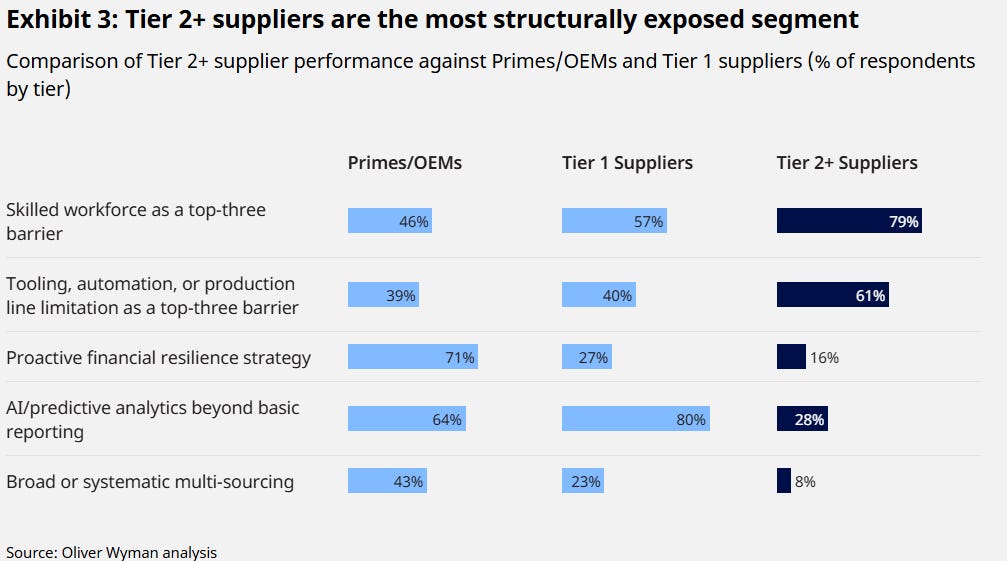
Our Take: The good news is that vendors (at all levels) don’t think they need more than 2 years to double production and more importantly they don’t seem to need major capex to make it happen. The downside of the responses is that a skilled workforce is a top barrier which is not always an easy fix depending on the locale. One area of interest is that tooling and automation could have a major impact on the Tier 2+ suppliers and while they say they don’t need capex to double production, they could potentially use capex to treble production with more automation. The report notes that suppliers should focus on “targeted automation, AI, advanced manufacturing, process redesign, and knowledge-capture opportunities” which is a solid recommendation and an area for OSW to help. Read the full report.
Full Report: The defense ramp-up reality check
Northrop gets $3B Framework Deal to Increase Motor Production for PAC-3, THAAD
BLUF: Northrop Grumman will become a second supplier of rocket motors for the in-demand PAC-3 interceptor while also increasing motor production for THAAD missiles.
Both agreements span a total of seven years, with the PAC-3 deal valued at $2B and the THAAD deal valued at $1B.
Northrop’s Allegany Ballistics Laboratory in West Virginia will stand up production for solid rocket motors for PAC-3, while the additional THAAD motor production will take place at its San Diego plant.
The Northrop deal follows a similar agreement to boost THAAD and PAC-3 solid rocket motor production, signed last week by L3Harris and the Pentagon. L3Harris is currently the sole producer of SRMs for PAC-3.
Our Take: While the company announcements hedge a bit more on exact increases, A&S is expecting this agreement to quadruple the production of THAAD interceptor structural components. This includes critical parts such as mid-body shells, muzzle covers and rail car assemblies. Establishing a second source for PAC-3 SRMs is a positive development given the current demand…and could also be useful for other iterations of high-end defensive munitions.
Related Article: DOW Signs Framework Agreements with Northrop Grumman to Ramp Production of PAC-3, THAAD Components
HII Teams Up with GrayMatter and Path for Robotic Shipbuilding
BLUF: HII (formerly known as Huntington Ingalls Industries) announced that it signed agreements with GrayMatter Robotics and Path Robotics to “accelerate the development and deployment of advanced physical AI automation across U.S. Navy shipbuilding programs, including aircraft carriers, submarines, destroyers, amphibious ships, future frigates and unmanned surface vessels.” in a deal worth up to $900M.
GrayMatter combines an autonomous intelligence layer with COTS robots to do the “last-minute,” often super-precise parts of the manufacturing process. Think sanding, grinding, coating, and inspection.
Their software (called SCAN&) scans a part with 3D sensors, creates a digital model, and figures out what finishing steps need to be done—then programs a robot to do them.
That saves operators hours on reprogramming robots every time the geometry of a ship or part changes. Their setup is very helpful for high-mix, high-variability stuff—like a shipyard.
Path builds autonomous welding robots that can also work on a variety of parts without being reprogrammed.
Traditional robotic welding requires engineers to manually teach the robot the exact weld path. That works well when you’re building thousands of identical parts, but not so well when you mix it up.
Path has built a physical AI model it calls Obsidian that scans parts with cameras and sensors, identifies where a weld should go, and then assigns robots to do it automatically. It also tests weld quality as it works.
Our Take: Given HII currently builds at least 3 major Navy ship platforms that GAO reports are behind schedule, with delays ranging from roughly one year to nearly five years, this is a promising development that can maybe help improve the speed and predictability of our critical maritime capabilities.
AE Industrial Closes Purchase of L3Harris’s Space Propulsion, Power and Electronics Units Establishing the Business as Rocketdyne
BLUF: AE Industrial, a private investment firm, has finalized the acquisition of the space propulsion, power and electronics units from L3Harris Technologies and is launching the entity as Rocketdyne.
The transaction re-establishes Rocketdyne as an independent company with more than 60 years of spaceflight heritage and a proven track record across civil, commercial, and national security space.
L3Harris will retain a minority stake in the business and continue to be a strategic partner.
AE Industrial will provide investment in Rocketdyne’s core capabilities, including:
upgrading the technology and manufacturing of the RL10 rocket engine
ramping up production of in-space propulsion thrusters
advancing nuclear power and energy solutions for space applications.
Our Take: L3Harris acquired Aerojet Rocketdyne in 2023 but its only divesting of the space business as part of this deal so it retains the SRM business which it has received OSW investment of a $1B convertible preferred equity to expand and modernize SRM production facilities, accelerate R&D, and increase production capacity. L3Harris is said to have retained a 40% share and by retaining the strategic partner connection is likely making out very well with this deal. It allows it to focus its IR&D and attention on the SRM business while allowing a separate entity to invest in and grow its space business.
OSC Signs $820M Loan Commitment with Performance Drone Works to Expand Domestic Drone Component Manufacturing
BLUF: The investment is intended to supply components to multiple manufacturers and platforms for a range of Group 1 and Group 2 unmanned aircraft produced by PDW and other domestic manufacturers.
Xona Clears Final Regulatory Hurdle for PNT Constellation

BLUF: Xona Space Systems has won FCC approval to broadcast its Pulsar navigation signals from a full satellite constellation, clearing the last regulatory hurdle before the company can scale deployment.
The authorization makes Xona the only FCC-approved private navigation constellation cleared to broadcast in the L-band, putting Pulsar alongside GPS and other nation-state networks.
Pulsar is built to augment legacy GPS including with signals up to 100x stronger than GPS, spoofing protection using a dynamic cryptographic watermark and compatibility with existing GNSS hardware.
Xona launched Pulsar-0 in 2025 to prove the signal could work without interfering with GPS. Since then, the company says it has logged 350+ transmission passes tracked by more than a dozen commercial receivers.
Xona’s biggest hurdle was proving to regulators it wouldn’t interfere with existing GNSS signals in the heavily protected L-band.
The first six Pulsar satellites are slated to launch in October, with initial operations set to begin in early 2027.
Quantum-Inspired Tech Lets Engineers Test Tens of Thousands of Drone Designs at Once
BLUF: Technology, developed by quantum-accelerated simulation software company BQP, uses advanced computing methods to explore thousands of engineering designs on existing high-performance computing and GPU systems.
Drone maker Modovolo has integrated BQP’s BQPhy simulation platform into its engineering workflow to test a much larger number of propeller designs than traditional methods allow to design its next-generation propellers.
The goal is to shorten the process of finding designs that can improve drone flight time and payload capacity while keeping manufacturing costs low.
Traditional computational fluid dynamics and structural analysis tools can make design optimization slow because engineers have to narrow many possible configurations into a manageable set.
BQP says this can compress tens of thousands of simulations into a fraction of the usual time and computing resources.
Our Take: The potential here is endless, definitely some exciting possibilities ahead. One misconception that many have about quantum is that it can process things like this because its inherently faster than a traditional GPU. The reality is that quantum tackles the problem from different vantage points given its parallel-like processing which allows for truly unique outputs that traditional methods might never arrive at even with the biggest supercomputer.
High-Purity Iron Producer Addressing Rare Earth Magnet Gap
BLUF: Hertha Metals, a high-purity iron production company from Texas, uses a unique single-step process to turn any grade domestic iron ore — mixed with natural gas — into high-purity iron, which it then converts into neodymium magnets.
China produces 90% of the world’s high-purity iron, dominating the industry.
Chinese high-purity iron is made electrolytically, using electric currents to drive a chemical reaction.
High-purity iron magnets are critical for defense systems because they require electric steel, which is high-purity iron combined with silicon.
High-purity iron is included in precision-guided munitions, autonomous vehicles, electric drive systems and F-35s.
Hertha was scheduled to break ground on a new plant that will produce high-purity iron by early 2028 and help achieve the company’s goal of delivering 300,000 to 500,000 tons of the metal per year by the end of 2030.
Our Take: Quite simply, this is huge. The ability to produce this onshore will be a dramatic relief to multiple supply chains that struggle to buy magnets from non-restricted sources.
Securing America’s Critical Data Supply Chain
Lucian Niemeyer and Sue Ghosh Sticklett
BLUF: The Supply Chain EO directing DoW to illuminate defense supply chains using complete indentured Bills of Materials tracing components, parts, equipment, software, and material through every tier of the supply chain and back to their origin is a timely and critical initiative. Yet it secures only half the battlefield.
The EO focuses on steel, titanium, microchips, rare earth minerals, and the industrial base that transforms them into military capability.
But every modern defense system depends upon something just as indispensable: trusted, verifiable, and fit-for-purpose data.
Critical data now flows through the armed forces with the same strategic importance as fuel, ammunition, and replacement parts.
However, if that information is corrupted, incomplete, biased, misleading, outdated, or stripped of context, even the most sophisticated weapon system can become extraordinarily expensive monuments to misjudgment.
Our adversaries understand the power of corrupting information for advantage.
A manipulated maintenance record can ground aircraft at the wrong moment.
Poisoned logistics data can send critical supplies to the wrong location.
A fabricated intelligence report can redirect surveillance.
Biased training data can cause an AI-enabled system to misclassify a legitimate target, overlook a threat, or fail in the operational environment.
By the time commanders discover the data corruption months after the exploitation, the operational consequences may already be irreversible.
When sensitive information crosses international boundaries, resides under competing legal jurisdictions, and moves through systems operating under uneven security standards, the chain of custody can be lost.
The new demand is Data Provenance—verifiable evidence showing where mission-critical data originated, which organizations/systems handled it, transformations it underwent, and whether its integrity and context were preserved.
The Department and the defense industrial base should adopt commercial technologies to preserve evidence of origin, transformation, custody, and authorized use across structured and unstructured data, including video, audio, documents, sensor feeds, databases, and AI outputs.
Certain mechanisms should include cryptographic signatures, trusted timestamps, secure metadata, content credentials, tamper-evident logs, hardware-backed attestations, robust watermarking, independent corroboration, and validation.
These capabilities should also enforce data use restrictions and ensure that only authenticated information is ingested into AI systems, allowing trust to travel with the data wherever it moves.
OSC/EDU Loans and Deals
Other Defense Industry News

Portfolio Executives Describe Changing Roles as Air Force Completes Acquisition Overhaul
“This is a monumental step forward, but our work is not done. Pushing these critical decisions down to the PAE level demands a heightened commitment to delivering results and holding ourselves accountable. We must continue to be bold, to learn and to adapt — ensuring we provide our warfighters with the decisive edge they need when they need it. We’ve focused on in on the decision making and matching the authority with the accountability at that point of a PAE. It gave us a chance to take a look at what level are we making those decisions and how far down can we delegate and streamline.” William Bailey, Acting Air Force SAE
“Each PAE has oversight over the entire lifecycle of all platforms in its portfolio. Rather than dividing authority across fragmented offices, they’re charged with enterprise-wide modernization, procurement and sustainment efforts while individual program managers retain responsibility for specific platforms.” Col. Timothy Spaulding, PAE for Bombers
“Instead of a program-by-program type focus, we now have a portfolio or enterprise focus. That means that I can help drive integrated propulsion acquisition strategies and outcomes across the enterprise, enhance those enterprise-wise results, ensure the vitality and protection of the propulsion industrial base and align our demand signal to optimize the use of limited funds that we have.” John Sneden, PAE for Propulsion
Air Force Delivers on Acquisition Transformation, Redesignates Executives as PAEs
While last month we reported the Air Force redesignated all the remaining PEOs to be PAEs, this latest announcement provides the updated list of PAE portfolios and executives.
Department of the Navy Establishes Direct Reporting Portfolio Manager for Robotic and Autonomous Systems
BLUF: SECNAV established Direct Report Portfolio Manager for Robotic and Autonomous Systems (DRPM RAS) a strategic restructuring to tightly integrate the development, requirements, and acquisition of RAS capabilities across the Department of the Navy (DON).
Chris Miller will serve as acting DRPM RAS reporting directly to William Toti, PTDO USECNAV and concurrently serve as acting PAE RAS.
RADM Casey Moton will replace Miller as PAE Maritime.
“We are at an inflection point in naval warfare, and the Department has been approaching robotic and autonomous systems through arcane processes that do not deliver capabilities at the speed our Sailors and Marines need.” William Toti, PTDO USECNAV
Weeks Relieve Downey as PAE Industrial Operations
VADM James Downey was relieved of his dual-hatted role as PAE Industrial Operations by RADM Todd Weeks and as NAVSEA Commander by RADM Pete Small during a joint change of command. Following the change of office and change of command, Downey is slated to retire after 40 years of distinguished and dedicated service to the U.S. Navy. Our Take: May VADM Downey have fair winds and following seas.
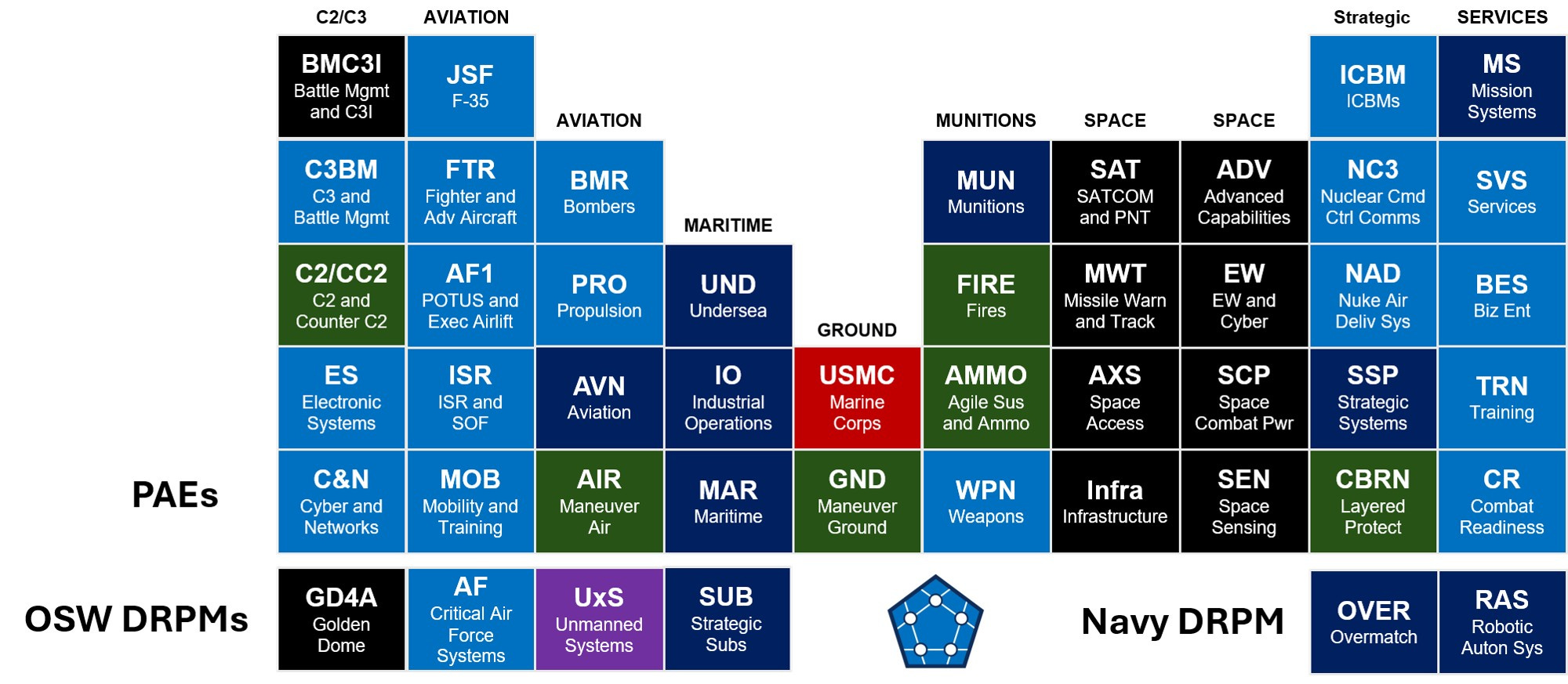
Can’t keep track of all the PAE and DRPM changes? No worries. You can see all the Portfolio Acquisition Executives and DRPMs on our Digital Pentagon platform.
Top Cover and Clear Metrics: How to Make the New PAE Structure Work
BLUF: What will it take for acquisition reform to finally succeed? New org charts aren’t enough: The people in the organization need new incentives.
The new PAEs have the power to launch sustainable reform that, at long last, shifts defense acquisition from a focus on procedural compliance to one on accomplishing the mission if they use that power to:
Provide believable, executable top cover for contracting officers, not just lip service about taking risks.
Refocus performance metrics to measure whether and how quickly acquisition outcomes produce mission results.
Compliance culture is not an attitude problem. The acquisition workforce is rational.
When COs exercise flexible methods and face a protest, an audit, or a congressional inquiry, they are personally exposed. They’re the ones who sign for the government: Their name is literally on the line. When COs follow standard procedures and an acquisition produces a poor outcome, bad career consequences rarely follow. Compliance remains the smart choice.
The PAE now holds direct authority over the PMs and COs within a portfolio. The PAE responsible for capability delivery across that portfolio as a whole, not just for milestone compliance on any single program.
For the first time, the leaders with institutional authority over COs have a mission that requires them to provide real top cover, because the PAE’s own success depends on the outcomes that cover enables.
This is what every past reform lacked.
Deploy top cover first, and the CO begins exercising flexible methods, because the risk of professional exposure has been removed. When metrics arrive, they make the resulting outcomes visible. The PAE can see what is working. Resources flow toward what works. The loop closes.
Top cover is a written, public commitment by the PAE, by name, to defend specific contracting decisions made in good faith using specific flexible methods.
Three metrics constitute a viable starting set.
Time-to-mission-effect tracks elapsed time from a validated operational need to capability in the operator’s hands
Post-award mission satisfaction, a structured assessment conducted by the requiring activity at six and 12 months, links the contract to the operator’s lived experience of how the product actually performs, rather than to technical acceptance alone.
Competitive yield, the number and quality of offers received, makes visible the firms that did not bid because the solicitation signaled that innovative vendors were unwelcome.
Law Firm Skeptical AI Can Help Speed Up Security Clearances
BLUF: DCSA has proposed using AI in its security clearance application process, but a New York-based law firm says questions remain about the technology’s potential benefits.
The firm (Tully Rinckey) helps candidates applying for security clearances, assists when clearance is in jeopardy over alleged violations of adjudicative guidelines.
Adjudicative guidelines are standardized rules used by the government to determine if an individual is trustworthy enough to hold a security clearance.
The firm uses 13 of these guidelines to help individuals either obtain or keep their security clearance.
At any given time, tens of thousands of applicants are stuck in backlogs.
The fear is that the very reason the agency wants to incorporate AI — to speed up the process — might have the opposite effect if an AI creates inaccurate results.
If the agency allows AI enough authority to flag cases and move the applications to a notice of intent to deny or revoke, then the cases Tully Rinckey responds to and potentially litigates will significantly increase.
Additionally, AI cannot follow up with references, such as an applicant’s prior employer, to confirm the answers on the application.
“Artificial intelligence may help accelerate parts of the background investigation process, particularly by identifying objective issues that warrant further review. However, AI is only as reliable as the data behind it, and accuracy concerns remain. Security clearance decisions often require human judgment to evaluate context, mitigation and credibility in ways that a machine cannot.” Anthony Kuhn, managing partner at Tully Rinckey
Palantir Calls on GSA to Withdraw Draft AI Acquisition Rule
BLUF: GSA should axe its draft large language model-specific acquisition rule, in part because it is purportedly unlawful and would undermine Trump administration goals if it were finalized, Palantir argued in recent comments on the proposal.
Palantir argued that GSA has no independent authority to finalize the proposed LLM rule and would violate FASA by mandating contracting requirements beyond standard commercial practices if it did finalize it.
Palantir also called the proposed LLM rule incompatible with legal requirements for defense acquisitions — such as limitations on the clauses defense agencies can require of contractors and prohibitions on “demanding proprietary IP rights as a condition of contract award”
Overall, it said it disregards decades of intellectual property rights precedence.
During last month’s listening session, industry groups widely urged GSA to clarify definitions and modify flowdown requirements if the agency wanted to achieve its goal of safeguarding government data processed by LLMs.
Groups also urged GSA to clear up the “unbiased AI principles” language with objective metrics contractors could use to ensure compliance with the regulation.
One group pointed to NIST AI RMF 1.0 trustworthiness criteria and the IEEE 7003 Algorithmic Bias standard as some third-party standards GSA could use instead.
Our Take: We have yet to see contract clauses that deal with highly technical elements and complex policy compliance ever result in the outcome desired. The key issue is always that there need to be skilled government officials who can monitor compliance and deal with the inevitable nuances. Those folks are not always readily available and therefore compliance becomes uneven and proforma. A better approach is to keep it simple so that principles that contractors need to adopt are articulated to get at the intent (with legal liability) or there can be a requirement to adopt a commercial standard for which there is third-party verification.
Contracting for Rapid Acquisition
Lorna Tedder, our former teammate and a Rapid Contracting OG, is what thirty-plus years as a Federal contracting professional, with rapid acquisition as her special sauce, actually looks like when distilled into the frameworks and mindsets that outlast every regime change, every new administration, and every round of acquisition reform.
The Trifecta of Effectiveness
The Crumblestones of Acquisition
The Fourth Turning lens
How to set up your own rapid contracting office


Giant US Army Cannon Fires Hypersonic Warhead in First Successful Live-Fire Test
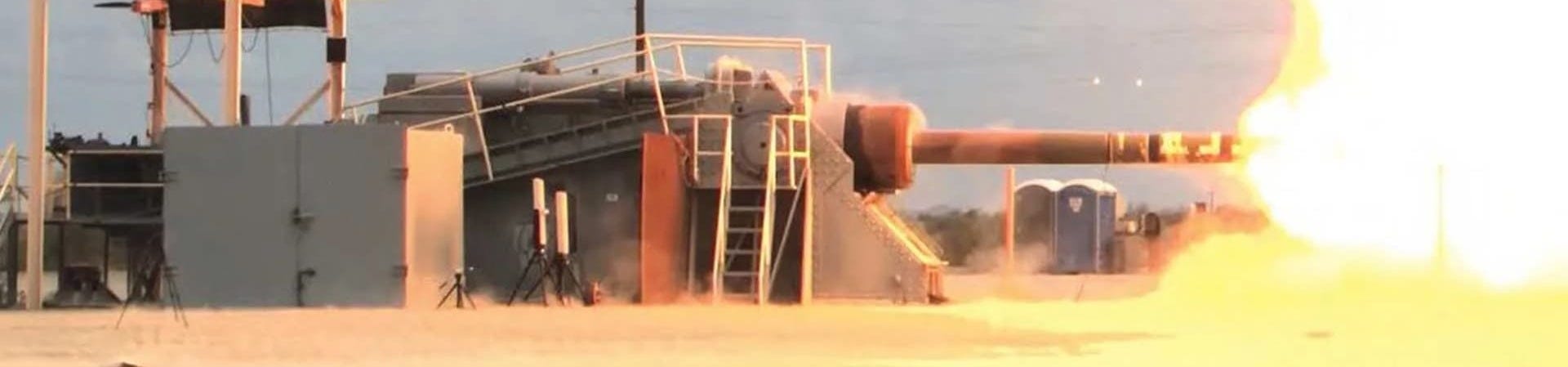
BLUF: The Heavy Artillery Test System (HATS) carried out its first hypersonic live-fire test at Yuma Proving Ground, AZ.
The trial was conducted through a collaboration between the Army’s DEVCOM Armaments Center, the Lawrence Livermore National Laboratory (LLNR), and the test range.
The team fired a specially made Integrated Launch Package (ILP) from the HATS, instead of a hypersonic missile. ILP is a hardened test package carrying the experimental payload.
The test demonstrated a faster, cheaper way to evaluate hypersonic payload performance at impact.
While a single complete hypersonic missile test can typically cost anywhere from $9.5-15M per launch, depending on the testing vehicle and program scope, the cannon-based approach significantly reduces testing costs.
ACC Exec Director Highlights Efforts to Accelerate Software Acquisition
BLUF: Danielle Moyer, ACC Executive Director, discussed how they are leading initiatives to reform the Army’s software acquisition infrastructure.
Army Contracting Command is focused on improving how software is purchased by consolidating contracts, adjusting contracting approaches and exploring new pricing strategies to create a more effective acquisition model.
One of the Army’s key software acquisition challenges is the fragmented way commercial software purchases are managed.
The Army frequently acquires identical commercial software products through numerous separate contracts, sometimes numbering in the dozens or hundreds, which makes it more difficult to track spending and limits the Army’s ability to negotiate more favorable terms.
Many existing Army procurement vehicles are not fit for commercial software purchasing.
When it comes to pricing, Moyer explained that because the FAR does not provide a dedicated framework for software purchases, contracting officers do not have specific guidance for commercial software pricing or assessing software labor categories.
The Army is moving toward greater enterprise-level contract consolidation for frequently purchased commercial software.
To improve commercial software procurement vehicles, the ACC is developing a smart contracting tool aimed at creating the foundation for a more centralized and data-driven software acquisition model.
In terms of pricing models, the command is exploring outcome-based and value-based pricing models that focus on the operational benefits a technology provides rather than only examining its underlying cost components.
Our Take: ACC’s push to consolidate commercial software contracts, modernize contract vehicles, and pilot outcome/value-based pricing is exactly the kind of pragmatic reform the Army needs! Danielle and her team are building a more scalable, data-driven acquisition model that will deliver better capability faster and at lower total cost. We strongly support these initiatives and their continued progress.
The Army’s Drone Bet Is Rational. The Timing Isn’t
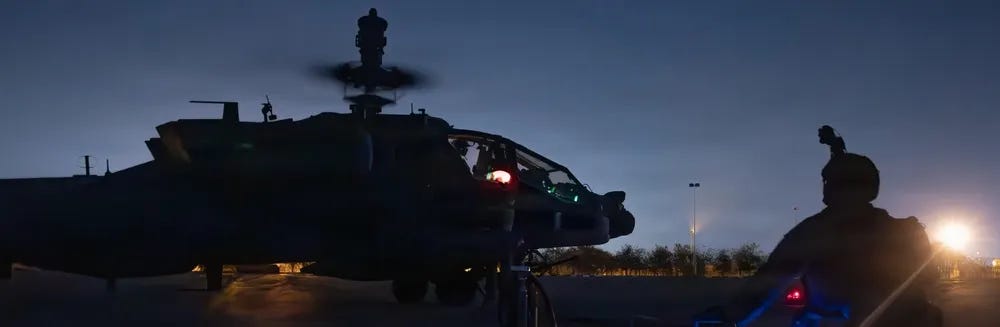
BLUF: The Army is dismantling manned aviation capacity on a fixed schedule while the systems meant to replace it remain, in large part, still on the drawing board.
The Army plans to cut close to 6,500 active-duty aviation positions in fiscal years 2026 and 2027, pulling pilots, aircrew, and maintenance out of the force and shifting the money toward drones and other unmanned systems.
The Army is now working against a shortfall of $4-6B, driven partly by costs tied to the Iran operation and an expanded homeland security mission, and aviation units in III Armored Corps could deploy next year at a lower state of readiness than commanders would prefer.
The FY27 budget request effectively guts new-buy funding for the legacy fleet.
The Army isn’t swapping a retired Black Hawk for a single unmanned aircraft. It’s running three efforts in parallel, and none are complete.
Launched effects are small drones a crewed Black Hawk carries and releases mid-flight for reconnaissance, jamming, or strike. Sikorsky landed a $43M contract last August to build the digital backbone that lets UH-60Ms do this, fielding targeted for 2026. That’s the helicopter keeping its pilots and picking up a new tool, not a replacement for it.
Sikorsky’s S-70UAS U-Hawk is a UH-60L with the cockpit stripped out and replaced by clamshell cargo doors, roughly 25% more hauling capacity, flying itself on Sikorsky’s MATRIX autonomy software.
The Army’s manned successor to the Black Hawk is the MV-75 Cheyenne II, a Bell V-280 Valor-derived tiltrotor flying roughly twice the speed and range of the aircraft it replaces.
helicopter reductions outrunning drone fielding, training cuts hitting crews the Army intends to keep, a fuel-driven shortfall suppressing flight hours, an industrial base harder to restart the longer it sits idle, and experienced pilots and maintainers walking out before their replacements are operational.
Any one of them is manageable alone. Stacked together, on the same two-year timeline, they describe a force thinner in the cockpit right when the drones aren’t ready to carry the load.
Our Take: This challenge is not unique to the Army. The Navy is retiring ships faster than it can deliver replacements, and the Air Force faces the same pressure with its fighter fleets. The underlying tension between sustaining manned legacy systems and fielding modern unmanned and autonomous capabilities requires PAEs and Service headquarters to manage warfighting capabilities as integrated portfolios. Leaders must deliberately balance near- and long-term force structure: protecting readiness and the ability to fight tonight while continuously modernizing, scaling new systems, and making the strategic investments required for the force of the future.
Army’s Black Hawk Helicopter Launches, Controls Multiple Combat Drones in Test
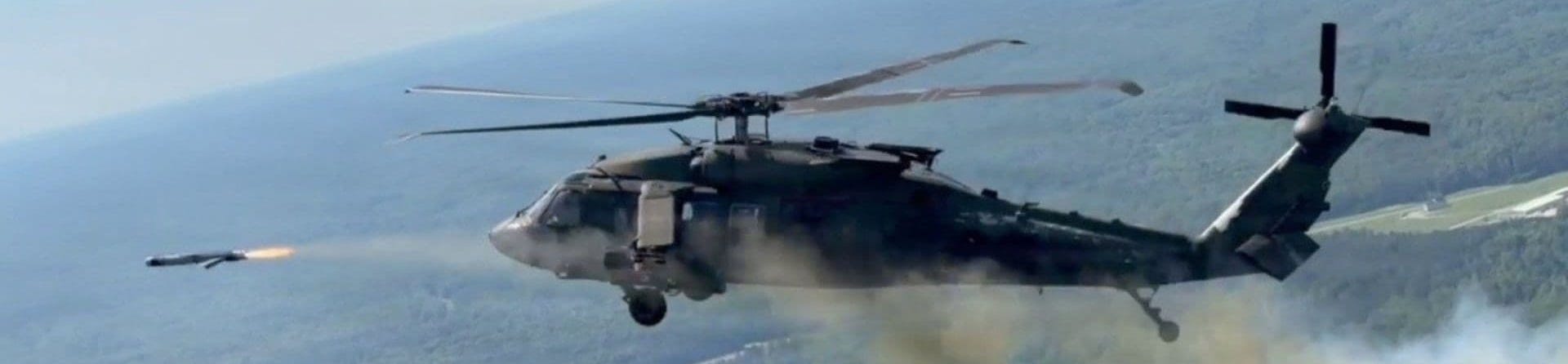
BLUF: The flight tests showed the upgraded Black Hawk can extend its battlefield reach while maintaining a safer stand-off distance.
The Army completed a major flight demonstration recently, showing that an H-60M Black Hawk helicopter can launch and control multiple air-launched effects (ALEs) during Project Convergence Capstone 6.
The tests marked another step toward giving Army helicopters greater reach in contested environments, allowing them to remain at safer stand-off distances.
The Increment 1 capability was completely designed and owned by the U.S. government. It was developed through collaboration between the Utility Helicopters Project Office and the DEVCOM Aviation and Missile Center, with help from Army technical programs and industry partners for integration and flight testing.
The upgraded H-60M can launch and control several air-launched effects using a fully networked system. This feature helps the helicopter operate farther away from enemy defenses while still reaching its targets.
During the event, soldiers and allied partners inspected the modified Black Hawk and met directly with program specialists to better understand the system’s capabilities.
“Successfully launching Air-Launched Effects from a Black Hawk is more than a milestone; it is a leap forward. By extending their reach and increasing lethality, we are changing the battlefield geometry and delivering a decisive advantage to our Soldiers.” BG Kevin Chaney, Deputy PAE for Maneuver Air.
Army Teams Up to Mature Mach 3 Ramjet Shell That Flies Above 65,000’

BLUF: Tiberius Aerospace has signed a CRADA with the Army to advance Sceptre, its precision-guided, ramjet-powered 155mm (about 6.1 inches) artillery munition.
The program seeks to extend the reach and precision of existing tube artillery without requiring militaries to purchase new launchers.
Sceptre is designed to travel beyond Mach 3, climb above 65,000 feet, and strike targets up to 93 miles (150 kilometers) away, including in environments where GPS signals are unavailable or disrupted.
Sceptre differs from conventional rocket-assisted projectiles because its liquid-fueled ramjet delivers propulsion throughout its flight.
This sustained thrust is intended to help the shell achieve greater speed, altitude, and range after being fired from a NATO-standard 155mm howitzer.
Army Launches Search for Counter-Drone Missile Priced Under $150K
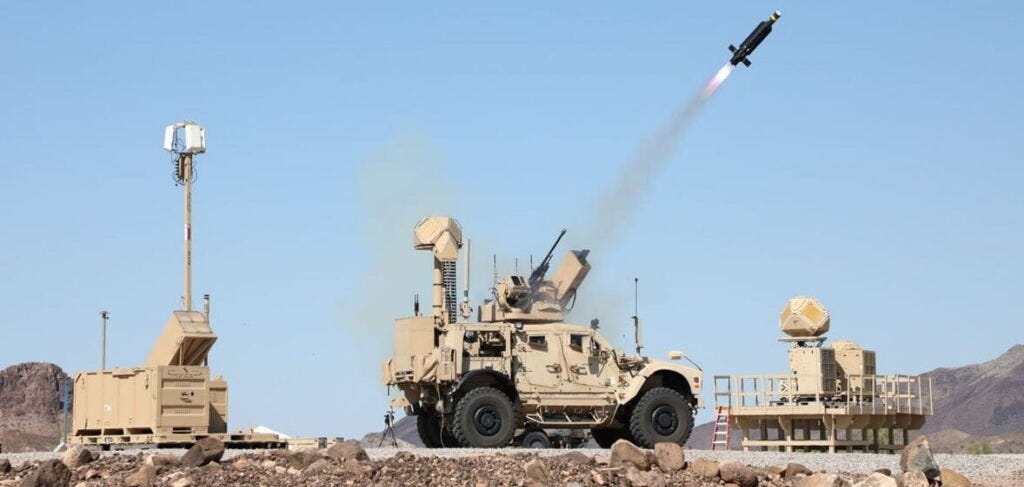
BLUF: The Army is seeking industry input to acquire a Next Generation C-sUAS Missile (NGCM) that costs less than $150,000 while still capable of taking down Group 2 and 3 sUAS and compatible with Raytheon’s Coyote launcher.
The Army also wants the missile to go faster and farther than current systems capable of countering drones weighing 21 to 1,320 lbs.
The principal objectives for this effort are to develop, produce, and sustain a missile capability at extended ranges with rapid launch and reduced time-to-target over existing effectors.
Though the Army has put out similar solicitations as part of its low-cost interceptor (LCI) program, this is the first time the service has asked for a missile with such a low price tag.
The Army is looking to buy at least 5,000 of the missiles, and is hoping to acquire 50 NGCMs to be ready for operational assessments by the 1Q FY28.
Related: Army wants a surface-to-air missile that can destroy small drones
Army Taps Rheinmetall-led Team for Sustainment UGVs
BLUF: Army CPE Mission Autonomy awarded Rheinmetall an 18-month prime integrator contract to develop autonomous logistics ground vehicles for the Army’s Project Sustainment initiative.
Team members include: Harbinger, Forterra, and Primordial Labs
Project Sustainment, which absorbed the Army’s Medium Multipurpose Equipment Transport (M-MET) program after CPE Mission Autonomy was stood up in March, is designed to remove soldiers from high-risk delivery routes while delivering essential supplies directly to the tactical edge.
Five companies—AM General, American Rheinmetall, Carnegie Robotics, HDT Robotics (BLADE), and Stratom—were downselected for the program last month.
The core platform that Harbinger’s delivering for the Project Sustainment initiative can carry payloads of up to 18,000 pounds, operate in temperatures ranging from -22°F to 131°F and at altitudes up to 12,000 feet, drive over 500 miles on the hybrid engine or 105 miles fully electric, and hit speeds of 65mph. It’s built to run off-road and in any type of weather (snow included). It can also export up to 350 kilowatts of power to external systems, making it a big ‘ole generator on wheels to help power operations in austere environments.
Forterra is providing the autonomy stack for the Harbinger vehicle to enable distributed, mission-aware, and resilient military operations in contested environments.
Primordial Labs is providing Anura, its software platform that turns robotic systems into battlefield teammates by using natural language commands to control and task unmanned systems.
The vehicles delivered for Project Sustainment will be integrated with an operational unit during a Transformation in Contact assessment in the 2QFY27.
Agile Acquisition: The ACC-Detroit Way
BLUF: ACC Detroit Arsenal finalized four prototype OT agreements totaling $72.8M in just 76 days from proposals to deliver autonomous breaching capabilities to heavy armor units.
That rapid turnaround illustrates how the command is aligning with the U.S. Army’s PAE model, accelerating modernized capabilities to warfighters.
ACC is aggressively implementing portfolio-centric, commercial-first strategies.
Additionally, executing the first BOAST initiative award in just over 30 days compressed traditional administrative lead time by nearly 11 months.
A Total InteGrated Engine Revitalization Hackathon brought 40 industry partners together to resolve critical bottlenecks for the AGT 1500 engine powering the Abrams tank.
"Our team is doing critical work to provide tailored, agile contracting support aligned directly with the Army’s PAE structure. We are actively driving acquisition reform by using every tool available—from OT Authorities to expanding Project FAST TRACK—to drastically improve source selection speeds, break down barriers for non-traditional defense vendors, and deliver lethal capability at speed." John Jolokai, ACC-Detroit Arsenal Director
Our Take: Great to see John and the ACC Detroit team move out on portfolio centric, commercial first strategies, actively engaging industry, competitions, and rapid OTAs.
Army Expands Hydra-70 Rocket Supply Chain Through Innovative OTAs
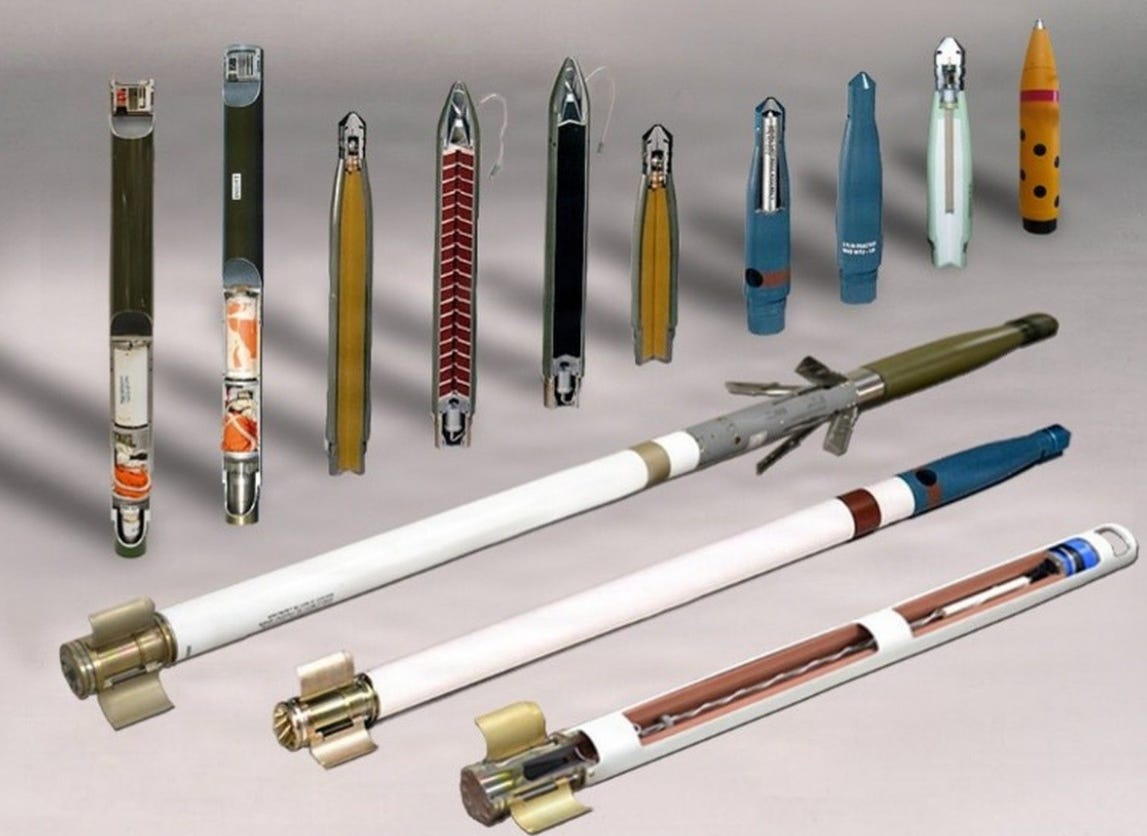
BLUF: The Army’s Aviation Rocket and Small Guided Munitions (ARSGM) Product Office used OTAs to diversify the Hydra-70 rocket supply chain and revitalize its defense industrial base awarding to Firehawk, iRocket, Nammo Perry, and Albers.
They used the One Nation Innovation (ONI) marketplace to award contracts
This innovative sourcing strategy allows the Army to engage multiple industry partners and capitalize on their expertise to improve the government owned Hydra-70 Technical Data Package (TDP).
Each of the participating vendors will deliver twenty-four prototype Hydra-70 M151 High Explosive rockets alongside a modernized TDP within 18 months. This initiative delivers immediate strategic dividends by establishing multiple viable production sources to drive competitive pricing on annual orders, while simultaneously updating the munition's product definition for improved manufacturability.
Upon successful prototype demonstration, follow-on agreements are planned to expand this effort to other variants in the Hydra-70 family of rockets which typically procures 100-200K annually.
Kratos Receives U.S. Army Contract to Develop a Next-Generation Seeker for the Javelin Missile System
BLUF: The Army DEVCOM C5ISR Center awarded Kratos Defense a contract to develop an Enhanced Seeker for the Javelin Close Combat Missile System.
Kratos will develop, build, and test a next-generation infrared seeker that addresses obsolescence in the current Javelin guidance section, improving the lethality of one of the Army’s most critical close combat weapons.
Other Army News:
Army, Industry Hack Away at Linking Traditionally Stovepiped Systems
Ondas Secures Army Order for Lethal Unmanned Systems for Over $50M
Landmark Deal Would Officially Add Laser Weapons to US Army Arsenal

Updating Navy Warships at the Speed of Software
BLUF: After years of wanting and waiting, the Navy is now updating combat systems over-the-air on ships at sea.
The Navy is now pushing over-the-air software updates to some of its most important and complex systems aboard ships.
It’s being applied to combat systems, like radar, sonar, and weapons.
The ship may set sail with one software baseline and fight with a better one.
It is a force designed to absorb new capabilities, reconfigure mission threads, and adapt faster than threats change in front of them.
CNO’s Fighting Instructions describe our Hedge Strategy, built to increase the Navy’s impact, adapt to dynamic adversaries, field asymmetric capabilities, and empower a distributed force.
Rapid software updates can strengthen the main battle force with tailored offsets against specific threats, without waiting for every platform to be redesigned, replaced, or overhauled in home port.
The Navy’s Adaptable Mission Architecture (AMA), is both a technical design philosophy and an operational mindset to build systems, teams, and decision processes that evolve continuously as missions, threats, and technology change.
AMA connects four areas that are too often treated as separate initiatives
Common modular open systems approach (MOSA) to computing
Common cloud and transport architecture, right down to enterprise services
Software-defined naval force;
Human talent required to integrate them.
Published interfaces, automated testing, secure delivery pathways, and constant Fleet feedback make components replaceable without rebuilding the entire mission thread. Every component is a tenant not a permanent owner.
Execution must match the architecture. Under Secretary Hegseth’s new Warfighting Acquisition System, the DoN established a PAE for Mission Systems to serve as a central integrator.
Portfolio accountability connects resources, integration, testing, and fielding to an operational effect, rather than a collection of programs. The PAE Mission Systems and DON CIO accept this charge.
The hardest part of modernization is changing how decisions are made, how teams work together, and how quickly the institution learns.
What we increasingly need are modular Lego blocks of capability and partners who help us phase out stovepiped systems and integration hogs — what the Navy calls Operation Cattle Drive.
Seapower has always depended on range, payload, endurance, logistics, and skilled Sailors. It now also depends on update speed and adaptation speed. Technology compresses timelines if you can adopt it well. Smart architecture accelerates integration.
Our Take: The Navy’s move to push OTA software updates to deployed combat systems and the AMA is a decisive step towards true software-defined warfighting. By treating platforms as modular, continuously updatable systems rather than static hulls, the Navy is finally closing the gap between technology cycles and operational need. We strongly support this approach and the institutional changes to execute it.
The Navy Tried a Different Approach to AI and It Worked

BLUF: The Navy didn’t just roll out AI. It rallied people around it. The Navy is currently executing a masterclass in technological adoption.
The Navy realized that simply deploying algorithms to its workforce was not enough. The bottleneck is no longer the capability of the technology. The true bottleneck is adoption speed.
To force a rapid evolution, Navy CTO Justin Fanelli just helped launch the AI Efficiency Challenge.
Start with accessible tools, clearly defining what success looks like, measuring the results, and turning top performers into champions who help others adopt AI.
Adapt what already exists, adopt what works, and scale what delivers.
The goal is to identify decentralized innovation and elevate the high achieving mavericks who are leaning the farthest forward.
Three leadership lessons from the Navy strategy
Gamify your tech adoption.
Demand a measured baseline.
Emphasize human machine teaming.
The smartest executives are borrowing a page from the Navy’s playbook: building systems that encourage continuous innovation and preparing teams to execute with confidence in a high-stakes economy.
“Deployment is not adoption and adoption is not impact, but they’re all related enough that you can line them up like dominoes. Make AI adoption a competition for outcomes — gamified and inspiring if possible. Put out a starter offering. Open the doors. Define what winning looks like. Measure the results, and turn your best users into champions. Adapt what exists, adopt what works, and scale what delivers.” Justin Fanelli, Navy CTO
P-8 Poseidon Crews Controlling MQ-4C Triton Drones Becoming A Reality

BLUF: The P-8A and MQ-4Cs were designed to work in concert, but direct in-flight control of Tritons will open new tactical possibilities and greatly extend the Poseidon's reach.
Boeing and Northrop Grumman are laying the groundwork to take teaming between the P-8A Poseidon maritime patrol plane and the MQ-4C Triton long-endurance maritime surveillance drone to a new level.
A first-of-its-kind test has demonstrated common command and control architectures that will enable P-8A crews to issue orders to MQ-4Cs.
The drones would then perform their assigned missions autonomously and report back. The Poseidon and Triton were designed to operate as a team from the start, but the ability to task the uncrewed aircraft directly in flight would offer new flexibility, especially to respond to sudden changes in the battlespace.
The testing was conducted in a laboratory environment and no aircraft involved.
Data routes included satellite relay to reflect realistic operational communications. Mission management and autonomy layers communicated via OMS/UCI rather than custom point to point interfaces.
Using UCI, the platforms can collaborate with any U.S. or allied asset sharing the same interface – reducing operator workload by distributing the mission tasks and accelerating commander decisions, making integration across platforms quicker and more cost effective.
The OMS/UCI architecture used to support the new P-8/MQ-4C teaming testing could further open the door to pairing the Poseidon with other uncrewed teammates, as well. General Atomics has already been pitching the SeaGuardian version of its MQ-9B drone as a new partner for the P-8A.
Our Take: This is an excellent example of multi-vendor integration to fuze manned and unmanned platforms to unlock new operational missions, expand performance, and opportunities for further tech insertion.
Navy, Saildrone to Use USVs in Expanded Counternarcotics Role
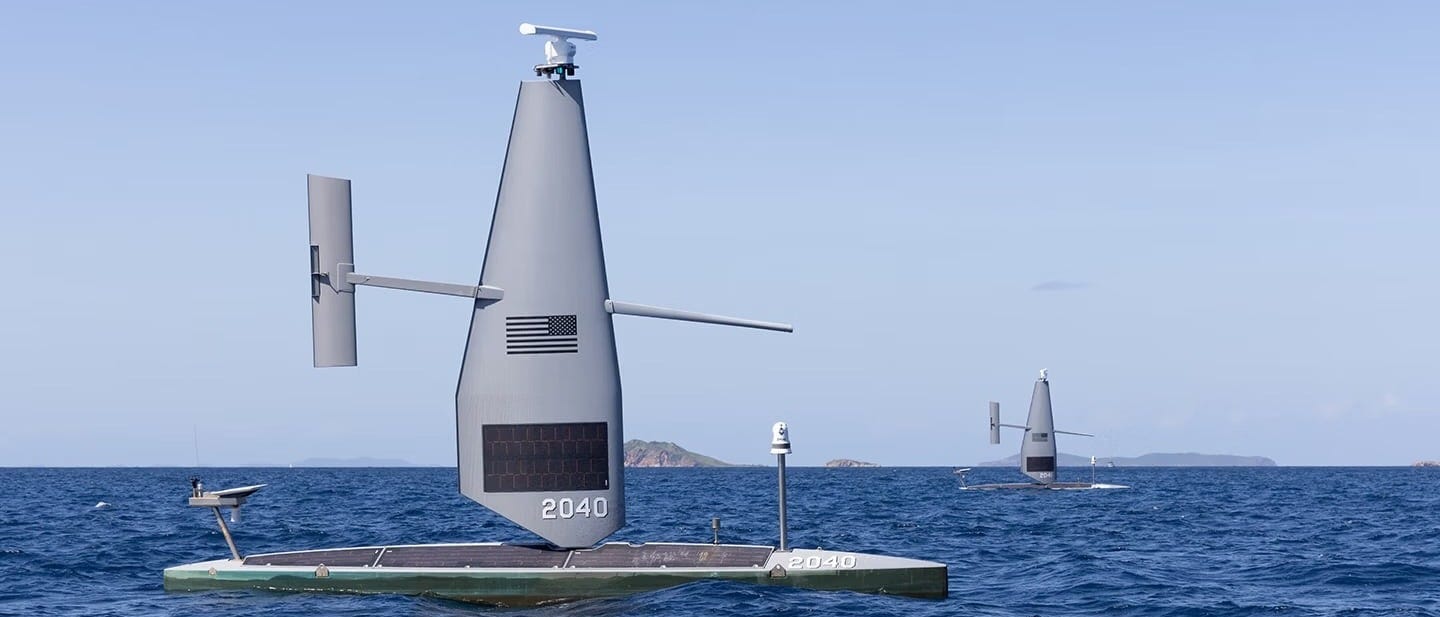
BLUF: Following the recent announcement that a Saildrone Voyager USV directly aided the Navy during a drug interdiction in the Caribbean that led to the seizure of more than $81M worth of cocaine, the Navy has awarded Saildrone a $16.3M task order to extend operations of the Voyager fleet in the Caribbean and Eastern Pacific.
The 33-foot-long Voyager is designed for persistent surface and subsurface surveillance and can also conduct nearshore mapping missions and seafloor characterization.
“The continuity of Saildrone’s presence along the southern border for nearly three years demonstrates the strategic value we bring as the world’s most experienced operators of USVs. Our unmatched ability to remain on station and on mission in critical regions for months at a time is why our fleet serves as a powerful deterrent to bad actors. We look forward to continuing to partner with the Navy in its mission to secure the country’s maritime approaches and southern border.” VADM (ret.) John Mustin, Saildrone President
Navy Seeks Seabed Superiority in Undersea Warfare Push

BLUF: The Navy is seeking seabed superiority in both offensive and defensive operations around the ocean floor as part of enhancing asymmetric advantage in underwater warfare.
Developing both defensive and offensive seabed warfare capability is a primary line of effort COMSUBFOR is delivering on, under the CNO’s Fighting Instructions for generating an integrated battleforce.
“Today, as we’re talking, we are deploying seabed warfare capability. This is for the full spectrum of operations, both defensive and offensive On defensive and offensive seabed warfare capability, this really, really is a growth area and something we’re really moving out on. On the offensive side, it’s the ability to dominate and have what I call ‘seabed superiority. We talk about sea control. We talk about air superiority. I’d like you to think in terms of dominating, controlling the undersea, controlling the seabed, and having seabed superiority” VADM Richard Seif, COMSUBFOR
Lockheed’s New Submarine-hunting Sonar That Doubles Detection Range Tested by Navy
BLUF: Lockheed Martin’s SensorMAX acts as a digital sonar assistant, helping helicopter crews handle more information during anti-submarine missions.
The software is also designed with a lightweight, platform-independent architecture. That means the same processing capability can be deployed on aircraft, surface ships, or ground stations, allowing the Navy to integrate the technology across multiple platforms instead of limiting it to a single system.
Lockheed Martin said the RIMPAC 2026 demonstration is an important step toward integrating adaptable AI with more maritime sensors. Instead of relying on fixed software, operators can keep improving acoustic detection models and distribute updates across connected platforms.
The company believes this approach can reduce the time between spotting an underwater contact and making tactical decisions. With AI systems that learn from new acoustic signatures during missions, future naval operations could keep better watch over aircraft carriers, warships, and other important assets, while improving protection against stealthier undersea threats.
Jet-Powered JDAM Production Is A Go For The Navy
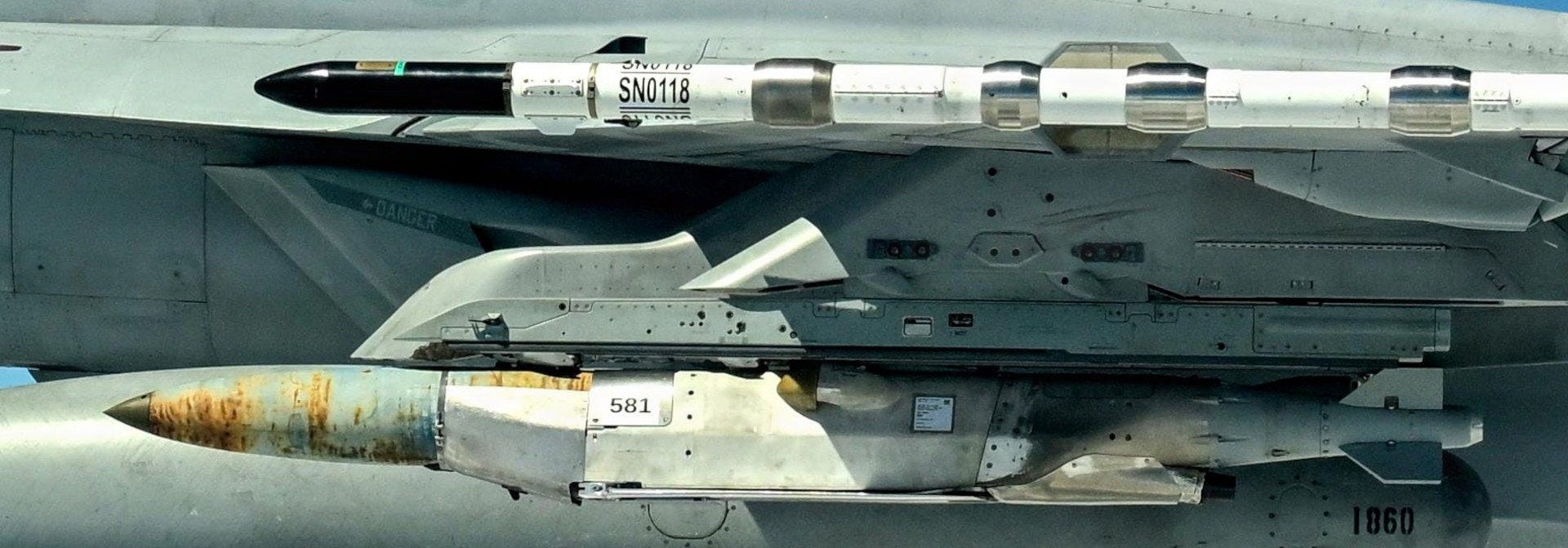
BLUF: Boeing has been cleared to start producing Joint Direct Attack Munition-Long Range (JDAM-LR) precision-guided weapons for the Navy.
The JDAM-LR is essentially a small cruise missile derived from the JDAM family of precision-guided bombs. The weapon will give the Navy, and potentially other services, a new way to bolster stocks of air-launched stand-off munitions.
This all follows the Navy’s announcement of successful test launches of JDAM-LRs from F/A-18E/F Super Hornet fighters back in April.
The Navy (through the Air Force) awarded Boeing a UCA for $75M related to JDAM-LR production.
Like unpowered JDAMs, the JDAM-LR is more of a kit than a munition by itself.
The PDU contains the guidance section, systems to interface with the launching aircraft, a pop-out wing kit, and a compact turbojet engine. PDU is then combined with a standardized low-drag 500-pound-class bomb as its warhead to create a complete weapon.
“This first production contract is a major milestone for the JDAM LR program, demonstrating our ability to deliver long-range precision-strike capability at a significantly lower cost. Scaling production of the GBU-75 will provide the fleet with an affordable, sustainable solution designed to eliminate long-range land and sea-based threats to U.S. and international forces and enable them to safely and effectively operate in a contested battlespace.” Bob Ciesla, VP of Boeing Precision Engagement Systems
Related: Air Force signs off on production of long-range JDAM, Boeing`s 300-nautical-mile range JDAM LR precision strike weapon enters production, and Air Force signs off on production of long-range JDAM
Navy Eyes Advanced Payload Launcher for Future Attack Boats

BLUF: The Navy wants to integrate payload launchers capable of supporting undersea weapons and drones for the fleet’s future attack boats.
The Director of Submarine Programs expressed interest in launchers that could support a wider variety of payloads than the current fleet.
Representatives from General Dynamics Electric Boat and HII’s Newport News Shipbuilding division will present concepts covering future payload integration.
While unmanned underwater vessels – and other drone systems – were not explicitly named in the solicitation, attributes pertaining to supporting equipment of this type were highlighted in the Navy’s announcement.
The interest in advanced payload launchers comes amid the ongoing conceptual development of the Next-Generation Attack Submarine or SSN(X) and the introduction of modernized Virginia-class submarines.
These platforms will simulate operating autonomously in denied areas, providing critical targeting data and enhancing our ability to detect, track, and hold adversary forces at risk.
This demonstration leverages unmanned systems as force multipliers, enabling manned platforms to operate with greater stealth, lethality and efficiency.
Other Navy News:
Investment casting firm wins US Navy contract for MRO replacement parts
Navy is reclassifying 19 Virginia-class submarines to reflect increased attack capabilities
Smack Prepares For Next Phase of Contract to Advance Navy’s Maritime Decision-Support Modernization

Marine Corps Establishes Robotics Integration Group, Experiments with Drones in Field Operations

BLUF: The Marine Corps established Marine Corps Robotics Integration Group (MCRIG) to integrate, standardize, and institutionalize training for Group 1 and Group 2 small UAS and counter-sUAS across the Total Force
The establishment of MCRIG reflects the Marine Corps’ continued effort to adapt to the rapidly evolving character of warfare, where inexpensive, commercially available unmanned aircraft have fundamentally changed how modern militaries detect, target, maneuver and fight.
MCRIG also establishes a deliberate process for transitioning emerging capabilities into formal Marine Corps training.
As the service-level integrator, MCRIG receives validated capability packages, including tactics, techniques and procedures, pilot courses and training requirements, from specialized organizations responsible for experimentation and operational assessment and once validated.
It develops the curriculum, training support packages and certification standards before distributing them through designated regional hubs that execute standardized instruction across the Fleet Marine Force.
Marines Make History With First Attack Drone Live-Fire Series in South Korea
BLUF: Marines assigned to the 4th Marine Regiment, 3rd Marine Division, successfully concluded the Marine Corps’ first series of live-fire first-person view attack drone flights in South Korea.
This historic training series marks a significant milestone in force modernization, demonstrating the Marine Corps’ ability to field emerging technologies in the Western Pacific rapidly.
The series featured two distinct training events: an inaugural range conducted by the 3rd Light Armored Reconnaissance Battalion, and a second iteration carried out by the 3rd Battalion, 7th Marine Regiment.
Throughout the training series, Marines used the Neros Archer drone to execute precise anti-armor and antipersonnel explosive strikes.
With an effective range of approximately 20 kilometers, this technology extends the tactical influence of small units far beyond traditional squad-level infantry weapons, allowing Marines to conduct precision strikes from positions of relative safety.
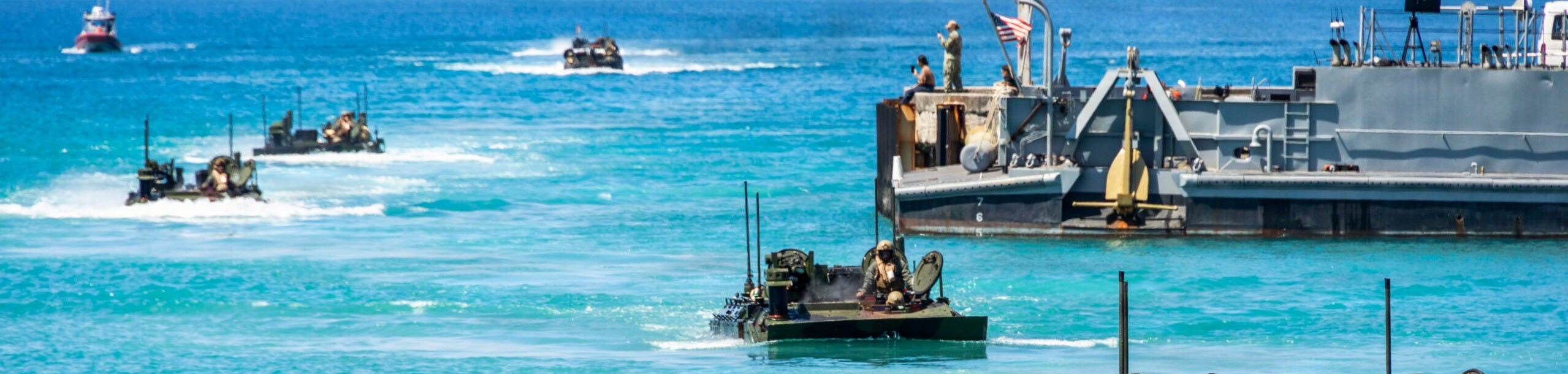
U.S. Marine Corps ACVs to Counter Drones with Anduril Jammer Package
BLUF: The U.S. Marine Corps’ new amphibious assault vehicles will receive jammers to defeat UAS through a program that is set to begin this fall.
The Portfolio Acquisition Executive – Marine Corps released a solicitation on Monday identifying interest in pursuing Anduril’s Pulsar-Lite to meet an Urgent Statement of Need for a counter-UAS.
This follows an initial notice of intent announced in July for the mounting of the Anduril EW system onto the Amphibious Combat Vehicle.
According to the service’s drone downing needs, Anduril’s Pulsar-L should be able to detect group 1 and 2 UAS two miles away. The system is expected to be able to jam these threats from two miles away.
Fifty units of Pulsar-L are expected to be delivered within the first year, and further production is required to support additional counter drone efforts.
Marines Forge a Layered MADIS Air-Defense Shield in Okinawa on China’s Pacific Maritime Flank
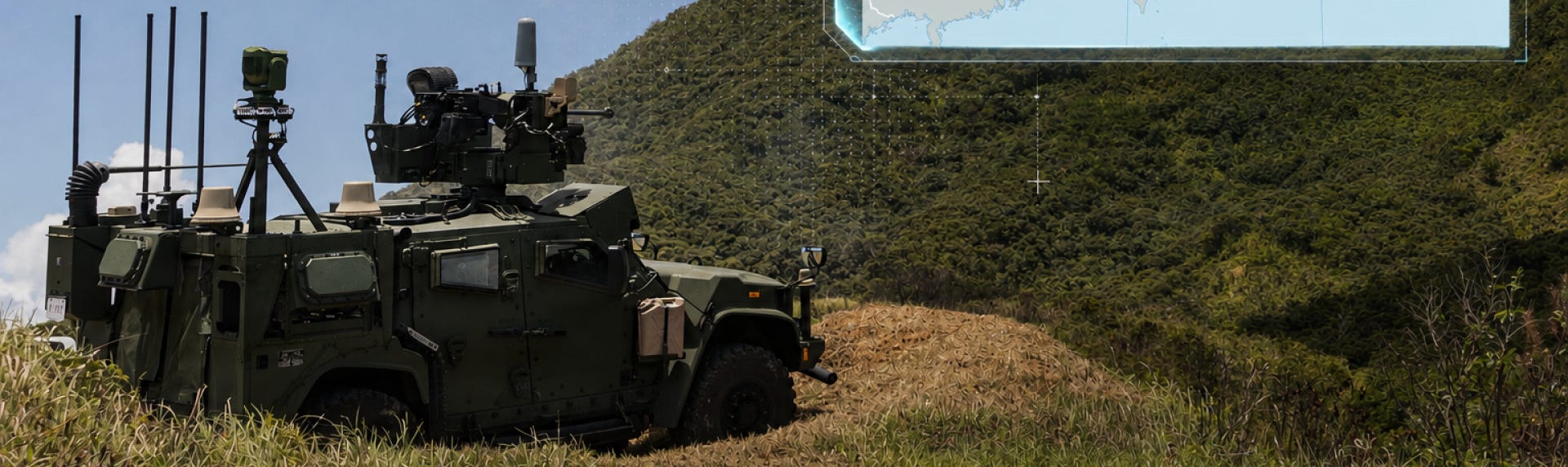
BLUF: Marines advanced their ability to counter drones and low-flying aircraft in the Indo-Pacific after conducting a live-fire exercise with the Marine Air Defense Integrated System (MADIS) at Camp Schwab, Okinawa, only weeks after the system was delivered to the 12th Marine Littoral Regiment.
The exercise marked the shift from fielding to operational readiness, strengthening the survivability of forward-deployed forces positioned along the First Island Chain near China’s primary maritime approaches.
MADIS combines Stinger missiles, a 30mm cannon, electronic warfare, and networked sensors on mobile Joint Light Tactical Vehicles to provide layered protection against drones, helicopters, and low-altitude aircraft.
Deployed alongside capabilities such as NMESIS, it enhances the Marines’ ability to sustain distributed operations, protect critical combat assets, and reinforce deterrence by making U.S. forces in Okinawa harder to detect, target, and defeat.
Other Marine Corps News:

Air Force Seeks New Ideas for Cheap MQ-9 Alternatives by Year End
BLUF: The Air Force plans to select vendors by the end of 2026 to help develop concepts for cheap, attritable drones that could perform the MQ-9 Reaper mission—providing persistent intelligence, surveillance, and reconnaissance, as well as strike capabilities—in a new way.
DIU issued a solicitation for a “massed modular aircraft,” or MMA, where it imagined a fleet of uncrewed aircraft operating in groups, but remaining effective even as some are shot down.
The MMA fleet should be large enough to absorb losses, he said, and inexpensive enough that losses can be replaced without difficulty. That would put the drones between a sophisticated munition and a small aircraft.
The Air Force plans to pattern its MMA contracting process similarly to its Collaborative Combat Aircraft program.
The CCA program identified competitors, fostered multiple alternatives, and even after down-selects left the door open for losers to re-enter competition later.
To differentiate MMAs from CCAs, the Air Force clarified that MMAs are intended for intelligence, surveillance and reconnaissance missions, with added strike capability, while the first CCAs are designed for air-to-air combat.
“We’re still early, we’re still seeing what industry can support. But I do think that it is more kind of that CCA mentality of, set a large target … for what this could become across the right portfolio, at the right price point, so that we can have that attrition tolerance.. We will find whether there’s a sweet spot in that cost curve to make sure that they both provide the capabilities we need, and that they are attrition or loss tolerant, so that we can use them in the right environment going forward.”
Col John Dayton, PAE for ISR & SOF
Our Take: We think the strike capability being added to this platform is misguided if its anything larger than a Hellfire/JAGM type missile because then the form factor will have to become larger and then range and time on station will become competing requirements…and the platform will get much more expensive. The only reason that the MQ-9s were used so much in the Iran conflict is because they were the only unmanned asset that was available in any volume. In the future, where there are multiple variants of CCAs flying around, this will be less necessary. However, CCAs are likely to never have the loiter time needed for an ISR aircraft so keeping it lightly armed and less visible (i.e. not big missiles hanging off the pylons) is key. The CCA strategy may also not play well here since the Air Force can’t even quantify a number that it wants to buy. Taking multiple vendors through production to then only buy 5 a year for a few years is not a viable approach. CCA worked and industry was motivated because there were a thousand+ production ramp in the pipeline.
Ondas Announces New AFRL Contract Award to Advance Long Range Grasshopper™ Autonomous Aerial Delivery System
BLUF: AFRL awarded a ~$6M contract to DZYNE Technologies, now part of Ondas, to advance the Long‑Range Grasshopper™, an autonomous, runway‑independent precision aerial delivery system designed for extended‑range logistics in contested and austere environments.
This award builds on years of collaboration between AFRL and the engineering teams now operating within Ondas Sentinel.
Their 2024–2025 flight test campaign validated the Long‑Range Grasshopper’s autonomous deployment, jet‑engine air‑start, extended‑range navigation, and precision payload delivery.
The new contract accelerates development of scalable autonomous logistics capabilities aligned with the Air Force’s Agile Combat Employment (ACE) concepts.
The effort builds on the mature Grasshopper glider architecture, which has seen extensive operational use delivering up to 500 pounds of critical payload with precision into contested or infrastructure‑limited environments.
Our Take: This is a critical capability that will need to be scaled in the near future to support logistic deliveries in areas with less-than-ideal infrastructure or where there is a high threat from adversaries. Our only problem with AFRL here is that they are picking winners before a program has even been established. If the industrial base needs funds to tailor their solutions, then distribute funds to multiple likely competitors so that when a program is kicked off, there is more than one company ready to support. Instead, AFRL is funding their preferred winner and will expect any other entrants to do the work on their own dime to compete when a program is started. This is an ok approach when DARPA is trying to push the boundaries of what the tech can do but the requirements here are not that and instead this is a development program in disguise.
F-47 Program Producing Test Aircraft, On Schedule for 2028 Flight
BLUF: The Air Force’s F-47 program has begun its engineering and manufacturing development phase and will fly in the coming years.
The program, described as “extreme teaming” with industry partners, entered the phase with “unprecedented maturity.”
The engineering and manufacturing phase includes maturing, integrating and testing all parts of the F-47. It will produce a small number of test aircraft for evaluation and includes priced options for low-rate initial production.
The first Boeing F-47 is on track for its first flight in 2028.
The Air Force plans to buy at least 185 F-47s, matching the size of the F-22 Raptor fleet it intends to replace.
Our Take: We certainly hope that speed to flight is not compromising other key aspects of the jet like readiness. With plans to only replace the F-22 force (at less than 200 fighters), if readiness is not a key design and testing criteria, then the F-35 will be put in the same spot as the F-22 where readiness is consistently below 50% which means that only a small portion of the fleet is available for operations. We have seen too many times where sustainment is an afterthought on these complex programs.
Related Article: B-21 bomber, F-47 next-generation fighter ahead of schedule
Air Force Jet Engine Manufacturing Plagued by ‘Significant Challenges’
BLUF: Dissatisfied with the quality of the engines for its fighter jets, the Air Force is looking for new engines — and perhaps new manufacturers based on a recent RFI.
According to the RFI, the Air Force will “pursue a strategic competition requiring industry to innovate manufacturing and guarantee supply chain resiliency.”
F-35 fighter deliveries and upgrades have been delayed by engine issues, with a GAO report noting last year that “the engine contractor is still not delivering engines to contract specifications after 20 years of production.”
B-52 modernization has been stalled in part by engine issues that have raised costs by $3B and delayed initial operational capability by 15 months.
The Air Force is now embarking on a multiyear fighter engine procurement project that envisions more than 180 engines per year by 2034.
The RFI specifically cites engines for the F-15EX and F-16.
Our Take: This RFI is a classic example of what’s wrong with the acquisition system. The acq community puts out an RFI essentially asking for the moon from industry (including the below gems) for engines that are milspec engines which means that they are likely unapplicable for commercial OEMs. In the RFI, they say nothing about adopting different business models that would allow for better margins to justify investments, although they do harp on performance incentives and driving lower costs. They also don’t talk about how they might support accelerated testing and verification for a new engine provider even though that has to be a major barrier. The only dim light in the whole affair is that they at least put a number on the engines buy although it’s less clear how that is guaranteed. Is the Air Force taking on the role of engine provider like it just did for the T-7 or will the Air Force direct Boeing to buy a certain number from this new vendor?
“establishes a resilient, sustainable supply chain from day one.”
“what minimum volume your supply chain can justify private capital investments (such as facility expansion, tooling modernization, or advanced automation) and how those investments will structurally lower your long-term unit costs.”
A better approach is to have a series of targeted discussions with the few companies that could reasonably support this requirement. Take the next 6 months to work out the finer points of what investments might be needed, how they could be financed possibly with a mix of private and OSW IBAS funding, what business models might be employed to support lower lifecycle costs (to include sparing strategies, field repair, relief from certain requirements etc). In those discussions, the Air Force could share what is has to offer to support this ramp up including how IP might be shared, how government facilities might be made available to companies etc.
Below is our general reaction to these types of RFIs which requires industry to spend hundreds of hours detailing responses based on a hundred different assumptions that could be executed in a more efficient and collaborative approach with industry.

Air Force Expands Autonomous Flight Tests with Live, AI-Enabled Intercepts
BLUF: The Air Force and Lockheed Martin recently demonstrated an artificial intelligent agent autonomously flying a fighter jet using live infrared sensor data — a critical step in ongoing developments of AI-enabled combat.
It conducted multiple flight tests in April where an AI agent processed live targeting data and then controlled an aircraft to execute intercepts.
The experiment featured the X-62 Variable In-flight Simulation Test Aircraft (VISTA), which performed 27 autonomous air intercepts across eight flights.
The demo — dubbed HAVE HEAT — was one of two rapid experiments held under the X-62’s ongoing Mission Systems Upgrade program.
The effort broadly aims to expand the test aircraft’s ability to evaluate AI-enabled flight for future combat applications.
Unlike previous tests that relied heavily on simulated sensor inputs, HAVE HEAT used real-time onboard infrared data to guide and target a live T-38 Talon aircraft.
Our Take: This is great progress because the ability to rapidly test and field AI agents that can help execute increasingly more advanced behaviors is crucial for DoW.
Related Article: X-62A Toting Infrared Search and Track Pod Used Its AI ‘Brain’ To Autonomously Intercept An ‘Enemy’ T-38
B-52 Modernization Program $3B Over Budget
BLUF: Cost overruns and schedule delays have put the program to replace the B-52 Stratofortress’ engines some $3B over budget.
The Air Force’s “Commercial Engine Replacement Program will likely continue to face significant challenges as the Air Force plans to begin production with little to no developmental flight testing” is what GAO reported.
The Air Force is modernizing 76 of the aircraft with an initial estimate of $21B for the overall program, which includes 13 capabilities, including new engines.
Ten of those 13 are experiencing cost, schedule or performance challenges.
The 13 modernization programs also include: a new radar; six new comm systems; integrating a new long-range, nuclear-capable missile still in development; a new “black box;” two new training devices; new advanced target pod displays; and a plan to reduce the crew size from five to four.
The Air Force currently plans to fly the bomber into the 2050s. Boeing developed and delivered the aircraft and continues work on the program, with Rolls-Royce delivering the new engines.
The engine and radar programs have experienced cost increases of more than 30 percent and schedule delays of more than three years since the programs began early development.
BLUF: This program is really disappointing since it was started under the MTA authority, but it seems clear that the program was trying to do too much in one chunk. This is why acquisition programs need to break these types of major upgrades into incremental improvements to disperse the execution risk. It is hard with major legacy platforms where you don’t want to take them down for long deport periods multiple times, but this is the alternative - let the debate start on which way is better.
Related Article: US Push for 100 Years of B-52 Sees Delay, Costs Up, GAO Says
Air Force Taps Quantum Computing to Protect Electric Grid from Cyber Threats

BLUF: Eaton, a U.S. power management company, has landed a $7M contract from AFRL to develop quantum computing tools aimed at protecting the nation’s electric grid from increasing cyber and physical threats.
The company announced the two-year project on Thursday. Eaton will team up with Infleqtion and Pennsylvania State University to develop new quantum-powered ways to detect and respond to several grid failures at once.
The research will use quantum computing, machine learning, and advanced visualization to help power operators spot vulnerabilities and handle disruptions.
The goal is to make the grid more resilient as utilities deal with more severe weather, wildfires, cyberattacks, and other risks.

U.S. Senate Confirms Schiess to Lead Space Force

BLUF: The Senate on Aug. 6 confirmed Lt. Gen. Douglas Schiess as the next chief of space operations, installing a career missile and space officer to lead the Space Force as it prepares for a sharp expansion in funding, personnel and military missions driven by growing competition with China.
He assumes command as the six-year-old service is seeking a major increase in resources to support new missile warning and tracking satellites, resilient communications networks and other classified space programs.
During his confirmation hearing, Schiess argued that the Space Force has completed its initial institution building phase but must now rapidly expand its workforce, infrastructure and operational capabilities to keep pace with China.
Our Take: We hear good things and wish Gen Schiess the best as he takes over Space Force at such a critical juncture.
Senate Installs New Chiefs for Space Acquisition, Spy Satellites
BLUF: The Senate on Aug. 7 confirmed Erich Hernandez-Baquero to oversee military space acquisition and Roger Mason to lead the National Reconnaissance Office, putting two industry veterans in charge of major parts of the U.S. national security space enterprise
Hernandez-Baquero said his priorities would be acquisition reform, integration across missions and rebuilding the acquisition workforce.
Mason told senators his top priorities would be accelerating an architecture that combines proliferated satellites with more sophisticated government systems, speeding adoption of new technology and making the NRO’s entire enterprise from satellites through ground networks more resilient.
Air Force Expands Blue Origin Rocket Cargo Contract
BLUF: AFRL has added $11.7M to a Blue Origin contract aimed at exploring how commercial rockets could be used to transport military supplies around the world, expanding the agreement to about $13M.
Under the agreement, Blue Origin will define technical and mission requirements for adapting its systems to support “point-to-point” cargo transport.
The concept involves launching supplies aboard a rocket from one location and delivering them to a designated destination, potentially cutting journeys that now take hours or days to less than an hour.
The contract remains focused on studies and systems analysis rather than an operational launch or a demonstration of a complete cargo-delivery system.
Blue Origin is one of several companies receiving funding through the Air Force Research Laboratory’s Rocket Experimentation for Global Agile Logistics program, known as REGAL.
How We Might Be Building a Strait of Hormuz in Space
BLUF: The current conflict with Iran is teaching DoW some hard lessons specifically how drastically the proliferation of low-cost drones, missiles and mines will impact the future of warfare. Put simply, they give a weaker adversary the asymmetric ability to impose military consequences wildly disproportionate to their cost.
A much deeper lesson for space has almost nothing to do with drones or missiles, or even Iran. It is about chokepoints.
There is a paradox at work here that runs through business strategy, military doctrine and national security policy alike: The rational pursuit of efficiency in the near term creates profound vulnerabilities over the long term.
In warfare, those vulnerabilities can become critical – existential, even.
Resource concentration and repeatability enable economies of scale.
Vertical integration reduces costs.
A single optimized architecture simplifies operations.
Fewer contractors simplify acquisitions.
Standardization makes systems easier to manage.
But what looks like efficiency to an acquisition official becomes an obvious target to an adversary.
The definition of resilience shouldn’t be complicated: it means after an adversary has studied our architecture, identified its critical dependencies and attacked them intelligently, can the commander still accomplish the mission?
If not, you don’t have resilience. You have a chokepoint.
In an earlier era, chokepoints were what Gen. John Hyten called our “big, fat, juicy targets,” large, exquisite and expensive satellites, most of them in GEO.
In the following years, Space Force wisely moved toward architectures composed of greater numbers of smaller, low-cost satellites built by multiple suppliers.
That was an important step. But proliferation of small satellites should not be confused with proliferation of dependencies.
Future chokepoints may emerge from a single-mission, mega-constellation; a single ground architecture; a single cloud or software environment; or a single critical supplier buried within multiple prime contractors’ supply chains.
What’s even worse? A single company controlling several of those layers simultaneously.
That is also why competition is more than just good acquisition policy.
Competition is a key part of resilience. Multiple suppliers ensure different technologies, different supply chains, different software architectures and failure modes, meaning no single attack can bring down the entire architecture.
Continuous competition also prevents any single contractor or technology from becoming too entrenched to challenge (another chokepoint).
A diverse industrial base in and of itself is a national security asset.
The best way to defend America’s Strait of Hormuz in Space is to make sure we never build one.
Our Take: Amen. Continuous competition has to be the name of the game. That does not mean you can’t scale initially with one vendor, it just means you need to be able to add new vendors in the mix over time in a dynamic architecture.
Space Force Closely Watching Execution Risk as it Implements Acquisition Reforms
BLUF: As the Space Force enacts acquisition reforms over the next few years that shift how it sets requirements, manages programs, and fields systems to operators, the SSC head wants to ensure this transformation doesn’t disrupt program execution.
Before the transformation push, the Space Force had spent the prior year scouring its procurement programs for opportunities to better partner with commercial companies, tightening the link between operational units and acquisition teams, and speeding up fielding timelines for key systems.
The Space Force has continued to make progress on many of its early reform tasks, namely: the delegation of contracting authorities to acquisition experts; and the incremental rollout of nine mission-focused portfolio acquisition executives, which the service finalized in mid-June.
It’s also creating several new processes and forums designed to streamline requirements generation and validation, including the establishment of a capability trade council with representatives from the service acquisition office as well as the user community that will help negotiate requirements trades.
The Space Force is also rethinking what role SSC will play in providing the organizational structure to support the new PAEs including on reducing the size of SSC headquarters and redistribute personnel among the PAEs.
It’s still looking at options to more closely couple its operator-acquirer teams.
The Space Force is also working with Congress to make sure its PAEs have the authorities they need to craft portfolio-level budgets and shift funding between programs as new technology emerges or as threats evolve.
Our Take: In general, it’s a little odd to worry about execution when it comes to acquisition transformation because the intent is to reexamine if the current execution plans are still the best way to deliver the needed capabilities. But we definitely get that that organization shifts have created some disruption. We would encourage SSC to not create more new orgs or change orgs in the near future but let the PAEs do their work with the new constructs they have. We are very supportive of pushing SSC staff to the PAEs. That’s an excellent start to putting the emphasis on execution.
Space Force Awards K2 Space $22.9M for Laser Communications Demonstration
BLUF: Space Force awarded K2 Space a $22.9M contract to test laser terminals designed to transmit data directly between satellites in orbit.
Under the contract announced July 31, K2 Space will procure, integrate, launch and operate two Enterprise Space Terminals, with each terminal carried as a hosted payload on a separate K2 satellite.
The demonstration is scheduled to be completed by 2028.
Space Systems Command has selected CACI International, General Atomics and Viasat as Phase 3 suppliers under the Enterprise Space Terminal program, a roughly $100M effort launched in 2024 to develop and evaluate optical communications hardware from multiple vendors.
The three companies are developing terminals designed to use common technical standards. The Space Force has not disclosed whether K2 will purchase both flight units from one company or select terminals from two different suppliers.
Optical communications use tightly focused laser beams to transmit data between satellites.
They require precise pointing and tracking, particularly when spacecraft are separated by thousands of miles and moving relative to one another
The Commercial Satellite Revolution is Changing Warfare — Here’s How America Can Stay Ahead
BLUF: Throughout the Iran war, commercial space has played a key and troubling role as Chinese commercial firms have publicly posted high-resolution, close-up satellite imagery of U.S. military platforms at Middle East bases for American adversaries to see and use.
The good news is that the United States has ample opportunities to better leverage its own commercial space advances, and those of its allies and partners, to strengthen U.S. national security as the space race heats up.
For decades, military advantage in space depended almost entirely on government-owned satellites and national intelligence organizations.
Commercial space has altered that equation, fundamentally changing how wars are fought and how military power is projected.
Put simply, the government monopoly on space has disappeared, shifting key military space capabilities from government control to the private sector.
Defense planners will have to grapple with this evolution. Future conflicts will likely be shaped by commercially-owned satellite constellations that provide communications, intelligence, and data services to governments worldwide.
The convergence of commercial satellite imagery, resilient communications, SAR space platforms, and AI-enabled analysis demonstrates a fundamental shift in military space power that the United States should work to harness.
The proliferation of low-cost launch, small satellites, and commercial remote sensing has handed the United States a strategic opportunity — but one also afforded to its adversaries. The new space race is on.
Our Take: This is dead-on. We need to rethink everything from how we used to operate. We need new business models and operational concepts ASAP.
SpaceX’s Satellite Ambitions Squeeze Out Rivals Reliant on its Rockets
BLUF: SpaceX is increasingly reserving space on its rockets to launch its own Starlink satellites, crowding out rival space companies that have long depended on the company to get their payloads into orbit.
Starlink’s share of SpaceX missions has grown year after year, rising from 54% of the Falcon 9 rocket’s manifest in 2020 to about 79% so far in 2026.
In recent months, at least seven spacecraft companies have been told that Falcon 9 is fully booked for all types of missions until 2028 or 2029.
They added that the bottleneck is driven by SpaceX’s plans to transition to the new Starship rocket, designed to be fully reusable and cheaper than Falcon 9.
Space Force Establishes $981M Contract Vehicle to Develop Testing, Training Infrastructure

BLUF: Space Force has established a pool of 15 companies to build out a complex, digital environment for testing new systems and training guardians.
The Space Force has established a pool of 15 companies to build out a complex, digital environment for testing new systems and training guardians.
The National Space Test and Training Complex (NSTTC) Innovative Technology & Engineering – Space Test and Range (NITE-STAR) is a new contract vehicle to accelerate the service’s development of modernized test and training capabilities.
The indefinite-delivery/indefinite-quantity deal has a value of up to $981M and includes two five-year periods, according to the Space Force.
The 15 companies in the vendor pool are Amentum Technology, BAE Systems, CACI, Firefly Aerospace, L3Harris, Lockheed Martin, Northrop Grumman, Pacific Crest Alliance, Parsons, Redwire Space Missions, Rocket Lab, Sierra Space, Boeing, Viasat and York Space Systems.
The NITE-STAR contract is the latest effort to develop a flagship Operational Test and Training Infrastructure (OTTI) one of the Space Force’s top priorities.
Our Take: Smart contractors will look at the actual budgets allocated to this important mission in terms of how seriously they lean forward and compete on this IDIQ. In general, we don’t like IDIQs, but it might make sense here since for the initial 5 years to get things in-place. Exercising the second 5-year option would be folly.
Related Articles:
Space Force Picks 15 Firms to Build Test and Training Infrastructure
Space Force establishes $981M framework for next-generation space test and training capabilities
Space Force Accelerates SB-AMTI capabilities with Multi-Vendor Awards
BLUF: The Space Force has awarded a second task order of three initial Firm-Fixed-Price Other Transaction Authority (OTAs) agreements totaling $615M under the Space-Based Sensing and Targeting portfolio.
This effort targets rapid maturity of emerging technologies through growth of the vendor base, and diversification and development of multiple Space-Base Airborne Moving Target Indicator (SB-AMTI) capabilities.
The awardees for these OTAs are Rocket Lab, STR, LLC, and one other industry company who cannot be named at this time due to operational security.
By actively seeking a wider array of commercial partners, the government is deliberately lowering barriers to entry and maturing a deeper pool of capable vendors.
This approach fosters continuous, long-term competition, reduces supply chain constraints, and mitigates industrial risk.
“Our mandate is clear: we must move fast and aggressively harness the innovation of the commercial sector. The core focus of this second task order is diversifying our capabilities and ensuring we don’t rely on a single technical solution. With these new partnerships, we are exploring unique innovations and technologies and fundamentally different ways to accomplish the airborne moving target indication mission.
Maturing these varied technical solutions now gives us distinct performance advantages for the future and guarantees we are fielding the absolute best technology available. While our initial awards allowed us to rapidly establish a baseline, these new agreements demonstrate our commitment to expanding our partnerships. A resilient space architecture demands a robust, competitive industrial base, and tapping into the broader commercial market is how we get there.”
Brig Gen Ryan Frazier, Portfolio Acquisition Executive for SBST.
Our Take: We think Ryan is nailing how a portfolio should be managed. Take advantage of what’s available while also planning for the next set of capabilities. Invest government funding where needed to build or tailor the specific thing that is needed to enable a military capability but be sending demand signals and mapping where the commercial tech space is evolving to gain a first mover advantage when an opportunity presents itself.
Related Article: Space Force Awards Three New Vendors for Sensing, Targeting Tech
SDA Has Plenty Left to Give Amid Potential Dissolution

BLUF: As the Space Force looks to standdown the agency in lieu of portfolios, SDA will be remembered as a great initiative that demonstrated some new technologies and had some issues along the way but provided many lessons learned for the new PAEs.
SDA and SpRCO are not going away but rather being reimagined into the PAE structure.
SDA will continue to deliver the hardware, integrated software and ground infrastructure for what it has already awarded in Tranches 1, 2 and 3 of the architecture.
Our Take: SDA helped change the game for space acquisition by shifting the focus to the commercial sector and to proliferated constellations. It had some issues that were regretful but more recently seems to have incorporated lessons learned and is on a much better path.

The War China Might Choose: A New Taiwan Option
BLUF: Analysts generally organize the options for a Chinese military move against Taiwan into three categories: (1) an invasion to seize direct control of the island; (2) a “joint firepower strike” that would bomb Taiwan’s cities and political institutions; (3) and a maritime blockade to starve Taiwan into submission but there is a third less examined option to consider in planning.
The first three options are complex, high-cost gambles for China that would consume large quantities of military assets and result in immense casualties and property damage.
A blockade would add the risk of directly attacking third parties—specifically, cargo ships from other countries—making it more likely that China would also have to fight international powers, including the U.S.
However, a “blockade by fire”—a missile strike campaign directed against Taiwan’s port infrastructure—would minimize the risks that China would face.
This kind of strike would not focus major combat operations in the heart of Taiwan’s cities, as in the case of an invasion or a joint firepower strike.
Nor would it put third-party ships at risk, as with a traditional blockade.
And because a blockade by fire would use only a small number of missiles aimed targets in Taiwanese ports, it would avoid the need to enforce a cordon around the island and avoid exposing China’s navy to defensive missile fire from Taiwan.
Under a blockade by fire, international commercial ships would still be free to sail around the island, meaning that other East Asian countries such as Japan and South Korea could continue the bulk of their trade essentially undisturbed.
Wargame results suggest that China would need to fire fewer than 500 missiles over 100 days to reduce Taiwan’s imports to 15% of their average peacetime level.
To deter a blockade by fire, Taiwan’s most obvious move would be to bulk up its missile defenses.
Taiwan’s best hope, then, for deterring and defending itself from a blockade by fire would be to prepare to survive one.
Taiwan should stockpile essential items, including the parts and materials needed to repair port infrastructure.
Taiwan and its willing partners should also conduct exercises that specifically focus on preparing the island’s ports to operate under crisis conditions and to practice mitigating and repairing damage.
Vatn Touches Down in Taiwan
BLUF: Vatn, the autonomous underwater vehicle (AUV) startup announced that it’s inked a deal with the Taiwanese government’s top military R&D center, the National Chung-Shan Institute of Science and Technology (NCSIST), to collaborate on naval defense projects focused on the company’s Skelmir AUV.
The startup’s flagship AUV is called the Skelmir, which has two variants.
The 6-inch diameter AUV (the S6) has a 10- 20 lb payload capacity, a range of 20 nautical miles, and a top speed of around 23 mph
The heftier 12-inch diameter one (the S12) can carry a 250lb payload over 200 nautical miles and at speeds up to 34.5 mph.
Both are designed to be configurable for a range of different missions, from one-way attack with a go-boom payload to ISR and, as of last month, mine-hunting and neutralization.
“Vatn was really founded with the idea of defending Taiwan, defending Ukraine, defending our allies in challenging parts of the world. Our AUVs are cheaper than really anything else in the market, so it enables you to buy enough to actually have a fleet and an effect. They’re able to actually intercept and defeat moving targets, get on station faster if they’re carrying sensors, and act as more realistic decoys.” Vatn CEO Nelson Mills
Rheinmetall Pivots to New Frigate to Make Up for Contract Loss
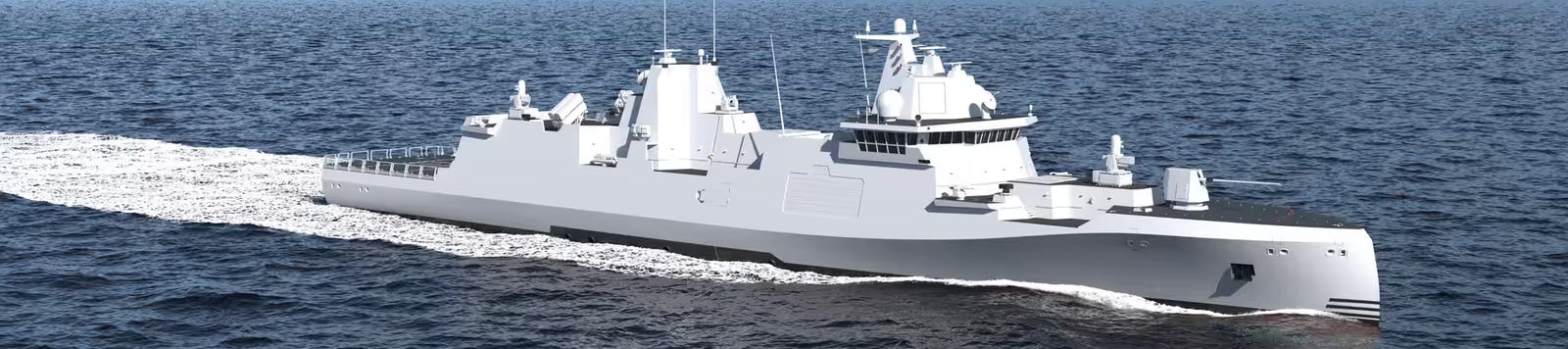
BLUF: Rheinmetall AG is turning to its own frigate and several smaller boats to fill its underused shipyards after losing a German naval contract worth several billion euros.
The move was a blow to Rheinmetall, which last year ventured into shipbuilding, buying Naval Vessels Lürssen in September.
The German deal would have included Rheinmetall taking over making the frigates from Dutch naval group Damen Schelde Naval Shipbuilding BV that had been beset by production problems.
The defense ministry canceled the project because it feared delays, cost overruns and litigation issues and assumed that the MEKO frigates could be a faster alternative.
It’s set to buy as many as eight MEKO A-200 frigates from TKMS AG& Co., which are smaller and carry less firepower.
Rheinmetall is also trying to win new clients for support and mine hunter boats and is speeding up making autonomous vessels.
Related Article: Rheinmetall reveals new guided missile frigate
Europe’s Defense Spending Surge Favoring the Primes
BLUF: Defense spending is growing sharply across Europe, but as money trickles down from higher military budgets and funding mechanisms, its distribution has not been felt equally across the continent’s industrial base.
Startups need early traction, end-user feedback and an invitation to the big boys’ club, he said. But the current flow of money is reflective of governments that are too risk averse when it comes to purchasing a product that is under development.
As a result of legacy mindsets, many startups are still not getting traction, “even though they may be having the best product in class.”
Transformation is also seen as less important in lieu of filling gaps such as ammunition, air and missile defense systems, armored vehicles, long-range fires, stockpile replenishment and production capacity — traditional capabilities at the forefront of previous world wars.
Startups in Europe attracted around $8B to $9B of venture capital investment in 2025, a trend that is creating a new industrial landscape.
As long as procurement favors traditional avenues, there will always be a trade-off with innovation.
“We learned on the battlefield in Ukraine that craftiness and fast iteration is the way to go, but when it comes to purchasing, governments tend to be waiting for the final product. You want to know what you get.”
Jens Holzapfel, business director at Nordic Air Defense
Ukraine’s Fire Point Starts to Integrate European Tech into Missile Defense System
BLUF: Ukrainian drone and missile maker Fire Point has secured agreements from a dozen+ European defense companies to provide radar, guidance and other systems for the Freyja missile defense project and is starting to integrate the various systems.
The pan-European project was launched in Paris last month by 10 governments and 12 defense firms - including Eurosam, Leonardo, Thales and SAAB.
Kyiv currently relies on the U.S.-made Patriot system to down ballistic missiles that fly at several times the speed of sound, but global shortages of its interceptor missiles, exacerbated by the war in Iran, have left Ukraine exposed.
The Ukrainian company is providing the FP7.X – a faster version of its FP7 ballistic missile – as the interceptor and is now integrating that with the guidance system, known as a seeker.
Norway’s Kongsberg is working on the command center integrating the various systems.
Fire Point aims to produce a ballistic interceptor for less than €1 million ($1.2 million) per missile, a quarter to a sixth of the cost of a Patriot.
The project would use open-source architecture and allow different options to be swapped in and out — such as a Weibel radar for one made by Saab.
The number of industrial partners could rise to around 20, increasing production capacity.
Our Take: If we were betting people, we would put real money that Ukraine figures this out in record speed given the realities on the ground.
Telesat Secures $2.3B Arctic Military Satcom Contract w/Canada
BLUF: Telesat LEO ULC, one of the world’s largest and most innovative satellite operators, today announced that it has signed a $2.3B Telesat Lightspeed services contract with Canada’s Defence Investment Agency (DIA) to deliver secure Military Ka-band (Mil-Ka) Arctic connectivity to the Canadian Armed Forces (CAF) under the Enhanced Satellite Communications Project – Polar (ESCP-P) program.
This is the largest contract in Telesat’s history and will significantly expand the scale and capacity of the Telesat Lightspeed network.
This agreement allows Telesat to immediately expand its Telesat Lightspeed network by 69 fully funded satellites, bringing the initial constellation from 156 to 225 satellites, all to be built by MDA Space, with commercial and Mil-Ka capacity.
The expansion will be funded through milestone-based payments from the Government of Canada starting in Q3 2026.
This contract ensures the Canadian Armed Forces will have access to secure, resilient and sovereign connectivity years earlier than originally planned, at a great value for money, and with a scalable architecture designed to meet future global requirements and support interoperability with allies and partners.
Australia Commits to Buying Secretive AIM-260 JATM Missiles, First Non-US User
BLUF: Australia will be the first export customer for the American-made beyond-visual-range air-to-air AIM-260 Joint Advanced Tactical Missile (JATM).
The country will invest “almost” $736 million AUD ($518 million USD) to buy “up to 450” missiles for the Royal Australian Air Force (RAAF).
Canberra first plans to integrate the AIM-260 on the RAAF’s Boeing F/A-18F Super Hornet fighters, followed by its fleet of Lockheed-Martin F-35A fifth-generation fighters and then its Boeing EA-18G Growler Electronic Attack aircraft.
Our Take: It’s great for the U.S. to have an early buyer of what looks to be a very expensive missile which will help with the economics. It’s also a sign of the growing relationship between the U.S. and Australia that such an exquisite missile would be released to an ally so quickly.
China’s ‘Sixth-Gen’ Fighter Jet Spotted with Design Upgrades, J-36’s Design Improved
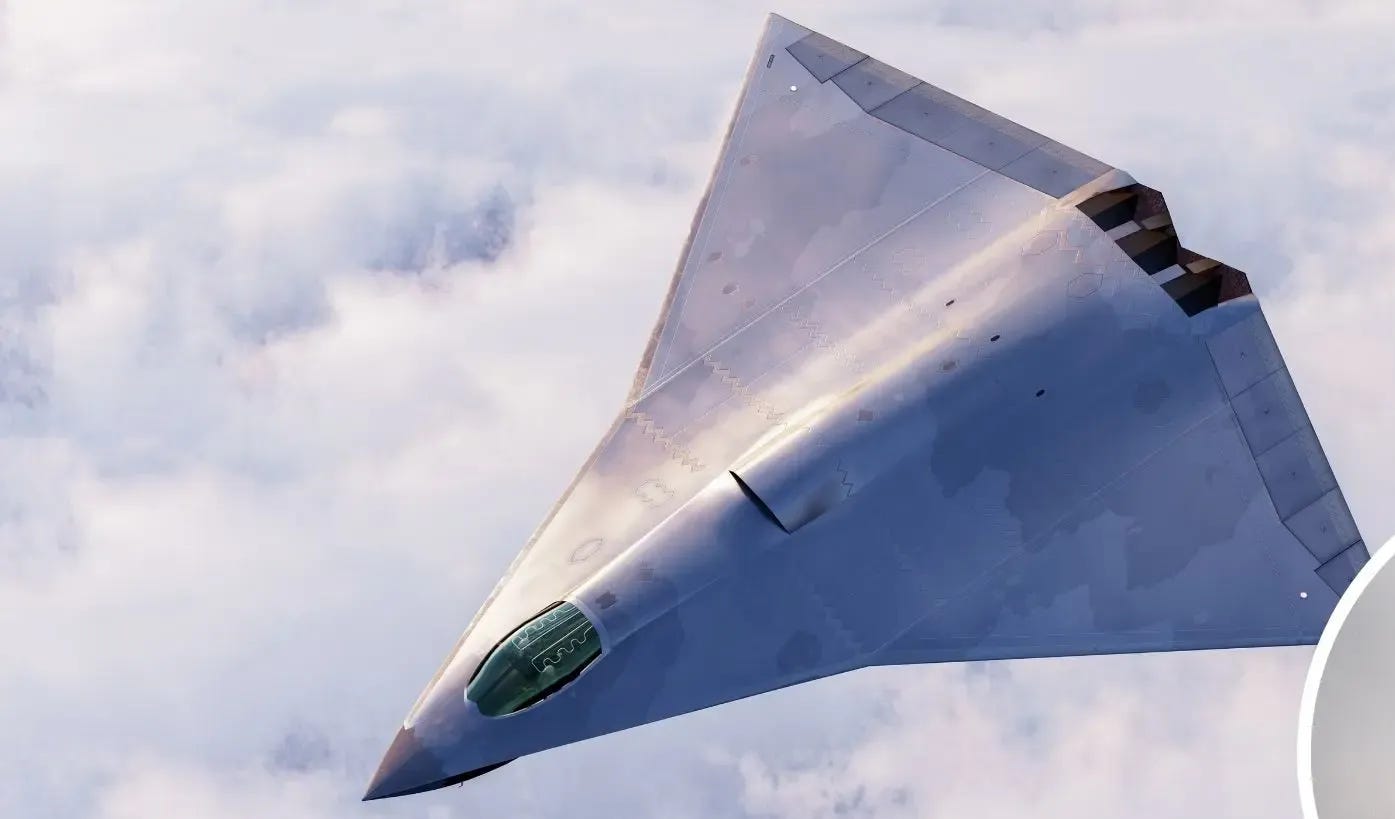
Our Take: New images circulating online appear to show what defense analysts believe is the fifth prototype of China’s sixth-generation J-36 fighter jet.
According to observers, the newly photographed aircraft appears to feature several refinements compared with earlier prototypes.
These include possible improvements to the airframe, engine integration, and aerodynamic design, suggesting that engineers are continuing to evaluate and enhance the aircraft through successive flight tests.
Experts suggest these adjustments are aimed at improving radar evasion, aerodynamic efficiency and engine performance.
Analysts have described it as having a tailless configuration and a distinctive three-engine layout, features that could support long-range operations, reduced radar visibility, and the integration of advanced sensors and weapons.
The emergence of another apparent prototype indicates that China may be accelerating its flight-testing program.
Developing multiple prototypes allows engineers to test different design changes, validate performance, and identify technical issues before it enters production.
Netherlands Commences USV Design for New ASW Frigates with Thales FLASH Sonar
BLUF: The Dutch Ministry of Defence, acting through the Materiel and IT Command (COMMIT), has formally commissioned Dutch Naval Design (DND) to begin designing a 12-meter uncrewed surface vessel (USV) for anti-submarine warfare (ASW).
The uncrewed craft will be deployed from the Royal Netherlands Navy’s upcoming generation of ASW frigates, significantly expanding the naval task group’s reach and underwater threat detection capabilities.
Concurrently, the Dutch MoD cleared the way to finalize the procurement of a modified variant of the FLASH dipping sonar from Thales Underwater Systems France, which will be integrated directly into the USV platform.
Development of the platform will be carried out by the “USV Alliance,” an industrial consortium formed under the Dutch Naval Design framework—a strategic partnership uniting the Ministry of Defence, defense industry leaders, academic institutions, and research centers.
Other International News:


It’s Continuing Resolution Season in Washington
Senate passed a Continuing Resolution this morning 90-6 to run through Dec 11. It rejects the administration request for $1B for the Trump-class battleship and rejects obligating funds for five key munitions programs. It generally freezes most DoD programs at prior levels (restricting new starts or production increases) but includes limited carve-outs/anomalies, such as for certain shipbuilding, classified procurement, and the nuclear weapons enterprise. It further does not include the exemption for unobligated reconciliation funds that would be taxed 8%.
House passed version of the CR bill extends funding until Dec 4. They will review the Senate bill upon returning from August recess on Aug 31.
How Congress Is Fumbling National Defense
BLUF: Congress’ reliance on stopgap funding may put the budding revival of the US military defense base and innovation on hold.
As the August congressional recess approaches, the foundational task of the nation’s elected legislators to provide for the common defense remains undone. Rather than passing annual appropriations, congressional attention has already turned to stopgap spending bills.
A 65-day continuing resolution would mean a loss of $1.7B per day in defense buying power, the difference between a continuing resolution extension of current funding and the budget needed for next year.
Put another way, just one day of lost buying power would be enough to purchase 379 of the critically needed advanced Patriot air defense missiles.
Momentum is just now building through industrial base and supply chain revitalization, investments in unmanned systems and AI capabilities and capacity, a shipbuilding surge, and overall modernization and readiness improvements.
All that is about to come to a destructive and unnecessary halt unless Congress takes decisive action.
General Caine succinctly summarized the urgency, saying that the funding was needed while we are still in the “window of opportunity” for it to matter. That goes for the supplemental request and the entire 2027 budget. Before training and exercises are canceled. Before modernization momentum is lost.
Congress must return from the August recess ready to put the nation’s security and its military above all other concerns, and to pass both the required emergency spending and the full 2027 budget request before the end of the fiscal year and before asking voters to let them keep their jobs.
Our Take: The #1 thing that Congress can do to support national security: Pass a defense appropriation ON TIME!
See our NDAA and budget posts for the latest insights and analysis.

Autonomous Warships, China’s 230X Advantage, and Swarms of Robot Ships | Dino Mavrookas and Vib Altekar
All-In-Podcast
A Conversation with the Pentagon’s Chief Buyer | Michael Duffey, USW(A&S)
Cogs of War
Contracting as the Competitive Advantage | Mike Derrios, Greg Baroni, Stephanie Halcrow, Ben Harris, Jim Hasik, and John Tenaglia
GMU Baroni Center
How AI and Quantum are Transforming Defense Cybersecurity | Vince Crisler
NDIA Emerging Tech Horizons
Modular Counter-UAS Systems for Military Vehicles | Bryan Bockmon
SAE Aerospace and Defense Technology
Why America Can’t Build Drone Batteries Without China, Yet | Trent Clawson
Drone Wars Podcast

Space and Missile Defense Symposium
Aug 11-13 • Huntsville, AL
TechNet Augusta 2026
AFCEA • Aug 17-20 • Augusta, GA
MODSIM World
NTSA • Aug 18-19 • Alexandria, VA
Fed SuperNova
Aug 18-20 • Austin, TX
ONR sBAA Industry Day
Aug 20 • Washington DC area
SmallSat Conference
Aug 23-26 • Salt Lake City, UT
DIB Accelerator 2026
ASW(IBP) • Aug 25-27 • Philadelphia, PA
Space Warfighting Forum
NDIA • Aug 25-27 • Colorado Springs, CO
Prodacity
Rise8 • Aug 25-27 • Nashville, TN
Intelligence and National Security Summit
AFCEA • Aug 26-27 • Bethesda, MD
See our Events Page for all the other events over the next year.
While I agree with Ferrari’s article lamenting the rather casual pace of fielding UxS — he forgets that the entire DOTLMPF-P enterprise needs to get energized and move at that same accelerated pace.
Still waiting on actual fielding timelines for counter-UxS directed energy. Navy's been testing HELIOS since 2019, but program of record remains vapor. Acquisition speed means little if integration lags years behind contract award.