

Headlines: $136B for Mega-Contracts
Columbia and Virginia Subs, PAC-3 Missiles, and Exploring Lower Cost Alternatives


Welcome to the latest edition of Defense Tech and Acquisition.

The biggest stories across the Department and the defense industry this week:
The Army awards Lockheed Martin a $59B contract for PAC-3s. The Navy says hold my beer and awards General Dynamics and HII a $77B contract for Virginia and Columbia subs. DoW also pursues lower-cost munitions and drones.
An array of new drones exercise and DoD pursues drones that carry drones.
CHAOS and Atropos combine to advance modular, long-range autonomy
Acq reform requires empowered leaders and stakeholder engagement
The Army launched Reveille Forge, an Integrated Development Environment
NVIDIA provided the Navy the Department’s biggest supercomputer.
CCAs will be optionally attritable and improves ACE operations at EOU
Space Force advances AMTI; ESS progresses using novel acq framework
Ukraine Hits Russia in the Caspian While Iran Refines Missile CONOPS

Navy Awards $76.6B in Contracts for New Virginia, Columbia-class Subs
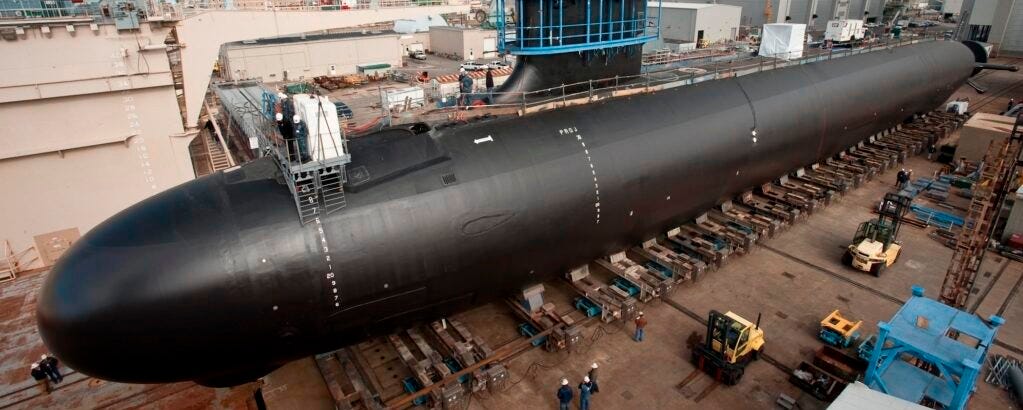
BLUF: The Navy awarded General Dynamics Electric Boat and HII Newport News Shipbuilding a $42.1B for nine Block VI Virginia-class subs and a $29.5B contract for five Build II Columbia-class subs.
Coupled with previously awarded funds of $5B for shipyard enhancements, the contracts are valued at a total of $76.6B.
The awards drive the critical, once-in a generation recapitalization of the Navy’s undersea forces and the Nation’s nuclear triad.
The Columbia Class submarines will provide an effective sea-based strategic deterrent to meet USSTRATCOM requirements.
Furthermore, these contract awards support the fielding of enhanced Virginia Class submarines, a platform engineered for unparalleled stealth, heavy payload strike capability, and multi-domain lethality.
The Navy now has seven Columbia Class submarines under contract, complementing a force of 26 operational Virginia Class submarines with 23 more slated to be built.
Meanwhile, the Virginia-class submarine program has faced some challenges and delays, stemming from late material deliveries and a shortage of experienced workers, according to a GAO report released this month.
Shipbuilders are constructing Virginia-class submarines at the pace of one per year as of June 2025, falling short of the Navy’s target of two per year.
“This historic investment underscores the Department’s continued commitment to undersea superiority and the recapitalization of our nuclear triad. By securing the continuous production of both the Columbia and Virginia classes, we ensure we will continue to deliver the world’s most lethal, survivable and resilient combat platform to our global Combatant Commanders, while providing long-term stability to our shipbuilding industrial base.” VADM Robert Gaucher, DRPM Strategic Submarines
Related: DoW Awards Historic Shipbuilding Contract to Cement Undersea Dominance
Army Adds $54B to Lockheed PAC-3 Agreement, Totaling $59B
BLUF: The Army awarded Lockheed Martin an undefined contract action (UCA) mod worth $53.86B for PAC-3 MSE interceptors, bringing the total value of the seven-year contract to $58.62B.
The contract is undefinitized, meaning dollar values and quantities could change as negotiations continue.
The UCA enables a highly resilient, warm production line capable of rapidly scaling the delivery of critical PAC-3 MSE interceptors to U.S. and allied forces.
Lockheed Martin inked another deal with the Pentagon to ramp up production for the Precision Strike Missile (PrSM) in March, and late last month, signed another massive UCA for nearly $35B to increase production of the Terminal High Altitude Area Defense (THAAD) interceptors over a seven-year period.
The additional funding from the UCA allows the company to supercharge PAC-3 MSE production and triple capacity by the end of 2030
“Today’s announcement turns concept into reality, providing industry with the long-term demand signals it needs to build a resilient supply chain, scale production, and deliver critical capabilities to our Warfighters at the speed of relevance.” Michael Duffey, USW(A&S)
Related Article: Pentagon Inks Patriot and THAAD Component Deal with L3Harris
US Missile Defenses to Get Strengthened with New 4-fold THAAD Propulsion Expansion
BLUF: L3Harris signed a framework agreement with the DoW and Lockheed Martin for a seven-year contract that would quadruple production of propulsion systems used by THAAD.
L3Harris supplies THAAD’s Solid Rocket Boost Motors and Liquid Divert and Attitude Control Systems, two key propulsion components used by the interceptor.
L3Harris has also reached a separate seven-year framework covering propulsion systems for the PAC-3 Missile Segment Enhancement interceptor.
Our Take:
These mega-contracts $77B for Columbia and Virginia submarines and $54B for PAC-3s are clear big bets for the DoW. These lock-in a major recapitalization of vital strategic capabilities that have been woefully delayed and limited in production.
Each contract exceeds the combined value of all OT Agreements awarded over the last two years.
They dwarf by a factor of 8.5X the total lifetime federal obligations of the NatSec100 companies ($16B) and exceed the total private capital raised for those companies ($118.2B).
None of this diminishes the value of emerging defense technologies. Autonomy, attritable systems, advanced sensors, and software-defined capabilities remain essential for distributed lethality and cost-imposition. But the sheer magnitude of these traditional programs underscores the platforms and interceptors that underwrite nuclear deterrence and theater air-and-missile defense still absorb the overwhelming share of near-term procurement dollars. The defense-tech ecosystem will continue to grow, yet it will do so in the shadow of contracts whose individual values exceed the entire lifetime federal spend of the current generation of national-security startups.
X-Bow Unveils New Low-Cost Supersonic Interceptor

BLUF: X-Bow Systems rolled out their Buckler interceptor, designed to down Shahed-type Group 3 drone threats at supersonic speed, all at an appealing and mass-procurable sub-$100,000 price point.
X-Bow’s SRMs come in all different sizes, ranging from a 34.5-inch motor (designed for big ol’ missiles, hypersonics, and space launch) to smaller motors and rocket-assisted take-off (RATO) kits for Group 3 UAVs, namely Aevex’s 200lb Disruptor drone, which it’s produced thousands of RATO kits for.
Lockheed also tapped the startup as a new independent supplier of SRMs and other services for their existing and future programs after leading X-Bow’s $105M Series B funding round last year.
X-Bow is building the Buckler’s airframe, solid-rocket motor, and propellant all in-house. X-Bow says that vertical integration is aimed at solving the industrial-base bottleneck defense leaders cite as the top constraint on scaling interceptors.
Singularity Defense Raises $80M to Build Missile Interceptors at Automotive Scale
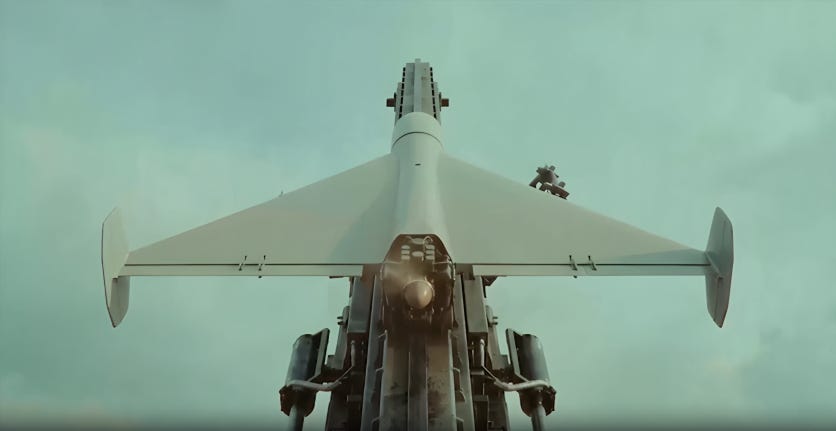
BLUF: Singularity Defense emerged from stealth to announce an oversubscribed $80 million Series A round and with it, the most explicit public bet yet that the Western air defense crisis can be solved not through better missiles, but through better factories.
The company has been building, flight-testing, and delivering air defense capability to the U.S. military in near-total secrecy. It is not yet ready to name the system publicly.
What it is ready to say is this: the interceptor is missile-based, ground-launched, built entirely from in-house subsystems including its own solid-fuel rocket motor, and designed to integrate with the C2, radar, and fire control infrastructure already in service across the U.S. military and that the bulk of the fresh $80M is going toward production lines the company says will exceed anything currently operating in the United States for air defense.
The company's engineering thesis begins not with a new seeker or a novel propellant, but with a production philosophy borrowed from the auto industry.
Singularity builds all key subsystems in-house — including its own solid-fuel rocket motor, a significant vertical integration decision that no established defense contractor has made for interceptor-class missiles in recent memory. For components it does not build in-house, it sources from commercial suppliers already producing at high volume, ensuring the supply chain does not constrain the production line.
The test cadence is the other half of the manufacturing thesis. Singularity is conducting multiple flight tests per month — a pace that compresses development iteration cycles that typically take quarters into weeks. Each test cycle feeds directly into design changes that can be implemented without waiting for a prime contractor's quarterly review cycle, because the people designing the system and the people building the prototype are in the same building.
Our Take: Both X-Bow Systems and Singularity Defense represent a parallel shift in the interceptor market: startups leveraging deep vertical integration and production philosophies borrowed from high-volume commercial manufacturing to deliver mass-procurable, lower-cost alternatives to traditional prime-contractor munitions. Both treat costs, speed, and volume as primary design drivers, positioning vertically integrated architectures as alternatives to the traditional munitions models.
Navy Picks RAACM-ER Low-Cost Cruise Missile For Program To Help Arm Allies
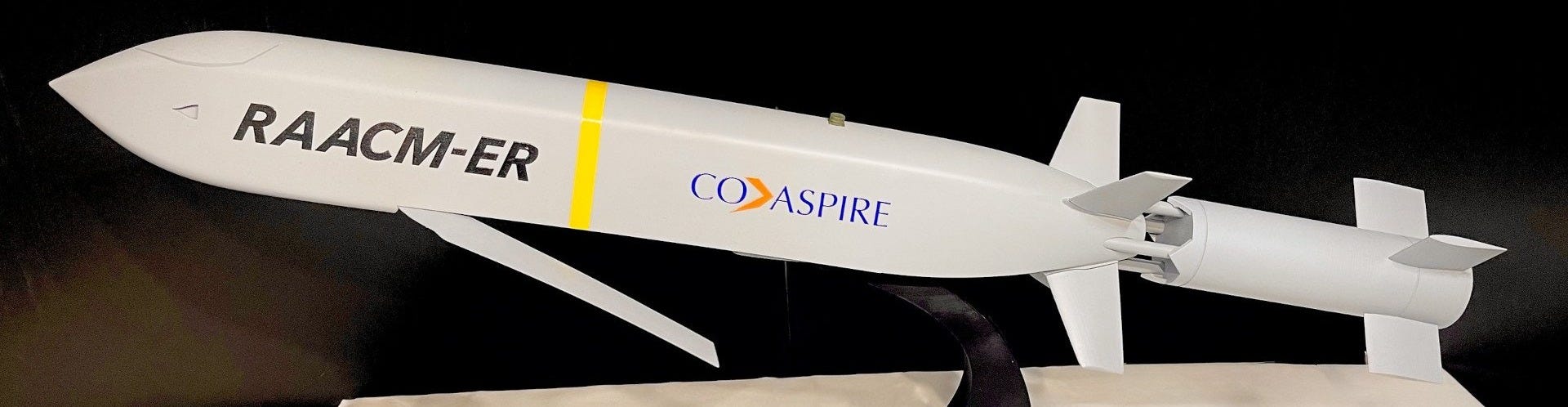
BLUF: The CHAOS program aims to give friendly ground forces new, cheaper ways to strike ships and targets on land at extended ranges.
Navy awarded CoAspire a $70M OTA for development of a ground-launched version of Rapidly Adaptable Affordable Cruise Missile-Extended Range (RAACM-ER) cruise missile.
Continued work on the design will now be done under a program aimed primarily at giving U.S. allies and partners a new, lower-cost way to strike moving targets at sea and on land.
CoAspire will design, build, test, and deliver to Program Acquisition Executive for Munitions and its program office, PMX-201, an affordable, ground-launched, mid-range, cruise missile system that can attack both land-based and moving maritime targets.
The end-use Foreign Military Sale (FMS) customers are allies and coalition partners needing an affordable yet highly effective maritime strike weapon that can be easily manufactured at scale.
CoAspire is also now developing what it says is a separate surface-launched version of RAACM-ER, called GHOST, for the U.S. military’s Low-Cost Containerized Missiles (LCCM) program.
Related: Navy picks $70M cruise missile designed for rapid mass production

Lockheed Taps Rotating Detonation Rocket Engines to Boost Missile Range, Speed

BLUF: Lockheed Martin and Venus Aerospace have formed a joint agreement to adapt Rotating Detonation Rocket Engine (RDRE) technology for military hardware, focusing on long-range precision strikes.
Rotating detonation propulsion could enable future precision fires systems to achieve significantly greater range and speed while remaining compatible with the Army’s need for affordable, scalable production.
The contract aims to transform this advanced propulsion setup from experimental flight demonstrations into standardized missile platforms.
It aims to meet defense requirements for faster, longer-range strike assets that are scalable for high-volume manufacturing.
CDAO Announces Team of Teams for Project Swarm Forge Crucible 3
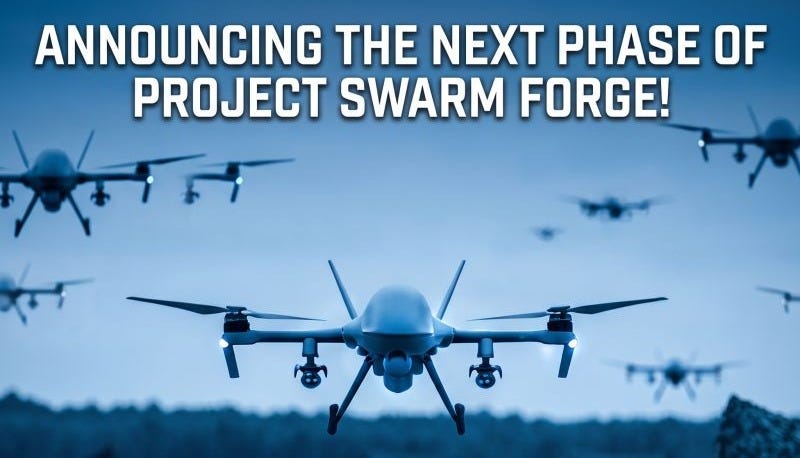
BLUF: Following a highly successful Project Swarm Forge Crucible 2, CDAO selected the top-performing commercial drone and autonomy tech companies to advance to Crucible 3 this September.
Rather than looking for individual stars, we are driving a Team of Teams approach.
To defeat complex threats, we need the private sector to collaborate. We want the best hardware builders partnering with the best autonomy software developers and AI innovators to build unified, dominant systems.
AeroVironment | Anduril | Astaral Technology | Auterion Government Solutions | Breaker | Chord Robotics | DAINAMIX | Gambit | GDIT | Hardy Dynamics | Helsing | LMI Solutions | Lockheed Martin | Mistral | NODA AI | Nokturnal AI | OpenDefense | Palantir | Post Quantum Labs | Regent Defense | Scientific Systems | Scout AI | Shield AI | Skyeton | SwarmInt | Tycho Ai | VICTUS
Exclusive: Invest in High-Potential Startups Like These

Alumni Ventures is offering readers early access to high-potential startup opportunities, including companies like Cambium, which recently raised $100M and was available to AV Syndicate members before the round.
Join the AV Syndicate to invest alongside name-brand venture firms like Founders Fund, General Catalyst, and Andreessen Horowitz (a16z) in some of today’s most exciting U.S. Strategic Tech companies.
You get:
• Curated deal flow of high-potential U.S. Strategic Tech startups
• No cost and no commitment to join
• The flexibility to invest only if a company excites you
Access opportunities before they close.
The Pentagon’s AI Strategy Has a Funding Problem
BLUF: In the span of two weeks, the White House issued two of the most ambitious AI directives in American history. The executive order mandating rapid AI adoption and hardened cyber defense across the government and the National Security Presidential Memorandum 11 directing every element of the national security enterprise to accelerate AI adoption, anchored by four pillars: adoption, adaptation, assurance, and accountability.
The strategy is sound. The harder challenge is execution, and a fiscal squeeze on the FY26 O&M accounts threatens to stall it before it begins.
The software that those directives call for is bought with O&M, and the Iran war has drained those accounts.
Private capital has made a generational commitment to American defense technology, yet the sector still draws <1% of total Pentagon contract dollars. Investors who backed these companies expect returns, and most of these firms depend on government contracts to earn them.
The FY26 bills hits AI software at the command level. The Pentagon created a dedicated software appropriation in recent years, but it remains a limited pilot, and most fielded command tools are still bought the way other recurring services are, with operations and maintenance dollars.
That puts AI software in direct competition with training, maintenance, and operating tempo for the same dollars, and the commands that most need decision-speed tools are often the least able to afford them.
The Pentagon could use reprogramming flexibility could move meaningful dollars into the technology and software accounts that fund commercial software licenses in the weeks that remain.
If FY2026 closes without meaningful new awards in the AI and commercial technology categories because O&M funding ran dry and no one acted, there will be real damage.
The Department of War Should Establish a Strategic Compute Reserve
BLUF: The DoW should create a Strategic Compute Reserve to mobilize America's commercial data center capacity for classified military use during wartime, mirroring how the Civil Reserve Air Fleet surges civilian airlift for national defense.
Of the more than 35 gigawatts of data center capacity currently under construction in the U.S., >90% has already been pre-committed to a corporate customer.
The Pentagon has confirmed that Maven Smart System usage during Epic Fury surged month-to-month by 38% on unclassified workloads and 89% on classified workloads. By token volume, top daily usage surged by 4,425%, hitting a peak of 20 billion tokens a day.
As of early 2025, CENTCOM’s classified network ran on just four NVIDIA H100 GPUs, with a partnership with Air Force Research Laboratory set to add 24 more.
The DoW should reimagine its regulatory frameworks around risk-based accreditation, identifying which rules still make sense in a cloud computing environment and which are obsolete.
The DoW should work with cloud service providers to upgrade and maintain physical and cyber security environments, scaled to the sensitivity of the workload and the current capabilities of each facility.
The DoW should develop a rapid conversion model that accepts some equipment may need to be removed rather than converted.
The Make-or-Buy Line has Moved
BLUF: One foundational pillar of acquisition reform is the implementation of a commercial first policy, which laid out several initiatives: leveraging existing but less often used acquisition authorities, maximizing non-traditional contract vehicles, and increasing the use of more flexible solicitations. Most critically, it drives a commercial solution-first paradigm. If the immediate commercial solution isn’t sufficient, acquisition officers then find ways to modify it. If that approach does not work, then and only then do they pursue development.
Businesses have started to see exponentially growing capability in the leading large language models, industry adoption of new AI-optimized interaction protocols, and the proliferation of agentic enabling tools that astronomically reduce the barriers to developing the software they need.
The department should pursue the commercial procurement of infrastructure, agentic tools, and model access for its existing internal software development organizations. If done, it could build nearly all its software systems and applications in-house with unheard-of responsiveness, full government ownership, and at a fraction of the cost it spends today.
Open source models such as Google’s Gemma series, agentic harnesses such as Hermes Agent and Open Code, and supporting tools such as Open Notebook and Honcho offer great capability with no licensing costs.
The little-used Acquisition of Services pathway is particularly promising. This authority has the lowest barrier to entry and is built for large enterprise-wide contracts spanning many users and organizations.
Any closed-system solution that requires full adoption into its environment to see value deserves no consideration.
The Services should plan for their eventual departure from large single data platforms.
These powerful tools are only useful if partnered with knowledge and discipline.
The department needs to set conditions for these internal development teams to jump right into work and deliver value when called upon. It can do this through the establishment of pre-accredited development and production environments and a streamlined onboarding process for its internal developers to enter and begin work.
Drone Swarms vs Cruise Missiles: Range, Cost, Power Compared
BLUF: Drone swarms and cruise missiles are both designed to make life difficult for modern air-defense systems, but they do it in very different ways. Cruise missiles rely on long range, precision, low-altitude flight, and powerful warheads. Drone swarms, meanwhile, trade individual capability for numbers, coordination, and the ability to saturate defenses.
Cruise missiles remain better suited for deep, high-value precision strikes where range and explosive power are essential.
Drone swarms are potentially more useful for reconnaissance, saturation attacks, locating enemy defenses, attacking dispersed targets, and overwhelming defensive networks.
DARPA Challenge Pushes Limits of Heavy-Lift Drone Technology

BLUF: DARPA next week will kick off its inaugural Lift Challenge, a weeklong competition that aims to “revolutionize heavy vertical-lift aviation” by finding a drone capable of lifting and transporting a payload four times its own weight. The agency will award $6.5M in prizes to the winners.
The Lift Challenge has attracted more than 100 competitors for drones, ranging from drone manufacturers to engineers to academics to hobbyists.
Competitors must build a drone capable of non-assisted vertical takeoff that weighs less than 55 pounds. During the competition, the drones will have to pick up a minimum payload of 110 pounds and move it back and forth on a 1,000-foot course 30 times, or five nautical miles, in less than 30 minutes.
“Multirotor drones are limited in their usability because of their low payload-to-weight ratios, meaning they can only transport a payload equal to or less than their own weight. As payload requirements increase, so does the size and the cost of the drone. With the Lift Challenge, our goal is to dramatically increase the useful load, which will then drive down the cost per pound of transported cargo.” Phillip “Donna” Smith, the Lift Challenge Program Manager
UGVs Become Drone Bases That Launch Aerial Assets on the Move
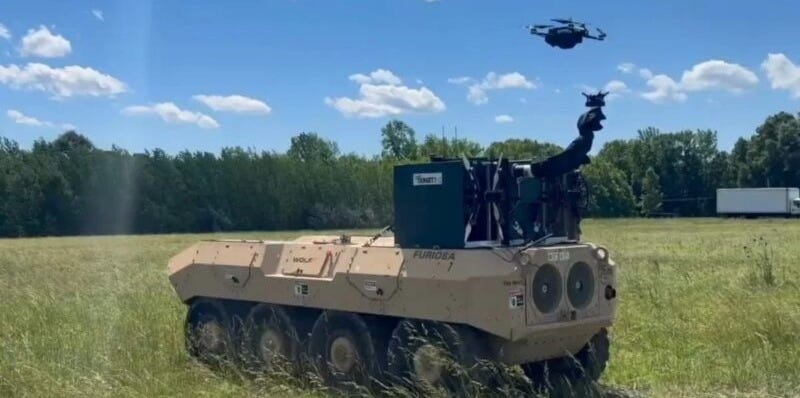
BLUF: Target Arm and HDT Global are creating a mobile autonomous platform that allows drones to launch, recover, and continue operating without stopping or requiring human intervention.
The concept combines Target Arm’s Ralar 2 robotic system and the Hunter WOLF and WOLF-X unmanned ground vehicle (UGV) duo from HDT Global.
The integrated system is designed to keep drones operating while the ground platform itself is moving, combining robotic manipulation, sensors, and autonomy to support continuous aerial operations.
A robotic arm mounted on the vehicle captures and guides drones during recovery, while the platform also launches multiple unmanned aircraft in sequence.
Target Arm said the technology could support a range of missions beyond battlefield operations, including search and rescue, covert surveillance, logistics, and maritime patrol.
By allowing UGVs to function as autonomous launch and recovery platforms, the system could reduce the need for human involvement in routine drone operations and allow personnel to focus on higher-priority battlefield tasks.
America Should Build the Future of Unmanned Aviation
BLUF: Drones will become a ubiquitous part of American life. The drone story has barely begun. Americans must ask who builds these machines and where their data goes.
From Ukraine to Iran, inexpensive drones have transformed the economics of warfare, allowing relatively cheap aircraft to threaten militaries and infrastructure worth billions. What was once a niche technology has become one of the defining weapons of modern war. But the battlefield is only the beginning.
In the coming decades, drones will become as common a tool for first responders and critical infrastructure as helicopters and radios are today, because they can solve problems that have always put human lives at risk.
American manufacturers should not win solely because foreign competitors were restricted. They should win because they built the better aircraft.
Unmanned aviation will not remove people from the mission. It is about making dangerous jobs safer and giving the people doing them better information before they have to act.
America now has the opportunity to help build that future. We should not settle for merely replacing what came before. We should build aircraft worthy of the people who will depend on them, and capable of being present when the moment matters most.
OSC Signs $820M Conditional Loan Commitment with Performance Drone Works to Expand Domestic Drone Component Manufacturing
BLUF: OSC issued a conditional loan commitment of up to $820M to PDW to establish high-volume domestic manufacturing capacity for critical drone components.
The project is intended to supply components to multiple manufacturers and platforms, representing a significant expansion of domestic production capacity for drone components.
These components are intended to support a range of Group 1 and Group 2 unmanned aircraft produced by PDW and other domestic manufacturers.
With this strategic financing, OSC will enable the development of production capacity to address critical component bottlenecks facing the broader U.S. unmanned-systems ecosystem.
"PDW will be one of several domestic component producers receiving OSC loan commitments in support of President Trump's Executive Order 14307, 'Unleashing American Drone Dominance.' Expanding domestic component production will benefit manufacturers throughout the ecosystem and improve supply-chain resilience." David Lorch, OSC Director
Other Defense Tech News:
US pursues utility-scale quantum computers with new $125M DARPA validation deal
US firm unveils Mach 2+ airborne test platform for hypersonic vehicle development
In First, TRANSCOM Operationalized AI Agents to Support Epic Fury
DOW Awards a Nearly $7B Oracle Agreement to Accelerate the Arsenal of Freedom

CHAOS Industries Acquires Atropos Group, Uniting Sensing and Effects with Autonomous Airborne Platforms
BLUF: CHAOS Industries acquired Atropos Group, an aerospace company developing autonomous air platforms.
CHAOS’ counter-drone radar and sensing systems are in production at U.S. facilities and deployed to protect critical infrastructure.
The Atropos acquisition builds on that manufacturing base, bringing airframe production into the domestic supply chain and adding U.S. manufacturing capacity and jobs.
Within its first year, the Atropos Group completed six major design iterations, flew a one-fifth-scale prototype, completed a conceptual design review for a large autonomous aircraft, and advanced the initial design of a modular, long-range surveillance and strike platform.
By integrating CHAOS’ sensing and effector technologies with Atropos’ air vehicle design and autonomous flight software, the combined company will deliver a mobile platform capable of detecting, tracking, engaging, and defeating aerial and other threats while on the move.
Related Articles:
Our Take: We’re excited for our friends at Atropos for the opportunities ahead.
Boeing Mulls Building ‘Many’ Ghost Bat Production Hubs Overseas
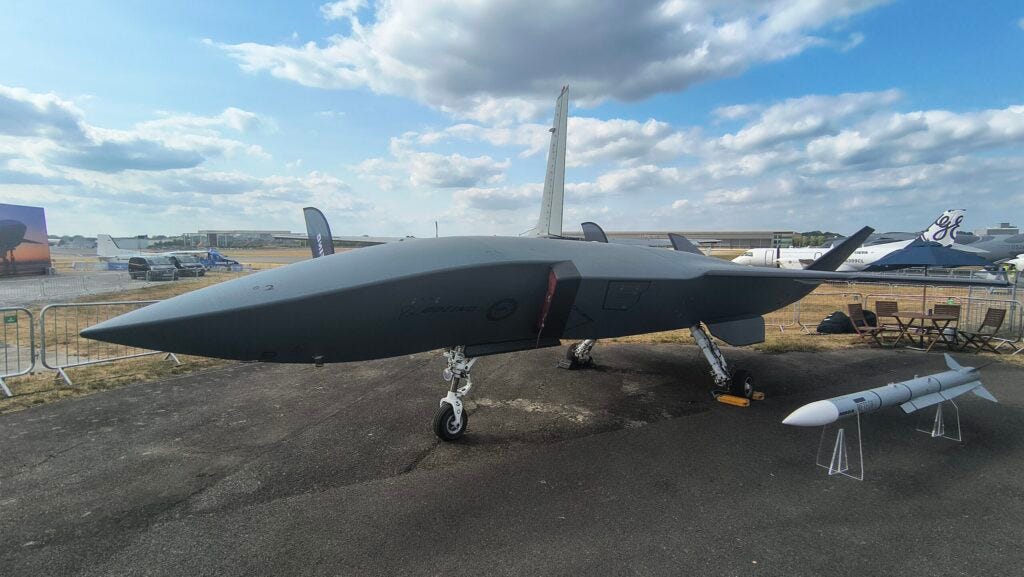
BLUF: Boeing is considering plans to build MQ-28 Ghost Bat production facilities in more countries, as it steps up a major push to secure international orders of the drone wingman from countries who prioritize weapons built within their own borders.
Boeing announced that Hensoldt has been added to its German MQ-28 supplier base in support of a bid to land Berlin’s CCA requirement.
Germany is on course to become the first European CCA operator under a target to field the drones with crewed fighters in 2029.
“I think we’d rather have many smaller factories building them, localized for countries to meet their own local needs than having one mega factory.” Glen Ferguson, MQ-28 Global Program Director
Our Take: Boeing’s strategy makes sense for attracting foreign business, but it is a little ironic given Boeing has built its business on having large mega-factories which usually comes with increased efficiency and ability to move skilled workers across different lines when needed.
Lockheed Martin Raises 2026 Guidance Following Record $230B Backlog
BLUF: Driven by major contract wins, such as a $35B MDA contract for THAAD interceptors and multiple Army munitions awards, LMC now projects full-year sales between $79.75B and $81.75B (3% higher than projected).
LMC CEO Jim Taiclet attributed the strong performance to strategic investments made ahead of demand, including expanding munitions capacity and advancing counter-drone technologies like the Sanctum system.
To further support its growth, the company recently announced plans to acquire undersea-warfare firm Ultra Maritime for $3.45B and partnered with Rheinmetall to establish a European center for tactical missile production.
Our Take: Only time will tell if the strategic investments accelerate production of THAAD to 400 closer to 2032 or 2027. We remain disappointed that the department didn’t hedge more with a lower cost alternative to pair with THAAD production. Seems there is little procurement funding left over to pursue a more scalable and lower-cost interceptor that would provide DoW with additional options.
L3Harris Postpones Missile Unit IPO Until Mid-2027
BLUF: L3Harris is postponing its planned spinoff of its missile solutions unit until at least mid-2027, with its CEO saying that the business is being undervalued even as demand soars for solid rocket motors and other weapons components.
The company wants to let the market “settle down” rather than completing the spin off by the end of the year as originally projected.
L3Harris will continue to invest in the facilities needed to help scale up production of solid rocket motors and other missile components and won’t start to need the money from the IPO until the late 2027-2029 timeframe.
Currently, the company is one of two domestic suppliers — alongside Northrop Grumman — of large SRMs, a key propulsion technology used in missiles.
Related Article: L3Harris delays missile business IPO to 2027 despite surging defense demand
Our Take: It seems that despite initial investor enthusiasm, DoW taking an equity share has caused some consternation among the financial community given the government is simultaneously a major customer, investor and regulator. It seems the government maintains warrants (to purchase stock later at a preferred price) and that new public shareholders would likely only own a small, noncontrolling interest. That is not the only concern driving the IPO valuation but seems to be key.
This is why we have expressed concerns that DoW taking equity in some companies and not others creates a market and competition distortion. While it makes sense from a financial investor point of view, a future equity sale is unlikely to benefit DoW directly as those funds will go back to the Treasury.
Firehawk Aerospace Awarded AFRL Contract to Develop Breakthrough High-Thrust Propulsion System
BLUF: Firehawk Aerospace has been awarded a multi-million-dollar contract by the Air Force Research Laboratory (AFRL) to continue developing and evaluating a hybrid rocket engine of increased size and capability.
Firehawk will develop and evaluate a hybrid engine of further increased size and performance capability and evaluate its performance as a possible propulsion system for a sled track test bed application.
Firehawk’s approach to producing hybrid rocket engines has created significant breakthroughs in reliability and performance compared to traditional hybrid rocket engines.
Saronic and Samsung Heavy Industries Team Up
BLUF: Unmanned maritime darling Saronic is teaming up with Samsung Heavy Industries (SHI) to “accelerate the development of autonomy-capable maritime systems and technologies to strengthen America’s shipbuilding industrial base.”
Together, the two companies will work on autonomy and AI-powered solutions and integrate robotics and automated processes across Saronic’s shipyards.
SHI provides decades of experience in cutting-edge, high-volume shipbuilding and vessel design.
Related Article: Saronic Taps Samsung to Help Revive US Shipbuilding Capability
JIATF-401 Awards CACI $500M for Non-Kinetic cUAS
BLUF: CACI International has won a three-year, $500M contract to provide its non-kinetic SkyValor counter-drone system, along with “other tactical” unmanned systems, to the Joint Interagency Taskforce (JIATF) 401.
The SkyValor system specializes in providing “early warning detection” and uses radio frequency sensing and AI-enabled EW to take down drone threats
The systems will be used for the Pentagon’s Domestic Shield program — a project aimed at protecting US military installations and critical infrastructure from drone threats.
Red Cat Receives $2.49M Air Force Order for Black Widow Systems
BLUF: Red Cat Holdings, Inc, a U.S.-based provider of advanced all-domain drone and robotic solutions for defense and national security, received a $2.49M FFP contract from the Air Force for Black Widow™ sUAS, training and related support.
The customer organization is the U.S. Air Force Security Forces Center (AFSFC), which trains, equips, and managed program execution for the Air Force Security Forces enterprise worldwide.
Black Widow is Red Cat’s flagship short-range reconnaissance system and the U.S. Army’s selected platform for its Short Range Reconnaissance Program.
Honeywell Aerospace, Shield AI Collaborate to Advance Development of Autonomous Aircraft
BLUF: Honeywell Aerospace and Shield AI announced an MoU under which Honeywell will develop a trusted autonomy software stack on Shield AI’s Hivemind Software Development Kit, integrating Honeywell Aerospace’s Anthem™ avionics, navigation, and sensing portfolio.
Under the collaboration, the companies will evaluate joint pursuits of defense Unmanned Aerial System programs globally.
They will also explore how Honeywell Aerospace’s certified systems can extend Hivemind’s reach into both U.S. and international markets, supporting allied nations seeking domestic autonomy capability.
Global Drone Manufacturer Selects Fayetteville for First Flagship Manufacturing Facility in the U.S.
BLUF: Skyeton, Inc., a manufacturer of unmanned aerial systems (UAS) will invest more than $3.1M in Fayetteville to establish its first flagship manufacturing operation in the U.S. creating at least 162 new jobs in Cumberland County.
Skyeton, Inc. is the U.S. subsidiary of Skyeton Holdings, a global manufacturer of UAS for the defense and commercial sectors.
Skyeton has more than 350,000 combat-proven flight hours of its long-endurance Raybird platform for intelligence, surveillance, and reconnaissance missions.
The company’s expansion will use cutting-edge technologies to design, engineer, manufacture, test, distribute, and support its composite UAS from a 28,500-square-foot production facility.
AV and Applied Intuition team up to bring collaborative autonomy to new Mayhem 10 drone

BLUF: AeroVironment and Applied Intuition are teaming up to produce a drone capable of autonomously operating in swarms or “hunter-killer” teams under the direction of one operator.
AV, best known for its Switchblade suite of loitering munitions, launched a new unmanned aerial system product line in April by unveiling the Mayhem 10.
Now, Applied Intuition will add its Acuity ISR/Strike software to the drone so teams of Mayhem 10 platforms can operate autonomously.
Billed as a “highly adaptable” launched effects system, the Mayhem 10 has the ability to switch from intelligence, surveillance and reconnaissance (ISR) payloads to electronic warfare, communications and precision strike missions without having to change the air vehicle.
The Mayhem system can carry a 10-pound payload and fly more than 60 miles, and the platform can be assembled and launched in less than five minutes.
The companies validated the integration by running the systems through collaborative autonomy missions and demonstrated multiple Mayhem 10 drones collaborating against different threats.
Related Article: 10-pound payload drone gets autonomous swarm brain for coordinated strike mission
Rune Technologies Selected by Air Force to Advance AI-Enabled Logistics for Agile Combat Employment
BLUF: Rune Technologies has been selected by AFWERX for a Phase 1 SBIR award to advance AI-enabled logistics command and control for Agile Combat Employment operations. The effort applies Rune’s TyrOS platform to address the most pressing challenges in the Department of the Air Force (DAF).
Defense Unicorns and Paramify Unite
BLUF: Defense Unicorns, the leader in airgap-native software delivery and national security missions, today announced a strategic partnership with Paramify, a leading provider of compliance automation, to deliver a streamlined, scalable path to federal security compliance for defense and government customers.
The partnership integrates Paramify’s compliance automation platform directly into Defense Unicorns’ Unified Defense Stack (UDS).
Paramify’s risk-first platform automatically maps security controls across multiple frameworks, including IL 4 and 5.
This further enables teams to deploy mission-critical software in complex, regulated environments with greater speed, clarity, and most importantly collaboration with critical, additional organizations.
Other Defense Industry News:

Embracing Acquisition Reform: A Critical Step for the Army’s Future
BLUF: In the wake of SECWAR’s address on acquisition reform, it’s clear that the Army is not just reacting but proactively leaning into a transformative approach. This is an opportunity we cannot afford to miss. The Army’s alignment with the Adaptive Acquisition Framework is essential, but it requires more than just policy adjustments—it demands a cultural shift that empowers leaders and engages all stakeholders.
At the heart of this reform is the imperative to hold Capability Portfolio Executives and program managers accountable for developing robust, risk-balanced acquisition programs that deliver capabilities in a timely manner.
Program estimates should reflect commercial pricing and incentivize effective contracts.
PAEs must be empowered to align the institution with the needs of acquisition programs, ensuring that decisions are made swiftly and effectively.
Successful acquisition hinges on 4 things:
Clear, stable and executable requirements
Adequate funding
A sound acquisition strategy
The ability to make timely decisions.
The new construct the Army is executing eliminates a multitude of difficulties by giving the PAE the responsibility of aligning the enterprise.
We must recognize that a high-ranking individual focused on institutional alignment is essential for timely decisions and successful acquisition outcomes.
With strong leadership and determination, we can reshape our approach to acquisition. I wholeheartedly support the notion of the PAE being responsible for determining requirements.
Concerns about the PAE’s readiness to navigate complex technological trade-offs are valid. However, these risks can be mitigated by surrounding the PAE with a skilled team equipped with critical thinking abilities and experience.
Another significant risk lies in the size of the portfolios and whether the span of control is manageable. If handled correctly, with accurate data and facts, this can be manageable.
For success, we must unite the best talent around common goals. Effective execution management is critical, and anyone perceived as an impediment to change must be addressed promptly.
Our Take: We could not agree more. We want PAEs to be given the maximum amount of responsibility because the diffused nature of accountability has been at the heart of acquisition reform issues. However, PAEs need to surround themselves with skilled people who think differently and are willing to help challenge the status quo because they cannot be everywhere at once. They also need to rely on their data because with so much complexity, the only way to know where attention is needed is to see the noise in the reporting. While speed is paramount, there is also a need for discipline in having an acquisition strategy that guides each effort whether it’s a small prototype or larger program. This of course should be scaled and streamlined according to the effort but it’s a disservice to industry to award a prototype without understanding (and funding) the follow-on activities if it achieves success.
Pentagon’s Special Ops Office Hosts First Shark Tank-Style Accelerator Event
BLUF: The first-ever Accelerator Event, sponsored by the office of the Assistant Secretary of Defense for Special Operations and Low-Intensity Conflict (SO/LIC), was a different kind of industry day where companies pitched capabilities in a Shark Tank-type exercise to solve some of the toughest problems for the special operations world.
The goal is to break down the bureaucratic barriers that are often derided in the acquisition world, seeking to prove that the acquisition system doesn’t have to take 10-plus years to deliver what SOF operators need today.
SO/LIC officials said they solicited responses from industry for problems drawn directly from operational commands, like the need for surveillance payloads on Group 3 medium-sized drones or BLOS comms that don’t use LEO satellites.
They whittled down around 700 proposals to 15 capabilities to pitch their solutions in Shark-Tank like presentations.
“We have to break away from the tradition of grading our success on our ability to follow a process that we created and to grading our success on the outcomes that we generate.” Cara Teeter, deputy assistant secretary of Defense for Special Operations Analysis, Resources, and Capabilities
Right to Repair: Law of Unintended Consequences
BLUF: Good intentions can lead to unintended and undesirable outcomes. There is a better path than enacting new statutes that will increase government costs, reduce industry competition, and expand federal control over intellectual property.
The proposal pushed by Reps. Maggie Goodlander and Pat Harrigan in NDAA deliberations highlights real frustrations – delayed repairs, flown-in contractors for simple fixes, and degraded readiness.
People of goodwill on all sides want troops to be able to fix what they are trained to fix and save time, money, and lives; but this “right to repair” legislation is a blunt instrument that overshoots its stated goal and risks harming the very readiness it claims to protect.
Counterproductively, however, this proposal imposes a default of “government purpose rights” for virtually all technical data, computer software, and documentation delivered under future War Department contracts.
The only exception is if a contractor meets a high evidentiary bar with clear and convincing proof of more restrictive rights, plus a compliant assertions table, private-funding documentation, segregable exclusions, and portion markings.
While rhetoric focuses on troops repairing gear in the field, the bill text creates default rights that apply across competitive and non-competitive procurements, with limited carve-outs and significant new obligations on industry.
There are broader problems of data management, forecasting, and supply chain execution, and granting broader data rights does nothing to fix these root causes.
Instead, such a course of action would only pretend to solve readiness while leaving the actual bottlenecks untouched.
Worse, the new law will likely raise costs for taxpayers. Contractors facing the prospect of losing control over privately developed IP – and potentially seeing it shared with competitors – will rationally price that risk into every proposal.
DoW already possesses the tools to acquire the rights it needs.
Under existing law, including 10 U.S.C. § 3771, the Secretary of War must prescribe regulations balancing government needs with contractors’ legitimate proprietary interests.
Section 3771 protects incentives for private investment in innovation while ensuring the government obtains necessary data rights for national defense, competition, and sustainment.
Our Take: We agree with Jeff here. While there are egregious examples of primes who had all their costs fully reimbursed still declare “restricted rights” on key items and stick it to the government at every opportunity to the point where operators in the field could barely repair anything themselves. DoW should use its existing authority to garner rights from those that were paid billions in development while honoring the IP from companies that invested private funds or real non-reimbursed IRAD to bring new capability to the warfighter.
After Palantir Beef, US Withdraws Bid to Improve Military Intel
BLUF: DIA has withdrawn a bid to improve a military intelligence system called MARS, (Machine-assisted Analytic Rapid-repository System) after a protest by Palantir.
Palantir filed a protest complaining that the US was seeking to build an intelligence system from scratch when the company has commercially-available products readily available.
DIA’s military intelligence systems have incurred criticism for deficiencies and delays since MARS was developed in 2018 to replace a legacy system known as MIDB, which was created in the 1980s and still remains in use.
MARS still relies on MIDB’s user interface, for instance, and the older system’s server isn’t due to be fully retired until March 2028.
Our Take: This is a classic example of what to not do and just shows how far we have to go to train the acquisition community. Literally, Maven is being used in every combatant command at the highest levels of classification. For an acquisition office to ignore that and pursue a custom application that does the same thing was just asking for this protest.
NIST Unveils New AI Evaluation Platform
BLUF: NIST aunched a new program on Monday granting researchers access to an isolated testbed environment to safely evaluate artificial intelligence models against various commands.
The AI Technology Evaluation, or AITE fundamental goal is to offer a universal rubric to effectively evaluate AI models’ capabilities and determine the state of the art for model performance.
It provides blind data for models to process when completing tasks to gain objective insights and conduct evaluations of model capabilities.
Initially, AITE will focus on conducting image analysis tasks using large vision language models across three domains: quantum science, genomics and public safety. More tasks will be available in the future.
U.S. Digital Corps Graduates Largest Class of Fellows Yet
BLUF: The General Services Administration on Wednesday celebrated the graduation of 71 U.S. Digital Corps fellows, marking the largest graduating class since the program’s inception.
CMMC Reform
Check out the guest article from our friend Sandeep on CMMC. Turning and Burning on Cybersecurity Compliance

PAE Fires Establishes “Reveille Forge” to Accelerate Rapid Integration and Capability Delivery

BLUF: PAE Fires has launched Reveille Forge, an Integrated Development Environment (IDE) at Redstone Arsenal.
The now-operational facility capitalizes directly on the momentum from the Pathway for Innovation and Technology (PIT) led Operation Jailbreak's Sprint 1 and the Army's first ever API Marketplace.
Designed to maintain a lean standing footprint, Reveille Forge remains poised to surge support when directed to integrate new capabilities for immediate deployment to operational theaters.
Operation Jailbreak’s first sprint focused on countering Unmanned Aerial System and Integrated Air and Missile Defense threats, bringing together >50 companies and 600 participants to "jailbreak" >74 previously isolated capabilities.
PAE Fires is institutionalizing that momentum by establishing Reveille Forge as a permanent hackathon environment to support its specific portfolio objectives.
This standing facility can operate independently or in conjunction of any future Jailbreak sprints.
The driving organization behind Reveille Forge is PAE Fires, working hand-in-hand with its portfolio of existing prime contractors, emerging vendors, government stakeholders, and academia.
Reveille Forge is purpose-built as a collaborative space where all stakeholders work side-by-side, building directly on the partnership model proven during Operation Jailbreak, where Industry competitors sat shoulder-to-shoulder in shared "validation zones."
An "Integrate-First" Pathway for Emerging Vendors and Capabilities
Initial Integration: Vendors demonstrate the viability of their product by successfully integrating it into the established government-owned architecture within Reveille Forge.
Capability Review: Once initial integration is demonstrated, government stakeholders will engage in formal capability discussions.
Testing: Valuable capabilities advance to the next phase of testing. Successful performance may inform follow-on testing, experimentation, acquisition decisions, or other government actions consistent with applicable laws, regulations, and competition requirements.
"Operation Jailbreak proved what's possible when industry, government, and academia stop working in silos and start working as one team. Carrying forward the momentum of Operation Jailbreak, Reveille Forge continues to drive early collaboration and integration, rapidly turning emerging technology into deployable capabilities.” LTG Frank Lozano, PAE Fires
Our Take: This is exactly the kind of integrate-first infrastructure the Army (and DoW) needs, building upon Jailbreak’s success for a more permanent collaboration engine. This enabled vendors an ability to demonstrate real integration into DoW architectures alongside established primes. Kudos to the PAE Fires team.
Army Acquisition Shift Demands New Contractor Sales Strategies
BLUF: Compressed acquisition timelines are rewarding contractors who invest in customer intelligence months before an opportunity appears. Not the ones who mobilize after it lands.
A CSO lands in your inbox on Tuesday and responses are due Friday. The customer wants a working capability to provide soldiers next month.
A smaller competitor wins not because they moved faster that week, but learning months before the opportunity existed in conversations with the customer.
Many organizations still think readiness means mobilizing capture faster. It doesn't. In compressed acquisition windows, the intelligence already exists, or you are making assumptions.
The intelligence that wins must now exist before the opportunity appears. Every competitor has the same AI, the same subscription data, and the same market intelligence. Advantage belongs to whoever creates intelligence others cannot buy.
The Army is complementing its traditional requirements process with faster, problem-based pathways. Characteristics of Need documents describe the operational problem and ask industry to solve it.
The Army is increasingly using non-FAR pathways such as commercial solutions openings and other transaction agreements, some moving from idea to award in as little as 90 days.
It is opening direct soldier touchpoints and accelerators, including the Army Pathway for Innovation and Technology, to put working prototypes in the warfighter’s hands early.
The firms pulling away won't necessarily have bigger proposal teams or better AI. They'll simply understand where their customers are heading before everyone else does.
Our Take: Fully agree that BD operates at an accelerated pace. Understanding and shaping opportunities ahead of solicitations is a competitive advantage for those who have existing contracts and deep relationships with DoW organizations. The acquisition transformation and commercial first model will pivot to where both government and industry require greater insights into each other’s camps to move out with greater speed and success. This Substack is one avenue to help.
Army Begins Shift to New AI-Enabled C2 Comms System
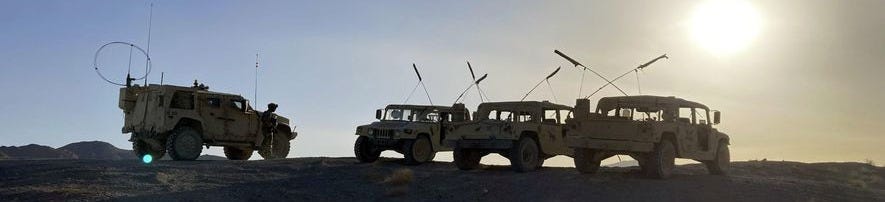
BLUF: The Army announced the successful demonstration of a >$3B Next Generation Command and Control (NGC2) digital communications prototype, saying the technology’s development is on pace to catapult military planning and operations into the future.
The prototype NGC2 system will soon move on to larger scale testing following a slate of exercises.
The new system amounts to a massive overhaul of the Army’s communications and planning structure, replacing previous — in some cases aged conventional equipment — with a futuristic combination of custom built and off-the-shelf components being provided by a slew of advanced defense tech companies.
While the system integrates AI into the C2 communications process, it should not be viewed as a replacement for military decision making or planning.
The system is being built in four layers and is meant to more closely mimic the consumer electronics industry than prior Army equipment. It is also being conceived with rapidly developing technology in mind.
The transport layer contains much of the communications hardware that lets the system use everything from SpaceX’s Starlink system to mesh radios and 5G cellular networks.
A data layer uses cloud-based computing to store the necessary information in real time, while an integration layer translates all of the available points on a given battlefield into useful bits and bytes for applications.
There are programs such as a target system provided by Palantir and a machine learning model for geospatial imagery by Striveworks. There is even a program being developed internally by the Army to help visualize electromagnetic spectrum planning for electronic warfare.
NGC2 relies on a major contract with Anduril and Palantir. The two are on contract with the Army to be the primary data providers for the system, with both providing a common baseline for other companies to build out their products.
“It enables us to do these things distributed. When you look at the modern battlefield conditions that we think we’re gonna have to fight in … the modern battlefield is going to require us to be distributed in order to protect and preserve our most important asset which is our soldiers, our combat power.” GEN Christopher LaNeve, Army Vice Chief of Staff
Army-Backed Aircraft Delivers Cargo Three Ways in Single Sortie Without Ground Crews

BLUF: Elroy Air has expanded the mission profile of its autonomous Chaparral cargo aircraft with three new unattended delivery modes developed for the Army, allowing the drone to deliver supplies without personnel or equipment at the receiving site.
The new capabilities let the aircraft release cargo from a hover, drop payloads while flying forward, or land and unload autonomously, giving military units more options to resupply forces operating in contested or remote areas.
Engineers programmed the aircraft to complete two autonomous payload drops during a single sortie without operator intervention during the release sequence, meeting requirements for communications-denied environments.
They released payloads while hovering over the target and dropping from 65’.
Elroy Air also completed a separate test of its ground delivery mode. After landing, the aircraft automatically released its cargo before departing, eliminating the need for ground crews or dedicated unloading equipment.
The same software and hardware package will also support commercial logistics missions where infrastructure remains limited or unavailable.
The vertical takeoff and landing platform does not require a runway, fixed delivery equipment, or personnel at the destination, making it suitable for disaster response, maritime operations, and remote terrain.
See the Video of Chaparral Deliveries
Army is Launching AI-Powered, Commercial-Facing DevSecOps Platform
BLUF: Army Acting CIO Gabe Chiulli teased Project Gatekeeper to automate intake, streamline requests and accelerate delivery of commercial tools.
The Army is launching a new commercial-facing initiative to streamline how industry partners submit code and software products for military accreditation.
Project Gatekeeper will deploy a tailored version of the Army’s DevSecOps platform onto NIPRnet, using AI to provide commercial developers with instant feedback and risk assessments. The project will help remove acquisition friction.
The concept behind this is that we are going to work with industry similar to Operation Jailbreak, where we can have industry partners commit code containers, whatever might be in isolated areas, and allow us to give you that feedback.
The platform addresses a widespread operational bottleneck where individual vendor requests for sponsorship and accreditation frequently exceed the capacity of Army personnel.
By allowing companies to upload code containers into isolated staging areas without requiring a Common Access Card, the platform offers a streamlined pipeline toward pipeline authorization and security approval.
To further simplify industry collaboration, the Army is establishing focus areas to communicate technology requirements at scale rather than managing disparate vendor inquiries.
Army Picks GM Defense, Ford, BC Customs for ISV-Heavy Prototypes

BLUF: The Army awarded OT agreements to GM Defense, Ford, and BC Customs to develop prototypes for the heavy variant of the infantry squad vehicle.
The companies will each provide three ISV-Heavy variants by March 30, 2027 to undergo operational assessments and limited developmental testing.
This competitive prototyping effort directly advances Army Senior Leader directives to enhance lethality and operational flexibility on the modern battlefield.
While the original ISV has allowed soldiers to zip around the battlefield with more agility and speed, the Army is hoping the heavy variant will provide more mobile electrical power. The Army is currently facing a critical capability gap in this area.
Our Take: A CSO in March, OTA awards in June, prototypes delivered by March. Competition among three vendors. Great stuff here.

Pentagon Puts out Call for Robot Boats That Launch Attack Drones
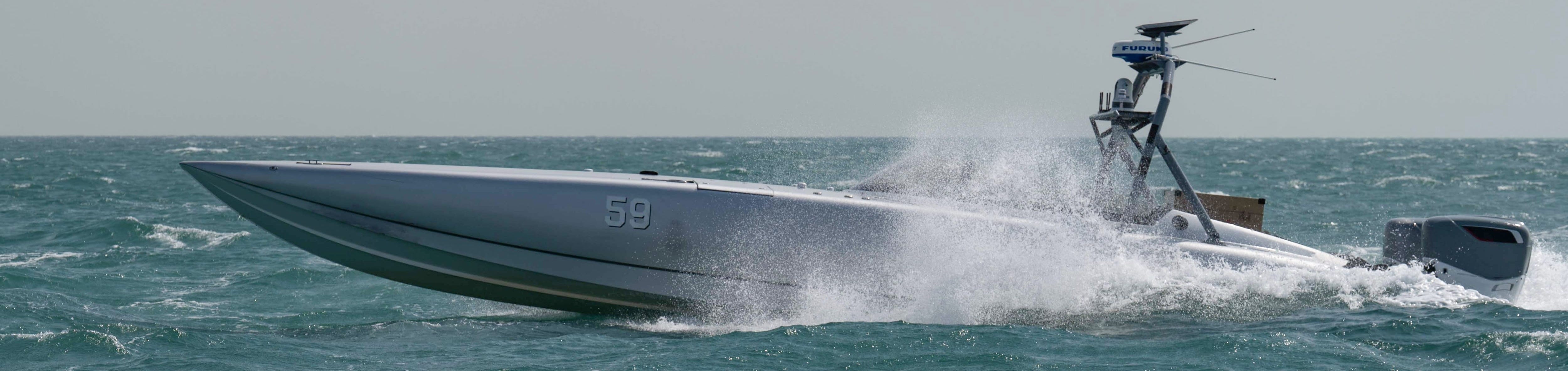
BLUF: DIU issued a solicitation for Suitable Warfighting Adaptive Payloads (SWAP-USV) to find mature, market-ready USVs fully integrated with two or more mature, market-ready aerial drones to detect, identify, track, and defeat hostile threats.
Technology must be mature enough to be deployed to the field within 120 days.
To make this happen, DIU created a year-long contest backed by $100M in prize money. DIU wants to partner with established maritime manufacturers, autonomy developers, sensor manufacturers, and UAS developers to execute a multi-phase Prize Challenge.
The SWAP-USV project is billed as a solution to a problem that has also plagued missile and drone defense on land: the economics favor the offense.
The cost-exchange ratio for detecting and neutralizing asymmetric maritime threats in contested environments is heavily skewed in favor of the adversary.
The drone boat must carry, launch and control at least two small UAVs.
The UAVs together should be capable of conducting kinetic strikes with a combined payload of at least 2 kilograms, or just over 4 pounds.
The system must be mobile enough to fit into a standard cargo container, on road trailers or on C-17 and C-130 transports.
Related Article: DIU Wants More USVs
Navy Seeks Multi-mission Host Vessel for Unmanned Systems, Helos
BLUF: The Navy is on the hunt for a new multimission vessel to launch and recover uncrewed aircraft and surface vessels along with helicopters and small boats.
PAE Maritime issued an RFI for the design and construction of an all-new platform or the modification of an existing vessel to meet a requirement for a versatile and modular ship capable of sustained and independent operations.
The primary mission of this vessel will be to serve as an afloat forward-deployed operations and staging base for UAS, USV, small boat, and U.S./multinational C2 missions capable of sustained communication in varied sea states.
Navy is seeking a steel monohull or catamaran craft measuring 300-400 feet in length. The craft should have a minimum sustained speed of 10 knots, a range of 9,600 nautical miles and the ability to remain at sea for 30 days without resupply.
The vessel must have a flight deck or helicopter pad capable of launching and recovering Sikorsky SH-60 and MH-60 Seahawk, MH-60T Jayhawk and MH-65 Dolphin helicopters.
It must also be equipped to launch and recover vertical take-off class 2 and 3 UAS with a minimum of 20x20-foot deck space dedicated to UAS recovery and storage.
For small boats and USVs, the Navy wants a “non-deck crane-based small boat launch and recovery system” to support 24- to 44-foot vessels weighing up to 35,000 pounds. It should have either a well deck, boat ramp, elevator or boat lift system, the RFI continues.
Industry responses are due by Aug. 19.
JAGM-Armed Saildrone Surveyor USV Joins RIMPAC 2026

BLUF: A missile-armed variant of Saildrone’s 20-meter Surveyor USV officially joined the at-sea phase of the RIMPAC 2026 Exercise. Featuring a custom launcher capable of firing four AGM-179 Joint Air-to-Ground Missiles (JAGM), the deployment marks a critical milestone in the Navy’s push to field a hybrid fleet of crewed and uncrewed combatants in the Indo-Pacific.
Designed for persistent maritime and undersea surveillance operations, the 20-meter-long USV can operate for months at-sea, according to a release from Saildrone.
Surveyor is one of several drones from the company, already operationally fielded in support of Navy and Coast Guard operations in the Middle East, Pacific and Caribbean.
Earlier this year, Saildrone revealed that defense contractor Lockheed Martin invested $50M to integrate a launcher capable of firing four AGM-179 Joint Air-to-Ground Missiles (JAGM).
Succeeding the Cold War-era AGM-114 Hellfire, JAGM uses a modernized seeker and can strike targets at extended ranges in future variants.
Aside from surface strike, Lockheed Martin proposed the system for counter-unmanned aerial system roles aboard American guided-missile destroyers and littoral combat ships amid the height of Red Sea engagements.
The surface-launched deployment scheme aimed to increase the Navy’s options to counter Houthi one-way attack drones.
Alongside Saildrone’s Surveyor, sea drones from HavocAi, Leidos and Splash Industries are participating in RIMPAC.
Navy Deploys GARC USV in First Live-Fire Training Exercise

BLUF: The Navy confirmed its first live-fire training exercise of its Global Autonomous Reconnaissance Craft (GARC) USV during a sinking exercise (SINKEX).
This comes a little over two weeks after CENTCOM used three Corsair USV to strike a submarine and ship maintenance facility at a naval base in Iran, marking the first time American forces have employed sea drones in combat operations.
USV Division 32 (USVDIV-32) executed the Navy’s first GARC live fire.
Related: Navy’s GARC Kamikaze Drone Boat Blew a Hole in Ex-USS Peleliu During Sinking Exercise
Seasats USV Records Chinese Warship in the Philippines’ Waters

BLUF: Seasat’s Lightfish USV passed a Chinese destroyer operating in the Philippines’ exclusive economic sone and recorded the first such video by a US company.
The Chinese ship approached the USV, but as a matter of safety, the Lightfish was broadcasting its position loudly through the Automatic Identification System (AIS), the international tracking system used by oceangoing ships to monitor their locations and prevent collisions.
The 11-foot-long, 3-foot-wide lightweight USV is designed primarily for maritime ISR and sensing. Despite its small size and low cost (~$250,000), the solar- and backup generator-powered Lightfish can be at sea for up to six months in Sea State 6+.
The startup has snagged a joint $24M contract with the Navy and Marines under the APFIT program to accelerate production of the Lightfish in January, which followed an $89M-ceiling SBIR Phase 3 IDIQ with the Navy to deliver the USVs to the Marine Corps last October.
It’s also completed some pretty insane journeys, including a 7,500-mile trans-Pacific voyage from San Diego to Japan last year. The Lightfish snapped a very up-close and personal picture of a Chinese destroyer northwest of Guam on that trip.
“The Lightfish had recently completed the first autonomous transit of the Taiwan Strait, where they also snapped some photos of Chinese warships operating during the over 1,000 nautical mile journey. This sighting off the coast of the Philippines came on the tail end of that mission. The Chinese ship didn’t take any threatening action and Seasats “tried to maintain respectful maneuvering and distance.” Mike Flanigan, Seasats founder and CEO
Related: USV maker Seasats says drone came within meters of Chinese warship during Pacific transit
Military’s Largest Supercomputer is now live at Navy base
BLUF: Naval Support Activity Monterey, California, is now home to the Pentagon’s most powerful supercomputer.
NPS received a DGX GB300 computer, the highest-performing AI processing system available for enterprises under a CRADA between NPS and AI giant NVIDIA that began in December 2024.
A ribbon-cutting ceremony to launch the new system took place with NVIDIA founder and CEO Jensen Huang and ADM Samuel Paparo, PACOM Commander.
The makeup of the supercomputer which combines 36 NVIDIA Grace CPUs with 72 NVIDIA Blackwell Ultra GPUs, according to officials enables it “to process large volumes of work in parallel rather than just sequentially.
The CRADA and installment of the supercomputer started with an expressed interest from Huang to partner with the school and help make NPS one of the premier AI institutions in the world, and definitely the premier U.S. defense institution or school for AI.
Related: NVIDIA donates DGX GB300 supercomputer to US Navy`s Naval Postgraduate School
Our Take: We expect the next NPS Acquisition Research Symposium to operate at the next level armed with this supercomputer.
Navy Awards Hyliion $41.7M for Megawatt-scale Energy Platform
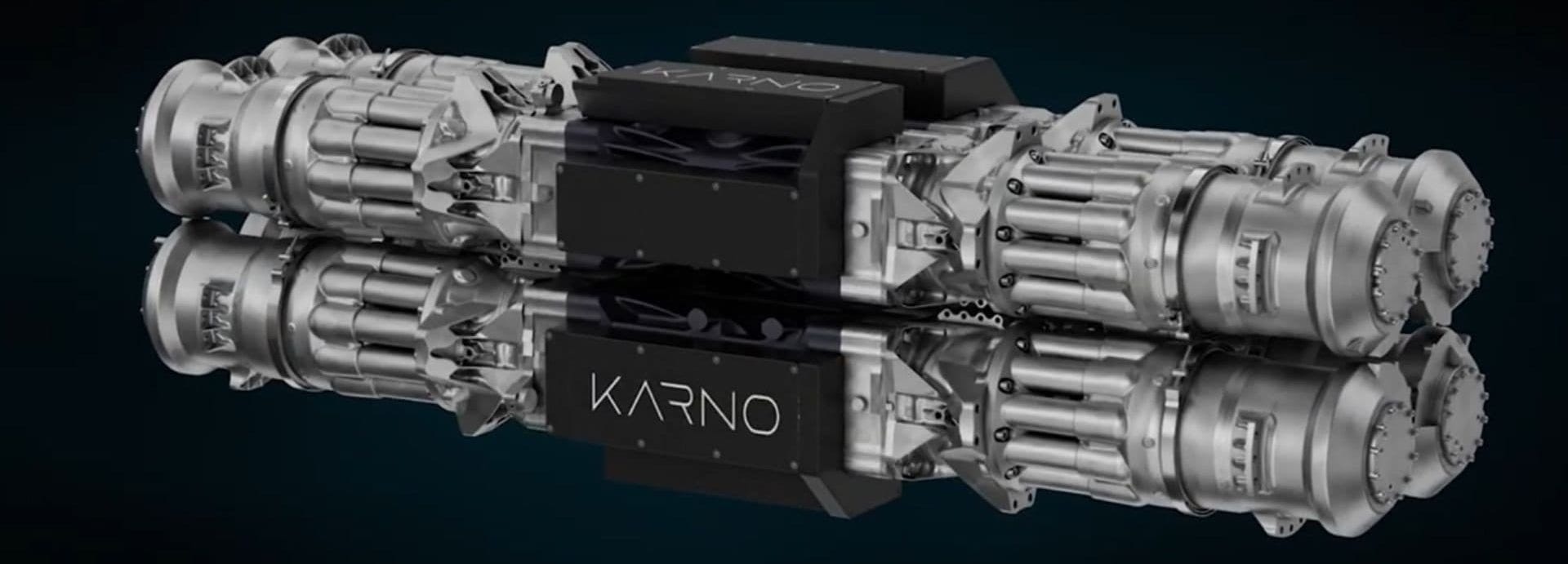
BLUF: Hyliion Holdings secured a $41.7M cost-plus fixed fee contract from the Office of Naval Research (ONR) to design, develop, build, test, and deliver 2-megawatt and 3-megawatt KARNO power generation systems.
While Hyliion initially introduced the KARNO platform for commercial and industrial energy applications, the Navy contract represents a move toward significantly larger power systems capable of supporting demanding military operations.
Unlike conventional diesel generators that rely on reciprocating piston engines, the KARNO Power Module is based on a linear generator architecture that converts heat into electricity with fewer moving parts.
Reliable electrical power has become increasingly important for modern military operations. Expeditionary bases, radar installations, communications facilities, ports, and logistics hubs all require dependable power generation, often in remote environments where access to conventional infrastructure is limited.
The Navy contract suggests growing government interest in modular, fuel-flexible power technologies that can provide resilient electricity generation across a range of operational environments.
Raytheon Secures $1.8B Contract Extension for Navy SPY-6 Radars
BLUF: Raytheon was awarded a $1.8B contract extension for SPY-6 radars for the U.S. Navy, building on the initial hardware production and sustainment contract awarded in March 2022. The contract includes options which, if exercised, would bring the cumulative value to $3.3B.
SPY-6 is now aboard two commissioned U.S. Navy ships and is installed on 11 others, all of which are undergoing various stages of testing.
Over the next decade, SPY-6 is expected to be deployed on more than 50 U.S. Navy ships, giving the fleet unmatched sensing capability and multi-mission readiness to stay ahead of evolving threats.
Raytheon invested >$800M to modernize its radar manufacturing facilities and expand production capacity. They are positioned to double SPY-6 output by 2028, helping ensure long-term availability and lowering cost for the Navy.
Related: RTX’s Raytheon lands $1.8B deal for U.S. Navy’s SPY-6 radar family
Navy Targets 90% Fleet Readiness with Predictive Maintenance and Faster Repairs
BLUF: Air and Fathom5 are combining predictive maintenance with enterprise logistics software to help the Navy accelerate repairs.
Air and Fathom5 have partnered to modernize how the U.S. Navy manages maintenance and repairs, combining enterprise logistics software with artificial intelligence to improve fleet readiness.
The collaboration aims to replace fragmented maintenance systems with a connected platform that helps sailors identify parts, predict equipment failures, and complete work orders even in communications-limited environments.
The partnership follows Fathom5’s success in Phase III of the DIU’s NextMRO Prize Challenge, where the company demonstrated software that turned operational Navy maintenance data into applications designed for use by sailors.
Air and Fathom5 now plan to expand those capabilities across the Navy’s broader maintenance and procurement network.
Fathom5 will integrate its AI-powered Condition-Based Maintenance technology with Air’s Enterprise Readiness platform, creating a system that connects maintenance planning, logistics, supply chains, and repair forecasting across multiple support levels.
Navy Warships to be Built by Partner Shipyards Under HII’s New Strategy
BLUF: U.S. shipbuilder HII has decided to change how it builds some Navy warships by moving part of the construction work to outside shipbuilding partners.
HII will now use this distributed production model for the Navy’s San Antonio-class amphibious transport dock program, beginning with the future USS Philadelphia (LPD 32).
The move marks the first time Ingalls has applied the model to its amphibious ship portfolio, extending an approach previously used on the company’s Arleigh Burke-class destroyer program.
The strategy is intended to increase shipyard capacity, support faster production, and strengthen the wider U.S. maritime industrial base as demand for Navy vessels continues to grow.
Under the initiative, eight structural units for USS Philadelphia have been assigned to two industry partners and have already entered early production. The modules will later be integrated into the ship at Ingalls’ Pascagoula, MS, shipyard.

B-21, Nuclear Deterrence, and the Risk of Legacy Defense Assumptions

Hannah Jude-Smith, Shane Praiswater and Brian Leitzke
BLUF: For the first time in its history, the U.S. must plan to deter and potentially fight two nuclear peer adversaries simultaneously. Russia’s persistent nuclear modernization and China’s accelerating strategic buildup together create a complex and fraught environment that existing policy assumptions have not confronted.
Into this environment arrives the B-21 Raider and its associated family of systems, offer planners new tools for horizontal escalation, precision strikes across contested geographies, and the kind of flexible, survivable conventional dominance that previous bomber generations could not reliably provide.
And yet the institutional logic governing how the United States employs its bomber force may prevent the B-21 from being used to its full potential.
The nuclear reserve requirement, an ingrained assumption that a meaningful portion of the bomber force must be held back for nuclear contingencies during a peer conflict, risks kneecapping one of the most capable conventional instruments in the American arsenal.
The B-21 Raider, paired with the F-47 and other current and future joint and coalition forces, is specifically suited to countering adversaries that field antiaccess and area-denial capabilities.
A careful reading of escalation theory, principally the ideas put forth by Thomas Schelling and Robert Powell, suggests that fully committing the B-21 to the conventional fight need not reduce deterrence. In fact, it may strengthen it.
US Strategic Command retains ultimate control of the nuclear-capable bomber force, and history suggests that this control is accompanied by a persistent reluctance to fully commit bombers to the conventional fight.
During the Korean War, Strategic Air Command commander General Curtis LeMay resisted deploying B-29s to the theater, arguing that doing so whittled away the nuclear deterrent force. The pattern repeated itself in Vietnam.
But the B-21 is not simply another bomber; it is designed to lead the combined air forces in the most contested environments imaginable. Withholding the B-21 from that role in the name of nuclear reserve does not merely reduce conventional striking power; it risks undesired escalation in a large-scale conflict.
In terms of future triad redundancy:
Legacy bombers will still exist well into the B-21’s fielding and carry the new Long-Range Standoff weapon
F-35s certified to carry the B61-12 gravity bomb provide a theater nuclear option that is credible against regional adversaries
The submarine force already carries the W76-2, a deployed low-yield warhead, on the Trident D5.
The Navy is also developing a nuclear-armed sea-launched cruise missile, a low-yield option for Virginia-class submarines with an initial operational capability targeted for 2034.
The Ground-Based Strategic Deterrent, when fielded, will modernize the intercontinental ballistic missile leg of the triad entirely.
Taken together, the imminent future triad constitutes a flexible, tailored nuclear deterrent that provides options, increases credibility, and reduces the risk of escalation to nuclear use. The B-21 does not need to remain on the ramp to make that deterrent credible. If a conventional conflict starts, it needs to be in the fight.
Our Take: We couldn’t agree more with this take (which is worth a full read). We take it a step further and contend that the U.S. is squandering treasure on excessive nuclear investments that could be used on building up lacking conventional forces. The fact that the U.S. has never taken action against N Korea despite its aggressive rhetoric or Libya (while it had nuclear weapons) despite those countries having the most bare bones nuclear program reaffirms our argument made here: Going Nuclear on Nuclear
The calculus for nuclear deterrence is way overstated given the last 70 years of history that has demonstrated no country (even with aggressive, paranoid leaders like Vladimir Putin and Kim Jong Un) sees an incentive for deploying nuclear weapons.
AFLCMC Partners with Space Systems Command to Award Next-Gen MAVRC GPS Receiver Agreements
BLUF: SSC on behalf of AFLCMC’s Electronic Systems Directorate, has awarded two agreements to BAE Systems and Trimble Military and Advanced Systems to support development of a next-generation Maritime and Aviation Receiver Card (MAVRC) military GPS user equipment receiver.
These agreements will support requirements development, risk reduction studies, and documentation for a design concept review milestone.
The effort is the first phase in a two-part approach that will inform future prototyping, demonstrations, and integration and testing to produce a GPS M-code receiver for maritime and aviation platforms.
MAVRC is designed to provide weapons system integrators with more resilient positioning, navigation, and timing capabilities in contested environments.4
The system is expected to improve anti-jam and anti- spoof performance, reduce Size, Weight, and Power (SWaP) demands, and include Regional Military Protection (RMP).
Will The F-47 Have to Fly Initially with Inferior Engines?
BLUF: With the Next Generation Adaptive Propulsion (NGAP) program not expected to be ready for integration onto an aircraft until 2030 and the F-47 expected to fly for the first time in 2028 raises the question of what engine will be used in the interim.
Both NGAP vendors (General Electric and Pratt & Whitney), announced they had completed assembly readiness reviews of their respective designs, known as the XA102 and XA103, in May.
More specific details about the XA102 and XA103 continue to be limited, but both are known to be so-called adaptive cycle designs.
In very broad terms, jet engines of this kind can perform like a turbofan when optimal and more like a turbojet when needed.
To provide additional context, GE has said in the past that the XA100 design it developed for AETP was around 25 percent more efficient than the F135.
It is not entirely uncommon for new aircraft prototypes to use a different engine from the one planned for production examples.
As one example, Lockheed’s Cold War-era F-104 Starfighter was developed around the General Electric J79 turbojet, but that engine was not ready for the start of flight testing.
Early XF-104 prototypes used older and less powerful Wright J65 turbojets instead.
Northrop Grumman originally planned to use Pratt & Whitney F401 turbofans on the F-14 Tomcat, but that engine program was cancelled.
Pratt & Whitney TF30 turbofans were used instead on early F-14As. However, problems and limitations surrounding those engines led to General Electric F110 turbofans being integrated onto later examples of the Tomcat.
Our Take: It seems likely that the Air Force will try to get the F-47 through its test points using the F-135 and maybe try to push test events related to propulsion until NGAP is available. If production proceeds, then there will just be two different variants of the F-47 until all can be modified up the latest configuration. In its favor, the F-47 is likely to struggle more with advanced mission system test points given the F-47 is not likely to be designed for dogfighting or missions that require providing close air support (where angle of attack and power can determine success or not) so the lack of an immediate XA102 or XA103 may not slow the testing much if at all. Teh bigger issue will be if the XA102 and XA103 powerplant is significantly more powerful and that energy is needed to power the rest of the aircraft. In that case, certain systems may be degraded if they can’t get the required power which could impact the mission effectiveness of the F-47. We hope that’s not the case.
Related Articles:
F-35 Engine Core Upgrade to Face Critical Review in August, Flight Testing in 2030
BLUF: A major planned upgrade for the F-35 fighter’s engine is expected to reach a major milestone in August when it undergoes its critical design review.
The critical design review is an important milestone in the progression of a major defense program to verify its design is stable, is likely to meet performance requirements, and is on track to meet its cost goals.
After the ECU program’s design review is finished, it is scheduled to undergo ground testing in late 2027. Flight tests will start around 2030.
GAO in a September 2025 report found that while the preliminary review validated ECU’s design met expectations, it found “major risks” such as a lack of integrated development and test schedules between the engine and the F-35, parts that were not arriving in time to support testing, and immature test plans.
Our Take: Looks like 2030 is going to be a big year for Air Force propulsion. In our experience, passing design reviews is only a small indicator of future success. Only with delivery of a prototype for test do real indicators for production readiness reveal themselves.
Air Force Reveals Plans for VTOL Bomber Prototype
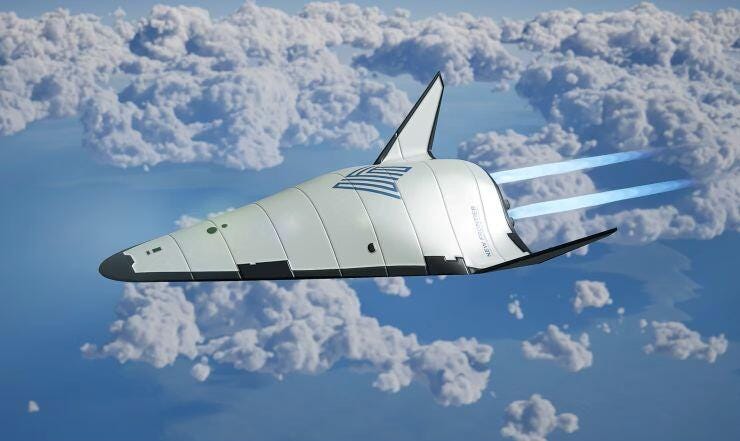
BLUF: The Air Force has released plans to experiment with a prototype reusable, rocket-powered aircraft for high-speed, long-range strike missions.
Although limited to a prototype program, the interest from Air Force Global Strike Command points toward a future bomber alternative that differs markedly from the stealthy, subsonic Northrop Grumman B-21 Raider.
The prototype described in solicitation documents released in mid-July calls for a liquid-fueled, rocket-powered, vertical-takeoff-and-landing (VTOL) aircraft.
After launching vertically, or potentially on a steep diagonal trajectory, the aircraft would transition to horizontal flight and accelerate to high—likely supersonic or hypersonic—speed, perform a strike mission and then return to its launch base for a vertical landing.
The concept requires the maturation of several technologies including advanced liquid rocket propulsion, autonomous flight control, thrust-vector control, aerodynamic control surfaces, cryogenic propellant management and high-temperature structural materials to demonstrate stable flight, controlled transition between flight regimes and reliable performance.
The concept appears closely aligned with plans by New Frontier Aerospace, based in Kent, Washington. The startup announced a year ago it had signed an agreement with the Air Force Institute of Technology to collaborate on advancing an “innovative, rocket-powered hypersonic [VTOL] aircraft.”
Over the longer term, New Frontier Aerospace aims to develop cargo aircraft capable of operating within the atmosphere and in space, including a scaled-up version with intercontinental range.
Related Articles
Air Force Must Fix Fleet Age, Size, Readiness Issues, Undersecretary Says
BLUF: Air Force Undersecretary Matthew Lohmeier agrees with the Heritage Foundation’s report that gave the Air Force an overall score of “weak.” While the service’s capabilities are strong, the think tank rated its capacity as weak and its readiness as very weak.
In the 25 years after the fall of the Berlin Wall, the Air Force reduced its overall end strength by nearly 40%.
Ten aircraft types that first flew more than 50 years ago are still in service, with nearly half of the fleet having an average age of more than 40 years old.
The Air Force has delegated ~85% of contracting authority down to its newly established portfolio acquisition executives.
The Air Force has cut the time it takes to get its largest aircraft (focus on strategic airlift) through depot in half.
The Air Force is aiming to increase its use of rapid acquisition authorities and award more multi-year contracts to provide industry a stable demand signal.
In return, the service is seeking more affordable mass to increase its magazine depth without breaking the bank.
“If our partners can’t deliver what we need on budget and on time, we’re not going to do business with them and maintain that relationship. We are doing our very best to leverage this rare opportunity not to reform but transform the acquisition landscape.”
“The problem is not capability; it’s the rate of production and our ability to sustain the capability that we already have. We’re losing ground on aircraft age and fleet size and are forced to extend some aircraft to the very last year of their engineered lifespan — and in some cases, we aren’t.”
Our Take: The Air Force has certainly made progress in some key areas. Decreasing the time for depot induction is huge. Investments in FAMM and CCA are a huge step forward, but we are disappointed that more novel approaches aren’t being pursued for solving logistics and refueling challenges (both of which are critical for ACE operations). We do have big hopes for the Massed Modular Aircraft program being pursued in conjunction with DIU.
CCAs Will Be Optionally Attritable
BLUF: The Air Force’s new CCA may fly scores of missions over many years or only a few if commanders decide a mission is worth the risk of losing one, a middle ground approach being called “optionally attritable.”
The concept refinement process for the 2nd increment is expected to wrap up in about 10 months, after which the Air Force plans to whittle the number of potential vendors with workable designs to as many as six.
“We’ve actually never treated CCA as attritable. We have treated CCA as optionally attritable. CCA will have a very long service life, if they need to, or they could be attritable if that’s what the operational commander needs to happen.” Brig Gen(s) Tim Helfrich
Related Articles
First Anduril YFQ-44A rolls off production line for US CCA program
Air Force could tap up to 6 vendors for second increment of CCA drone program
CCAs Head to Air Force’s Main Drone Base for Exercise
BLUF: Both the YFQ-42A and YFQ-44A Collaborative Combat Aircraft headed to Creech Air Force Base, Nev. for an exercise focused on employing the semi-autonomous drones in more austere environments.
It’s the latest example of the Air Force’s Experimental Operations Unit pushing hard to get CCAs into exercises where they can simulate operational environments.
During the exercise, the CCAs “generated multiple sorties demonstrating reliability and extended range; integrated with manned platforms in the local airspace to project power across distributed battlefields; and simulated scenarios that will inform future requirements for the platform.
Related Articles
First Anduril YFQ-44A rolls off production line for US CCA program
US combat drones move closer to real-life missions with Air Force’s Nevada exercise
Air Force to Begin Concept Refinement of MQ-9 Replacement by End of Year
BLUF: The Air Force and the Defense Innovation Unit plan to start the concept refinement phase of its MQ-9A Reaper replacement effort during 1Q FY27.
The Air Force wants to bring multiple companies into the next stage of the Massed Modular Aircraft (MMA) program.
During that phase, both traditional and non-traditional vendors will conduct early analysis that will help the service shape its design, requirements and cost of the future unmanned aerial vehicle.
On July 7, DIU issued a commercial solutions opening for the MMA effort that called for an inexpensive, long-range drone outfitted with a variety of payloads that could “execute missions that the MQ-9A performs today.”
The notice stated that the Air Force wants to fly a full-scale MMA prototype within 21 months of awarding a contract, with plans to have 20 operational drones on stand-by by fiscal 2031.
A key aspect of the MMA effort is the platform’s overall affordability and ability to be produced en masse.
The MMA is expected to conduct a wide range of missions — including ISR and offensive strike — and could potentially fly solo or in a larger swarm formation.
Our Take: The key to success here is to keep the requirements manageable so that this doesn’t become an exquisite platform that winds up competing with CCA (or even more expensive aircraft) for funding. This should just be a truck that sensors can be swapped on (U-2 style) and a reasonable amount of specialized munitions can be employed for select missions. If this thing ever has a radar or tries to drop JDAMs, that’s how we’ll know it’s going to fail or not last.
Air Force Moves to Purchase T-7 Engines, Not Boeing
BLUF: The Air Force plans to buy the engines for its new T-7A trainer directly instead of having Boeing, the plane’s maker, provide engines as part of its contract.
The change could carry costs, but gives the service more control over a critical component of the jets.
LCMC released two “sources sought” notices for F404-103 engines in early July—one for the engines themselves, and a second for the engine’s technical data package, which is necessary for supporting acquisition and sustainment.
The notice for the technical data package is distinct from engine procurement, the Air Force spokesperson said, explaining that the data package is needed “to stand up organic depot-level repair capabilities for long-term sustainment.”
“Boeing had apparently, at least according to the government, not included proper pass-through clauses in their deals with some suppliers to get the technical data the government believes it needs.” defense analyst J.J. Gertler
Our Take: It is a little crazy that the Air Force didn’t pick up on this need (and shortfall) sooner than a year out from fielding. Usually a Depot Source of Repair Determination is held early in a program’s lifecycle so that planning should have been underway years ago.
Boeing Has Now Eaten $3B In Air Force One Cost Overruns
BLUF: Boeing has taken a fresh $280M loss on work to deliver two newly converted and fully equipped VC-25B Air Force One presidential aircraft to the Air Force.
The company says the new cost growth reflects investments to help it keep on track to finally deliver the first of these planes in 2028.
The program remains years behind schedule, as well as over budget, with Boeing now having paid more than $3B out of pocket.
The Air Force has been actively working to acquire the two VC-25Bs as one-for-one replacements for its aging VC-25A Air Force One aircraft since the late 2010s.
The Air Force has infused some additional funding into the effort, as well. This includes a $15.5 million contract modification to support communications systems work in December 2025.
Other Air Force News:
Air Force Eyes a Busy 2027 to Resolve KC-46 Vision System Issues
Air Force expands $500M counter-drone shield with 24/7 multi-sensor threat tracking

USSPACECOM Releases Space Warfighting Environment 2040 as Framework to Ensure Future of Joint Force’s All-Domain Advantage
BLUF: U.S. Space Command published The Space Warfighting Environment 2040 as a foundation for sustaining space superiority and enhancing Joint Force readiness and lethality as the operational domain continues to rapidly evolve and our competitors mobilize with intention.
SWE 2040 complements the U.S. Space Force’s Future Operating Environment 2040 and Objective Force 2040 by defining the environment and the warfighter-centered operational framework for the broader Joint Force.
By 2040, space will be more crowded, contested, and central to military operations, a reality that carries both risks and opportunities.
The document anticipates several factors that will define warfighting by 2040 and beyond, including:
the vulnerability of fixed terrestrial space-enabling infrastructure
proliferated dual-use spacecraft that absorb and regenerate under attack
in-space servicing and maneuver that turn orbit into a dynamic network
quantum developments that reshape trust, timing, and secure communication.
Our Take: We will break this down in more detail in a separate post.
SpaceX Lands $1.6B Space Force Contract for Military Sensing Satellite Launches
BLUF: SpaceX has secured $1.6B in Space Force contracts to launch 18 Falcon 9 missions supporting the military’s Space Based Sensing and Targeting (SBST) portfolio through the end of 2027.
The missions were awarded under two task orders through the National Security Space Launch (NSSL) Phase 3 Lane 1 program, which allows multiple commercial launch providers to compete for national security missions.
The satellites will support the Space-Based Sensing and Targeting portfolio, which uses spacecraft to detect and track airborne threats while relaying near real-time information to U.S. military forces.
Those capabilities are expected to support the Trump administration’s proposed Golden Dome missile defense initiative, which aims to build a layered missile defense network using space- and ground-based systems.
Related Articles:
Space Force to Launch 18 Comms and Targeting Missions by End of 2027
Space Force Awards Task Orders to Launch Space Based Sensing and Targeting Capabilities
Space Force Eyes Usable Airborne Target Tracking by 2028, More Capability to Follow
BLUF: The Space Force expects its nascent airborne moving target indicator program will have a “usable capability” in the next few years even while more work is needed beyond that to refine the sensing, data processing, and orchestration needed to deliver a global targeting capability from space.
The Space Force in April announced it had established an initial pool of vendors to compete for Space-Based AMTI contracts, and then in late May awarded SpaceX a $4.2B contract to begin building out the constellation.
The service plans to start launching those satellites over the next 18 months and have an initial capability on orbit by 2028.
The Air Force has long relied on ground-based radars and aircraft like the E-3 Sentry to track airborne targets like missiles, aircraft, and drones.
Now, it’s working with the Space Force and the National Reconnaissance Office to add satellites to the mix, an approach leaders expect will make the mission more resilient against adversaries’ anti-access/aerial-denial systems.
That shift is no small feat and will require a complex architecture of sensors, ground processing, and radar systems. To manage that complexity, the service is taking an iterative approach.
The award to SpaceX is meant to kickstart development of the space layer with delivery of some of the early space sensing capability in the next six to 12 months.
The SBST PAE is also working to mature the tasking, scheduling, and processing systems that will sift through data and deliver it to battle management systems.
That requires close coordination between software developers and battle managers across the military services who will use the data and incorporate it in their own workflows.
“Is it everything the joint force requires? I think that will probably extend beyond ‘28. But we are going to have capability they don’t have today. We’ll be able to do things that are high-value or value-added. We won’t be able to do them everywhere all the time.”
“We’ll compete for different space sensors, different types of sensors. We’ll go buy and populate part of the space layer, and then we will do another competition and continue to build out the space layer and then add some complementary phenomenologies to it.”
Space Force Awards Key Software Contract for Strategic SATCOM

BLUF: The Space Force awarded a major deal July 27 as part of its competition to develop the core mission planning software that will manage its future fleet of nuclear command and control satellites.
Space Systems Command announced a $287M award to Sphinx Defense to develop a mission planning prototype for the Evolved Strategic Satellite Communications program’s ground segment.
ESS will eventually take over the nuclear mission that’s performed today by the Space Force’s Advanced Extremely High Frequency satellite constellation.
The program is an important component of the Pentagon’s broader work to modernize the nuclear enterprise.
The ESS ground segment, dubbed the Ground Resilient Integration Framework for Operational NC3 or GRIFFON, will manage the strategic communication satellites and the capability they provide once they’re on orbit.
To do that, the service is utilizing a number of flexible acquisition tools, including the software acquisition pathway—which allows the military services to buy software more rapidly—and a novel competitive prototyping approach, which has companies building competing ground segment prototypes across four segments:
Framework, which is focused on establishing a modular, open architecture that can host multiple mission applications and services
Ground integration, which includes the internal and external ground interfaces like command and control terminals and space ground links
System of systems integration, which integrates the space and ground cryptographic terminals
Mission applications, which ranges from testing and training support to command and control and mission planning
That iterative development strategy means that this latest mission application award builds on previous phases of competitive prototypes.
Our Take: As previous advisors supporting this program, we are immensely satisfied to see this effort take off using novel acquisition approaches.
Space Systems Command Revolutionizes Strategic SATCOM Development with Project Enigma
BLUF: SSC is changing the game in strategic satellite communications with Project Enigma, an initiative that seamlessly connects contractor development environments to a government-hosted digital platform.
Designed to support the development of the Evolved Strategic Satellite Communications (ESS) system, Project Enigma fosters secure collaboration between government and industry partners.
Project Enigma leverages model-based systems engineering tools to optimize development workflows, enhance system security, and automate model deployment at scale.
This Platform-as-a-Service enables Impact Level 6 (IL6) collaboration, ensuring the highest standards of cybersecurity and data protection.
The Enigma platform represents a leap in how government and industry work together to innovate, streamline development, and deliver secure solutions for national security requirements.
With cyber-hardened architecture and tools designed to accelerate system integration, Enigma sets a new benchmark for collaborative capability.
Project Enigma is championing ESS digital engineering development by addressing challenges in secure collaboration.
With unified access to critical platforms, stakeholders can co-develop solutions, share insights, and innovate while maintaining strict security controls and compliance at the highest classification level.
ORBES Unveils Exo-ORB Maintenance Spacecraft

BLUF: ORBES, a California startup building robotic spacecraft for in-orbit servicing missions, unveiled its first inspection satellite today—called Exo-ORB.
The robotic spacecraft is one of two models ORBES is building.
ORB is a free-flying robot designed to fly inside pressurized space stations, replacing or flying alongside astronauts to perform tasks like inventory management.
Exo-ORB is the external alternative, designed to fly 10 m to 20 m away from its host spacecraft to perform up-close inspection on-orbit with a high-res camera.
Later iterations of Exo-ORB will come equipped with robotic arms to perform in-space maintenance tasks, such as repairs and component replacements.
Space Force Awards All Points $250M to Expand Satellite Processing at Vandenberg
BLUF: Space Force awarded All Points Logistics a $250M contract to expand satellite processing capacity at Vandenberg Space Force Base, California.
The award calls for additional spacecraft processing capacity — facilities where satellites are prepared for launch — to be available at Vandenberg by 2029.
All Points is the third company to receive a contract under a Commercial Solutions Opening, or CSO, initiative to expand satellite processing capacity.
The award is more than three times the size of the previous two contracts, making it the largest issued so far under the program.
$77.5M contract issued to Astrotech Space Operations in April 2025 to expand processing capacity at Vandenberg.
$78.25M award to Blue Origin in October 2025 for additional capacity at Cape Canaveral.
The Space Force is investing in additional capacity as the Pentagon prepares to launch more missile-warning, communications, navigation and intel satellites.
Satellite processing operations can require specialized clean rooms, high bays, hazardous-fueling areas, security systems and equipment for handling sensitive spacecraft.
Limited access to such facilities can delay missions even when rockets and launch pads are available.
Meeting the Navy’s Demand for 3D Printing

BLUF: The fleet of the future will not be built on the industrial base of the past. Industry, with support from the Navy, must adopt new methods of advanced manufacturing to accelerate new builds, clear maintenance backlogs, and claw back from a long period of decline.
3D printing is key to the shipbuilding revival. Where additive manufacturing (AM) has been used by the Navy, production and component lead times have been reduced dramatically, in some cases by up to 75%.
In 2025 alone, the Navy reportedly eliminated more than 1,400 cumulative days of delay by applying additive manufacturing to specific programs.
As CNO ADM Daryl Caudle described it, “That is not a science project. That is combat credibility gained back from the jaws of inefficiency.”
Today, only a small number of additively manufactured parts are approved by the Navy as interchangeable with traditionally manufactured parts.
The Navy has shown it can fast-track approvals for new manufacturing processes. NAVSEA approved 182 additively manufactured parts for use in ships and submarines last year, with more than 600 additional components undergoing engineering review.
NAVSEA 05 released four military standards for material process combinations covering stainless steel, titanium, and copper-nickel with an additional six materials standards slated for approval in the future.
For industry to realize the benefits of additive manufacturing, it needs the Navy’s immediate support in establishing clear requirements and specifications for parts interchangeability and source approval.
U.S. Tests More Than 35 Autonomous Systems for Future Indo-Pacific Naval Warfare

BLUF: RIMPAC 2026 launched more than 35 experiments that embed unmanned systems and emerging technologies into multinational naval operations around Hawaii. The trials will help determine how autonomous capabilities could strengthen future U.S. and allied maritime operations across the Indo-Pacific.
RIMPAC 2026 integrates autonomous systems into realistic fleet operations involving allied warships, aircraft and submarines.
The experiments combine persistent ISR, aerial threat detection, shipboard additive manufacturing, autonomous logistics and undersea warfare to assess whether these technologies can support distributed maritime operations while remaining fully interoperable with conventional naval forces and coalition command networks.
The exercise brings together 30 nations, more than 30,000 personnel, 31 surface ships, five submarines, and over 190 aircraft. Participants conduct more than 500 maritime events and 2,400 sorties while addressing over 5,000 scenario-based tactical problems.
This density requires experimental systems to share operating space, comms and procedures with crewed platforms rather than operate as separate demos.
It also exposes constraints related to multinational coordination, data circulation, and the maintenance of logistical support across an extended area.
For U.S. strategy in the Pacific, RIMPAC 2026 tests an architecture based on dispersing capabilities rather than concentrating them around a small number of major warships.
Surface and underwater drones increase surveillance persistence, while additive manufacturing and autonomous delivery reduce dependence on long and exposed logistics chains.
Integration with allied sensors, missiles, and command staffs turns each partner into a potential node for support or engagement.
In a theater defined by distance, threats to fixed bases and contested communications, the intended advantage depends as much on the resilience of the multinational network as on weapon range.
Northrop Grumman Scores $1.2B Navy Deal for Three E-2D Hawkeye Block II Aircraft

BLUF: Navy has awarded Northrop Grumman Systems a contract valued at up to $1.2B for the production, delivery and associated support of three E-2D Advanced Hawkeye (AHE) Block II airborne early warning and command and control aircraft.
The undefinitized, cost no-fee contract was awarded to Northrop Grumman’s Aerospace Systems business in Melbourne, FL, and covers the next phase of E-2D production for the Navy. Work is expected to be completed by December 2031.
The aircraft features an advanced radar system that delivers a two-generation improvement in detection and tracking capability, along with upgraded aircraft systems designed to improve reliability, supportability and operational readiness.
Its enhanced capabilities in littoral environments and over land allow carrier strike groups and joint forces to maintain situational awareness across complex operating environments.
Other Navy News:
OMB Wants Battleship, Aircraft Carrier Funding Anomalies in Latest Continuing Resolution Proposal
Navy Directed by Congress to Overhaul Torpedo Inventories for Two-War Strategy

Marine Corps Welcomes Delivery of Final MV-22B Osprey

BLUF: With the acceptance of the 359th and final tiltrotor aircraft, the Marine Corps marked the end of the MV-22B Osprey program of record, a milestone that will now shift efforts towards sustaining and modernizing the fleet for decades to come.
Though the Navy and Air Force also use variants of the Osprey, the Marine Corps maintains the majority of the fleet.
The Corps intends to keep the Osprey operational through 2055 with efforts that include improving wiring, working towards pro-rotor gear boxes, standardizing the fleet and redesigning parts of the aircraft for better safety.
“The MV-22B ... fundamentally changed the way the Marine Air-Ground Task Force generates combat power. It provides commanders with decision space that only speed and reach can provide, connecting ships, bases and distributed forces in ways previous generations could only imagine. Today, Marine commanders build operations around the assumption that the MV-22B will be there.” Lt. Gen. William Swan, Marine Corps’ Deputy Commandant for Aviation
Marine Corps 1st Maintenance Battalion Selects Tagup’s Manifest Platform to Advance Maintenance Decision-Making
BLUF: Tagup, a defense tech company delivering logistics decision advantage with next-generation AI, today announced a contract with the U.S. Marine Corps 1st Maintenance Battalion.
The battalion has selected Tagup's Manifest platform to bring AI-powered decision intelligence to Secondary Repairable Item (SECREP) maintenance, helping maintainers make more informed repair decisions that improve equipment availability and optimize limited maintenance resources.
Tagup will deploy its AI-powered Manifest platform to help Marines evaluate tradeoffs with data-driven decision support.
Using historical maintenance, repair, and supply data, Manifest simulates multiple repair courses of action, forecasts future demand, predicts turnaround times and repair costs, and recommends the repair strategy that best balances readiness, equipment availability, maintenance capacity, and mission requirements.
Marine Commandos Aim to Automate Armories with Computer Vision, Other Tech

BLUF: Marine Forces Special Operations Command (MARSOC) is on the hunt for high-tech capabilities that could streamline its armory operations.
MARSOC is teaming up with the SOFWERX innovation hub on a new automated armory initiative to bring together members of industry and other solution providers to help the command pursue commercially available technologies and other tools that could support digitization.
MARSOC armories maintain thousands of serialized weapons, optics, lasers, night vision devices, communications equipment, and other controlled assets that routinely transfer custody among operators, maintenance activities, and storage locations.
Current accountability processes rely heavily on manual inventories, handwritten forms, repetitive data entry, and multiple independent records. These processes are labor intensive, susceptible to human error, and consume significant man-hours while increasing accountability risk.
The command wants to collaborate with innovative companies to design a secure, zero-signature automated armory that relies exclusively on optical recognition and computer vision, and develop a passive, image-based inventory system where weapons, gear, and serial numbers are automatically tracked, verified, and logged simply by taking a digital photo or scanning an optical image as items enter or exit the facility.
B-21, Nuclear Deterrence, and the Risk of Legacy Defense Assumptions
Hannah Jude-Smith, Shane Praiswater and Brian Leitzke
BLUF: For the first time in its history, the U.S. must plan to deter and potentially fight two nuclear peer adversaries simultaneously. Russia’s persistent nuclear modernization and China’s accelerating strategic buildup together create a complex and fraught environment that existing policy assumptions have not confronted.
Into this environment arrives the B-21 Raider and its associated family of systems, offer planners new tools for horizontal escalation, precision strikes across contested geographies, and the kind of flexible, survivable conventional dominance that previous bomber generations could not reliably provide.
And yet the institutional logic governing how the United States employs its bomber force may prevent the B-21 from being used to its full potential.
The nuclear reserve requirement, an ingrained assumption that a meaningful portion of the bomber force must be held back for nuclear contingencies during a peer conflict, risks kneecapping one of the most capable conventional instruments in the American arsenal.
The B-21 Raider, paired with the F-47 and other current and future joint and coalition forces, is specifically suited to countering adversaries that field antiaccess and area-denial capabilities.
A careful reading of escalation theory, principally the ideas put forth by Thomas Schelling and Robert Powell, suggests that fully committing the B-21 to the conventional fight need not reduce deterrence. In fact, it may strengthen it.
US Strategic Command retains ultimate control of the nuclear-capable bomber force, and history suggests that this control is accompanied by a persistent reluctance to fully commit bombers to the conventional fight.
During the Korean War, Strategic Air Command commander General Curtis LeMay resisted deploying B-29s to the theater, arguing that doing so whittled away the nuclear deterrent force. The pattern repeated itself in Vietnam.
But the B-21 is not simply another bomber; it is designed to lead the combined air forces in the most contested environments imaginable. Withholding the B-21 from that role in the name of nuclear reserve does not merely reduce conventional striking power; it risks undesired escalation in a large-scale conflict.
In terms of future triad redundancy:
Legacy bombers will still exist well into the B-21’s fielding and carry the new Long-Range Standoff weapon
F-35s certified to carry the B61-12 gravity bomb provide a theater nuclear option that is credible against regional adversaries
The submarine force already carries the W76-2, a deployed low-yield warhead, on the Trident D5.
The Navy is also developing a nuclear-armed sea-launched cruise missile, a low-yield option for Virginia-class submarines with an initial operational capability targeted for 2034.
The Ground-Based Strategic Deterrent, when fielded, will modernize the intercontinental ballistic missile leg of the triad entirely.
Taken together, the imminent future triad constitutes a flexible, tailored nuclear deterrent that provides options, increases credibility, and reduces the risk of escalation to nuclear use. The B-21 does not need to remain on the ramp to make that deterrent credible. If a conventional conflict starts, it needs to be in the fight.
Our Take: We couldn’t agree more with this take (which is worth a full read). We take it a step further and contend that the U.S. is squandering treasure on excessive nuclear investments that could be used on building up lacking conventional forces. The fact that the U.S. has never taken action against N Korea despite its aggressive rhetoric or Libya (while it had nuclear weapons) despite those countries having the most bare bones nuclear program reaffirms our argument made here: Going Nuclear on Nuclear
The calculus for nuclear deterrence is way overstated given the last 70 years of history that has demonstrated no country (even with aggressive, paranoid leaders like Vladimir Putin and Kim Jong Un) sees an incentive for deploying nuclear weapons.
AFLCMC Partners with Space Systems Command to Award Next-Gen MAVRC GPS Receiver Agreements
BLUF: SSC on behalf of AFLCMC’s Electronic Systems Directorate, has awarded two agreements to BAE Systems and Trimble Military and Advanced Systems to support development of a next-generation Maritime and Aviation Receiver Card (MAVRC) military GPS user equipment receiver.
These agreements will support requirements development, risk reduction studies, and documentation for a design concept review milestone.
The effort is the first phase in a two-part approach that will inform future prototyping, demonstrations, and integration and testing to produce a GPS M-code receiver for maritime and aviation platforms.
MAVRC is designed to provide weapons system integrators with more resilient positioning, navigation, and timing capabilities in contested environments.4
The system is expected to improve anti-jam and anti- spoof performance, reduce Size, Weight, and Power (SWaP) demands, and include Regional Military Protection (RMP).
Will The F-47 Have to Fly Initially with Inferior Engines?
BLUF: With the Next Generation Adaptive Propulsion (NGAP) program not expected to be ready for integration onto an aircraft until 2030 and the F-47 expected to fly for the first time in 2028 raises the question of what engine will be used in the interim.
Both NGAP vendors (General Electric and Pratt & Whitney), announced they had completed assembly readiness reviews of their respective designs, known as the XA102 and XA103, in May.
More specific details about the XA102 and XA103 continue to be limited, but both are known to be so-called adaptive cycle designs.
In very broad terms, jet engines of this kind can perform like a turbofan when optimal and more like a turbojet when needed.
To provide additional context, GE has said in the past that the XA100 design it developed for AETP was around 25 percent more efficient than the F135.
It is not entirely uncommon for new aircraft prototypes to use a different engine from the one planned for production examples.
As one example, Lockheed’s Cold War-era F-104 Starfighter was developed around the General Electric J79 turbojet, but that engine was not ready for the start of flight testing.
Early XF-104 prototypes used older and less powerful Wright J65 turbojets instead.
Northrop Grumman originally planned to use Pratt & Whitney F401 turbofans on the F-14 Tomcat, but that engine program was cancelled.
Pratt & Whitney TF30 turbofans were used instead on early F-14As. However, problems and limitations surrounding those engines led to General Electric F110 turbofans being integrated onto later examples of the Tomcat.
Our Take: It seems likely that the Air Force will try to get the F-47 through its test points using the F-135 and maybe try to push test events related to propulsion until NGAP is available. If production proceeds, then there will just be two different variants of the F-47 until all can be modified up the latest configuration. In its favor, the F-47 is likely to struggle more with advanced mission system test points given the F-47 is not likely to be designed for dogfighting or missions that require providing close air support (where angle of attack and power can determine success or not) so the lack of an immediate XA102 or XA103 may not slow the testing much if at all. Teh bigger issue will be if the XA102 and XA103 powerplant is significantly more powerful and that energy is needed to power the rest of the aircraft. In that case, certain systems may be degraded if they can’t get the required power which could impact the mission effectiveness of the F-47. We hope that’s not the case.
Related Articles:
F-35 Engine Core Upgrade to Face Critical Review in August, Flight Testing in 2030
BLUF: A major planned upgrade for the F-35 fighter’s engine is expected to reach a major milestone in August when it undergoes its critical design review.
The critical design review is an important milestone in the progression of a major defense program to verify its design is stable, is likely to meet performance requirements, and is on track to meet its cost goals.
After the ECU program’s design review is finished, it is scheduled to undergo ground testing in late 2027. Flight tests will start around 2030.
GAO in a September 2025 report found that while the preliminary review validated ECU’s design met expectations, it found “major risks” such as a lack of integrated development and test schedules between the engine and the F-35, parts that were not arriving in time to support testing, and immature test plans.
Our Take: Looks like 2030 is going to be a big year for Air Force propulsion. In our experience, passing design reviews is only a small indicator of future success. Only with delivery of a prototype for test do real indicators for production readiness reveal themselves.
Air Force Reveals Plans for VTOL Bomber Prototype
BLUF: The Air Force has released plans to experiment with a prototype reusable, rocket-powered aircraft for high-speed, long-range strike missions.
Although limited to a prototype program, the interest from Air Force Global Strike Command points toward a future bomber alternative that differs markedly from the stealthy, subsonic Northrop Grumman B-21 Raider.
The prototype described in solicitation documents released in mid-July calls for a liquid-fueled, rocket-powered, vertical-takeoff-and-landing (VTOL) aircraft.
After launching vertically, or potentially on a steep diagonal trajectory, the aircraft would transition to horizontal flight and accelerate to high—likely supersonic or hypersonic—speed, perform a strike mission and then return to its launch base for a vertical landing.
The concept requires the maturation of several technologies including advanced liquid rocket propulsion, autonomous flight control, thrust-vector control, aerodynamic control surfaces, cryogenic propellant management and high-temperature structural materials to demonstrate stable flight, controlled transition between flight regimes and reliable performance.
The concept appears closely aligned with plans by New Frontier Aerospace, based in Kent, Washington. The startup announced a year ago it had signed an agreement with the Air Force Institute of Technology to collaborate on advancing an “innovative, rocket-powered hypersonic [VTOL] aircraft.”
Over the longer term, New Frontier Aerospace aims to develop cargo aircraft capable of operating within the atmosphere and in space, including a scaled-up version with intercontinental range.
Related Articles
Air Force Must Fix Fleet Age, Size, Readiness Issues, Undersecretary Says
BLUF: Air Force Undersecretary Matthew Lohmeier agrees with the Heritage Foundation’s report that gave the Air Force an overall score of “weak.” While the service’s capabilities are strong, the think tank rated its capacity as weak and its readiness as very weak.
In the 25 years after the fall of the Berlin Wall, the Air Force reduced its overall end strength by nearly 40%.
Ten aircraft types that first flew more than 50 years ago are still in service, with nearly half of the fleet having an average age of more than 40 years old.
The Air Force has delegated ~85% of contracting authority down to its newly established portfolio acquisition executives.
The Air Force has cut the time it takes to get its largest aircraft (focus on strategic airlift) through depot in half.
The Air Force is aiming to increase its use of rapid acquisition authorities and award more multi-year contracts to provide industry a stable demand signal.
In return, the service is seeking more affordable mass to increase its magazine depth without breaking the bank.
“If our partners can’t deliver what we need on budget and on time, we’re not going to do business with them and maintain that relationship. We are doing our very best to leverage this rare opportunity not to reform but transform the acquisition landscape.”
“The problem is not capability; it’s the rate of production and our ability to sustain the capability that we already have. We’re losing ground on aircraft age and fleet size and are forced to extend some aircraft to the very last year of their engineered lifespan — and in some cases, we aren’t.”
Our Take: The Air Force has certainly made progress in some key areas. Decreasing the time for depot induction is huge. Investments in FAMM and CCA are a huge step forward, but we are disappointed that more novel approaches aren’t being pursued for solving logistics and refueling challenges (both of which are critical for ACE operations). We do have big hopes for the Massed Modular Aircraft program being pursued in conjunction with DIU.
CCAs Will Be Optionally Attritable
BLUF: The Air Force’s new CCA may fly scores of missions over many years or only a few if commanders decide a mission is worth the risk of losing one, a middle ground approach being called “optionally attritable.”
The concept refinement process for the 2nd increment is expected to wrap up in about 10 months, after which the Air Force plans to whittle the number of potential vendors with workable designs to as many as six.
“We’ve actually never treated CCA as attritable. We have treated CCA as optionally attritable. CCA will have a very long service life, if they need to, or they could be attritable if that’s what the operational commander needs to happen.” Brig Gen(s) Tim Helfrich
Related Articles
First Anduril YFQ-44A rolls off production line for US CCA program
Air Force could tap up to 6 vendors for second increment of CCA drone program
CCAs Head to Air Force’s Main Drone Base for Exercise
BLUF: Both the YFQ-42A and YFQ-44A Collaborative Combat Aircraft headed to Creech Air Force Base, Nev. for an exercise focused on employing the semi-autonomous drones in more austere environments.
It’s the latest example of the Air Force’s Experimental Operations Unit pushing hard to get CCAs into exercises where they can simulate operational environments.
During the exercise, the CCAs “generated multiple sorties demonstrating reliability and extended range; integrated with manned platforms in the local airspace to project power across distributed battlefields; and simulated scenarios that will inform future requirements for the platform.
Related Articles
First Anduril YFQ-44A rolls off production line for US CCA program
US combat drones move closer to real-life missions with Air Force’s Nevada exercise
Air Force to Begin Concept Refinement of MQ-9 Replacement by End of Year
BLUF: The Air Force and the Defense Innovation Unit plan to start the concept refinement phase of its MQ-9A Reaper replacement effort during 1Q FY27.
The Air Force wants to bring multiple companies into the next stage of the Massed Modular Aircraft (MMA) program.
During that phase, both traditional and non-traditional vendors will conduct early analysis that will help the service shape its design, requirements and cost of the future unmanned aerial vehicle.
On July 7, DIU issued a commercial solutions opening for the MMA effort that called for an inexpensive, long-range drone outfitted with a variety of payloads that could “execute missions that the MQ-9A performs today.”
The notice stated that the Air Force wants to fly a full-scale MMA prototype within 21 months of awarding a contract, with plans to have 20 operational drones on stand-by by fiscal 2031.
A key aspect of the MMA effort is the platform’s overall affordability and ability to be produced en masse.
The MMA is expected to conduct a wide range of missions — including ISR and offensive strike — and could potentially fly solo or in a larger swarm formation.
Our Take: The key to success here is to keep the requirements manageable so that this doesn’t become an exquisite platform that winds up competing with CCA (or even more expensive aircraft) for funding. This should just be a truck that sensors can be swapped on (U-2 style) and a reasonable amount of specialized munitions can be employed for select missions. If this thing ever has a radar or tries to drop JDAMs, that’s how we’ll know it’s going to fail or not last.
Air Force Moves to Purchase T-7 Engines, Not Boeing
BLUF: The Air Force plans to buy the engines for its new T-7A trainer directly instead of having Boeing, the plane’s maker, provide engines as part of its contract.
The change could carry costs, but gives the service more control over a critical component of the jets.
LCMC released two “sources sought” notices for F404-103 engines in early July—one for the engines themselves, and a second for the engine’s technical data package, which is necessary for supporting acquisition and sustainment.
The notice for the technical data package is distinct from engine procurement, the Air Force spokesperson said, explaining that the data package is needed “to stand up organic depot-level repair capabilities for long-term sustainment.”
“Boeing had apparently, at least according to the government, not included proper pass-through clauses in their deals with some suppliers to get the technical data the government believes it needs.” defense analyst J.J. Gertler
Our Take: It is a little crazy that the Air Force didn’t pick up on this need (and shortfall) sooner than a year out from fielding. Usually a Depot Source of Repair Determination is held early in a program’s lifecycle so that planning should have been underway years ago.
Boeing Has Now Eaten $3B In Air Force One Cost Overruns
BLUF: Boeing has taken a fresh $280M loss on work to deliver two newly converted and fully equipped VC-25B Air Force One presidential aircraft to the Air Force.
The company says the new cost growth reflects investments to help it keep on track to finally deliver the first of these planes in 2028.
The program remains years behind schedule, as well as over budget, with Boeing now having paid more than $3B out of pocket.
The Air Force has been actively working to acquire the two VC-25Bs as one-for-one replacements for its aging VC-25A Air Force One aircraft since the late 2010s.
The Air Force has infused some additional funding into the effort, as well. This includes a $15.5 million contract modification to support communications systems work in December 2025.
Other Air Force News:
Air Force Eyes a Busy 2027 to Resolve KC-46 Vision System Issues
Air Force expands $500M counter-drone shield with 24/7 multi-sensor threat tracking
USSPACECOM Releases Space Warfighting Environment 2040 as Framework to Ensure Future of Joint Force’s All-Domain Advantage
BLUF: U.S. Space Command published The Space Warfighting Environment 2040 as a foundation for sustaining space superiority and enhancing Joint Force readiness and lethality as the operational domain continues to rapidly evolve and our competitors mobilize with intention.
SWE 2040 complements the U.S. Space Force’s Future Operating Environment 2040 and Objective Force 2040 by defining the environment and the warfighter-centered operational framework for the broader Joint Force.
By 2040, space will be more crowded, contested, and central to military operations, a reality that carries both risks and opportunities.
The document anticipates several factors that will define warfighting by 2040 and beyond, including:
the vulnerability of fixed terrestrial space-enabling infrastructure
proliferated dual-use spacecraft that absorb and regenerate under attack
in-space servicing and maneuver that turn orbit into a dynamic network
quantum developments that reshape trust, timing, and secure communication.
Our Take: We will break this down in more detail in a separate post.
SpaceX Lands $1.6B Space Force Contract for Military Sensing Satellite Launches
BLUF: SpaceX has secured $1.6B in Space Force contracts to launch 18 Falcon 9 missions supporting the military’s Space Based Sensing and Targeting (SBST) portfolio through the end of 2027.
The missions were awarded under two task orders through the National Security Space Launch (NSSL) Phase 3 Lane 1 program, which allows multiple commercial launch providers to compete for national security missions.
The satellites will support the Space-Based Sensing and Targeting portfolio, which uses spacecraft to detect and track airborne threats while relaying near real-time information to U.S. military forces.
Those capabilities are expected to support the Trump administration’s proposed Golden Dome missile defense initiative, which aims to build a layered missile defense network using space- and ground-based systems.
Related Articles:
Space Force to Launch 18 Comms and Targeting Missions by End of 2027
Space Force Awards Task Orders to Launch Space Based Sensing and Targeting Capabilities
Space Force Eyes Usable Airborne Target Tracking by 2028, More Capability to Follow
BLUF: The Space Force expects its nascent airborne moving target indicator program will have a “usable capability” in the next few years even while more work is needed beyond that to refine the sensing, data processing, and orchestration needed to deliver a global targeting capability from space.
The Space Force in April announced it had established an initial pool of vendors to compete for Space-Based AMTI contracts, and then in late May awarded SpaceX a $4.2B contract to begin building out the constellation.
The service plans to start launching those satellites over the next 18 months and have an initial capability on orbit by 2028.
The Air Force has long relied on ground-based radars and aircraft like the E-3 Sentry to track airborne targets like missiles, aircraft, and drones.
Now, it’s working with the Space Force and the National Reconnaissance Office to add satellites to the mix, an approach leaders expect will make the mission more resilient against adversaries’ anti-access/aerial-denial systems.
That shift is no small feat and will require a complex architecture of sensors, ground processing, and radar systems. To manage that complexity, the service is taking an iterative approach.
The award to SpaceX is meant to kickstart development of the space layer with delivery of some of the early space sensing capability in the next six to 12 months.
The SBST PAE is also working to mature the tasking, scheduling, and processing systems that will sift through data and deliver it to battle management systems.
That requires close coordination between software developers and battle managers across the military services who will use the data and incorporate it in their own workflows.
“Is it everything the joint force requires? I think that will probably extend beyond ‘28. But we are going to have capability they don’t have today. We’ll be able to do things that are high-value or value-added. We won’t be able to do them everywhere all the time.”
“We’ll compete for different space sensors, different types of sensors. We’ll go buy and populate part of the space layer, and then we will do another competition and continue to build out the space layer and then add some complementary phenomenologies to it.”
Space Force Awards Key Software Contract for Strategic SATCOM
BLUF: The Space Force awarded a major deal July 27 as part of its competition to develop the core mission planning software that will manage its future fleet of nuclear command and control satellites.
Space Systems Command announced a $287M award to Sphinx Defense to develop a mission planning prototype for the Evolved Strategic Satellite Communications program’s ground segment.
ESS will eventually take over the nuclear mission that’s performed today by the Space Force’s Advanced Extremely High Frequency satellite constellation.
The program is an important component of the Pentagon’s broader work to modernize the nuclear enterprise.
The ESS ground segment, dubbed the Ground Resilient Integration Framework for Operational NC3 or GRIFFON, will manage the strategic communication satellites and the capability they provide once they’re on orbit.
To do that, the service is utilizing a number of flexible acquisition tools, including the software acquisition pathway—which allows the military services to buy software more rapidly—and a novel competitive prototyping approach, which has companies building competing ground segment prototypes across four segments:
Framework, which is focused on establishing a modular, open architecture that can host multiple mission applications and services
Ground integration, which includes the internal and external ground interfaces like command and control terminals and space ground links
System of systems integration, which integrates the space and ground cryptographic terminals
Mission applications, which ranges from testing and training support to command and control and mission planning
That iterative development strategy means that this latest mission application award builds on previous phases of competitive prototypes.
Our Take: As previous advisors supporting this program, we are immensely satisfied to see this effort take off using novel acquisition approaches.
Space Systems Command Revolutionizes Strategic SATCOM Development with Project Enigma
BLUF: SSC is changing the game in strategic satellite communications with Project Enigma, an initiative that seamlessly connects contractor development environments to a government-hosted digital platform.
Designed to support the development of the Evolved Strategic Satellite Communications (ESS) system, Project Enigma fosters secure collaboration between government and industry partners.
Project Enigma leverages model-based systems engineering tools to optimize development workflows, enhance system security, and automate model deployment at scale.
This Platform-as-a-Service enables Impact Level 6 (IL6) collaboration, ensuring the highest standards of cybersecurity and data protection.
The Enigma platform represents a leap in how government and industry work together to innovate, streamline development, and deliver secure solutions for national security requirements.
With cyber-hardened architecture and tools designed to accelerate system integration, Enigma sets a new benchmark for collaborative capability.
Project Enigma is championing ESS digital engineering development by addressing challenges in secure collaboration.
With unified access to critical platforms, stakeholders can co-develop solutions, share insights, and innovate while maintaining strict security controls and compliance at the highest classification level.
ORBES Unveils Exo-ORB Maintenance Spacecraft
BLUF: ORBES, a California startup building robotic spacecraft for in-orbit servicing missions, unveiled its first inspection satellite today—called Exo-ORB.
The robotic spacecraft is one of two models ORBES is building.
ORB is a free-flying robot designed to fly inside pressurized space stations, replacing or flying alongside astronauts to perform tasks like inventory management.
Exo-ORB is the external alternative, designed to fly 10 m to 20 m away from its host spacecraft to perform up-close inspection on-orbit with a high-res camera.
Later iterations of Exo-ORB will come equipped with robotic arms to perform in-space maintenance tasks, such as repairs and component replacements.
Space Force Awards All Points $250M to Expand Satellite Processing at Vandenberg
BLUF: Space Force awarded All Points Logistics a $250M contract to expand satellite processing capacity at Vandenberg Space Force Base, California.
The award calls for additional spacecraft processing capacity — facilities where satellites are prepared for launch — to be available at Vandenberg by 2029.
All Points is the third company to receive a contract under a Commercial Solutions Opening, or CSO, initiative to expand satellite processing capacity.
The award is more than three times the size of the previous two contracts, making it the largest issued so far under the program.
$77.5M contract issued to Astrotech Space Operations in April 2025 to expand processing capacity at Vandenberg.
$78.25M award to Blue Origin in October 2025 for additional capacity at Cape Canaveral.
The Space Force is investing in additional capacity as the Pentagon prepares to launch more missile-warning, communications, navigation and intel satellites.
Satellite processing operations can require specialized clean rooms, high bays, hazardous-fueling areas, security systems and equipment for handling sensitive spacecraft.
Limited access to such facilities can delay missions even when rockets and launch pads are available.
SpaceWERX Future Series: Adaptive and Intelligent Space Challenge
BLUF: Space Force S9C and SpaceWERX selected 29 solutions for awards and advancement to the next phase of the Adaptive and Intelligent Space (AIS) Challenge.
In April 2026, innovators from small businesses and research institutions were invited to submit solutions addressing some of the most complex challenges facing future space operations. Those advancing include:
Advanced Space | Aethero Space | Array Labs | Citra Space | EO Solutions | Ephemeris Net | EraDrive | Force AI | Fortastra | In Orbit Aerospace | KELLAR | Kinnami Software | Mithril Technologies | Neuron Dynamics | O-Astra ISR | Orbital Operations | OWL Integrations | PiLogic | Picogrid | R-DEX Systems | Raptor Dynamix | Seekr Technologies | SOPHIA SPACE | Space Kinetic | Starcloud | Synthetaic | ThinkOrbital | Web Sensing | Zenith Space Technologies
This Challenge addresses key technology needs broadly felt across national security space and complementary to where industry IRAD and private capital are headed.
This program aims to leverage STTR authority to accelerate novel dual-use technology development between academia and industry, and intentionally mature these capabilities with support from government partners.
Selected teams will have the opportunity to further develop and present their proposed technologies during a pitch day event for follow-on awards, currently anticipated for late 2026 or early 2027.
QuantX Labs Announces Successful In-Orbit Commissioning of World’s First Optical Frequency Comb
BLUF: QuantX Labs today announced the successful commissioning and operation of its optical frequency comb in orbit, marking a major milestone for Australia's space and quantum technology sector and demonstrating a world-first quantum timing capability in orbit.
The mission is supported through the Australian Space Agency's Moon to Mars Demonstrator Program and forms a key part of QuantX Labs' KAIROS program to develop next-generation precision timing technologies for space applications.
This mission also demonstrates the ability of Australian-developed quantum technologies to be integrated with international space platforms and rapidly transitioned from laboratory environments into operational space systems.
Agreement for Use of the Commercial Space Station Starlab
BLUF: Following Mitsubishi Corporation, DigitalBlast is the second company in Japan and Asia to reserve capacity aboard Starlab, advancing post-ISS space utilization.
Under this Reservation Agreement, DigitalBlast secures in advance a utilization allocation aboard Starlab — the next-generation commercial space station that will succeed the International Space Station (ISS), which is scheduled for retirement around 2030 — in order to provide services that leverage the space environment.
DigitalBlast will serve as a user-integration partner for R&D that puts the space environment to practical use, and will work to build itself into one of the gateways through which companies and research institutions in Japan and the wider Asia region can access orbit.

Two Wars Converge in the Caspian Sea as Ukraine Hits Iranian Supply Line to Russia
BLUF: Ukrainian drones have hit military-supply lines connecting Russia and Iran through the Caspian Sea, exploiting a new front in two increasingly intertwined wars.
Ukraine claimed responsibility for the strikes.
The Security Service of Ukraine said that it had launched drone strikes in the Caspian against a Russian oil field, a Russian missile boat and ships used to transport Iranian drones to Russia.
The strikes, part of a long-range drone campaign that has also reached deep into Russia, have brought Iran and Ukraine one step closer to a direct confrontation.
The Caspian trade offers Iran one way to circumvent a U.S. military blockade of its ports along the Persian Gulf and the northern Arabian Sea.
Targeting the Caspian, more than 430 miles from Ukraine’s nearest border, gives Kyiv an opportunity to disrupt Moscow’s links with Tehran.
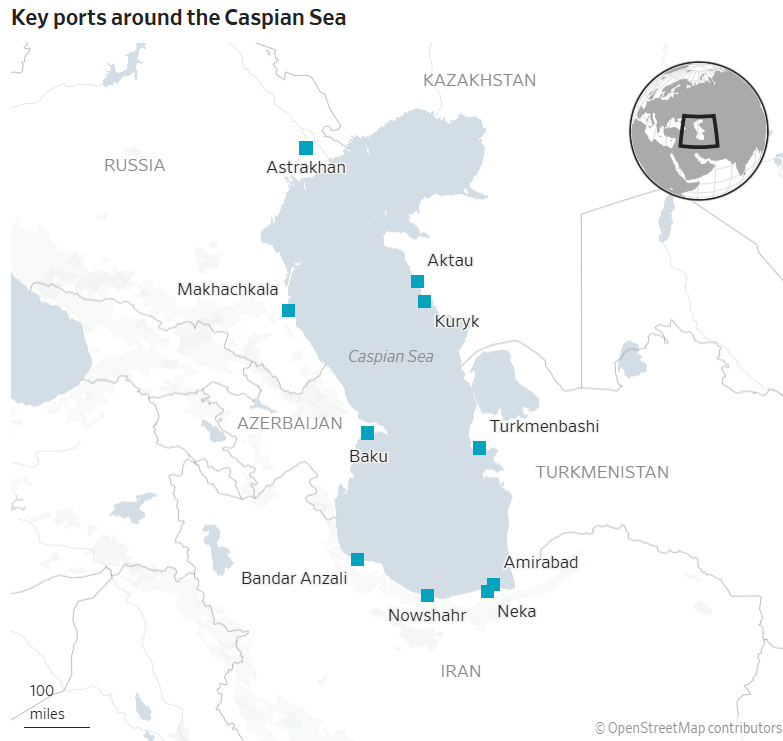
“We also achieved very strong results with long‑range strikes in the Caspian Sea—including vessels used in military cargo shipments involving Iran, as well as a warship.” Ukraine’s President Volodymyr Zelensky
Cheap, Accurate and Lethal: Iran’s Best Missile Is Getting More Dangerous
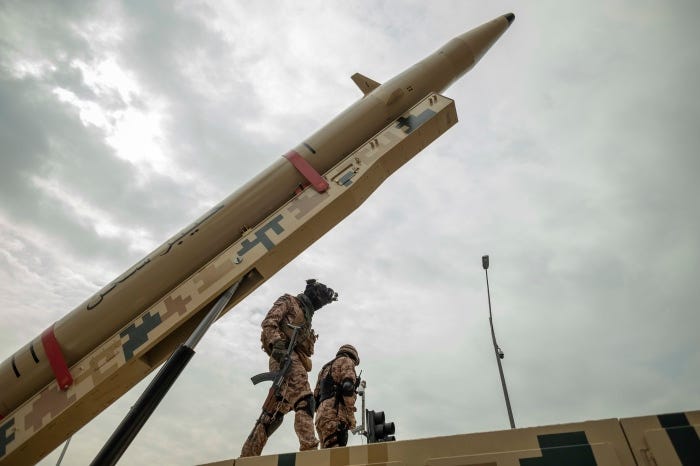
BLUF: The Kheibar Shekan missile is the workhorse of Tehran’s arsenal—a cheap, mobile, accurate weapon with a range of at least 900 miles. Recently, Iran has been using it in complex attacks, proving itself to be an adaptable adversary for the U.S.
Since the fighting picked back up this month, Iran has been firing the Kheibar Shekan at American bases.
It is using a combination of different flight paths, maneuvers and speeds to try to confuse U.S. defenses.
Unlike Iran’s older missiles that require lengthy prelaunch fueling, military analysts say the Kheibar Shekans can be kept fueled and loaded quickly into trucks or other vehicles for launching in an attempt to evade U.S. and Israeli warplanes.
In some variants of the missile, the nose section, which carries the explosive warhead and detaches during the final phase of flight, is equipped with a small engine that makes it capable of adjusting its direction as it nears its target at 6,000 miles an hour.

Chinese Destroyer’s Encounter with U.S. Drone Boat Highlights Future Rules of Engagement Issues
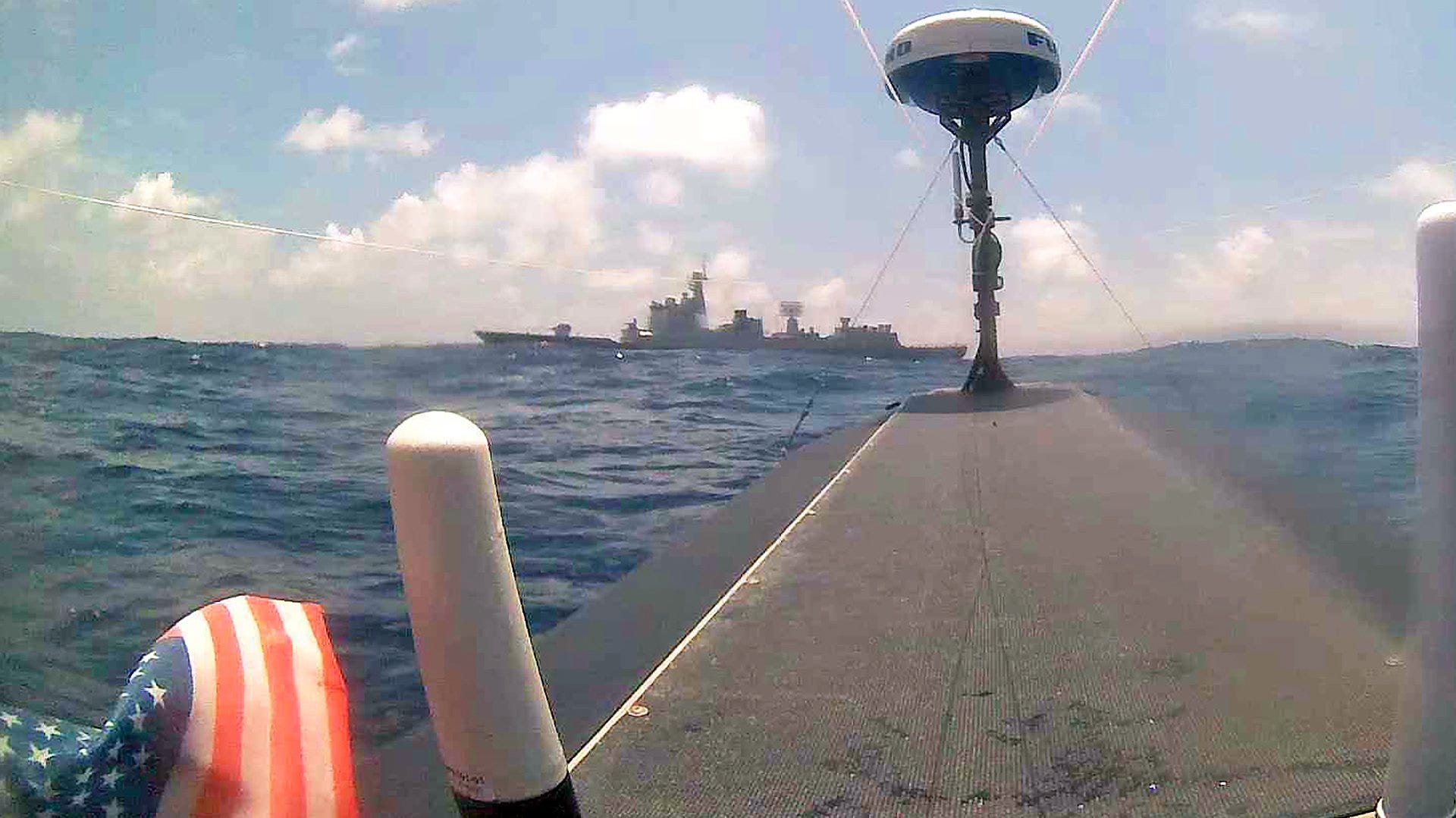
BLUF: During a long-endurance trek across the Pacific, a small uncrewed surface vessel (USV) owned by a California company had an encounter with a Chinese guided missile destroyer near the Philippines.
The Lightfish USV, owned by Seasats, came close enough to the Type 052D guided missile destroyer that it was able to capture the warship on video.
The incident highlights the growing presence of USVs, and especially in some of the world’s most contentious locales.
The USV coming so close to the Chinese surface combatant also underscores the potential danger USVs can pose even to an advanced warship.
It also raises questions about the rules of engagement navies, and even some merchant vessels in troubled areas, will have to adopt for when they happen upon USVs that come close without explanation or clear intent.
The incident in question took place about 73 miles northwest of the Philippine island of Luzon.
The Luzon Strait is one of the world’s most strategic waterways and a potential flashpoint. It sits south of Taiwan and north of the Philippines, in a channel that provides access from the greater Pacific to the South China Sea and vice-versa.
Australian MQ-28 Ghost Bat Fighter Drones Could Be Commanded by U.S. Pilots
BLUF: The Air Force is “threaded in tight” with the work Australians are doing with the MQ-28 Ghost Bat uncrewed aircraft.
This was underscored by the MQ-28’s participation at a major exercise earlier this year, lessons from which are feeding into the Air Force’s evolving plans for its forthcoming Collaborative Combat Aircraft (CCA) drone fleets.
Deep integration between the U.S. Air Force and the Royal Australian Air Force (RAAF) opens the door to American personnel potentially ordering Australian MQ-28s around in the future, too.
To date, the RAAF has received eight Ghost Bats, all in pre-production Block 1 configuration.
At Valiant Shield, the MQ-28 flew together with one of the U.S. Air Force’s new F-15EX Eagle II fighters, among a host of other American and allied aircraft.
Whether any of those platforms issued any direct commands to the Ghost Bat during the exercise is unclear.
ESA Taps Aalyria to Build Deep-Space Network Hub

BLUF: ESA has tapped Aalyria to build a piece of the internet’s off-world extension: a network-operations center that allows spacecraft, lunar missions, and ground stations to share data reliably across the solar system.
The center will run delay-/disruption-tolerant networking (DTN), which is a store-and-forward protocol built for space when a constant, instant connection is often impossible.
The system will deploy at Cornwall, UK’s Goonhilly Earth Station, which operates the first privately owned deep space antenna. Aalyria did not disclose the contract’s value or term.
Aalyria’s network management protocol will sit within LunaNet, the interoperability framework that NASA, ESA, and JAXA are building for the return to the Moon, alongside other operators.
The internet we use usually assumes users will always have an instant connection, but spacefarers don’t have that same luxury.
Signals to the Moon take ~2.5 seconds round trip;
Comms latency to Mars can exceed 40 minutes;
And links can easily drop as spacecraft move.
Rather than requiring an uninterrupted path from source to destination, DTN parks data at each node and forwards it when the next link opens.
“What’s new here is our combination of that implementation at the protocol level with the [Aalyria] Spacetime orchestration, so that we’re directing antennas where to point when—and when to establish links. Now that you have enough people talking a common language and talking common APIs to operate their networks, it starts unlocking networks of networks.” Aalyria CEO and cofounder Brian Barritt
Ukraine Wants Prototype European Missile Defence System by mid-2027
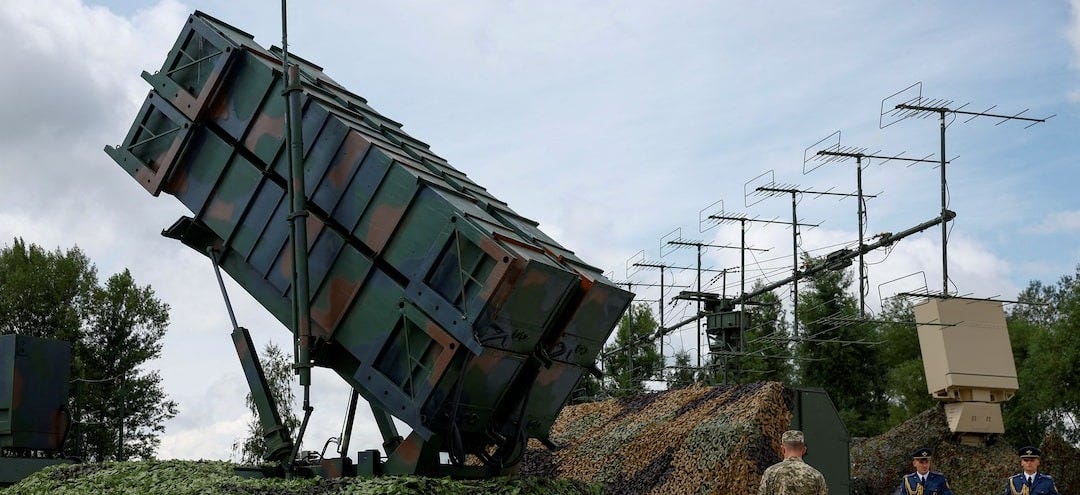
BLUF: Ukraine wants a prototype for a European anti-ballistic system codenamed Freyja to be ready within the first half of next year, as Kyiv pushes its allies to help deliver a weapon capable of downing Russian missiles.
An international steering committee tasked with estimating the R&D costs was due to convene for the first time soon.
Leaders from 10 European countries, including Ukrainian President Volodymyr Zelenskiy, as well as around a dozen defence manufacturers gathered at a summit in Paris two weeks ago to officially launch the anti-ballistic coalition.
Ukraine is chronically dependent on U.S.-made Patriot air defence systems, which is the only weapon in its arsenal capable of reliably downing Russia's ballistic missiles.
Supplies of Patriots have been affected by political volatility, low stocks and a lengthy production cycle.
Russia has stepped up its ballistic strikes on the capital Kyiv and southern port hub of Odesa this month, launching dozens of missiles, most of which Ukraine was unable to down due to lack of interceptors.
Freyja is an attempt to build a lower-cost alternative to the Patriot, which many European countries also rely on. Other air defence systems, such as Franco-Italian SAMP/T and German IRIS-T, have not yet proven capable of downing ballistic missiles.
The overall logic of this system is that it's an open architecture.
Our Take: We applaud Ukraine and Europe’s pursuit of a lower-cost, open-architecture missile defense system that prioritizes production and modularity. The plug-and-play approach is ideal. Yet we are skeptical in European defense firms’ ability to deliver a scalable functional prototype in a timely manner given their record of slow, expensive, and closed development cycles.
Pentagon weighing options to license Patriot production to Ukraine
BLUF: The Pentagon is looking at options for how to license production of Patriot interceptors to Ukraine, but it’s too early to say when Kyiv will be able to start building its own missiles.
Earlier this month, President Trump announced at the NATO summit in Ankara that the U.S. would give Ukraine a license to produce Patriot interceptors but gave few details, raising questions about the timeline and security considerations needed to allow Ukraine to begin building sensitive US technology during a hot war with Russia.
Zelenskyy later said he had met with a team of Lockheed Martin officials to talk about future opportunities for joint production and technology exchange.
Lockheed Martin manufactures the PAC-3 interceptor, one of the weapons used by the Patriot missile defense system.
The hard part of licensing PAC-3 production to Ukraine will be qualifying and certifying the indigenous supply chain that will build the interceptors. There’s only so many engineers that know how to do this stuff. There’s only so many qualified parts. Building a new supply chain takes time to find the qualified suppliers.
“We're evaluating a set of COAs right now, which include a mix of domestic and international sourcing for end units, where they're going to be located, how we're going to build it, and which variant.” Michael Cadenazzi, ASW(IBP)
Britain to Protect Ukraine’s Attack Drones with Signal Jammers

BLUF: Britain’s new PM will host Zelensky and announce an agreement which will allow Ukraine to start mass producing UK-designed signal jammers.
The jammers, which are a part of a project called Stone Cloak, are fitted to Ukrainian attack drones and hinder Russian air defences from tracking them.
Britain has directly supplied Kyiv with thousands of the pieces of kit, which are around the same size as a tablet computer.
The Prime Minister will announce that he is signing over the intellectual rights to Ukraine so the country can mass produce them itself.
Allowing Ukraine to mass produce Stone Cloak and use it in real battlefield conditions would also be beneficial to Britain’s own defence.
Army chiefs will be able to collect data on its performance, which they will use when building the system into the next generation of drones and missiles.

Senate Confirms Hurst as Pentagon Comptroller After 1.5-Year Vacancy
BLUF: After a year-and-a-half without a confirmed Pentagon controller, today the Senate voted 50 to 47, as part of a larger en bloc package, for Jules “Jay” Hurst to officially take on the role.
In the same voting bloc with 74 nominees, lawmakers approved Erich Hernandez-Baquero (HB) as the next Air Force assistant secretary for space acquisition and integration, a role that’s charged with overseeing all Space Force acquisition programs.
The Senate’s mass confirmation vote also included a thumbs up for the administration’s nominee to head the NRO, Roger Mason.
See our NDAA and budget posts for the latest insights and analysis.

Future of Defense Innovation & National Security: FY27 NDAA and Part 2 | Moshe Schwartz
Emerging Technologies Institute
How the Army Built a Game-Changing Missile System That Soldiers Actually Want to Use | LTC Jim Lawson and Dr. Shane Thompson
Fed Gov Today
APFIT x A Family-Owned Laser Manufacturer's Success Story | Matt Meyers
Last Week in DC
America’s Most Lethal Fighter Jet | F-15EX
Sam Eckholm and Boeing
Rebuilding America’s Critical Minerals Base | Alex Grant, Wes Spurlock, and Jonathan Panter
Cogs of War
Ukraine's F-16s just scored their first AIR-TO-AIR VICTORY
Sandboxx
Drone Dominance Program: Gauntlet 2 announcement
DIU
Defeating the Drones: The Airman’s Imperative to Defend Against Small UAV
Mitchell Institute for Aerospace Studies
Designing and Manufacturing Modern Military Ground Vehicles | Paul Beaker
Aerospace and Defense Technology
Mission Integrity, Financial Gravity, and Lean to Incorruptible | Eric Ries
Startup Defense

NCMA World Congress
NCMA • Jul 26-29 • Orlando, FL
Life Cycle Industry Days
Air Force • Jul 27-29 • Dayton, OH
DIA TECHINT
AFCEA • Jul 28-29 • Chantilly, VA
Air and Space Summit
Potomac Officers Club • Jul 30 • McLean, VA
Drone Dominance and Airspace Sovereignty One Year Later
American Drone Leadership Summit • Jul 31 • Washington DC
Space and Missile Defense Symposium
Aug 11-13 • Huntsville, AL
TechNet Augusta 2026
AFCEA • Aug 17-20 • Augusta, GA
MODSIM World
NTSA • Aug 18-19 • Alexandria, VA
Fed SuperNova
Aug 18-20 • Austin, TX
ONR sBAA Industry Day
Aug 20 • Washington DC area
SmallSat Conference
Aug 23-26 • Salt Lake City, UT
DIB Accelerator 2026
ASW(IBP) • Aug 25-27 • Philadelphia, PA
Space Warfighting Forum
NDIA • Aug 25-27 • Colorado Springs, CO
Prodacity
Rise8 • Aug 25-27 • Nashville, TN
Intelligence and National Security Summit
AFCEA • Aug 26-27 • Bethesda, MD
See our Events Page for all the other events over the next year.
The $136B figure for Columbia and Virginia boats tracks, but I'd flag that the $145B NATO munitions gap Rutte cited last month is the more urgent procurement story. Subs take decades. Missile stockpiles are empty now.